TL;DR
- A useful review comment has four parts: the behaviour you observed, the evidence, the effect on the team or the customer, and the next step. A phrase from a list supplies only the first.
- These 100 sample comments cover ten skills, each with strengths and areas for improvement, plus overall comments for three levels of performance. Replace every bracket with a real example.
- Describe what the person did and avoid labels for who they are. Nothing in the written review should be a surprise, because feedback belongs in regular conversations through the year.
It is review season. You have eight forms to complete, a box labelled “manager comments” and a blinking cursor. You know what you think of each person's work. Finding fair, specific words for it is the hard part.
This article gives you 100 performance review phrases to adapt: sample comments for strengths and for areas for improvement across ten skills, followed by overall comments for three levels of performance. First, it shows how to turn any phrase into a comment that is fair and useful.
Review comments are easier to write when goals, feedback and notes from the whole year are in one place. See how New Dynamics performance reviews bring that evidence into the conversation.
How to use these performance review phrases
A phrase from a list is a starting point. Used unchanged, it produces the vague review that everyone dreads. A useful comment has four parts.
- Behaviour. What the person did, in words that someone could observe.
- Evidence. A number, a date, a document or a named piece of feedback.
- Effect. What it meant for the team, the customer or the organisation.
- Next step. What to keep doing, or what to change, and the support you will give.
MIT Human Resources gives similar advice in its guidance on writing the performance review: “Focus on observable and measurable performance”, “Cite specific examples”, “Provide actionable feedback” and “Avoid vague statements and exaggerations”.
So “communicates well” becomes: “Writes clear updates. Her weekly project note meant that the steering group took decisions in one meeting, where it used to take two. Next year I would like her to coach two colleagues in the same approach.”
The phrases below contain square brackets. Replace each one with a real detail. If you cannot, you may not yet have the evidence to make the comment.

100 performance review phrases by skill
Quality of work
Strengths
- Delivers work that rarely needs correction. In the last quarter, [number] of [number] reports were accepted without changes.
- Checks work against the source before it leaves their hands, which has cut rework for the rest of the team.
- Sets the standard for [type of work]. Colleagues use their [document] as the model.
- Balances speed and accuracy well. Knows when good enough is right and when it is not.
- Spots errors in shared work and fixes the cause, so that the same problem does not return.
Areas for improvement
- Work is often returned for correction. [Number] of the last [number] [items] needed changes. Using the agreed checklist before submitting would help.
- Quality drops under time pressure. Flagging unrealistic deadlines earlier would protect the standard of the work.
- Tends to submit drafts as finished work. Building in a review step before sending would reduce rework.
- Attention to detail is inconsistent across tasks. It is strong on [task] and weaker on [task].
Job knowledge
Strengths
- Has a thorough understanding of [process or system], and is the person others go to with questions.
- Keeps their knowledge current. Summarised the new [regulation or release] for the team within a week.
- Applies knowledge to solve problems. Used their understanding of [area] to resolve [issue].
- Shares expertise generously through documentation, training sessions and one-to-one help.
- Learned [new tool or area] quickly this year and now works in it independently.
Areas for improvement
- Has gaps in [area] that slow down [task]. Completing [training] and shadowing [colleague] by [date] would close them.
- Relies on colleagues for routine questions about [system]. Building and using personal reference notes would increase independence.
- Has not yet kept pace with changes to [process or product]. Setting aside regular time to review updates would help.
- Knows the procedures but not yet the reasons behind them, which makes unusual cases difficult. Talking through examples with [colleague] would help.
Communication
Strengths
- Writes clear, concise messages. Readers know what is being asked and by when.
- Explains technical matters in plain language. Customers and non-specialist colleagues have commented on it.
- Listens carefully and sums up what they heard before responding, which prevents misunderstandings.
- Keeps stakeholders informed without being asked. Gave early warning of both delays this year, with options.
- Presents with confidence. The [presentation] led directly to [decision or result].
Areas for improvement
- Updates are often late or incomplete, so others have to chase. A short weekly written update would solve this.
- Emails can be long and hard to act on. Putting the request in the first two lines would help readers.
- Tends to stay quiet in meetings and raise concerns afterwards. Raising them in the room would help the team to decide better.
- Can come across as abrupt in written messages when under pressure. Rereading before sending would help.
Teamwork and collaboration
Strengths
- Helps colleagues without being asked. Covered [colleague]'s work for [period] and handed it back in good order.
- Shares information early and openly, so that others are not surprised.
- Gives credit to others by name when presenting joint work.
- Builds strong relationships with other teams. The work with [team] on [project] cut [problem] by [amount].
- Brings quieter colleagues into discussions, and the team makes better decisions as a result.
Areas for improvement
- Prefers to work alone and sometimes duplicates effort. Checking in with [team] at the start of a task would avoid this.
- Involved [team] late on [project], which cost [time]. Listing everyone affected at the outset would help.
- Can be dismissive of ideas that differ from their own. Asking a question before responding would improve discussions.
- Handovers are often incomplete. Using the standard handover note would help whoever picks up the work.
Reliability and dependability
Strengths
- Delivers what they promise, when they promise it. Met every deadline this period.
- Can be trusted with important work without close supervision.
- Gives early warning when a commitment is at risk, and comes with options.
- Is consistently punctual and prepared for meetings.
- Stays calm and dependable when plans change at short notice.
Areas for improvement
- Missed [number] agreed deadlines this period without warning. Flagging risks at least [number] days ahead is the priority.
- Takes on more than is realistic, and then delivers late. Checking capacity before saying yes would help.
- Attendance or punctuality has affected the team on [number] occasions. We have agreed [action].
- Follow-through on meeting actions is inconsistent. Keeping a visible action list would help.
Problem solving and initiative
Strengths
- Finds the cause of a problem before choosing a fix. Traced [issue] to [cause] and resolved it at source.
- Acts on problems they notice, within their authority, without waiting to be asked.
- Proposes practical improvements. The [change] now saves the team about [time] a week.
- Stays resourceful under pressure. Found an alternative [supplier or approach] within [time] when [event] happened.
- Uses data to test assumptions before acting.
Areas for improvement
- Tends to escalate problems without a proposed solution. Bringing one or two options each time would build judgement.
- Fixes symptoms quickly, but the same issues come back. Spending more time on causes would pay off.
- Waits for instructions when the next step is within their authority. We have agreed which decisions they can take alone.
- Can spend too long analysing before acting. Agreeing a time limit for reversible decisions would help.
Time management and productivity
Strengths
- Plans work well and meets deadlines without last-minute pressure.
- Focuses on priorities, and says no, with reasons, to work that does not fit them.
- Handles a high volume of work without loss of quality.
- Estimates accurately, which makes planning easier for everyone else.
- Uses meetings well. Arrives prepared, keeps to time and records actions.
Areas for improvement
- Spends too much time on low-priority tasks. Agreeing the top three priorities each week would sharpen focus.
- Underestimates how long work will take. Recording estimates against actual time for a month would improve this.
- Often works late to meet deadlines, which is not sustainable. We need to review workload and planning together.
- Is easily pulled away by interruptions. Protecting blocks of focus time would help.
Customer focus
Strengths
- Understands what customers need before proposing a solution.
- Earns consistently strong feedback. Satisfaction averaged [score] across [number] contacts.
- Owns problems until they are resolved, and keeps the customer informed throughout.
- Turned a complaint from [customer] into a renewed relationship by fixing the cause.
- Shares what they learn from customers with the product and service teams.
Areas for improvement
- Responses to customers are sometimes slower than our standard of [time]. Using templates for common questions would help.
- Can close an issue before confirming that the customer is satisfied. Checking first would reduce repeat contacts.
- Sometimes promises what the team cannot deliver. Checking with [team] before committing would avoid this.
- Needs to build knowledge of [product] in order to answer more questions without escalating.
Leadership and people management
Strengths
- Sets clear priorities. Every member of the team can explain what matters most this quarter.
- Holds regular one-to-ones, and the team reports that they are useful.
- Develops people. [Number] team members took on bigger roles this year with their support.
- Delegates decisions as well as tasks, and the team has grown in confidence as a result.
- Deals with poor performance and poor behaviour promptly and fairly.
Areas for improvement
- Steps in too quickly when work goes off track. Asking questions before offering answers would build the team's capability.
- Avoids difficult conversations, so problems grow. We have agreed that they will prepare the next one with my support.
- Feedback to the team is infrequent. Aiming for one specific piece of feedback per person each week would help.
- Shares too little context with the team. Explaining the reason behind decisions would improve commitment.
Learning and adaptability
Strengths
- Asks for feedback and acts on it. Changed [behaviour] after the spring review, and colleagues have noticed.
- Adapts quickly when priorities change, and helps others to do the same.
- Volunteers for unfamiliar work in order to learn.
- Completed [qualification or course] and applied it to [work].
- Treats mistakes as something to learn from, and shares the lessons with the team.
Areas for improvement
- Can be resistant to new ways of working. Trying [change] for a month before judging it would help.
- Has not yet acted on the feedback about [topic] from the last review. We have agreed specific steps this time.
- Did not make time for the development that we planned. We have booked [course or activity] for [date].
- Becomes discouraged by setbacks. Breaking the work into smaller milestones would help to rebuild confidence.

Overall performance review comments
The overall summary is the part people read first and remember longest. Keep it to three or four sentences: the headline, the main evidence, the priority for next year and your support.
Exceeds expectations
- [Name] had an excellent year. They exceeded [number] of [number] goals, and their work on [project] made a lasting difference to [team or customer].
- [Name] is a consistently strong performer who delivers high-quality work, supports colleagues and can be relied on with important projects.
- [Name] met all of their goals this year and grew noticeably in [skill]. They are ready for [next step].
- [Name] performed well in a year of significant change, keeping [service or output] steady while learning [new area].
Meets expectations
- [Name] met most of their goals this year. Strengths were [strengths]. The priority for next year is [area], with support from [support].
- [Name] delivered solid results in [area] and fell short in [area], partly because of [context]. We have agreed a plan to address it.
- This was a year of transition for [Name]. They are now established in the role, and we expect to see [outcome] in the next period.
Below expectations
- [Name] did not meet the expectations of the role this year in [areas]. We discussed specific examples, and have agreed clear goals, support and review dates.
- [Name]'s results were below the required standard in [area], although [strength] remained good. An improvement plan is in place, with a review on [date].
- [Name] has had a difficult year. We have agreed what needs to change, what support I will provide and how we will review progress each month.
Words to avoid in review comments
Labels for personality. “Lazy”, “negative”, “not a team player” and “has a bad attitude” judge the person. Describe the behaviour and its effect.
Always and never. They are rarely true, and they invite argument about the exception.
Vague praise. “Great job this year” gives the person nothing to repeat. Say what was great.
Comparisons with colleagues. “Not as strong as Sam” is unfair to both. Compare the work with the expectations of the role.
Anything linked to a protected characteristic. Comments about age, health, pregnancy, family circumstances, accent or similar have no place in a review, and they create legal risk. Our plain guide to the definition of discrimination at work explains the terms.
Loaded words applied unevenly. Check whether you describe the same behaviour as “assertive” in one person and “abrasive” in another.
Surprises. If the person is reading a criticism for the first time in the review, the failure is in the feedback during the year. Our negative feedback examples show how to raise issues when they happen.
How to write review comments in less time
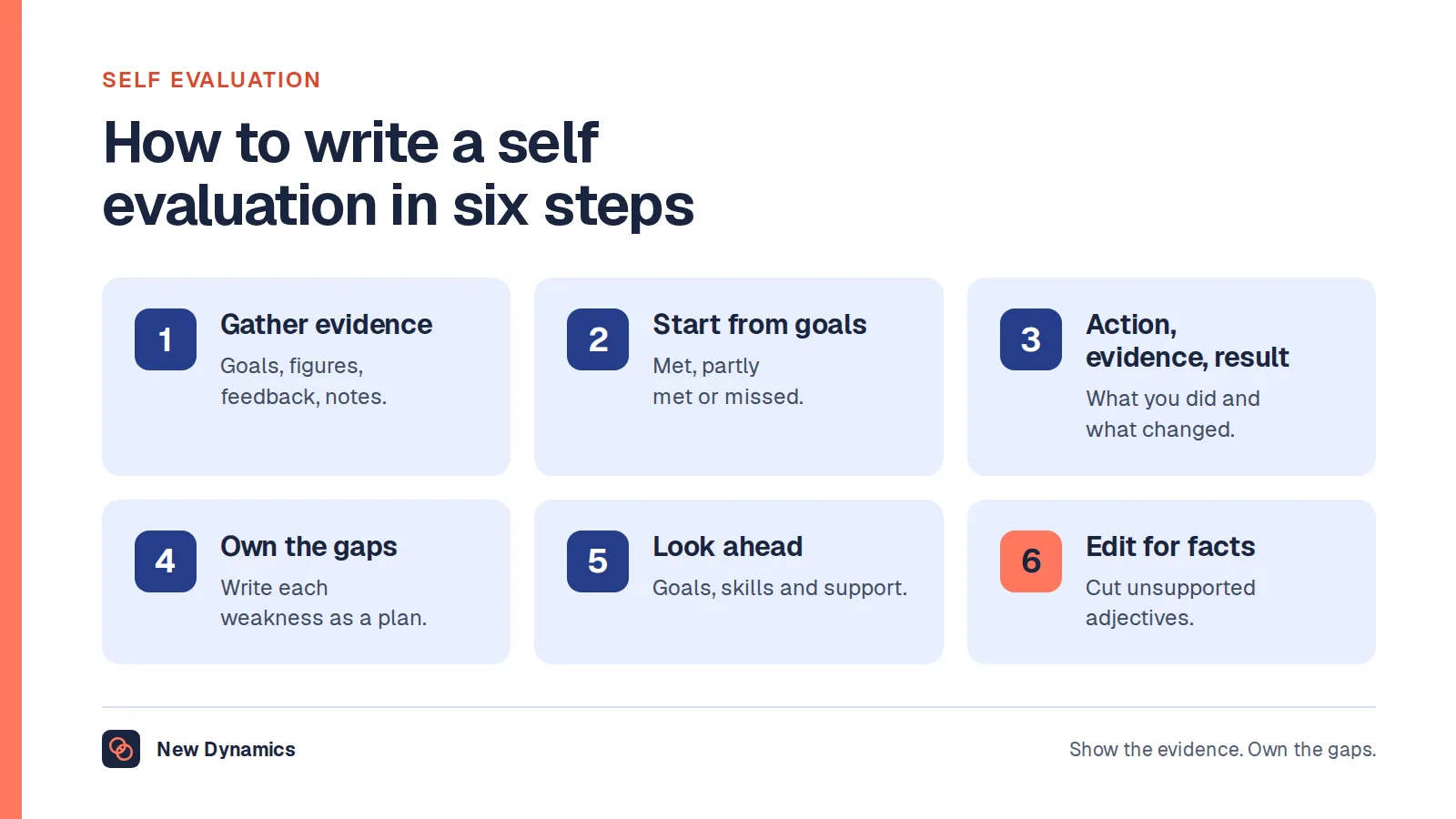
- Gather evidence first. Look at goals, one-to-one notes, feedback from others and the person's own self-assessment. Our self evaluation examples help employees to write one.
- Cover the whole period. Check that your examples do not all come from the last six weeks.
- Write the overall summary last. It should follow from the evidence, not the other way round.
- Balance the comments. Most people have real strengths and one or two priorities for improvement. Say both.
- Read it as the employee would. Would you understand what to keep doing and what to change?
- Check for consistency. Compare your comments across the team. Are you applying the same standard to everyone?
Acas notes that a review may look at whether someone is meeting agreed objectives, demonstrating the right behaviours and following an agreed development plan. Its guidance on performance reviews and appraisals adds: “It's important to keep a written record of what is discussed. This should be shared with the employee afterwards.” Write your comments knowing that the employee will read and keep them.
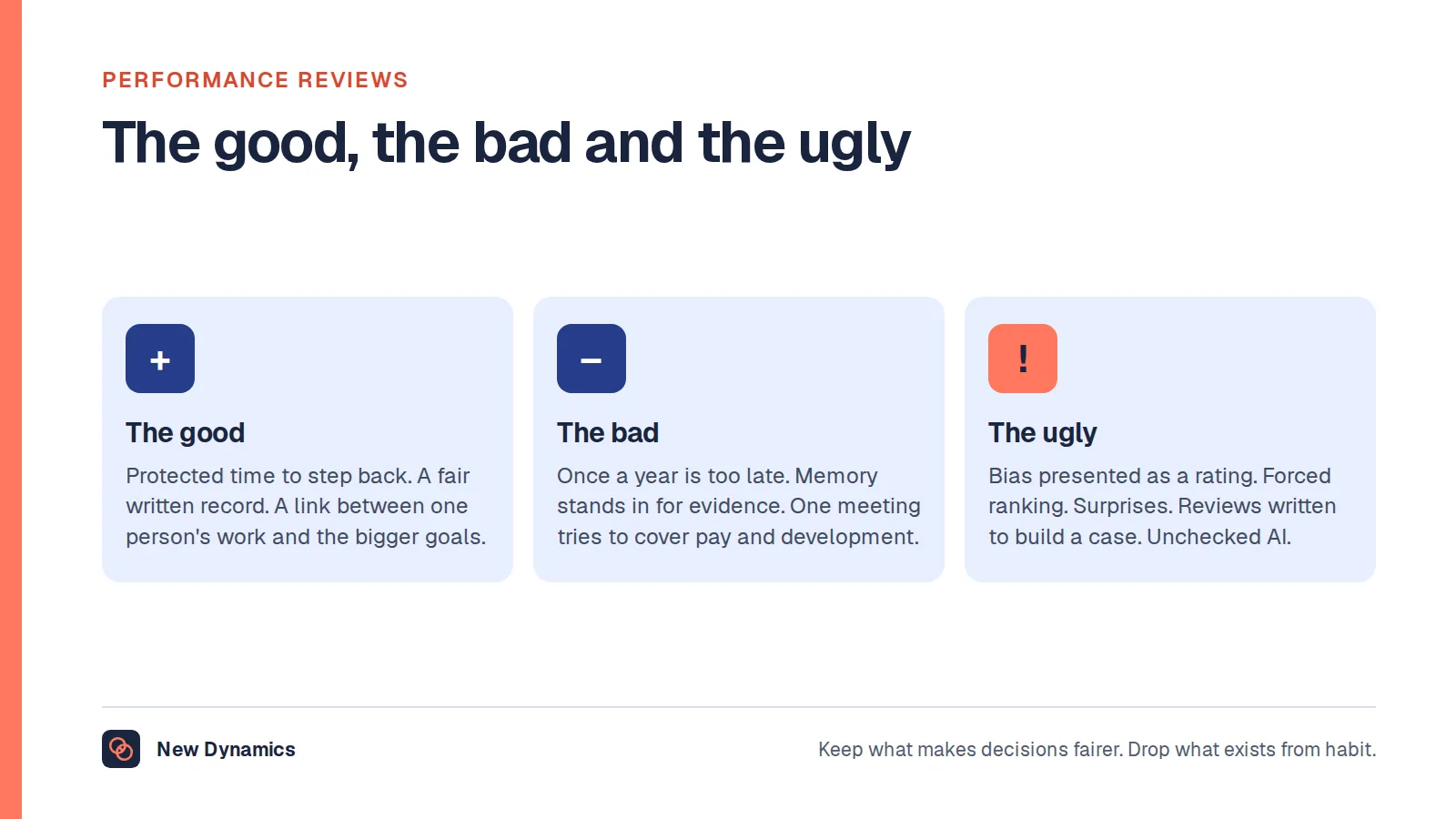
For the conversation itself, see performance reviews: the good, the bad and the ugly.

Frequently asked questions
What should I write in a performance review?
Write what the person did, the evidence, the effect on the team or the customer, and the next step. Cover results against goals and the behaviours behind them. Include real strengths and one or two priorities for improvement, each with an example.
What are some positive performance review phrases?
“Delivers what they promise, when they promise it.” “Explains technical matters in plain language.” “Finds the cause of a problem before choosing a fix.” “Helps colleagues without being asked.” Add a specific example and its effect to each one.
How do you write areas for improvement without sounding harsh?
Describe the behaviour and its effect, without labels, and pair it with a practical next step. For example: “Missed three agreed deadlines this period without warning. Flagging risks at least two days ahead is the priority, and we will check progress in our one-to-ones.”
What are good overall performance review comments?
Keep the summary to three or four sentences: the headline, the main evidence, the priority for next year and your support. For example: “Met all goals and grew noticeably in stakeholder management. Ready to lead a cross-team project next year.”
What phrases should be avoided in a performance review?
Avoid personality labels such as lazy or negative, the words always and never, vague praise, comparisons with named colleagues and anything connected to age, health, family circumstances or another protected characteristic. Avoid surprises too.
Can I use these phrases for a self-appraisal?
Yes. Change “they” to “I”, and add your own evidence and result. For a fuller method with 60 first-person examples, see our article on self evaluation examples.
Your next step: rewrite one comment
- Take one comment from a review that you are drafting.
- Check it for the four parts: behaviour, evidence, effect and next step.
- Add whatever is missing, and remove any label or adjective that you cannot support.
- Read it as the employee would.
For questions, an agenda and a fair process for the whole review, read and download our performance review guide. The guide is free to read, and the PDF uses our short download form. You can also use our open performance review template.
Want goals, feedback and notes from the whole year ready when you sit down to write? Book a New Dynamics demo and bring your current review form. You can also email contact@new-dynamics.com.