TL;DR
- Accountability at work means owning your commitments and their results: doing what you said you would, saying early when you cannot, and putting things right when they go wrong.
- It differs from responsibility, which is about who does a task, and from blame, which looks for a culprit. Accountability looks forward: what did we promise, what happened and what will we do now?
- Accountability grows where expectations are clear, commitments are visible, progress is reviewed regularly and honesty is safe. Without those conditions, demanding it achieves little.
“We need more accountability around here.” It is said in a great many meetings, usually about somebody else. What it means is less often spelled out. Does it mean working harder? Taking the blame? Being watched more closely?
This article makes it concrete. It gives you 35 accountability examples for employees, managers, leaders and teams, explains how accountability differs from responsibility and from blame, and sets out seven conditions that make it possible.
Accountability depends on goals that are visible and reviewed. See how New Dynamics Goals & OKRs keeps commitments, owners and progress in one shared place.
What is accountability at work?
Accountability means owning your commitments and their results. It has three parts.
- Own the promise. Be clear about what you will deliver, by when and to what standard. If you cannot commit, say so.
- Own the result. Report honestly on what happened, good or bad, without being chased.
- Own the fix. When something goes wrong, put it right, and work out how to stop it happening again.
Accountability, responsibility and blame
| Term | Question it answers | Direction |
|---|---|---|
| Responsibility | Who does the task? | Before and during |
| Accountability | Who answers for the result, and puts it right? | Forward-looking |
| Blame | Whose fault was it? | Backward-looking |
Several people may be responsible for parts of a piece of work. One person should be accountable for the outcome. Blame is what organisations fall back on when neither was clear.
The difference matters, because blame destroys the honesty that accountability needs. People who expect punishment hide problems. People who expect help report them early.

12 accountability examples for employees
- Confirming a commitment. “I will send the draft by Thursday at noon.” A date, in place of “soon”.
- Flagging a risk early. “The supplier data is late, so Thursday is at risk. I can deliver Friday morning, or send a partial draft on Thursday. Which would you prefer?”
- Admitting a mistake quickly. “I sent the wrong price list to the client. I have already called them and sent the correct one. Here is what I will change so that it does not happen again.”
- Finishing properly. Closing the ticket only once the customer has confirmed that the fix worked.
- Following up without being asked. Sending the actions after a meeting, and chasing your own.
- Saying no honestly. “I cannot take that on this week without dropping the audit work. Which matters more?”
- Not passing the problem on. Staying with a customer's issue until the right person has it, and checking later that it was resolved.
- Owning your development. Arriving at a review with evidence of what you achieved and what you want to improve. See our self evaluation examples.
- Asking when unsure. Checking the expected outcome at the start, not guessing and redoing the work.
- Keeping shared records up to date, so that others can rely on them.
- Speaking up about a problem that is not yours. Reporting the safety hazard, or the error in a colleague's figures, to the person who can fix it.
- Reporting your own results honestly, including the numbers that look bad.
10 accountability examples for managers
- Setting clear expectations. Agreeing with each person what they will deliver, by when and how it will be measured. Our performance goals examples show the wording.
- Keeping your own promises. Doing what you told the team you would do, such as the pay review, the conversation with another department or the decision by Friday.
- Owning the team's results. Saying “we missed the target, and here is my plan” to your own manager, without naming individuals.
- Addressing poor performance promptly. Raising the concern within days, with examples and support, and following the procedure if it continues.
- Holding everyone to the same standard, including high performers and friends.
- Admitting your mistakes to the team. “I underestimated that project. That was my call, and I got it wrong.”
- Reviewing progress regularly. A short weekly look at commitments, so that slippage is visible early.
- Giving credit and taking responsibility. Naming the people who did the work when it goes well, and standing in front of them when it does not.
- Closing the loop on feedback. “You told me that decisions reach you late. I now send a summary the same day.”
- Making decisions, and owning them. Not hiding behind “the company” or “HR”.
Our guide to what makes a good manager describes the routines behind these.
6 accountability examples for leaders
- Publishing goals and results, including the ones that were missed.
- Explaining decisions, especially unpopular ones, and taking questions.
- Following the rules that apply to everyone else, from expenses to the code of conduct. See our code of conduct examples.
- Acting on survey results, and telling people what changed and what will not.
- Accepting the consequences of failure personally, without looking for someone junior to carry them.
- Dealing with misconduct by senior or high-performing people as firmly as with anyone else.
7 team accountability examples
- A visible list of commitments. Who is doing what, by when, where everyone can see it.
- A weekly review in which each person reports on their own commitments: done, not done and what is next.
- One named owner for every task, even when several people contribute.
- Blameless reviews after a failure. What happened, why, and what will we change? Names matter less than causes.
- Peers holding each other to account. “You said you would send that on Tuesday. Is anything in the way?”
- Agreed team standards, such as response times, meeting behaviour and how decisions are recorded.
- Celebrating kept promises, as well as big wins.
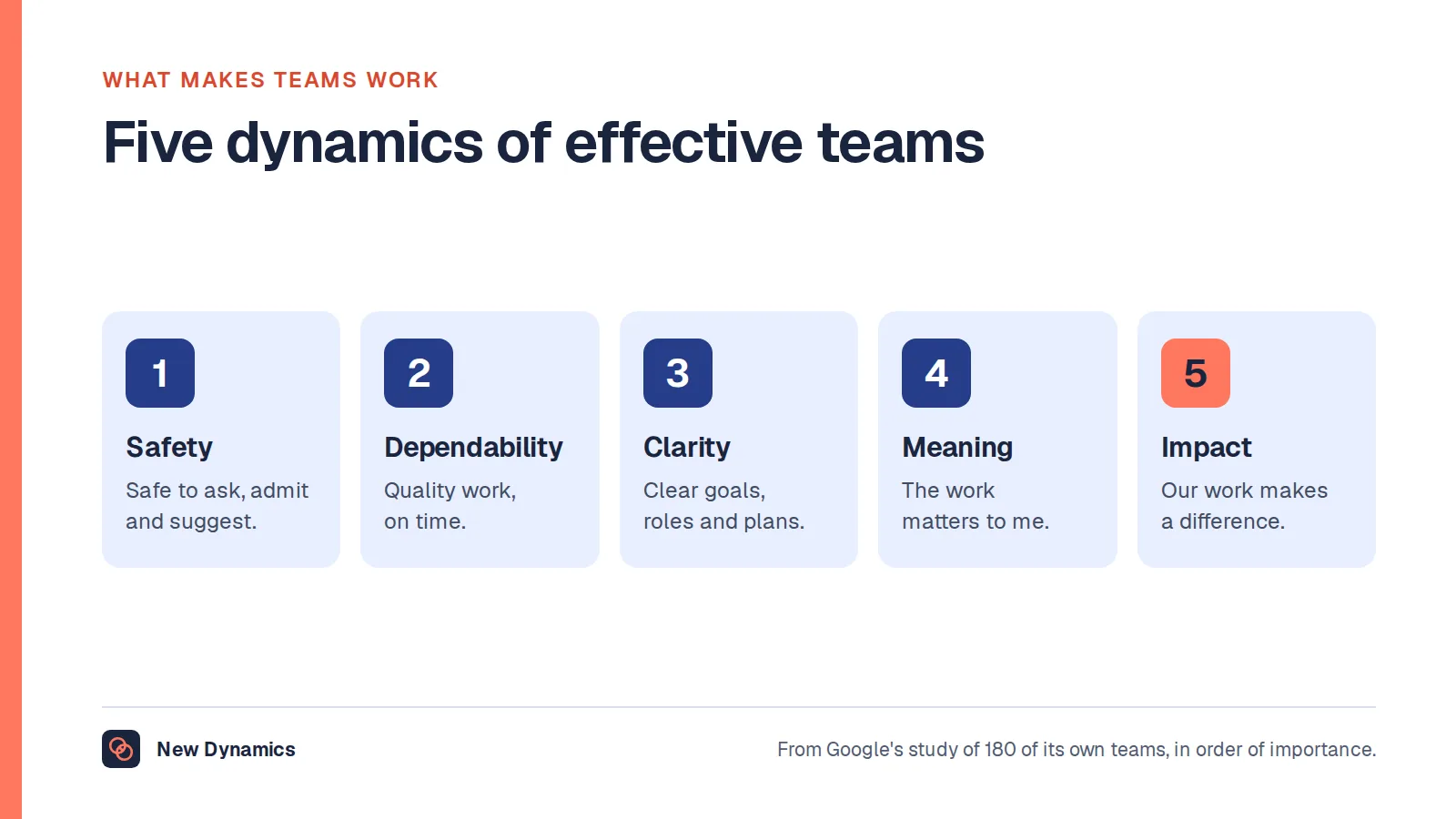
Google's study of what makes teams effective ranks dependability second among five dynamics: “On dependable teams, members reliably complete quality work on time.” It ranks psychological safety first. The two support each other. People take ownership of mistakes where it is safe to admit them. We explain more in why teamwork is important.

What accountability sounds like
| Avoiding accountability | Taking accountability |
|---|---|
| “Nobody told me.” | “I should have checked. I will confirm the brief at the start next time.” |
| “It is not my job.” | “That sits with finance. I will make sure that they have it.” |
| “I will try to get to it.” | “I will do it by Friday”, or “I cannot. Here is what I can do.” |
| “Mistakes were made.” | “I made a mistake. Here is what I have done about it.” |
| “The deadline was unrealistic.” | “I should have said so in week one. I am telling you now, with options.” |
| “We have always done it this way.” | “It is not working. Here is what I suggest.” |
Seven ways to build accountability
You cannot demand accountability into existence. You can create the conditions for it.
- Make expectations clear. Most so-called accountability problems are clarity problems. The UK Health and Safety Executive's Role standard says that the organisation should provide information “to enable employees to understand their role and responsibilities”, and should make sure that the requirements it places on people are clear.
- Give one owner to each outcome. Shared ownership usually means none.
- Make commitments visible. A shared list of who is doing what by when does more than any speech.
- Review regularly. A short weekly check makes slippage visible while it is still small. Our one-to-one meeting questions can help.
- Give people the authority and resources to deliver what they are accountable for. Accountability without authority is a trap.
- Make honesty safe. Thank people who bring bad news early. Treat a first mistake as something to learn from.
- Apply consequences fairly. Recognise kept commitments. Address repeated failures, whoever is involved. If nothing ever happens either way, people notice.
Leaders have to go first on all seven. People copy what they see.
Common mistakes
Confusing accountability with blame. A culture of blame produces concealment.
Accountability without clarity. You cannot hold someone to an expectation that was never stated.
Accountability without authority. Making someone answerable for results that they cannot influence is unfair, and demoralising.
Too many owners. “The team owns it” can mean that nobody does.
Only after failure. Accountability conversations should be routine, and should cover kept commitments as well.
One rule for some. Nothing undermines accountability faster than exceptions for senior or favoured people.
Monitoring in place of trust. Tracking every keystroke produces compliance. Ownership comes from clear goals and regular, honest conversation.

Frequently asked questions
What is an example of accountability at work?
An employee who realises that a deadline is at risk tells their manager early, explains why and offers options. When they make a mistake, they say so quickly, put it right and explain what they will change. That is accountability: owning the promise, the result and the fix.
What is the difference between accountability and responsibility?
Responsibility is about who carries out a task, and it can be shared. Accountability is about who answers for the result and puts things right, and it should rest with one person. A manager can delegate responsibility for a task while remaining accountable for the outcome.
How do you show accountability as an employee?
Make clear commitments with dates, flag risks early, admit mistakes quickly, finish what you start, follow up without being chased, say no honestly when you are overloaded and report your own results truthfully.
How do managers hold employees accountable?
Agree clear expectations and measures, make commitments visible, review progress regularly, give people the authority and resources that they need, address problems promptly and fairly, and recognise kept commitments. Managers must also keep their own promises.
What is team accountability?
It is a team's shared habit of making clear commitments to each other and keeping them. It shows in a visible list of who owns what, regular reviews in which people report on their own commitments, blameless reviews after failures and peers who feel able to ask each other about progress.
Is accountability the same as blame?
No. Blame looks backwards for a culprit, and encourages people to hide problems. Accountability looks forwards: what did we commit to, what happened and what will we do now? It depends on people feeling safe enough to be honest.
Your next step: make three commitments visible
- Write down your three most important commitments for this week, each with a date.
- Share them with your manager or your team.
- At the end of the week, report on each: done, not done and what is next.
- If you manage a team, start a shared list, and review it together every week.
For a fair way to review commitments and results at the end of a period, read and download our performance review guide. The guide is free to read, and the PDF uses our short download form.
Want every goal to have an owner, a date and a regular check-in? Book a New Dynamics demo and bring your team's current commitments. You can also email contact@new-dynamics.com.