TL;DR
- Teamwork is working cooperatively with others to achieve a shared goal. It matters because most valuable work is too big, too complex or too risky for one person.
- The main benefits are better problem solving, fewer errors, faster learning, resilience when people are away and work that feels more worthwhile.
- Google's study of 180 teams found that how a team works together matters more than who is on it. Psychological safety came first, then dependability, clarity, meaning and impact.
Almost nothing of value at work is made by one person. A customer's order passes through sales, operations, finance and support. A patient is cared for by a dozen professionals. Software is written, tested, released and supported by different hands. Whether those hands work as a team decides the result.
This article explains why teamwork is important in the workplace. It sets out ten benefits with examples, what research says makes teams effective, when teamwork is the wrong answer and how to build more of it.
Teams improve through honest, regular conversation. See how New Dynamics continuous feedback helps colleagues to share feedback and recognition as part of everyday work.
What is teamwork?
The Skills Builder Universal Framework defines teamwork as “working cooperatively with others to achieve a shared goal”. Its early steps are disarmingly practical: working with others when appropriate, keeping to time reliably, taking responsibility for completing tasks and helping others.
The words “shared goal” matter. A team depends on each other to reach a common result. A work group simply reports to the same manager. Google's researchers draw the same line in their guide to understanding team effectiveness. Much of the frustration about “teamwork” comes from asking a work group to behave like a team without giving it a shared goal.
A note on spelling: teamwork is one word. “Team working” and “teamworking” appear in British usage, often as an adjective, as in “team-working skills”. All mean the same thing.
10 benefits of teamwork in the workplace
1. Better solutions to complex problems
Different people see different parts of a problem. An engineer, a designer and a support agent looking at the same customer complaint will each notice something the others miss.
2. Fewer errors
A second pair of eyes catches mistakes. Peer review, handover checks and the freedom to say “that does not look right” are teamwork in action. They matter most where errors are costly, as in healthcare, aviation and finance.
3. Faster learning
People learn quickly from colleagues: by watching, by asking and by getting feedback. A new starter in a generous team usually becomes productive sooner than one who is left alone.
4. Resilience and cover
When knowledge is shared, holidays, illness and resignations do not stop the work. A team in which only one person can run payroll is one absence away from a crisis.
5. More capacity and speed
Work done in parallel finishes sooner. Just as important, a team can move effort to wherever the pressure is this week.
6. More ideas
Ideas improve when people build on them. A half-formed suggestion from one person becomes a workable plan in the hands of three.
7. Better decisions
A team that discusses a decision openly tests assumptions that an individual would not question. The condition is that people feel able to disagree. We return to that below.
8. Support under pressure
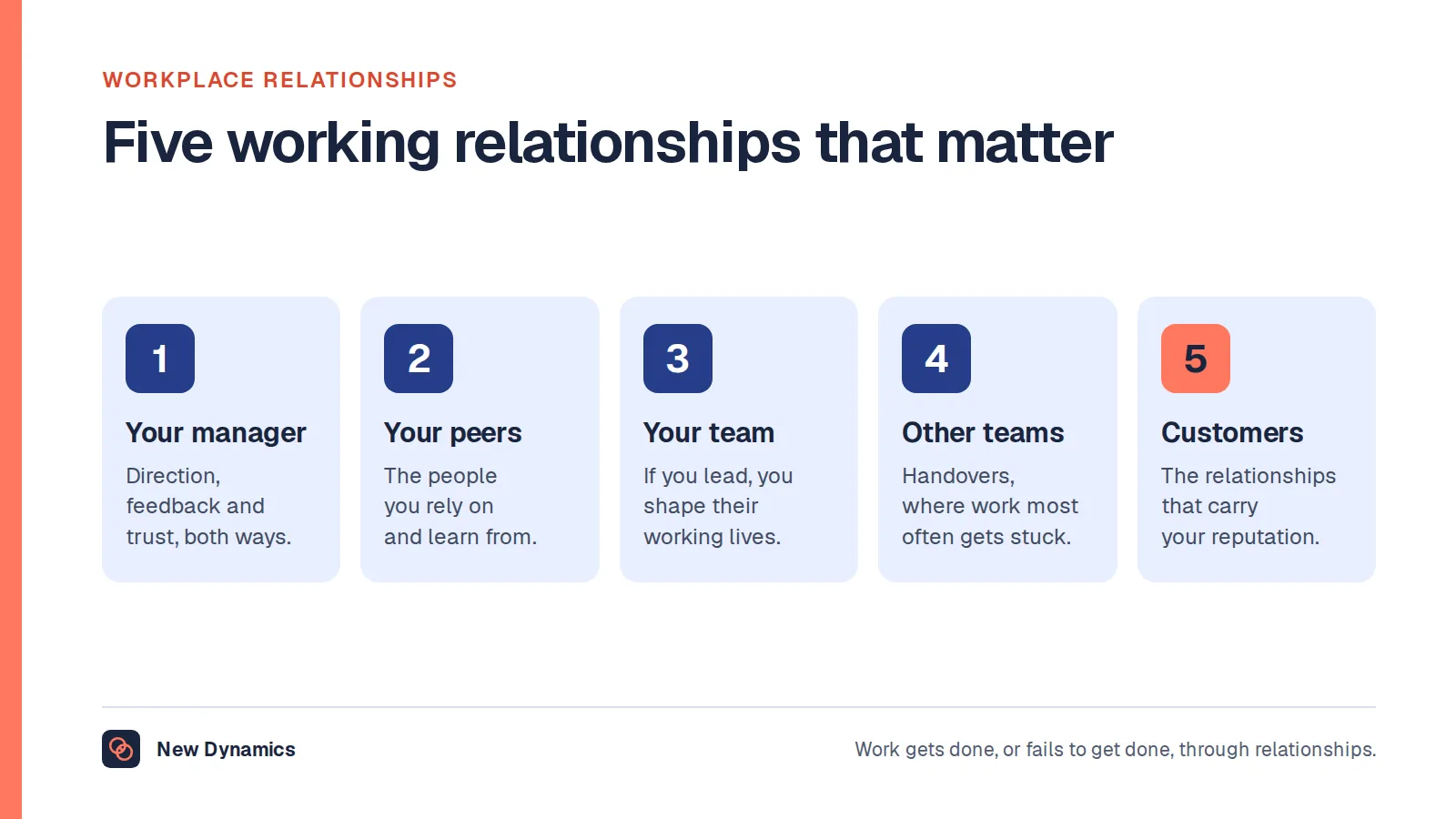
Hard weeks are easier with colleagues who notice, help and keep a sense of humour. The UK Health and Safety Executive includes support from colleagues in its Support standard for preventing work-related stress. See our guide to workplace relationships.
9. Work that feels more worthwhile
Belonging to a team that achieves something together is one of the more satisfying experiences at work. People often stay in a job for their team.
10. Better results for customers
Customers experience an organisation as one thing. They notice when sales, delivery and support work as a team, and they certainly notice when they do not.

What research says makes a team effective
Google studied its own teams to find out what separated the effective ones from the rest. According to its guide, the researchers identified 180 teams to study, a mix of high and low performers, and tested both who was on each team and how each team worked.
The central finding is quoted in the guide: “what really mattered was less about who is on the team, and more about how the team worked together”. Five dynamics stood out, in order of importance.
- Psychological safety. Teammates “feel safe to take risks around their team members”. They are confident that nobody will be embarrassed or punished for “admitting a mistake, asking a question, or offering a new idea”.
- Dependability. Members “reliably complete quality work on time”.
- Structure and clarity. People understand their job expectations, how to fulfil them and what follows from their performance. Goals should be specific, challenging and attainable.
- Meaning. People find a sense of purpose in the work itself or in what it produces.
- Impact. People judge that their work is making a difference, and can see how it contributes to the organisation's goals.
The guide also lists factors that were not significantly connected with team effectiveness at Google. They include colocation of teammates, consensus-driven decision making, extroversion of team members, the individual performance of team members, seniority, team size and tenure. Google notes that these may still matter elsewhere. This is evidence from one company, so treat it as a strong hint, not a law.
The practical lesson is encouraging. You do not need a team of stars. You need a group of capable people who feel safe to speak, keep their promises, know the goal and believe that it matters.

Roles in a team
Teamwork does not mean that everyone does everything. Effective teams are clear about who does what.
- Task roles cover the work itself: who leads, who decides, who does which part and who checks it.
- Process roles keep the team working well: someone to chair, someone to keep time, someone to record decisions and someone to ask “have we heard from everyone?”
- Rotating roles spread the load and build skills. Chairing the weekly meeting in turn is a simple example.
For any piece of shared work, agree three things at the start: the goal, who owns each part and how decisions will be made. That is what Google's researchers mean by structure and clarity. Our guide to cascading goals shows how team goals connect to the organisation's.
When teamwork is not the answer
Teamwork has costs, and it is worth being honest about them.
- Coordination takes time. Every extra person adds meetings, messages and handovers.
- Some work is better done alone. Writing, analysis and design often need long stretches of solitary concentration, followed by review from the team.
- Groups can go wrong. People may stay quiet to keep the peace, and a confident voice can carry a poor decision.
- Effort can hide. In a large group, some people coast, and resentment builds among those who do not.
- Responsibility can blur. “The team owns it” can come to mean that nobody does.
The answer is design. Keep teams small. Give every task a named owner. Let people work alone when the work calls for it. Use the team for what it does best: setting direction, solving hard problems, reviewing work and supporting each other.
How to build better teamwork
- Set a shared goal that needs everyone. Without one, you have a work group.
- Agree how you will work. Settle response times, meeting habits, how decisions are made and how disagreements are raised.
- Make it safe to speak. Leaders go first: admit a mistake, ask a basic question and thank the person who disagrees. See how to make an open door policy real.
- Make commitments visible. A shared list of who is doing what by when builds dependability.
- Connect the work to its purpose. Share customer stories and results, so that people see the impact.
- Recognise team behaviour. Thank people for helping, sharing and handing over well, as well as for individual results. Our employee recognition quotes offer words to use.
- Review how the team is working, and not only what it delivered. A short retrospective each month is enough.
- Deal with problems early. A member who does not deliver, or who behaves badly, damages the whole team.
What about team building?
Away days and social events can help people to get to know each other, and that has value. They cannot fix unclear goals, unfair workloads or a manager who punishes bad news. Build the team through the work first: shared goals, clear roles, honest meetings and help given freely. Then enjoy the bowling.
How to show teamwork as an individual
- Do what you said you would do, when you said you would do it.
- Share information before people have to ask.
- Offer help, and ask for it.
- Give credit by name.
- Disagree openly and kindly, then commit to the decision.
- Hand work over in a state that you would like to receive it.
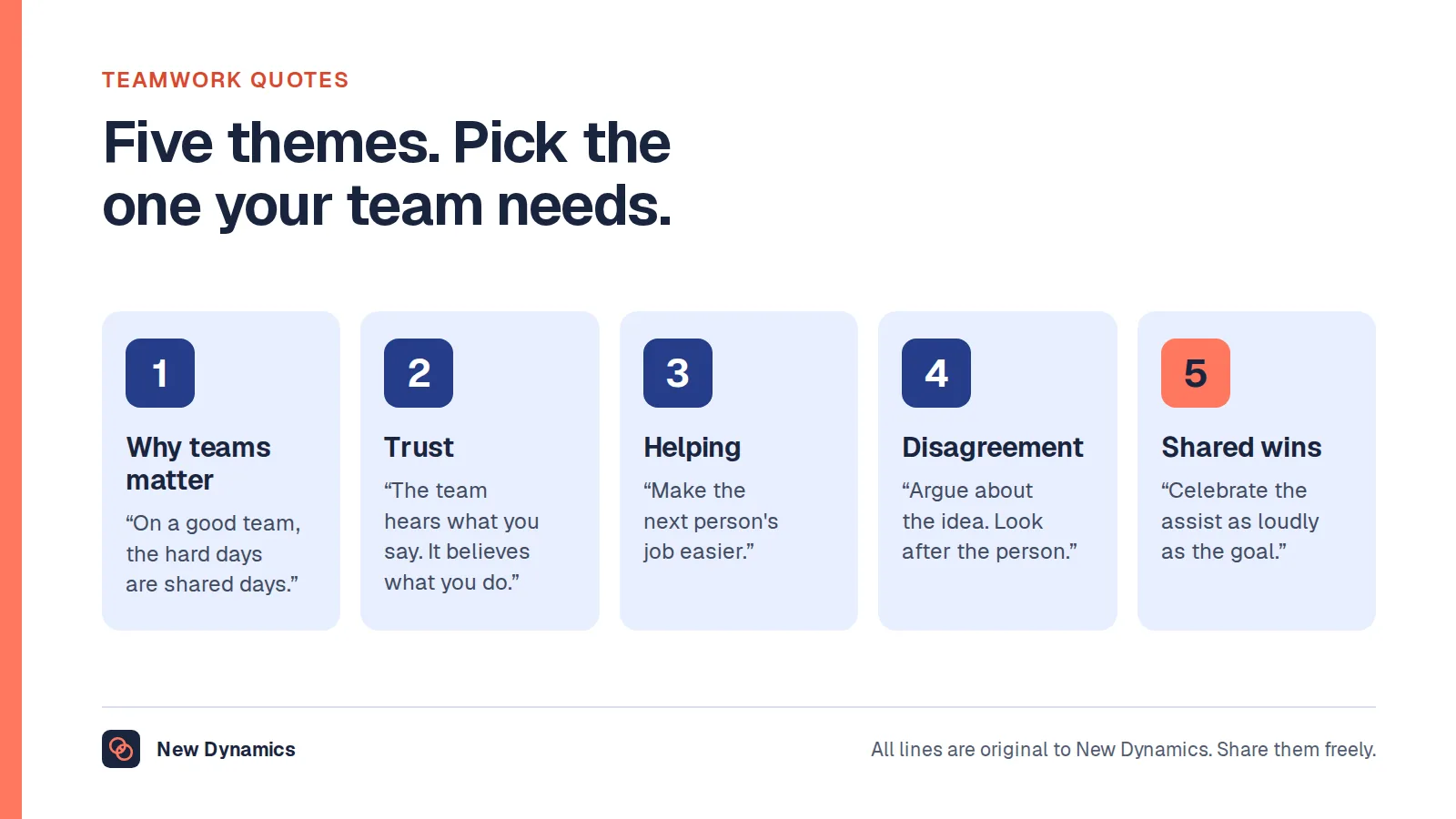
These are also the behaviours to describe on a CV. See soft skills for a CV. For lines to share with your team, see our teamwork quotes.

Frequently asked questions
Why is teamwork important in the workplace?
Most valuable work is too large or complex for one person. Teamwork brings together different skills and viewpoints, catches errors, spreads knowledge, provides cover when people are away and makes work more satisfying. Customers also experience better, more joined-up service.
What are the benefits of teamwork?
The main benefits are better solutions to complex problems, fewer errors, faster learning, resilience when people are absent, more capacity, more ideas, better decisions, support under pressure, more satisfying work and better results for customers.
What is the main advantage of effective teamwork?
The main advantage is that a team can achieve what no individual could: it combines different skills and perspectives to solve problems and deliver results that are beyond one person's reach, while catching each other's mistakes along the way.
What makes a team effective?
Google's study of 180 teams found five dynamics, in order of importance: psychological safety, dependability, structure and clarity, meaning and impact. How the team worked together mattered more than who was on it.
What are the disadvantages of teamwork?
Teamwork takes coordination time. Some work is better done alone. Groups can suppress disagreement, some members may coast, and shared responsibility can become nobody's responsibility. Small teams, named owners and clear decision rules reduce these risks.
How can I improve teamwork in my team?
Set a shared goal that needs everyone, agree how you will work together, make it safe to speak up, make commitments visible, connect the work to its purpose, recognise helpful behaviour and review regularly how the team is working.
Your next step: check the five dynamics
- At your next team meeting, show the five dynamics.
- Ask everyone to say which is strongest in the team and which is weakest.
- Pick the weakest, and agree one change to try for a month.
- Review it together.
For ways to listen to your team and act on what you hear, read and download our employee engagement guide. The guide is free to read, and the PDF uses our short download form.
Want shared goals, feedback and recognition in one place for every team? Book a New Dynamics demo and bring your team's current habits. You can also email contact@new-dynamics.com.