TL;DR
- A good employee is someone who delivers reliable results and makes the people around them better. The traits behind that fall into four groups: dependable, collaborative, thoughtful and growing.
- Every trait is only useful when you describe it as behaviour. “Reliable” is a label. “Delivers what they promised, and says early when they cannot” is something you can see, hire for and develop.
- Good employees are made as well as found. Clear expectations, feedback, fair treatment and a good manager bring these qualities out in most people.
Ask any manager to describe their best team member, and the answers sound alike. “I never have to chase her.” “He makes everyone around him better.” “She tells me when something is wrong.” Rarely does anyone begin with qualifications.
This article sets out 15 traits of a good employee, each with behaviours that you can observe. It also gives you 60 words to describe a good employee, interview questions to help you spot the traits, ways to develop them and a caution about what “good” should never mean.
Traits become visible through goals, feedback and review conversations. See how New Dynamics performance reviews bring results and behaviours into one fair conversation.
What makes a good employee?
A good employee delivers reliable results and makes the people around them better. Skills and knowledge get someone hired. The traits in this article decide how much of that skill turns into value.
One caution before the list. A trait is an adjective, and adjectives mean different things to different people. The UK Civil Service, in its Success Profiles guidance, assesses behaviours, which it defines as “the actions and activities that people do which result in effective performance in a job”. We take the same approach. Each trait below comes with behaviours.
The 15 traits fall into four groups.
- Dependable: reliable, accountable, honest, careful with quality.
- Collaborative: a team player, a clear communicator, respectful, focused on the customer.
- Thoughtful: a problem solver, shows initiative, uses good judgement, organised.
- Growing: eager to learn, adaptable, open to feedback.

15 traits of a good employee
Dependable
1. Reliable. They do what they said they would do, when they said they would do it. Google's study of what makes teams effective lists dependability second among five dynamics: “On dependable teams, members reliably complete quality work on time.”
- Meets deadlines, and gives early warning when one is at risk.
- Turns up on time and prepared.
2. Accountable. They own their work and their mistakes.
- Says “That was my error, and here is what I am doing about it.”
- Follows a task through to the end, including the dull parts.
See our accountability examples at work for 35 more.
3. Honest. They tell the truth, including when it is awkward.
- Reports bad news early and plainly.
- Records time, expenses and results accurately. See our code of conduct examples.
4. Careful about quality. They take pride in the standard of their work.
- Checks work before handing it over.
- Fixes the cause of an error, not only the error.
Collaborative
5. A team player. They help others to succeed, and they share credit.
- Offers help without being asked, and asks for it without embarrassment.
- Hands work over in a state they would like to receive it. See why teamwork is important.
6. A clear communicator. They listen well and express themselves plainly.
- Keeps people informed without being chased.
- Sums up what they heard before responding.
7. Respectful. They treat everyone with dignity, whatever their role.
- Behaves the same way with the cleaner and the chief executive.
- Disagrees without making it personal.
8. Focused on the customer. They understand whom the work is for.
- Asks what the customer, internal or external, really needs.
- Owns a problem until it is resolved.
Thoughtful
9. A problem solver. They bring solutions, or at least options.
- Looks for the cause before choosing a fix.
- Says “Here is the problem, and here are two things we could do.”
10. Shows initiative. They act on what they notice, within their authority.
- Improves a process without waiting to be asked.
- Volunteers for work that stretches them.
11. Uses good judgement. They know what to decide alone, what to check and what to escalate.
- Weighs the risks before acting.
- Knows when good enough is right, and when it is not.
12. Organised. They manage their time and priorities.
- Plans the week, and can say what matters most today.
- Says no, with reasons, to work that does not fit the priorities. Our SMART goals for productivity offer examples.
Growing
13. Eager to learn. They keep their skills current, and they are curious.
- Asks questions, and admits what they do not know.
- Applies what they learn, and shares it.
14. Adaptable. They cope with change, and help others to do so.
- Adjusts when priorities shift, and stays constructive.
- Tries a new way of working before judging it.
15. Open to feedback. They seek it, listen to it and act on it.
- Asks “What could I have done better?”
- Thanks people for criticism, and visibly changes. See our growth mindset examples.
60 words to describe a good employee
Use these in references, reviews, recognition and recommendations. Pair each with an example, or the word will carry little weight.
| Group | Words |
|---|---|
| Dependable | reliable, dependable, punctual, consistent, conscientious, thorough, accurate, diligent, committed, trustworthy, honest, accountable, responsible, steady, professional |
| Collaborative | cooperative, supportive, generous, approachable, respectful, inclusive, diplomatic, considerate, helpful, articulate, attentive, patient, tactful, fair, loyal |
| Thoughtful | resourceful, analytical, practical, perceptive, decisive, organised, methodical, proactive, inventive, thoughtful, focused, efficient, sensible, observant, strategic |
| Growing | curious, adaptable, flexible, resilient, coachable, motivated, ambitious, open-minded, self-aware, persistent, enthusiastic, humble, versatile, energetic, positive |
For example: “Maria is conscientious. She checked 1,200 product records before the migration, and no errors were reported afterwards.”
For full sentences, see our performance review phrases and our job reference examples.

How to spot these traits when you hire
Ask about past behaviour, probe for detail, and ask every candidate the same questions.
| Trait | Interview question |
|---|---|
| Reliable | Tell me about a time when you were at risk of missing a deadline. What did you do? |
| Accountable | Describe a mistake you made at work. What happened next? |
| Team player | Tell me about a time when you helped a colleague at some cost to yourself. |
| Communicator | Give an example of explaining something complicated to someone new to the subject. |
| Problem solver | Describe a problem you solved that was not strictly your job. |
| Initiative | What is something you improved without being asked? |
| Open to feedback | Tell me about some feedback that was hard to hear. What did you change? |
| Adaptable | Describe a time when your priorities changed suddenly. |
Listen for specifics, for “I” as well as “we”, and for what the person learned. Our manager interview questions include a scorecard that you can use for any role.
How to develop the traits of a good employee
If you are an employee
- Pick one trait. Ask your manager or a trusted colleague which would make the biggest difference.
- Turn it into a behaviour, and practise it daily. For reliability: reply to every request with a date, and meet it.
- Ask for feedback after a month.
- Keep a record of examples. They will be useful at review time, and when someone asks about your strengths and weaknesses. See our self evaluation examples.
If you are a manager
Traits are not fixed. Most people show more of them when the conditions are right.
- Make expectations clear. People cannot be reliable about priorities that they do not know.
- Give regular feedback, on behaviour as well as results.
- Recognise the traits when you see them. People repeat what they see being valued.
- Make it safe to be honest. People report mistakes early where the response is help, and late where it is blame.
- Be fair. Few things drain commitment faster than seeing effort go unrewarded, or poor behaviour tolerated.
- Model them. Teams copy what managers do.
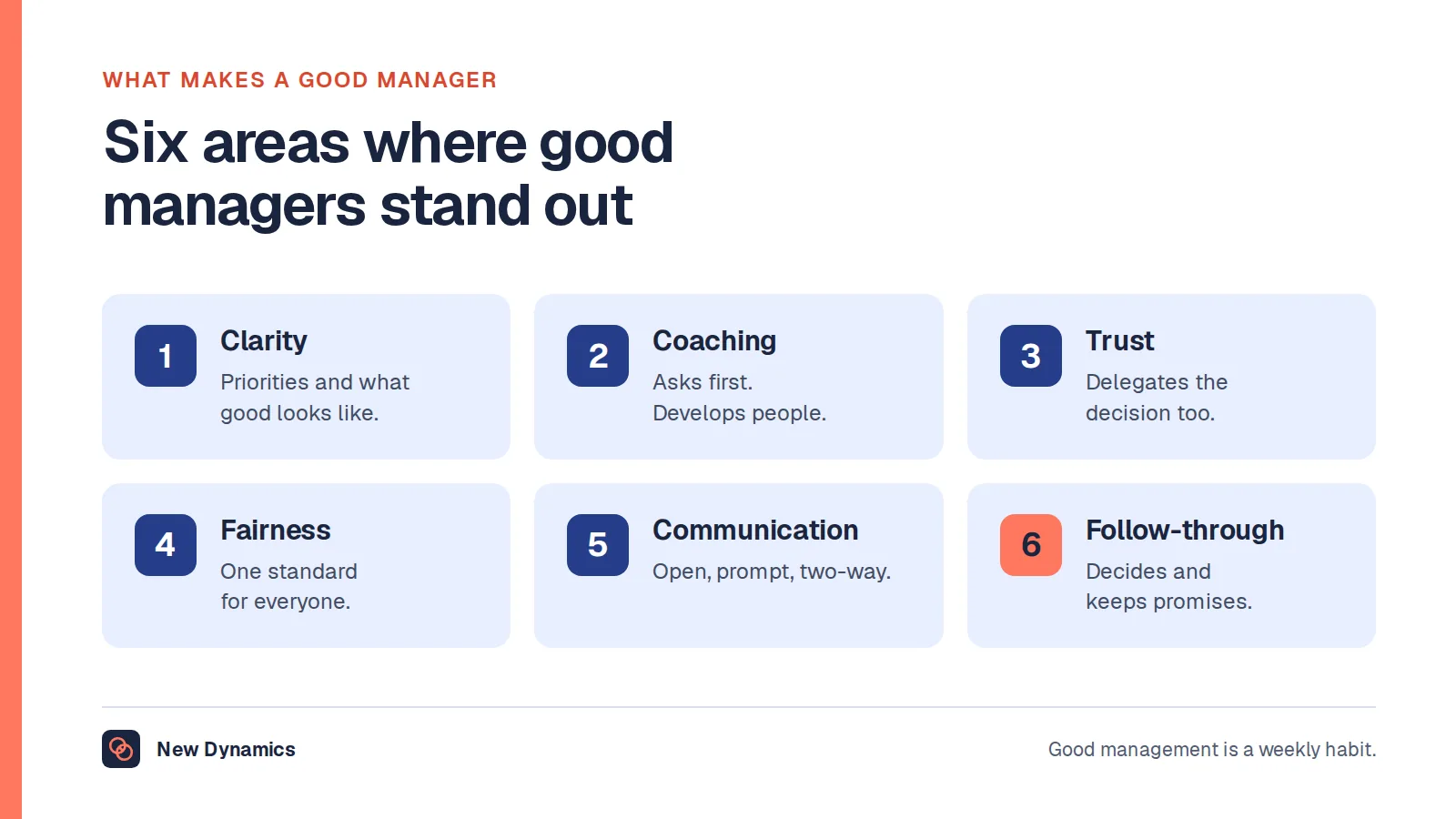
Our guide to what makes a good manager sets out the routines.
What “good employee” should never mean
Some ideas of the good employee do harm.
- Always available. Long hours and instant replies are not traits. They are a risk to health and to judgement.
- Never says no. A good employee pushes back when the workload is unrealistic or the request is wrong.
- Never disagrees. Compliance is not commitment. The colleague who challenges a poor decision is doing their job.
- Fits in. “Culture fit” can become a preference for people who resemble those already there. Look for people who share your values and add something new.
- One style. Quiet people can be excellent communicators. Part-time staff can be fully committed. Judge the behaviour and the results.
Judge every trait by evidence, and apply the same standard to everyone.

Frequently asked questions
What are the traits of a good employee?
The most valued traits are reliability, accountability, honesty, care about quality, teamwork, clear communication, respect, customer focus, problem solving, initiative, good judgement, organisation, eagerness to learn, adaptability and openness to feedback.
What are the top five qualities of a good employee?
If you must choose five: reliable, a team player, a clear communicator, a problem solver and open to feedback. Together they cover delivering work, working with others, thinking and improving.
What words describe a good employee?
Useful words include reliable, conscientious, thorough, trustworthy, supportive, approachable, articulate, resourceful, proactive, organised, decisive, curious, adaptable, resilient and coachable. Always pair the word with a specific example.
How do you identify a good employee in an interview?
Ask for past examples of each trait, such as a time when they were at risk of missing a deadline or received hard feedback. Probe for what they did and what they learned, ask every candidate the same questions and score the answers.
Can the qualities of a good employee be learned?
Yes. They are behaviours, and behaviours can be practised. Clear expectations, regular feedback, recognition and fair treatment help most people to show more of them. A good manager makes a large difference.
What is the most important quality in an employee?
Reliability is the foundation: doing what you said you would, and saying early when you cannot. It makes planning possible and builds the trust on which every other quality depends.
Your next step: describe your best colleague
- Think of the best person you have worked with.
- Write down three things they did, as behaviours.
- If you are hiring, turn those into interview questions.
- If you are developing yourself, choose one to practise for a month.
For a worksheet that turns behaviours into feedback and development actions, read and download our competency-based feedback guide. The guide is free to read, and the PDF uses our short download form.
Want goals and behaviours reviewed together, with evidence from the whole year? Book a New Dynamics demo and bring your current review form. You can also email contact@new-dynamics.com.