TL;DR
- A business consultant is hired by an organisation to study a problem it cannot or would rather not solve alone, recommend what to do and, in the better engagements, help do it and measure the result. O*NET lists business consultant and management consultant among the titles of management analysts, whose tasks include gathering and organising information on problems or procedures, interviewing personnel and observing on site, analysing the data and developing solutions, documenting findings and recommendations, and conferring with staff to ensure newly implemented systems work.
- An engagement has six stages: the brief, research and diagnosis, analysis and options, the recommendation, implementation support and measurement. Business consultant is the general title; management consultant is the same job with a strategic and organisational focus, and the specialisms run from operations, finance and technology to HR and change. Prospects describes the ladder from analyst to consultant, senior consultant, managing consultant, principal and partner, and the National Careers Service adds freelance work and setting up a firm.
- Certifications exist but are not required to practise. In the UK, Prospects lists the CMI Professional Consulting qualifications at levels 5 and 7, developed with the Institute of Consulting, Certified Management Consultant status through the Institute, and Chartered Management Consultant status as the highest accreditation; the National Careers Service names chartered management consultant status as industry recognition. Ask a prospective consultant about them, then ask for references, a written scope, named people and a measure of success before you sign.
A company has a problem it has looked at for a year: margins falling, a department that cannot keep staff, a system nobody trusts. Somebody suggests a consultant, and the room divides between those who have seen a consultant fix something and those who have seen one produce a slide deck. What does a business consultant do, exactly, and how do you tell in advance which kind you are about to hire?
This article answers the question using three primary sources, the US O*NET occupational database, the Prospects graduate careers service and the UK National Careers Service. It sets out the six stages of an engagement, the difference between a business and a management consultant and the specialisms, the certifications for management consultants including the Certified Management Consultant credential, how to hire a consultant and what to ask, a job description template for employing one, and how to measure the work.
A consultant's recommendation only counts once it becomes somebody's objective with a date and a measure. See how New Dynamics Goals & OKRs turn an agreed plan into owned goals with visible progress, whether the plan came from inside or outside.
What is a business consultant?
A business consultant is engaged by an organisation, for a fee and a fixed period, to study a defined problem, recommend what to do about it and, depending on the engagement, help do it. The consultant brings outside perspective, a method and experience of the same problem elsewhere; the organisation keeps the decision.
O*NET lists “Business Consultant” and “Management Consultant” among the reported titles of management analysts, an occupation it describes as conducting “organizational studies and evaluations, design systems and procedures, conduct work simplification and measurement studies, and prepare operations and procedures manuals to assist management in operating more efficiently and effectively”. Its tasks include “gather and organize information on problems or procedures”, “interview personnel and conduct on-site observation to ascertain unit functions, work performed, and methods, equipment, and personnel used”, “analyze data gathered and develop solutions or alternative methods of proceeding”, “document findings of study and prepare recommendations for implementation of new systems, procedures, or organizational changes”, “confer with personnel concerned to ensure successful functioning of newly implemented systems or procedures” and “prepare manuals and train workers”.
The National Careers Service puts the day-to-day tasks plainly: speak to staff, managers and customers to understand issues; collect and analyse data to pinpoint areas for improvement; create models to test possible solutions; prepare reports and present recommendations to the client; and support businesses as they put plans into action.
Business consultant or management consultant?
The titles overlap. Management consultant usually means the strategic and organisational end of the work, often in a consultancy firm with a graduate intake; business consultant is the broader title, used by independents and smaller firms and by specialists in operations, finance, marketing, technology, HR and change. The Prospects management consultant profile covers the firm-based version; O*NET's occupation covers both. What matters when hiring is the specialism and the stage of the engagement the consultant will own, not the title.
What a business consultant does: the six stages of an engagement
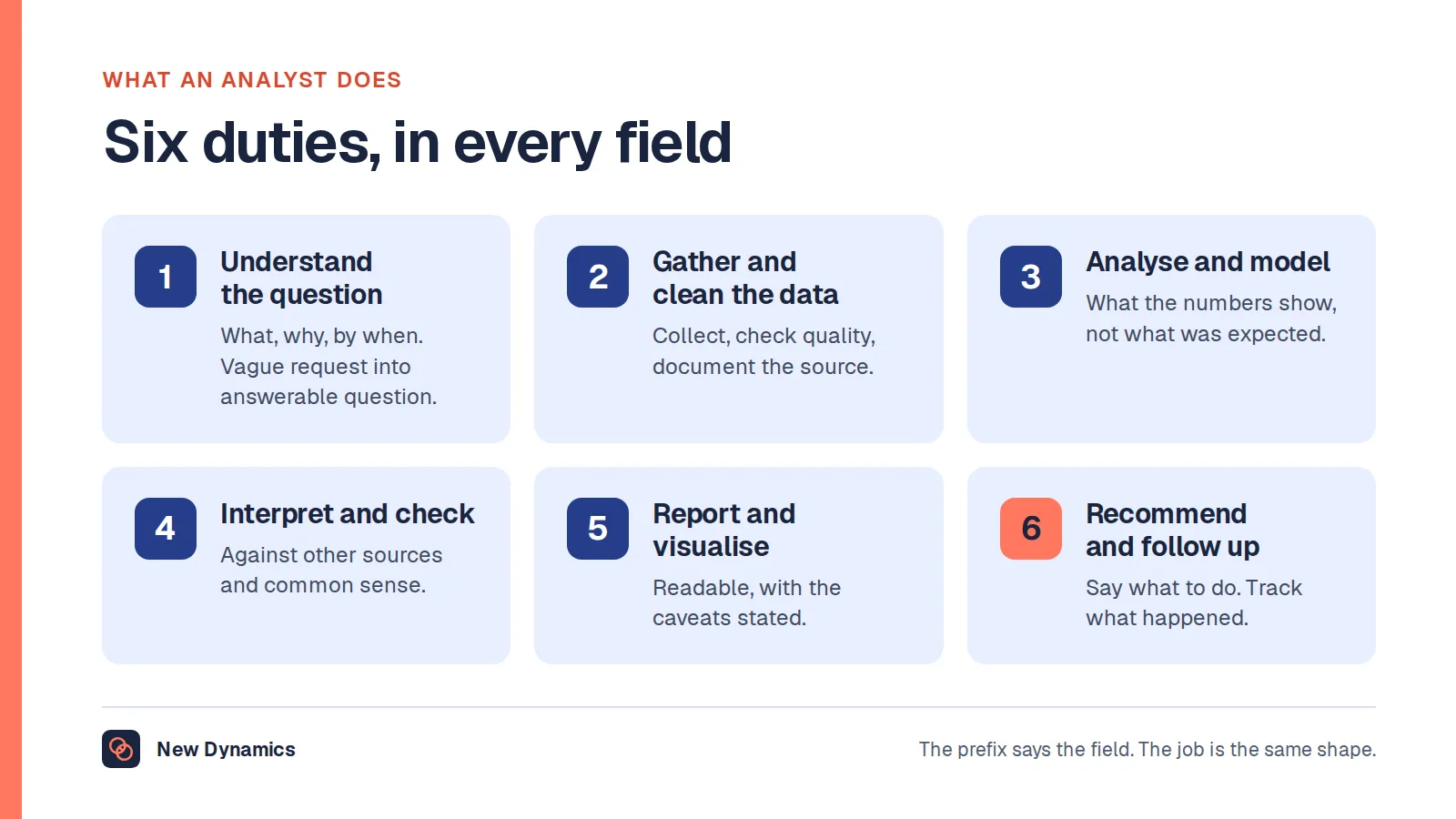
Grouped from the O*NET tasks and the Prospects responsibilities, a good engagement runs through six stages.
- The brief. Agree the problem, the scope, the people involved, the timetable, the fee and what success will look like. Prospects lists preparing proposals and pitches among the responsibilities; the client's job at this stage is to make the brief specific enough to be measured.
- Research and diagnosis. Gather and organise information; interview employees, managers and other stakeholders; observe on site; run focus groups and workshops, as Prospects lists. The consultant's first value is finding out what is happening, which insiders often cannot say out loud.
- Analysis and options. Analyse the data, identify the issues, form hypotheses and develop solutions or alternative methods of proceeding, in O*NET's words; test them with models where the problem is numerical.
- The recommendation. Write and present findings and recommendations, with the evidence, the options considered and the cost and risk of each. The deck is not the deliverable; the decision it enables is.
- Implementation support. Develop and implement the tailored solution with the client's staff; keep the client informed and deciding; make sure processes and practices are adopted, as Prospects describes; train workers in new procedures, as O*NET lists.
- Measurement. Manage and evaluate the effectiveness of the implemented solution, adjusting where necessary, to make sure the targeted outcomes are achieved. An engagement that ends at stage four has delivered advice; one that ends at stage six has delivered a result.

The specialisms
Consultants specialise by problem: strategy and organisation; operations and process; finance and cost; technology and systems; marketing and sales; people, HR and change; and sector specialisms in health, public services, retail, manufacturing or professional services. An independent consultant usually has one; a firm has many and staffs an engagement from them. Ask which the consultant has solved before, for whom and with what result.
Certifications for management consultants
Consulting is not a regulated profession; anyone can use the title. Certifications exist as evidence of method and standing, and the ones with weight are those awarded by professional institutes rather than by training vendors.
- Professional qualifications. Prospects lists the CMI Professional Consulting qualifications at level 5 and level 7, “developed in cooperation with the Institute of Consulting” and available as an award, certificate or diploma, and notes that consultancies often support staff to take them while working.
- Certified Management Consultant. Prospects says that “with experience, you can apply for Certified Management Consultant (CMC) status through the IC”, the Institute of Consulting. The CMC is a practitioner credential assessed on experience and competence; equivalent credentials are awarded by national institutes in other countries under the same name.
- Chartered Management Consultant. Prospects describes Chartered Management Consultant status as “the highest level of accreditation you can achieve”, for experienced consultants who have made a significant contribution to the profession; the National Careers Service says chartered status “gives you industry recognition of your skills and expertise”.
- Postgraduate and specialist qualifications. An MBA or a business Masters, and the professional qualifications of the specialism: accountancy, project management, HR, technology.
None is required. A consultant without any may be excellent; a consultant with all of them may still be wrong for your problem. Treat certification as one signal beside references and results.

Skills a good consultant has
Prospects lists communication and presentation, the ability to convey complicated information clearly, interpersonal skills at every level of an organisation, creative problem solving, analytical skill, strategic planning, project management, flexibility and resilience, leadership, a thorough and logical approach, the ability to work in a team and alone, the ability to cope with pressure, data analysis, the confidence to put forward convincing commercial arguments and manage resistance, and commercial awareness. The National Careers Service adds judgement, initiative and customer service.
From the client's side, the skills that matter most are listening before recommending, saying what the evidence does and does not support, and telling the client what they do not want to hear.
How to hire a business consultant: what to ask
- What is the problem, in one sentence, and how will we know it is solved? Write the answer down before you speak to anyone; it becomes the brief and the measure.
- Who has solved this before? Ask for two or three comparable engagements, the result, and a reference you can call.
- Who will do the work? The people who pitch are not always the people who deliver. Name them in the contract.
- Which of the six stages are you buying? Advice only, or implementation and measurement too. Price and expectations follow.
- What will you need from us? Time from named people, access to data and decisions on a timetable. Most failed engagements failed here.
- What are the certifications and memberships, and what do they mean? Ask, listen, and weigh the answer against the references.
Then write a scope, a timetable, the deliverables by stage, the fee and the measure of success into the contract. Our guide to the independent contractor covers the employment-status questions that arise when a consultant works inside your business for a long period.

Business consultant job description template
For organisations employing an in-house consultant, or a consultancy writing an advert.
Job title: Business Consultant (state the specialism: Operations, Finance, Technology, People and Change)
Reports to: Managing Consultant, Practice Lead or, in-house, Director of Strategy or Operations
Scope: State the clients or internal customers, the specialism, the size and number of engagements, the travel and the business development expected.
Purpose: Help clients solve defined business problems by gathering evidence, analysing it, recommending practical solutions and supporting their implementation to a measured result.
Responsibilities:
- Agree briefs, scopes and measures of success with clients; prepare proposals and pitches.
- Gather and organise information; interview staff, managers and stakeholders; observe on site; run workshops.
- Analyse data; identify issues; develop and test options; model where the problem is numerical.
- Write and present findings and recommendations with evidence, options, cost and risk.
- Support implementation with the client's staff; train people in new procedures; manage change and resistance.
- Evaluate the effectiveness of implemented solutions and adjust to achieve the targeted outcomes.
- Lead junior consultants and analysts; develop client relationships.
Skills and experience:
- Degree, usually; O*NET places the occupation in Job Zone four. Prospects notes that graduates usually begin as analysts.
- A record of solving comparable problems in the specialism, with measured results and references.
- Analytical and modelling skill; clear writing and presentation; interpersonal skill at every level.
- Project management; resilience; commercial awareness; the confidence to argue a case and manage resistance.
- Professional qualifications, CMC or chartered status desirable; state which, and what experience can replace them.
Working pattern: State the travel and time at client sites; the National Careers Service notes frequent travel and nights away.
Progression: Senior consultant, managing consultant, principal, partner, as Prospects describes; or independent practice.
How to measure a consultant
Measure the engagement on the outcome agreed in the brief, not on the volume of slides:
- The measure of success written in the brief, checked at the end of implementation and again after the agreed period.
- Adoption. Whether the new process, system or structure is in use, by the people who were meant to use it.
- Transfer. Whether the organisation can now do without the consultant for this problem.
- The relationship. Whether the people who worked with the consultant would do so again.
Frequently asked questions
What does a business consultant do?
Studies a defined problem for an organisation, recommends what to do and, in the better engagements, helps implement the change and measures the result. The US occupational database lists gathering information, interviewing personnel and observing on site, analysing data and developing solutions, documenting recommendations and conferring with staff to make new systems work among the tasks of management analysts, which include business and management consultants.
What is the difference between a business consultant and a management consultant?
Mostly the setting and the focus. Management consultant usually refers to the strategic and organisational end of the work, often in a consultancy firm; business consultant is the broader title used by independents, smaller firms and specialists in operations, finance, technology, marketing, HR and change. The US occupational database covers both in one occupation.
What is a Certified Management Consultant?
A practitioner credential awarded by a professional institute on the basis of experience and competence. In the UK, Prospects says that with experience a consultant can apply for Certified Management Consultant status through the Institute of Consulting, and describes Chartered Management Consultant status as the highest level of accreditation. National institutes in other countries award the CMC under the same name.
Do business consultants need certification?
No. Consulting is not a regulated profession and anyone can use the title. Certifications from professional institutes, such as the CMC or chartered status, and the CMI Professional Consulting qualifications, are evidence of method and standing, but references and measured results matter more when choosing a consultant.
How much does a business consultant cost?
It varies with the specialism, the consultant's seniority, the firm and the stages of the engagement being bought, from advice only to implementation and measurement. Agree a written scope, the deliverables by stage, the fee and the measure of success before starting, and ask what time and access will be needed from your own people.
Your next step: write the problem in one sentence
- State the problem and the measure of success before you speak to a consultant.
- Decide which of the six stages you are buying.
- Ask for comparable engagements, references and the names of the people who will do the work.
- Put the scope, deliverables, fee and measure in the contract, and turn the recommendation into owned objectives when it arrives.
For a way to write the objectives a consultant's recommendation becomes, read and download our SMART goals guide. The guide is free to read, and the PDF uses our short download form.
Want an agreed plan to become owned goals with visible progress, so the recommendation does not stay in the deck? Book a New Dynamics demo and bring the last report you commissioned. You can also email contact@new-dynamics.com.