TL;DR
- A car salesperson sells vehicles to customers at a dealership or motor group, and handles everything around the sale: qualifying the buyer, demonstrating the car, valuing the part-exchange, arranging finance and add-ons, preparing the paperwork, and handing the car over. O*NET covers the role under Retail Salespersons, described as those who “sell merchandise, such as furniture, motor vehicles, appliances, or apparel to consumers”, and lists Car Salesman among the reported job titles.
- Two parts make it a distinct trade. The part-exchange means every deal is a purchase as well as a sale, and O*NET lists “estimate and quote trade-in allowances” among the tasks. The finance and insurance layer is regulated: a dealership arranging credit is acting as a credit broker, and the FCA requires brokers to make clear in advertising “that they are brokers and not lenders”, to use the legal name that appears on the Financial Services Register, and to be transparent about their status and any links to lenders.
- Pay is usually a basic salary plus commission, which makes the target structure part of the job description rather than an afterthought. An advert that states the stock, the target, how commission is calculated and what training is given attracts people who can do the job; one that says “OTE uncapped” attracts everyone else.
Most car sales adverts describe the dealership and skip the job. They mention a brand, a showroom and uncapped earnings, and leave out the three transactions the salesperson is actually running at once: selling a car, buying one back, and arranging the money that pays for the difference.
This article sets out a car salesperson job description that a dealership can use: what the job involves, seven duties, how part-exchange and finance work, the consumer law the sales floor meets, how the job is paid, routes in, and a template to copy. It is general information about the role, not legal or regulatory advice.
Showrooms lose new starters in the first three months more often than in any later quarter, usually because nobody taught them the product or the process before putting them on the floor. See how New Dynamics onboarding gives every new starter the same first weeks.
What does a car salesperson do?
A car salesperson sells vehicles to customers, and manages the sale from the first enquiry to the handover and beyond.
O*NET covers the occupation as Retail Salespersons, described as those who "sell merchandise, such as furniture, motor vehicles, appliances, or apparel to consumers". Car Salesman appears among the reported job titles, alongside Sales Consultant and Sales Executive, which is what most UK dealerships call the role today.
The title varies by employer: sales executive, sales consultant, sales specialist, product genius, business development executive. The work is broadly the same. What changes is the mix of new and used stock, whether enquiries arrive online or through the door, and how much of the finance conversation the salesperson handles themselves.
Seven duties
O*NET lists twenty-four tasks for the occupation. Seven groups cover the dealership version.
- Qualify the buyer. "Greet customers and ascertain what each customer wants or needs", then establish the budget, the use, the timescale and whether there is a vehicle to part-exchange.
- Product and demonstration. "Recommend, select, and help locate or obtain merchandise based on customer needs and desires", "demonstrate use or operation of merchandise" and "describe merchandise and explain use, operation, and care of merchandise to customers". In practice: knowing the range, running the test drive, explaining the technology.
- The part-exchange. "Estimate and quote trade-in allowances", appraising the customer's current car, checking its history and condition, and agreeing a figure.
- The deal. "Compute sales prices, total purchases, and receive and process cash or credit payment", negotiate within the authority you have been given, and know when to involve the manager.
- Finance and add-ons. "Sell or arrange for delivery, insurance, financing, or service contracts for merchandise", within the rules set out below.
- Paperwork and compliance. "Prepare sales slips or sales contracts", "maintain records related to sales", and "maintain knowledge of current sales and promotions, policies regarding payment and exchanges, and security practices".
- Stock and the showroom. "Inventory stock and requisition new stock", "ticket, arrange, and display merchandise to promote sales", and "place special orders or call other stores to find desired items".

Handover and follow-up are not separate O*NET tasks but they are where repeat business is made or lost: preparing the vehicle, explaining the controls and the warranty, and calling the customer afterwards.
A day on the sales floor
- Morning. Check overnight online enquiries and respond; walk the forecourt and check the stock you are selling actually exists and is prepared; follow up yesterday's unclosed conversations.
- Through the day. Appointments, walk-ins, test drives, appraisals, quotes, waiting.
- Between customers. Chasing a part-exchange valuation, chasing a finance decision, chasing a delivery date, updating the system so someone else can pick up the enquiry.
- End of the month. The part everyone outside the trade underestimates: the target is monthly, so the last week is not like the first.
The part-exchange: every sale is also a purchase
Valuing the incoming car is the skill that separates a competent car salesperson from a competent salesperson.
- Appraise honestly. Condition, mileage, service history, tyres, damage, outstanding finance and the paperwork that should come with it.
- Understand what the figure means. The part-exchange allowance and the discount are two levers on the same deal, and customers experience them differently.
- Know your limits. What you may agree alone, and what needs the sales manager or the buyer.
Get this wrong in the customer's favour and the profit disappears; get it wrong in theirs and they find out from the next dealer. Both cost the dealership something.
The finance and insurance layer, and why it is regulated
Most vehicles are not bought outright, so most car sales involve credit, and arranging credit is a regulated activity in the UK.
A dealership that introduces customers to lenders is acting as a credit broker. The FCA's summary of the key rules for credit broking firms sets out what follows, and says plainly that it "is not a full list of rules that apply to credit brokers" and that firms "should always check the relevant parts of the Handbook". Among the rules it lists:
- Brokers must "make clear in their advertising that they are brokers and not lenders".
- All correspondence and advertising must include the firm's legal name "as it appears in the Financial Services Register", not merely a trading name.
- Firms must make clear "their status, including the extent of their powers, the nature of the service they provide and any links to lenders".
- Financial promotions, including websites, "must be clear, fair and not misleading", and firms "must not mislead as to their identity or status".
- All credit brokers "must pay regard to the interests of their customers and treat them fairly", with communications that are clear, fair and not misleading.
- Brokers are "prohibited from unfairly passing customers' data – including payment details – to third parties, without consent or for a purpose other than that which consent was given".

For the job description this has three practical consequences. The role needs named training before the person is let near a finance conversation. It needs a clear line about what the salesperson may say and what only a business manager or specialist may say. And the training has to be repeated and recorded, not done once. Which permissions a dealership holds, and which staff may do what, is a question for that business and its compliance team, not for an article.
The consumer law the sales floor meets
Dealerships sell to consumers, so the general rules on returns and refunds apply. GOV.UK's guidance on accepting returns and giving refunds is the plain-English version:
- You must not mislead customers about their rights, "for example by displaying a sign that says you do not accept returns or offer refunds".
- Where a sale is made at a distance (online, by phone or by mail) the customer has a 14-day right to cancel, another 14 days to return the item, and a refund within 14 days of you receiving it back, with no reason required.
- You "must repair or replace an item if a customer returns it within 6 months - unless you can prove it was not faulty when they bought it". After six months you can ask the customer to prove the fault existed at sale.
- Customers "have up to 6 years to make a claim for an item they've bought from you (5 years in Scotland)".
A salesperson does not need to recite this. They need to know that the promises they make on the forecourt are enforceable, and to escalate a complaint rather than improvise one.
Pay, targets and what they do to behaviour
Prospects' sales executive profile describes the shape: business-to-consumer roles are customer-facing and involve "higher volumes of smaller sales, for example selling cars, financial services or retail products directly to customers", and pay is usually a combination of a basic salary and commission, with rates varying considerably.
Four things decide whether the structure works:
- What is measured. Units, gross profit, finance penetration, add-ons, customer satisfaction scores, usually several at once, sometimes pulling against each other.
- Whether the target is achievable. A target nobody hit last year does not motivate; it teaches people to ignore targets.
- Whether the rules change mid-month. Changing the scheme after people have planned their month is the fastest way to lose a good salesperson.
- What happens to satisfaction scores. Tie pay to a survey and you get pressure on customers to score well, which is not the same as serving them well.
Set all four out in writing before the person starts. Our guide to keeping good people covers the wider pattern: showrooms lose staff to the scheme far more often than to the work.
How it differs from four nearby jobs
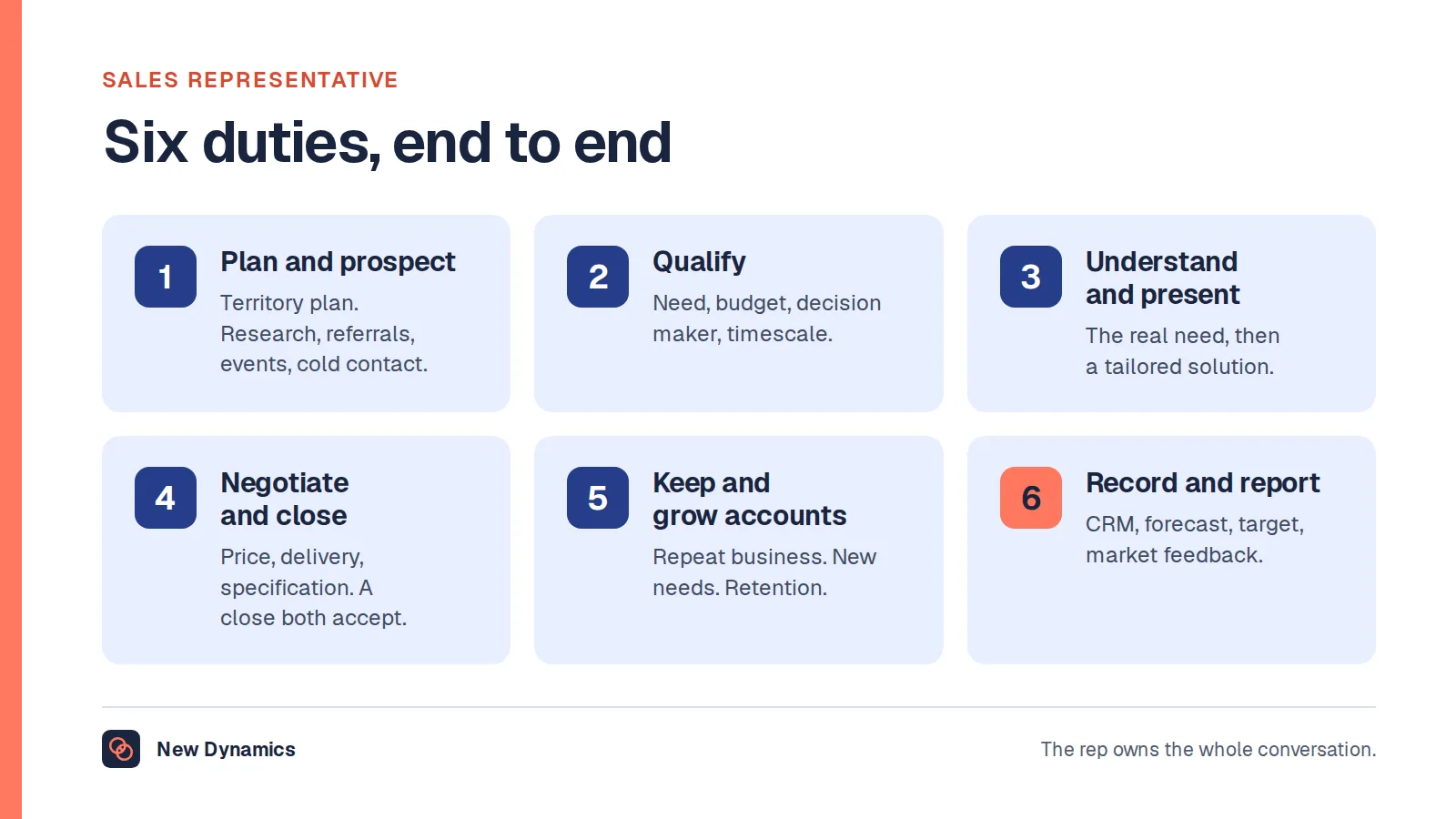
- Sales executive in other industries. Longer cycles, fewer transactions, no part-exchange, and usually no regulated finance conversation. See our sales representative job description.
- Business manager or finance and insurance specialist. Takes the finance and add-on part of the deal, usually with additional permissions and training.
- Sales manager. Runs the floor, approves deals outside the salesperson's authority, owns the stock and the monthly number.
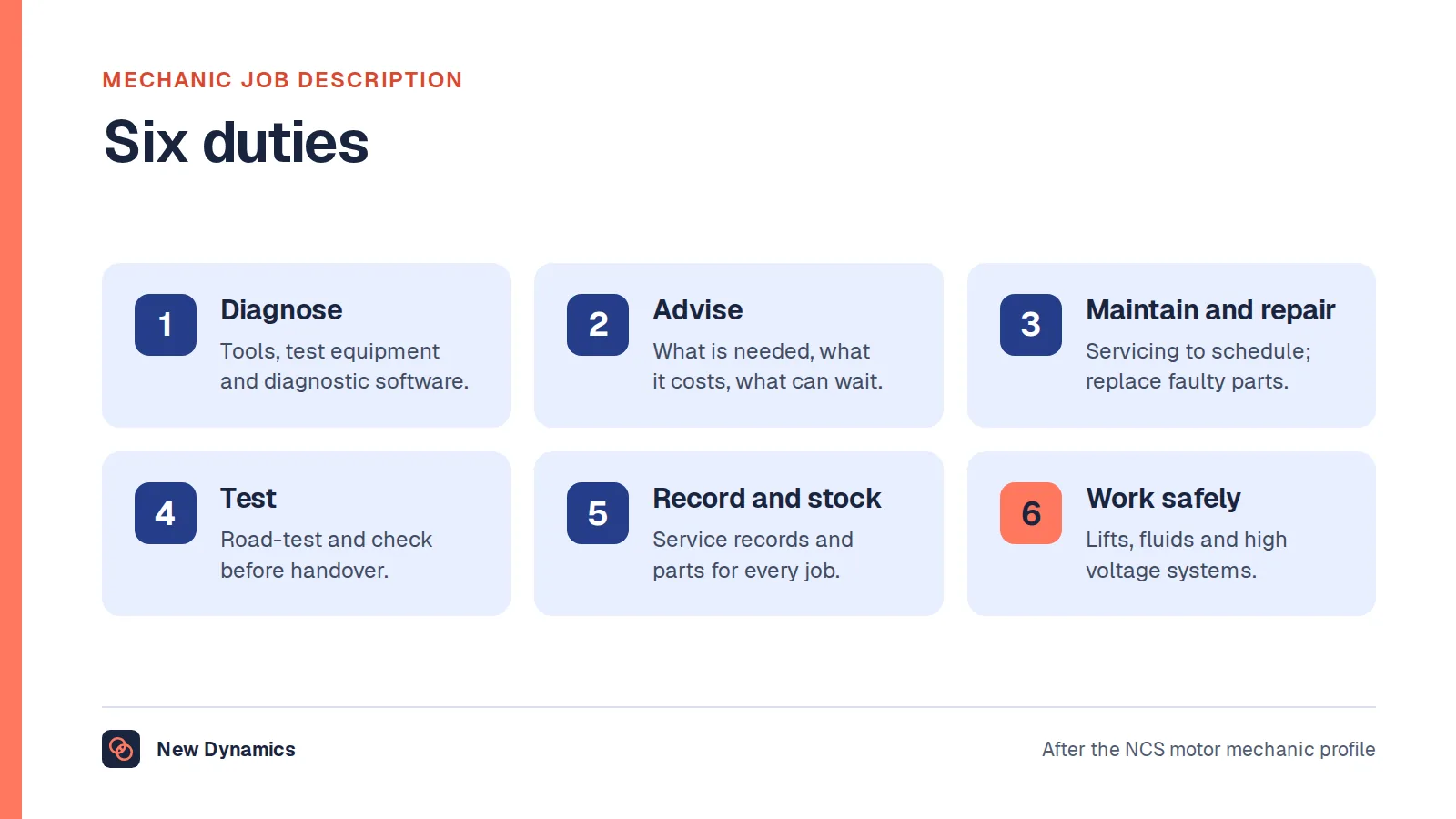
- Service adviser. Works in aftersales, booking and explaining repairs rather than selling vehicles; the counterpart to our mechanic job description.
Routes in
There is no required qualification. Dealerships usually recruit on aptitude and attitude and train the product.
- Direct application from another sales or customer-facing role. Retail and hospitality both transfer well.
- A trainee or apprentice scheme with a motor group or manufacturer, which combines product training with the showroom.
- From elsewhere in the dealership (service reception, valeting, parts) which has the advantage that the person already knows how the site works.
A full driving licence is usually essential because of test drives and vehicle movements, and employers generally check the licence. Manufacturer product accreditation and the firm's own compliance training normally follow in the first weeks.
A car salesperson job description template
Job title: Sales executive (cars)
Reports to: Sales manager
Purpose: Sell new and used vehicles and related products, giving every customer a clear, honest buying experience that they would repeat.
Responsibilities
- Respond to online, telephone and showroom enquiries within the agreed time, and record every enquiry in the system.
- Establish each customer's needs, budget, timescale and part-exchange position.
- Present suitable vehicles, explain specification and running costs, and conduct test drives in line with the insurance and licence-check policy.
- Appraise part-exchange vehicles and agree allowances within your authority.
- Prepare quotations and orders, and negotiate within the discount and allowance limits set by the sales manager.
- Introduce customers to the dealership's funding options and add-on products in line with FCA requirements and the firm's compliance procedures, and complete the required training before doing so.
- Keep accurate records of every customer, order and delivery date.
- Prepare and conduct handovers, and follow up afterwards.
- Support stock presentation, forecourt standards and marketing activity.
You will need: a full driving licence; the ability to listen before presenting; comfort with numbers and with a CRM system; and a willingness to complete and repeat compliance training.
Hours and pay: [days, weekends and bank holidays, rota notice]. [Basic salary] plus commission; the scheme is set out in the offer and reviewed [period].
What the advert should say
- The stock and the enquiries. New, used or both; which brands; how many enquiries arrive online and how many walk in.
- The target and the scheme. What is measured, how commission is calculated, and when it is paid.
- The hours. Weekends, bank holidays, how far ahead the rota is published.
- The training. Product accreditation, compliance training, and what happens before the first finance conversation.

Frequently asked questions
What does a car salesperson do?
Sells vehicles and the products that go with them, and runs everything around the sale: qualifying the buyer, demonstrating the car, valuing the part-exchange, agreeing the deal, arranging finance and add-ons, preparing the paperwork and handing the vehicle over. O*NET's tasks for retail salespersons include greeting customers and establishing what they need, demonstrating and describing the merchandise, estimating and quoting trade-in allowances, and selling or arranging delivery, insurance, financing or service contracts.
What qualifications do you need to sell cars?
None are required by law in the UK. Employers look for a full driving licence, customer-facing experience and numeracy, then train the product. Anyone involved in arranging finance must complete the dealership's compliance training first, because introducing customers to lenders is credit broking and is regulated by the FCA.
Is a car salesperson the same as a sales executive?
Usually yes: sales executive and sales consultant are the titles most UK dealerships now use for the job. Business manager is a different role, taking the finance and insurance part of the deal.
How are car salespeople paid?
Typically a basic salary plus commission. Prospects notes that salaries and commission rates vary considerably in sales, and that pay is usually a combination of a basic salary and commission. The measures behind the commission (units, gross profit, finance penetration, add-ons, satisfaction scores) matter as much as the headline figure, so they belong in the advert.
What rules apply when a dealership arranges car finance?
A dealership introducing customers to lenders is acting as a credit broker. The FCA's key rules require brokers to make clear in advertising that they are brokers and not lenders, to include the legal name that appears on the Financial Services Register in advertising and correspondence, to be transparent about their status, powers and links to lenders, and to treat customers fairly with communications that are clear, fair and not misleading. The FCA's page is a summary; firms should check the Handbook. This is general information, not legal advice.
What does a car salesperson need to know about returns?
That the promises made on the forecourt are enforceable. GOV.UK's guidance states that businesses must not mislead customers about their rights, that distance sales carry a 14-day right to cancel, that a faulty item returned within 6 months must be repaired or replaced unless the business can prove it was not faulty when sold, and that customers have up to 6 years to claim, or 5 in Scotland.
Your next step: write the job, not the showroom
- Put the stock, the enquiry mix and the rota in the advert.
- State the target and how commission is calculated, rather than an uncapped figure.
- Name the training that happens before the first finance conversation, and diary the repeat.
- Give every new starter the same structured first three weeks.
For the reasons good salespeople leave, and what keeps them, read and download our employee retention guide. The guide is free to read, and the PDF uses our short download form.
Want onboarding, objectives and check-ins in one place, so a new starter's first month is the same every time? Book a New Dynamics demo and bring your current induction checklist. You can also email contact@new-dynamics.com.