TL;DR
- A category manager owns one category of products or spend and is judged on how it performs. In retail, that means a product category such as frozen food or menswear: its range, suppliers, prices, promotions and margin. In procurement, it means a category of what the organisation buys, such as IT hardware or facilities services: its supply market, suppliers, contracts and cost. Brand-side category managers do a third version, advising retailers on how a whole category should be ranged and shelved.
- Prospects describes retail buyers progressing into category management as a senior route in supermarkets and major retailers, with duties from analysing buying patterns and negotiating with suppliers to presenting buying plans. O*NET lists category purchasing manager among the titles for purchasing managers, whose tasks include developing cost reduction strategies, reviewing contracts and directing buyers.
- Write the job description around which version it is, the category and its size, the numbers the role owns (sales, margin, availability and waste in retail; savings, risk and supplier performance in procurement), the suppliers and stakeholders, and the team. The skills are the same in both: analysis, negotiation, commercial judgement and influence without authority.
A supermarket has a category manager for breakfast cereals. A cereal maker has a category manager who advises supermarkets on breakfast cereals. A hospital has a category manager for medical consumables it buys. All three have the same title and different jobs. What is a category manager? Someone who owns one slice of what an organisation sells or buys, end to end, and answers for how it performs.
This article separates the three versions, sets out the duties using the UK careers service Prospects and the US O*NET database as sources, lists the numbers the role is judged on, the skills and routes in, and gives a job description template for the retail and procurement versions.
Category managers live by a number that should be agreed, visible and reviewed. See how New Dynamics Goals & OKRs keep the category's targets and progress in one place with the rest of the team's.
Category manager definition
A category is a group of related products or a group of related spend. A category manager is responsible for that group as a whole: understanding its market and its customers, choosing what is in it and who supplies it, negotiating the terms, setting or influencing the prices, and delivering the category's numbers. The word to notice is “owns”. A buyer buys lines; a category manager owns the category's strategy and results.
Three jobs called category manager
| Version | Employer | Owns | Judged on |
|---|---|---|---|
| Retail category manager | A retailer | A product category: range, suppliers, price, promotion, space | Sales, margin, availability, waste, market share |
| Brand-side category manager | A manufacturer or brand | The brand's view of a whole category at its retail customers | Category growth at the retailer, the brand's share |
| Procurement category manager | Any organisation that buys | A category of spend: market, suppliers, contracts, demand | Savings, value, risk, supplier performance, compliance |
Retail
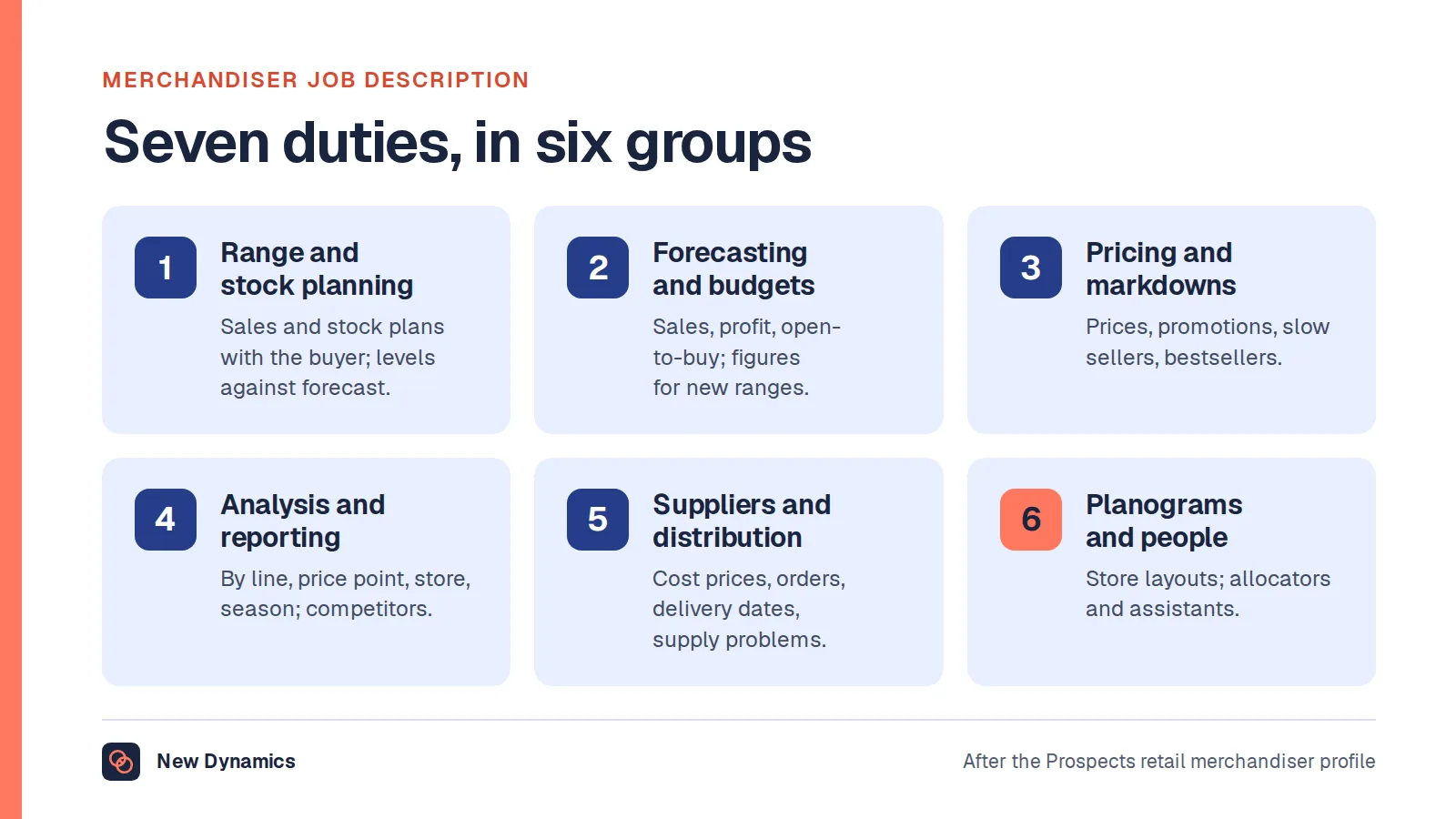
Prospects describes the buying ladder in retail as trainee, junior buyer, buyer, senior buyer and buying manager or director, and says that category management roles “provide senior leadership pathways in supermarkets and major retailers”. The retail category manager is usually a senior buyer who has been given a whole category to run: not only what to buy, but how the category is priced, promoted, laid out on the shelf and grown against competitors. The merchandiser job description covers the planning partner who decides how much stock goes where.
Brand-side
Large suppliers employ category managers whose customers are the retailers. Their job is to understand the whole category, including competitors' products, and to advise the retailer on range, space and promotion so that the category grows, in the expectation that the brand grows with it. It is a sales and insight role as much as a buying one.
Procurement
O*NET lists “Category Purchasing Manager” among the sample titles for purchasing managers, who “plan, direct, or coordinate the activities of buyers, purchasing officers, and related workers involved in purchasing materials, products, and services.” In procurement, category management means dividing an organisation's spend into categories, studying each supply market, and running a strategy for each: which suppliers, which contracts, what demand and what savings. A procurement category manager might own IT hardware, professional services, fleet or facilities.

Category manager duties
Grouped from the Prospects retail buyer responsibilities, the O*NET tasks for buyers and for purchasing managers, and the practice of the role, the work has five parts in every version.
- Understand the category. Prospects: analyse consumer buying patterns and predict future trends; keep up to date with market and digital trends; use data-driven tools and analytics to forecast demand. O*NET's buyers task: monitor and analyse sales records, trends or economic conditions “to anticipate consumer buying patterns, company sales, and needed inventory”. In procurement, this is the supply market analysis.
- Set the strategy. Decide the range or the sourcing approach, the suppliers, the price or cost position, the promotions or the contract model, and the targets. Present it: Prospects lists presenting buying plans to senior managers.
- Manage suppliers and negotiate. Prospects: “meet suppliers and negotiate contracts, prices and delivery terms”; maintain supplier relationships and source new ones; attend trade fairs and showrooms. O*NET's purchasing managers: locate vendors and “interview them to determine product availability and terms of sales”; review contracts for conformance to policy; resolve grievances and claims against suppliers.
- Deliver the numbers. Prospects: review performance indicators such as sales data, margins and discount levels; plan and manage stock levels with merchandising and supply chain teams. O*NET's purchasing managers: “develop cost reduction strategies and savings plans” and control budgets. Sustainability and ethical sourcing sit here too, in Prospects' list.
- Lead and influence. Prospects: work closely with e-commerce, marketing and store teams; mentor junior staff. O*NET: direct and coordinate the buying staff, hire and train them. Much of a category manager's influence is over people who do not report to them: stores, marketing, finance, budget holders.

The numbers a category manager is judged on
The advert should say which of these the role owns and what good looks like. The examples are not benchmarks.
Retail and brand-side: category sales and growth; gross margin and margin rate; availability and waste; promotional effectiveness; market share; supplier terms and income; range productivity per line and per metre of shelf.
Procurement: savings against baseline; total cost and value delivered; contract coverage and compliance; supplier performance against service levels; supply risk; stakeholder satisfaction.
Set these as quarterly objectives the category manager and their team can see. Our OKR guide shows how.
Skills and routes in
Prospects lists analytical and numerical ability, commercial awareness, organisation, communication and interpersonal skills, resilience under pressure, negotiation, creativity in product selection, presentation, teamwork and problem-solving. O*NET's essential skills for purchasing managers are active listening, speaking, monitoring, reading comprehension, writing, critical thinking, active learning, mathematics and learning strategies.
Qualifications. Prospects says retailers prefer degrees in fashion buying and merchandising, business or retail management, supply chain management or marketing, accept Level 4 and higher apprenticeships, and that entry without a degree is possible through administrative roles. O*NET places purchasing managers in Job Zone Four, usually a bachelor's degree plus considerable experience, and buyers in Job Zone Three. In procurement, professional qualifications from the relevant institute are often asked for; name the one your organisation uses.
Routes. In retail, the buying ladder, with Prospects noting that each step usually takes two to three years. In procurement, from buyer or procurement officer through senior buyer to category manager and then head of category or procurement.
Category manager job description template
Job title: Category Manager, with the category named, for example Category Manager, Chilled Foods, or Category Manager, IT and Telecoms
Reports to: Head of Buying, Trading Director or Head of Procurement
Direct reports: Buyers, assistant buyers or category analysts; state how many
Scope: State the category, its annual sales or spend, the number of suppliers and lines or contracts, and the channels or business units it serves.
Purpose (retail): Own the strategy and performance of the category: range, suppliers, price, promotion and space, to grow sales and margin while maintaining availability and reducing waste.
Purpose (procurement): Own the sourcing strategy and supplier base for the category, to deliver value, manage risk and meet the needs of the organisation's budget holders.
Responsibilities:
- Analyse the category's customers, market and competitors, or its supply market and demand.
- Set and present the category strategy, targets and plans.
- Select and manage suppliers; negotiate prices, terms, contracts and delivery.
- Deliver the category's numbers; review performance and act on it.
- Work with merchandising, marketing, stores and e-commerce, or with budget holders, finance and legal.
- Lead and develop the category team; mentor junior buyers.
- Apply the organisation's sustainability, ethical sourcing and compliance requirements.
Skills and experience:
- Several years' buying or procurement experience, including supplier negotiation.
- Strong numeracy and analysis; confident with data tools.
- Commercial judgement and the ability to influence people who do not report to you.
- Presentation and communication with senior managers and suppliers.
- Relevant degree, apprenticeship or professional qualification, or equivalent experience.

Frequently asked questions
What does a category manager do?
They own one category of products or spend: they analyse its market and customers, set its strategy, choose and negotiate with suppliers, deliver its sales, margin or savings, and lead the buyers or analysts who work on it. In retail the category is a group of products the business sells; in procurement it is a group of things the organisation buys.
What is the difference between a category manager and a buyer?
A buyer selects and purchases lines; a category manager owns the whole category's strategy and results, including price, promotion, space or contract model, and usually leads the buyers. Prospects describes category management as the senior pathway beyond buyer and senior buyer in large retailers.
What is category management in procurement?
Dividing an organisation's spend into categories, analysing each supply market, and running a strategy for each covering suppliers, contracts, demand and cost. The US occupational database lists category purchasing manager among the titles for purchasing managers.
What is a brand-side category manager?
A category manager employed by a manufacturer or brand whose customers are retailers. They analyse the whole category and advise retailers on range, space and promotion so that the category grows, and the brand with it.
What qualifications does a category manager need?
Prospects says retailers prefer degrees in buying and merchandising, business or retail management, supply chain or marketing, and accept higher apprenticeships; in procurement, a professional purchasing qualification is often asked for. Experience as a buyer, with supplier negotiation, matters most.
Your next step: name the category and its number
- Say which version the role is: retail, brand-side or procurement.
- Name the category, its sales or spend, and its suppliers.
- State the numbers the role owns and what good looks like.
- Describe the team and the stakeholders the category manager must influence.
For a method that turns the category's targets into quarterly objectives the team can see, read and download our OKR guide. The guide is free to read, and the PDF uses our short download form.
Want category targets, supplier reviews and the team's objectives in one place? Book a New Dynamics demo and bring your current job description. You can also email contact@new-dynamics.com.