TL;DR
- A retail merchandiser ensures that products appear in the right store or website, at the right time and in the right quantities, as Prospects puts it, working with buyers to forecast trends, plan stock levels and monitor performance. The buyer selects the lines; the merchandiser decides how much money to spend, how many lines and in what quantities.
- The duties fall into seven groups: range and stock planning, forecasting and budgets, pricing, promotions and markdowns, analysis and reporting, suppliers and distribution, display and planograms, and managing junior staff. A visual merchandiser is a different job: designing displays and store layouts that encourage sales.
- Write the position description around the product area, the budget and the systems, and say whether the role is head-office merchandising, in-store visual merchandising or a field role that services stores for a brand.
Merchandiser is one of those titles that means three different jobs. In a retailer's head office it is the analyst-planner who decides how much of each line to buy and where it goes. On the shop floor it is the visual merchandiser who builds the display. In the field it is the person who visits stores for a brand to check stock and fixtures. A merchandiser job description has to say which.
This article gives a merchandiser position description for the head-office retail role, using Prospects as the main source, explains how it differs from the buyer and the visual merchandiser, sets out seven duties, the skills, routes in and a merchandising job profile template to adapt. The routes are for the UK; the duties are the same in any retailer.
Merchandisers live by forecasts against actuals. See how New Dynamics Goals & OKRs keep targets and progress in one place.
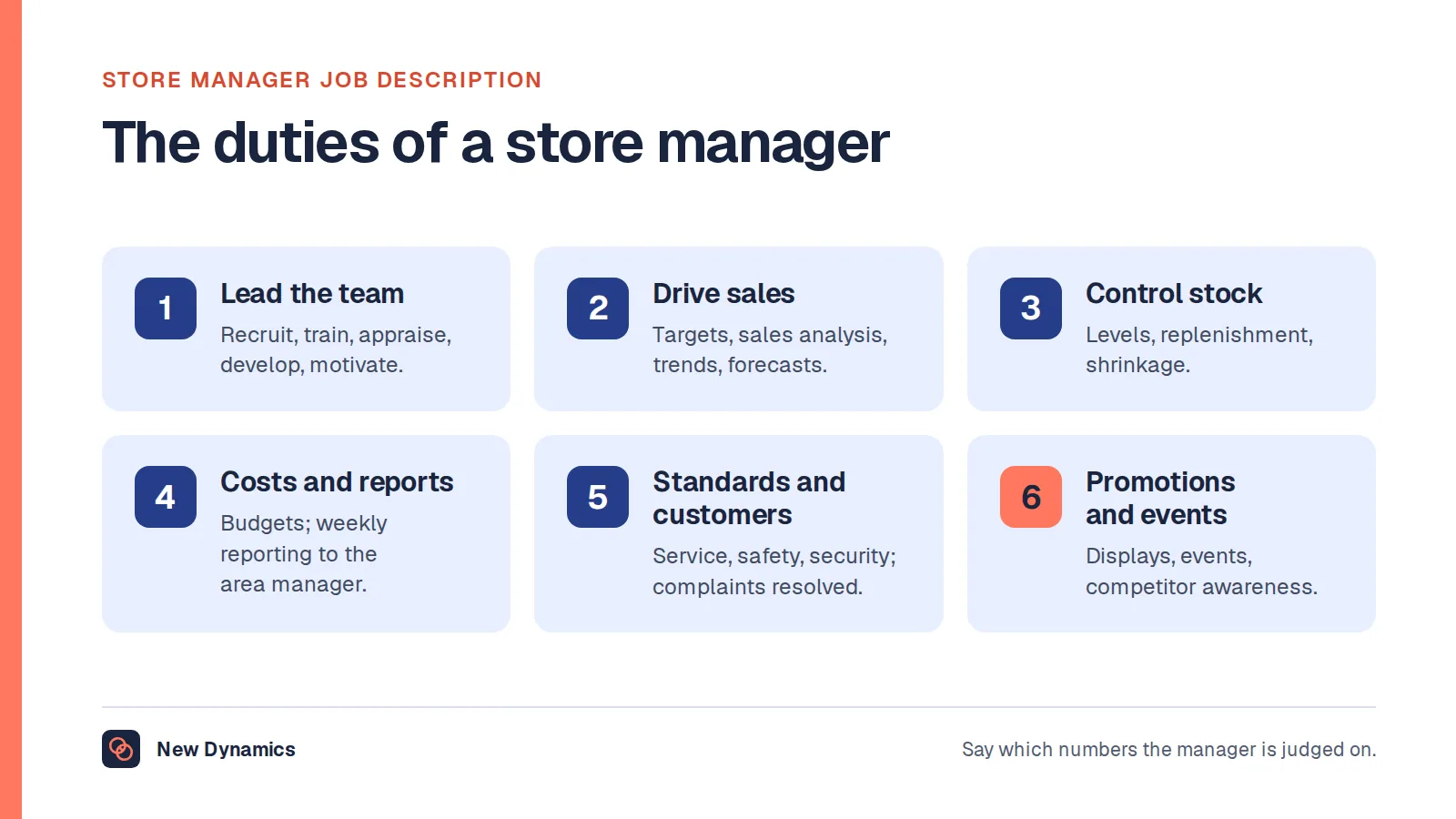
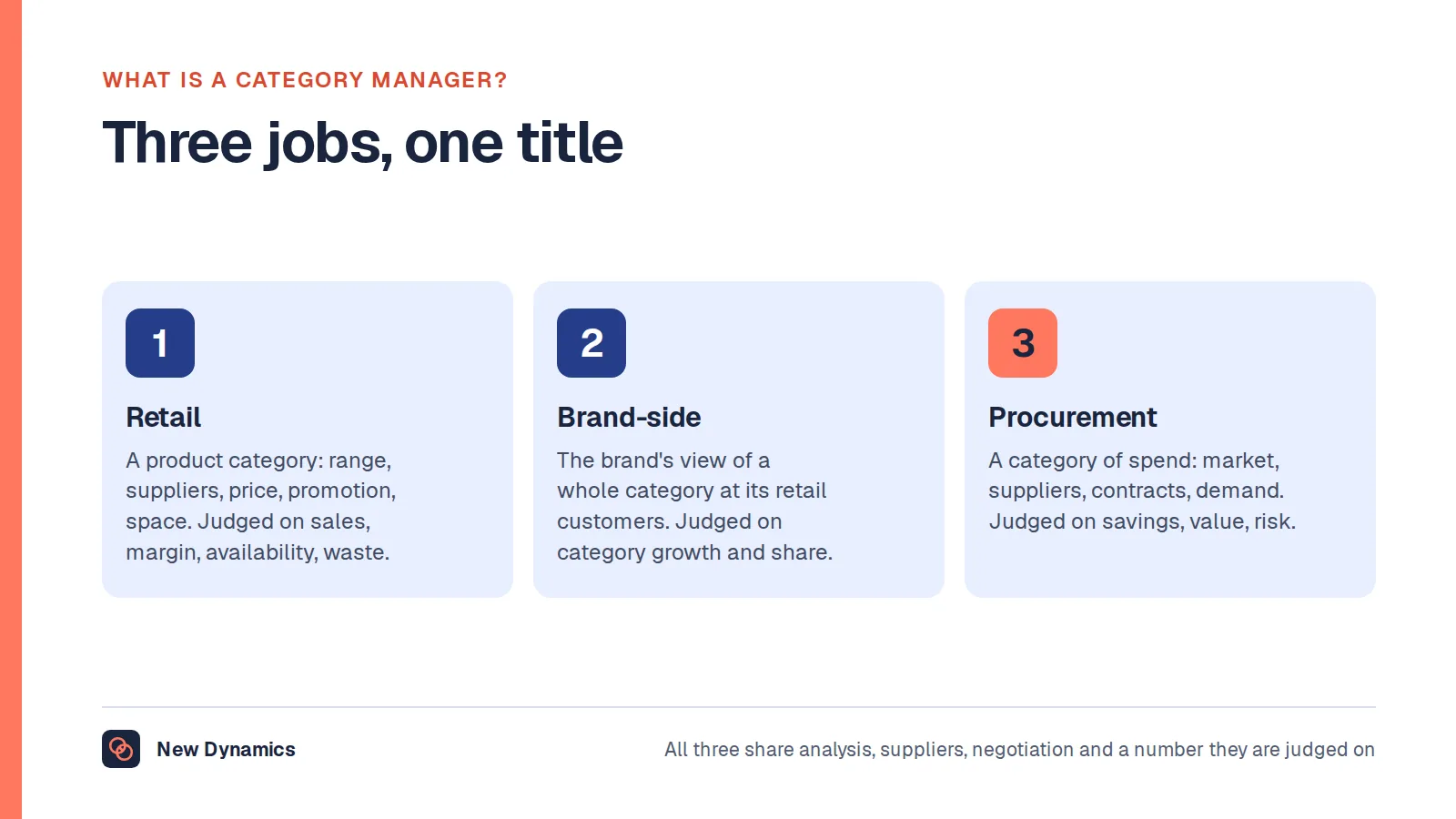
The merchandiser's buying partner is often a category manager; see what a category manager is for the role that owns the category's strategy and margin.
What is a merchandiser?
Prospects says retail merchandisers “work closely with buyers to predict future sales and ensure maximum profitability”, and defines the job in one sentence: “Your role as a retail merchandiser is to ensure that products appear in the right store or website, at the right time and in the right quantities.” That involves working with buying teams to forecast trends, plan stock levels and monitor performance, and playing “a key role in maximising profits by setting prices, managing the performance of ranges and planning promotions and markdowns”, as well as overseeing the delivery and distribution of stock and dealing with suppliers.
The division of labour with the buyer is the heart of the role. Prospects: “While the buyer selects the lines, the merchandiser decides how much money should be spent, how many lines should be bought, and in what quantities. In smaller companies, both roles may be carried out by the same person.”
Three jobs called merchandiser
| Title | Where | What it does |
|---|---|---|
| Retail merchandiser | Head office | Plans ranges, stock, budgets, prices and promotions with the buyer |
| Visual merchandiser | Stores | Designs displays, layouts and windows that encourage sales |
| Field or brand merchandiser | On the road, in retailers' stores | Checks stock, fixtures and point-of-sale for a supplier's brand |
The National Careers Service says visual merchandisers “design eye-catching product displays and store layouts that appeal to customers and encourage sales”, with window dresser and display assistant as alternative titles; its tasks include creating floor plans and displays with design software, using space and lighting creatively, sourcing props and signs, dressing retail dummies, working with marketing on promotions and launches, supporting store openings, training sales staff on displays and following brand guidelines for a consistent look across stores. The rest of this article is about the head-office retail merchandiser; use the visual merchandiser tasks above if that is the job you are describing.
Merchandiser duties: seven responsibilities
Prospects lists what a retail merchandiser typically needs to do, from planning product ranges with buyers to managing junior staff. Grouped for a position description, the work has seven parts.
- Range and stock planning. Plan product ranges and prepare sales and stock plans with buyers; control stock levels against the season's forecasts.
- Forecasting and budgets. Forecast profits and sales, optimise the sales volume and profitability of designated product areas, plan budgets and present forecasts and figures for new ranges.
- Pricing, promotions and markdowns. Set prices, monitor slow sellers and act with price reductions or promotions, and make sure bestsellers reach their full potential.
- Analysis and reporting. Analyse bestsellers by price point, colour and style; analyse the previous season and report on the current one; gather customer reactions; watch competitors; make financial presentations to senior managers.
- Suppliers and distribution. Meet suppliers, negotiate cost prices, order stock, agree timescales and delivery dates, complete the paperwork, and deal with production and supply problems as they arise.
- Display and planograms. Work with visual display staff and department heads on how goods are displayed, and produce store layout plans, known as planograms.
- People and data. Manage, train and supervise junior staff such as allocators and assistant merchandisers, and maintain the data library and systems the work runs on.

Skills to ask for
Prospects lists strong analytical and numerical skills to work out budgets and understand sales figures; the ability to work under pressure in a dynamic environment and to identify problems and recommend solutions quickly; sound decision-making and the ability to plan and prioritise; excellent communication and negotiation; teamwork and relationship-building; strong commercial acumen and an understanding of what will appeal to customers; computer literacy; creative flair; and self-confidence. It notes that a driving licence is often required.
For visual merchandising, the National Careers Service lists attention to detail, teamwork, new ways of doing things, customer service, flexibility, the ability to sell, judgement, verbal communication and confident software use.
Prospects also describes the stakes: a fast-moving, competitive environment “with high levels of responsibility for potentially very large budgets, where even minor errors can result in vast reductions in profit”. Ask for evidence of accuracy under pressure, not just enthusiasm for retail.
Routes in and qualifications
Prospects says competition is strong, that office-based work experience is often essential, that graduate schemes in merchandising are limited though some retail management schemes include it, and that most graduates apply directly to entry-level roles such as allocator, which involves data analysis, stock allocation and liaising with suppliers. Experience with a major retailer demonstrates an understanding of stock control. The usual ladder is allocator or merchandising administrator, assistant merchandiser, merchandiser, senior merchandiser, then head of merchandising.
For visual merchandising, the National Careers Service says you could progress to team leader and visual merchandising manager, or move into buying, exhibition design or interior design.

Working pattern
Prospects describes normal hours of 9am to 5pm, Monday to Friday, with longer hours around new store openings, promotions, range launches and production problems, occasional weekend or evening work for store visits or competitive shopping, and travel to stores, suppliers, trade fairs and, in fashion, overseas. Work is mainly office-based, usually at head office. The National Careers Service gives visual merchandisers 36 to 40 hours with evenings and weekends on a rota, in a store, sometimes physically demanding and cramped.
Merchandiser position description template
Job title: Merchandiser (Retail), or Assistant / Senior Merchandiser
Reports to: Senior Merchandiser or Head of Merchandising; works alongside the Buyer
Direct reports: Allocators, assistant merchandisers
Purpose: Plan and manage the stock, sales and profitability of a product area so that the right products are in the right stores and channels at the right time and in the right quantities.
Responsibilities:
- Prepare range, sales and stock plans with the buyer; control stock levels against forecast.
- Forecast sales and profit; plan and manage the open-to-buy budget; present figures for new ranges.
- Set prices, plan promotions and markdowns, and manage slow sellers and bestsellers.
- Analyse sales by line, price point and store; report weekly and by season; monitor competitors.
- Negotiate cost prices and delivery with suppliers; manage orders, intake and distribution; resolve supply problems.
- Produce planograms and agree displays with visual merchandising and store teams.
- Manage, train and supervise allocators and assistants; maintain the data library and systems.
Skills and experience:
- Strong numeracy and analysis; confident with spreadsheets and merchandising systems.
- Commercial judgement and an understanding of the customer.
- Decision-making, prioritisation and calm under pressure.
- Communication and negotiation; teamwork with buyers, stores and suppliers.
- Experience as an allocator or assistant merchandiser, or equivalent.
Working pattern: Head-office hours, peaks around launches and promotions, store and supplier visits, travel.
Our job description template explains each section; for the store side, see our store manager job description, and for the data skills, our analyst job description.

Frequently asked questions
What does a merchandiser do?
A retail merchandiser makes sure products appear in the right store or website, at the right time and in the right quantities, as Prospects puts it: planning ranges and stock with buyers, forecasting sales and profit, setting prices and markdowns, analysing performance, managing suppliers and distribution, producing planograms and supervising junior staff.
What is the difference between a merchandiser and a buyer?
Prospects draws the line: the buyer selects the lines; the merchandiser decides how much money should be spent, how many lines should be bought and in what quantities. The buyer chooses the product, the merchandiser plans the money and the stock. In smaller companies one person does both.
What is a visual merchandiser?
A different job from the retail merchandiser. The National Careers Service says visual merchandisers design eye-catching product displays and store layouts that appeal to customers and encourage sales, working in stores with floor plans, props, lighting, windows and brand guidelines.
What skills does a merchandiser need?
Prospects lists analytical and numerical skills, working under pressure, decision-making and prioritisation, communication and negotiation, teamwork, commercial acumen, computer literacy, creative flair and self-confidence, often with a driving licence. Accuracy matters because errors in large budgets cut straight into profit.
How do you become a merchandiser?
Usually by joining a retailer's head office as an allocator or merchandising administrator, often after office-based work experience, and progressing to assistant merchandiser, merchandiser and senior merchandiser. Prospects says graduate schemes dedicated to merchandising are limited and competition is strong.
What is a merchandising job profile?
Another name for the job description or position description: the purpose, duties, skills, reporting lines and working pattern of the merchandiser role. The template above is one, for the head-office retail merchandiser; adapt it with the National Careers Service tasks for a visual merchandiser.
Your next step: say which merchandiser
- State whether the role is head-office, visual or field merchandising.
- Name the product area, the budget and the systems.
- Define the split with the buyer and the reporting line.
- Set the forecast, stock and margin targets the merchandiser will be reviewed against.
For setting and tracking those targets, read and download our OKR guide. The guide is free to read, and the PDF uses our short download form.
Want merchandisers' targets, forecasts and reviews in one place? Book a New Dynamics demo and bring your current job descriptions. You can also email contact@new-dynamics.com.