TL;DR
- Direct hire means the person is employed by the organisation they work for, on that organisation's payroll and contract, whether or not a recruitment agency introduced them. GOV.UK draws the line in a sentence on its agency workers guidance: “You're an agency worker if you have a contract with an agency but you work temporarily for a hirer”, and “You're not an agency worker if you use an agency to find permanent or fixed-term employment.”
- The term exists because staffing companies sell two different things: their own temporary workers, who remain the agency's, and a direct placement, where the agency finds someone and the hiring organisation employs them. For the employer the difference is who carries the employment: the contract, the payroll, the rights, the notice, the training and the risk. For the worker it is the difference between a job with one employer and an assignment with a hirer.
- The choice between direct hire, agency temp, temp to perm, a fixed-term direct hire and a contractor should be made on the work, not the budget line. GOV.UK's employment status guidance says status determines “their rights” and “their employer's responsibilities”, notes that a person may have a different status in tax law, and that courts and tribunals make the final decision. Label the arrangement from the facts of the work, not the other way round.
An advert says "direct hire". A candidate who has been temping reads it as a promise of something more secure, and is roughly right, but could not say why. A manager filling the role thinks it means "not through an agency", and is wrong. What is direct hire employment, precisely, and how does it differ from the alternatives?
This article answers that with the distinction the UK government draws, compares the five ways an organisation can fill a role, sets out what changes for the employer and the worker, explains where employment status fits, and says when each option makes sense. It describes the UK position and is general information, not legal or tax advice.
Whoever employs the person, the first month decides whether they stay. See how New Dynamics onboarding gives a new starter clear tasks, a named person and planned check-ins from day one.
What direct hire means
Direct hire means the person is employed by the organisation they work for. The employment contract, the payroll, the employment rights and the obligations sit with that organisation.
The confusion comes from recruitment agencies, which do two different things. GOV.UK's guidance on agency workers' rights makes the distinction in two sentences: “You're an agency worker if you have a contract with an agency but you work temporarily for a hirer. Agencies can include recruitment agencies, for example ‘temp agencies'.” And then the line that defines direct hire: “You're not an agency worker if you use an agency to find permanent or fixed-term employment.”
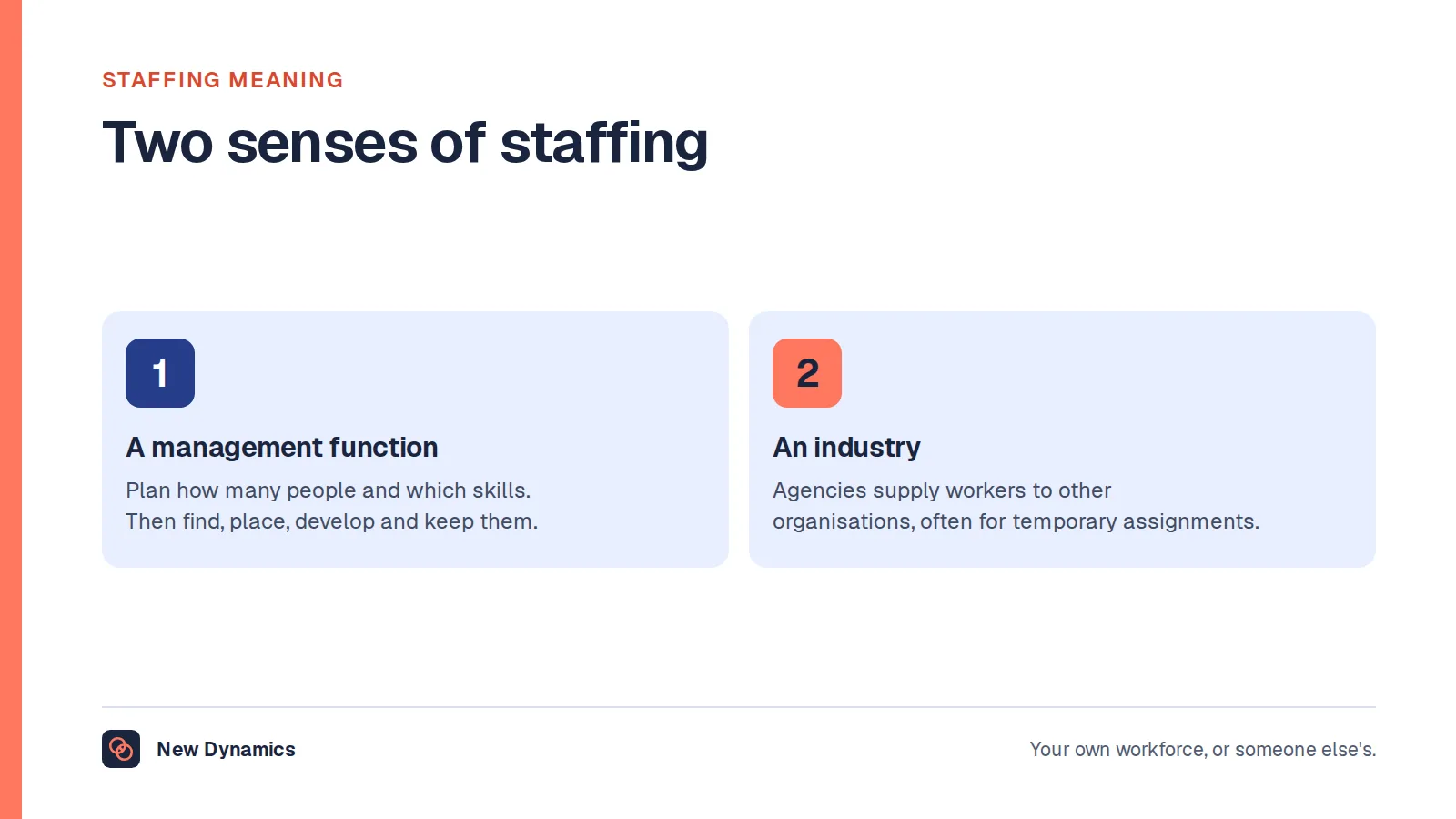
So an agency can be involved in a direct hire. It finds the candidate, and is usually paid a fee for doing so. What makes it a direct hire is that the employment is with the hiring organisation, not with the agency. In staffing-industry language the same thing is called a direct placement or permanent placement; our post on the meaning of staffing covers the industry's terms.
Five ways to fill a role
| Option | Who employs the person | Typical use |
|---|---|---|
| Direct hire | The hiring organisation, permanently | Ongoing work that is part of the organisation |
| Agency temporary worker | The agency; the person works temporarily for the hirer | Cover, peaks, uncertainty about the need |
| Temp to perm | The agency first, the hirer later if it converts | Trialling the person or the need |
| Fixed-term direct hire | The hiring organisation, until a date or task ends | A project, a season, maternity cover |
| Contractor | Nobody: they are in business on their own account | Defined, specialist or time-boxed work |

Fixed-term is still direct hire. GOV.UK's guidance on fixed-term contracts says employees are on a fixed-term contract if “they have an employment contract with the organisation they work for” and “their contract ends on a particular date, or on completion of a specific task, like a project”, and that workers “do not count as fixed-term employees” if they “have a contract with an agency rather than the company they're working for”. A fixed-term employee is directly employed; the job is what is temporary, not the employment relationship.
Contractor is not a milder form of employment. Our post on the independent contractor sets out the difference and the risk of getting it wrong.
What changes for the employer
- The contract and the payroll. In a direct hire the organisation issues the contract, runs the person through payroll and deals with the deductions and the pension duties.
- The rights and obligations. Employment rights, notice, family leave, sick pay and the procedures for managing performance and conduct sit with the employer.
- The cost shape. A direct hire is salary plus employment on-costs, with a one-off recruitment fee if an agency was used. A temporary worker is an hourly charge that includes the agency's margin, with no long commitment.
- Induction and development. A direct hire joins the organisation: induction, objectives, review cycle, training, progression. The people who do not get that are usually the temporary workers doing the same job at the next desk.
- The commitment. Direct hire is the harder decision to reverse, which is why the selection process should be better than the one used for temporary cover.
What changes for the worker
- Whose employee they are, and therefore who owes them notice, pay in lieu, sick pay and family leave.
- Security and continuity, including qualifying periods that depend on continuous employment with one employer.
- Benefits and the internal market, such as pension, discounts, internal vacancies and development budgets.
- Belonging. The practical difference people report most: being invited to the things that make a workplace, rather than being the person who is not on the list.

Where employment status fits
The label on the arrangement does not settle the rights. GOV.UK's guide to employment status says that “in employment law a person's employment status helps determine: their rights, their employer's responsibilities”, and lists the main types as worker, employee, self-employed and contractor, director, and office holder. It adds two warnings worth putting in any policy: “a person may have a different employment status in tax law”, and “courts and tribunals can make final decisions on employment status”.
The practical rule: decide the arrangement from the facts of the work, write it down accurately, and do not use a label to avoid an obligation. Calling someone a contractor does not make them one.
When each option makes sense
- Direct hire when the work is ongoing and part of the organisation, when you need the person to build relationships and institutional knowledge, and when you are prepared to select carefully.
- Agency temporary work when the need is genuinely temporary, urgent or uncertain: absence cover, a seasonal peak, an unexpected gap.
- Temp to perm when you or the candidate need to test the fit, or when the budget for a permanent post is not yet approved. Be honest about the conversion criteria and the timetable; the arrangement sours when "perm" never arrives.
- Fixed-term direct hire when the work has an end, such as a project, a funded programme or maternity cover. It gives the person employment and you a clear finish.
- A contractor when you are buying a defined piece of work from someone in business on their own account, and you are genuinely not directing how they do it.

Mistakes to avoid
- Using "direct hire" as a synonym for "no agency". It describes who employs the person, not who found them.
- Long-term temporary work to avoid a headcount decision. The work is permanent; the arrangement is not, and the mismatch costs more than the post would have.
- Promising conversion without criteria. If temp to perm has no date and no standard, it is a temporary job with a hopeful adjective.
- Labelling to reduce obligations. Status follows the facts, and, as GOV.UK notes, tribunals decide.
- Onboarding only the permanent people. If a temporary worker is doing the job, they need the induction the job requires.
Frequently asked questions
What is direct hire employment?
Employment where the worker is employed by the organisation they work for, on its contract and payroll, with employment rights owed by that organisation. An agency may have introduced the candidate and been paid a fee; that does not change who employs them. GOV.UK puts the boundary plainly: you are not an agency worker if you use an agency to find permanent or fixed-term employment.
What is a direct hire position?
A vacancy that will be filled by employing someone directly, rather than by taking on an agency temporary worker or engaging a contractor. It may be permanent or fixed term; either way the employment relationship is with the hiring organisation.
What is the difference between direct hire and contract work?
A direct hire is employed by the organisation. A contractor is in business on their own account and supplies services under a contract, with fewer rights and different tax treatment. GOV.UK warns that employment status determines rights and responsibilities, that tax status can differ, and that courts and tribunals make the final decision.
What is the difference between direct hire and temp to perm?
In temp to perm, the person starts as the agency's worker and may become the hirer's employee later if the arrangement converts. In a direct hire they are employed by the organisation from the start. Temp to perm only works when the criteria and the timetable for converting are agreed and honoured.
Is a fixed-term contract a direct hire?
Yes. GOV.UK says fixed-term employees have an employment contract with the organisation they work for, ending on a particular date or on completion of a task, and that workers contracted to an agency rather than the company do not count as fixed-term employees. The job has an end; the employment is still direct.
Your next step: decide from the work
- Write down whether the work is ongoing, project-based, seasonal or genuinely one-off.
- Choose the arrangement that matches it, and say plainly in the advert which one it is.
- If it is temp to perm, agree and write down the conversion criteria and the date.
- Give every new starter the same induction, whoever employs them.
For an induction that works for permanent and temporary starters alike, read and download our employee onboarding guide. The guide is free to read, and the PDF uses our short download form.
Want induction, objectives and check-ins recorded for everyone doing the work, not only the permanent staff? Book a New Dynamics demo and bring your current induction checklist. You can also email contact@new-dynamics.com.