TL;DR
- Staffing is the management of the number and types of workers that an organisation needs: planning how many people, with which skills, and then finding, placing and keeping them.
- The word has a second sense. The staffing industry supplies workers, often temporary ones, to other organisations through staffing or employment agencies.
- The staffing process has six steps: plan, recruit, select, onboard, develop and review. When a gap appears, hiring a permanent employee is only one of five ways to fill it.
“We have a staffing problem” can mean that the rota has a hole on Friday night. It can mean that the company cannot hire engineers. It can mean that the agency has sent the wrong temp. The same word covers a manager's daily puzzle, a strategic process and an entire industry.
This article gives the meaning of staffing, separates its two main senses, sets out the staffing process in six steps, compares five ways to fill a gap, and explains how staffing agencies work, with the UK rules on agency workers.
You cannot staff a structure that you cannot see. See how New Dynamics org charts show roles, reporting lines and the relationships between them.
What does staffing mean?
The Cambridge Dictionary's business entry defines staffing as “the management of the number and types of workers needed in an organization”. Its examples show how the word is used: staffing levels, staffing shortages, staffing costs, staffing cuts and “a staffing agency”.
Two senses sit inside that definition.
- Staffing as a management function. Deciding how many people the organisation needs, with which skills, and then finding, placing, developing and keeping them. Some management textbooks treat staffing as a function of management in its own right, beside planning, organising, leading and controlling.
- Staffing as an industry. The business of supplying workers to other organisations, usually for temporary assignments. Acas notes that an employment agency “can also be called” a recruitment agency, a temporary work agency, a staffing company or an employment business.
The first sense is about your own workforce. The second is about borrowing someone else's.

Staffing, recruitment and workforce planning
These three terms overlap.
| Term | What it covers |
|---|---|
| Workforce planning | Working out the people and skills that the organisation will need, and the gap |
| Recruitment | Attracting and selecting people for particular vacancies |
| Staffing | The whole cycle: planning, recruiting, placing, developing, scheduling and reviewing |
The CIPD's factsheet on workforce planning gives a description that fits staffing as a whole. It is about “getting the right number of people with the right skills employed in the right place at the right time, at the right cost and on the right contract”.
The staffing process in six steps
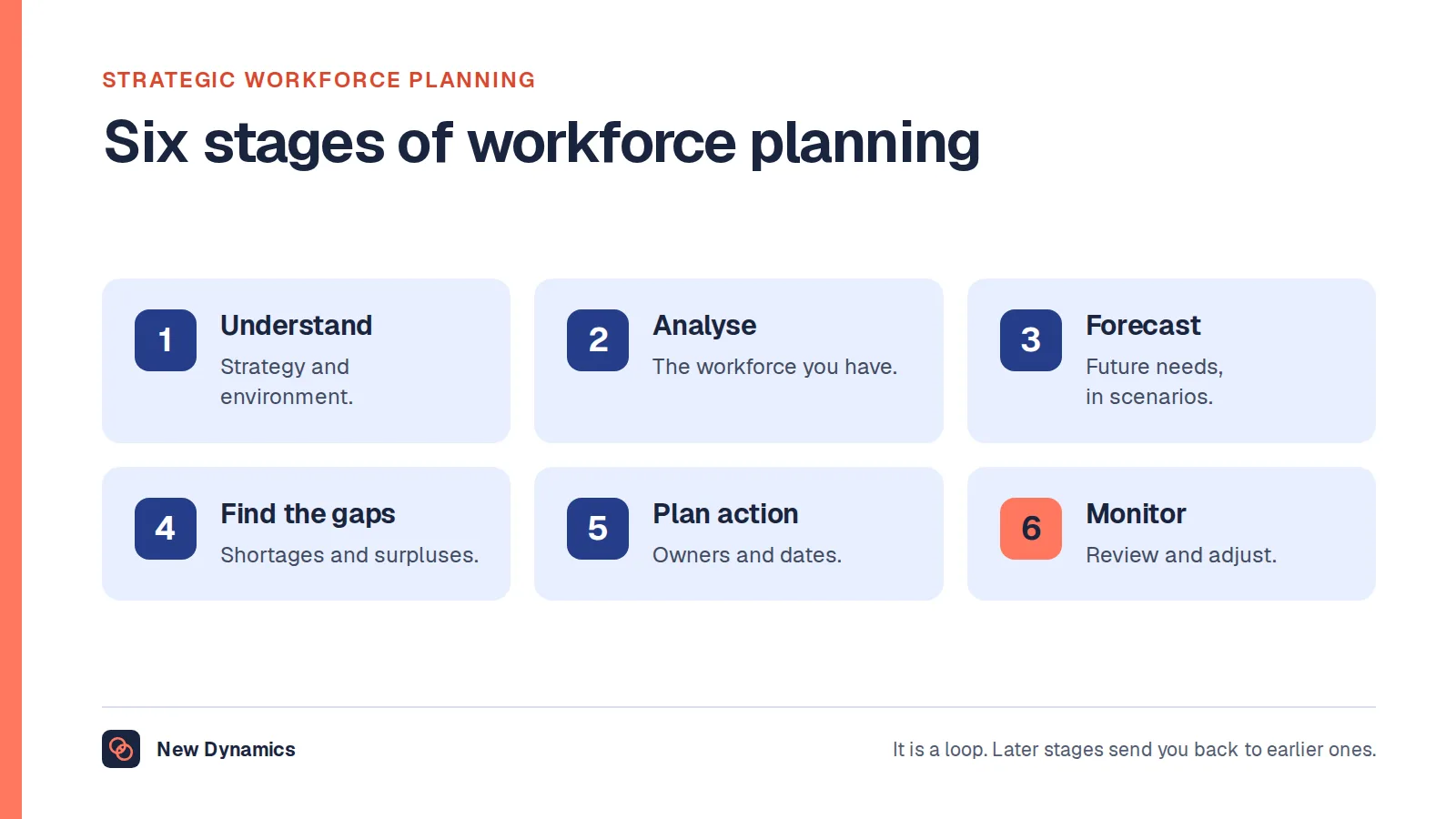
- Plan. Start from the work. What has to be done, in what volume, and when? Which skills does it need? The CIPD describes this as “balancing labour supply (skills) against the demand (numbers needed)”. Our guide to strategic workforce planning covers the method.
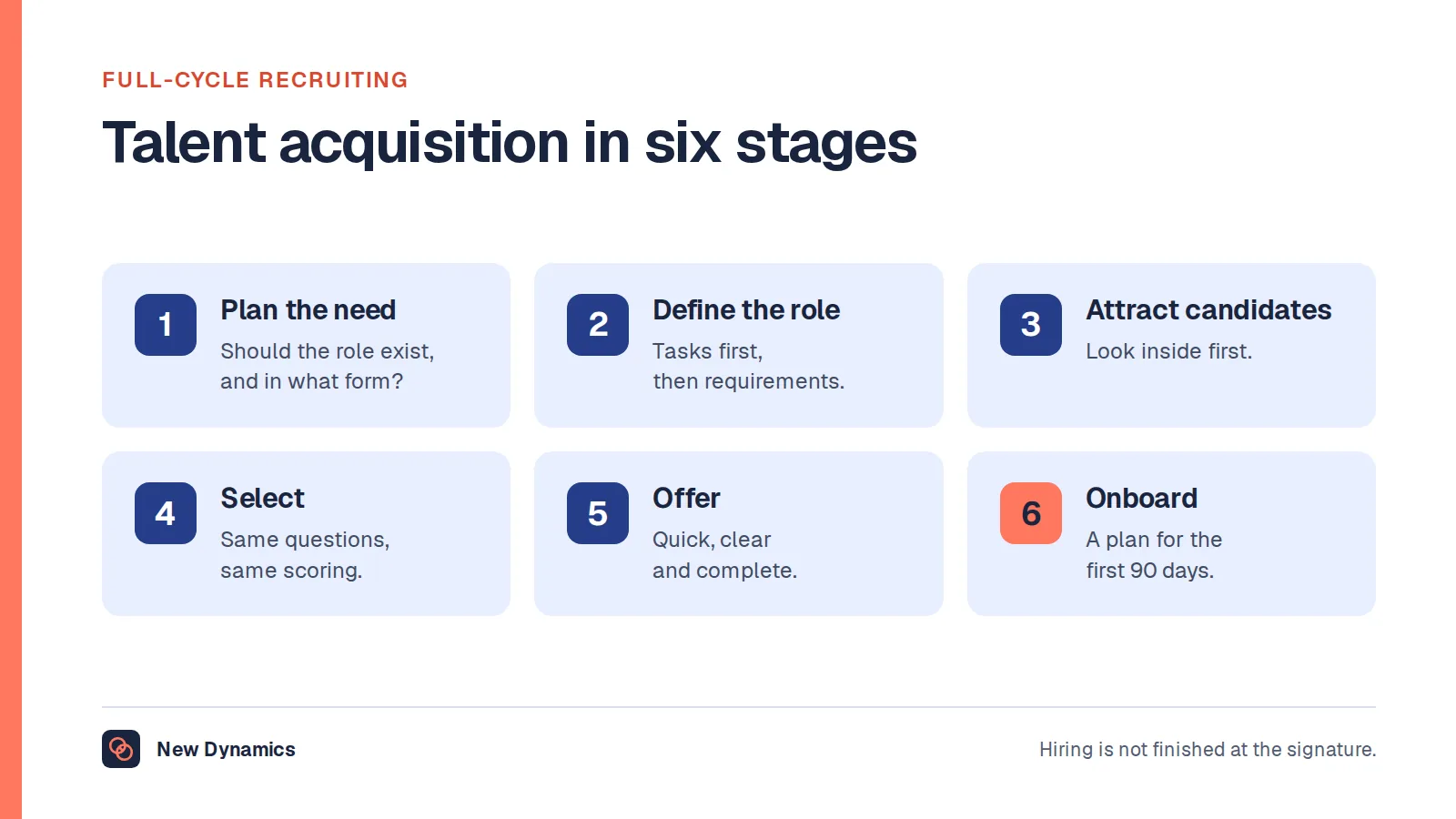
- Recruit. Attract suitable people, from inside the organisation first, then from outside. Our article on talent acquisition explains the wider approach.
- Select. Assess candidates fairly against the requirements of the job, with the same questions and the same scoring for everyone.
- Onboard. Place the person in the role, and give them the information, equipment, relationships and early goals that they need.
- Develop. Train, coach and move people, so that tomorrow's gaps can be filled from within.
- Review. Check staffing levels against demand, look at who is leaving and why, and adjust the plan. Our guide to the meaning of attrition shows how to read the numbers.
The cycle never finishes, because demand, skills and people all keep changing.

Staffing levels: how many people do you need?
A staffing level is the number of people, with given skills, who are needed to do a given amount of work safely and well. Cambridge's example sentence is about hospitals, where the question is sharpest: “They offer guidance on safe staffing levels in hospitals.”
Three approaches are common.
- Workload-based. Measure the demand, such as calls, patients, orders or tickets, and the time that each takes. Then work out the hours needed, and add allowances for leave, sickness and training.
- Ratio-based. A fixed number of staff for each unit of demand: one supervisor for every ten operators, one teacher for every thirty pupils. Some sectors have ratios that are set or recommended by regulators or professional bodies. Our article on the med surg nurse gives an example from nursing.
- Budget-based. Start from what you can afford. This is common, and it is the approach most likely to leave the work and the workforce out of balance.
Understaffing shows up as overtime, errors, sickness and resignations. Overstaffing shows up as cost, and as bored people. Both are easier to see when you look by team and by time of day than when you look at a single company-wide figure.
Five ways to fill a staffing gap
When a gap appears, the reflex is to open a permanent vacancy. It is one option of five.
- Existing staff. Redeploy, retrain, promote, or offer extra hours. This can be the fastest and cheapest route, and it develops people.
- A permanent employee. Right for lasting, core work. Slowest to arrange and hardest to reverse.
- A fixed-term employee. Right for a defined period, such as a project or cover for parental leave.
- An agency worker. Right for short-term or uncertain demand. Quick to start, and it can cost more by the hour.
- A contractor or freelancer. Right for a specialist piece of work with a clear output. Check the person's employment and tax status with care.
Match the contract to the nature of the need. Temporary solutions to permanent needs tend to cost more in the end, and permanent solutions to temporary needs can end in redundancies.

How staffing agencies work, and the UK rules
Cambridge defines an employment agency as “a business that is paid to find suitable workers for other companies and organizations”. In a temporary placement there are three parties. Acas explains the arrangement in its guidance for agency workers: the worker's contract is with the employment agency, the agency places them with a hiring organisation for an assignment, and “the hiring organisation is responsible for directing your work”.
If you hire through an agency in the UK, four points are worth knowing.
- Who counts as an agency worker. GOV.UK's guide to agency workers' rights says: “You're an agency worker if you have a contract with an agency but you work temporarily for a hirer.” Someone who uses an agency to find a permanent or fixed-term job is not an agency worker.
- No fees for finding work. Acas states that an employment agency must not charge a worker a fee to register or to find them assignments. Entertainment and modelling agencies are an exception.
- Information in writing. Before an assignment, the agency must give the worker details that include the hiring organisation, the start date and likely length, the type of work, the location, the hours, the pay, and any risks to health and safety.
- Rights after 12 weeks. Acas explains that once someone has worked on the same assignment at the same hiring organisation for 12 weeks, they get more rights, which cover the same pay, the same holiday, and the same working patterns and rest breaks. Acas itself calls this a complex area of law.
GOV.UK adds rules for the agencies themselves. For example, an agency cannot supply a temporary worker to replace someone who is taking part in industrial action.
These rules apply in Great Britain, and other countries differ. This is general information, not legal advice. We do not name or rank staffing agencies.
Common mistakes
Staffing to the budget, not to the work. Start with demand.
Hiring in a hurry. A rushed appointment can cost more than a vacancy.
Overlooking the people you have. Look inside before you advertise.
Permanent work done by a parade of temps. It costs more, and knowledge leaves with each one.
Treating agency workers as invisible. They work under your direction, in your culture, in front of your customers. Induct them, include them, and know their rights.
One headcount number. A company can be overstaffed on Monday morning and understaffed on Friday night.
No review. Staffing levels that were set three years ago describe a different business.
Frequently asked questions
What is the meaning of staffing?
Staffing is the management of the number and types of workers that an organisation needs. It covers planning how many people and which skills are required, and then recruiting, selecting, onboarding, developing and reviewing them.
What is the staffing process?
The staffing process has six steps: plan the people and skills that the work needs, recruit, select fairly, onboard, develop people so that future gaps can be filled from within, and review staffing levels against demand.
What is the difference between staffing and recruitment?
Recruitment is the part of staffing that attracts and selects people for particular vacancies. Staffing is the whole cycle, which also includes planning, placing, developing, scheduling and reviewing the workforce.
What is a staffing agency?
A staffing agency, also called an employment agency, recruitment agency or temporary work agency, is a business that is paid to find suitable workers for other organisations. In temporary work, the worker's contract is with the agency, and the hiring organisation directs the work.
What are staffing levels?
Staffing levels are the numbers of people, with given skills, who are needed to do a given amount of work safely and well. They can be based on measured workload, on fixed ratios or on budget.
What rights do agency workers have in the UK?
Acas says that an agency must not charge workers a fee for finding work, and must give assignment details in writing. After 12 weeks on the same assignment, agency workers gain rights that include the same pay and the same holiday. This is general information, not legal advice.
Your next step: look at one team
- Choose one team, and list the work it does, by volume and by time.
- Compare that with who is there, and when.
- For any gap, run through the five ways to fill it before you open a vacancy.
- Put a date in the diary to review it in six months.
For a method that compares the skills you have with the skills you need, read and download our skills gap analysis guide. The guide is free to read, and the PDF uses our short download form.
Want to see your roles and reporting lines in one place before you plan? Book a New Dynamics demo and bring your current structure. You can also email contact@new-dynamics.com.