TL;DR
- To expedite is, in the Cambridge Dictionary's definition, “to make something happen more quickly”, and that is the job. A restaurant expeditor, often shortened to expo, stands at the pass between the kitchen and the floor: reading the tickets, calling the orders to the sections, timing the courses so a table's plates arrive together, checking every dish against the order and its allergen instructions, and sending it out with the runner or server.
- It is not a separate occupation in the occupational databases, which is why job adverts for it vary so much. The duties come from the kitchen supervisor's role: O*NET's first-line supervisors of food preparation and serving workers “specify food portions and courses, production and time sequences, and workstation and equipment arrangements”, “observe and evaluate workers and work procedures to ensure quality standards and service” and “inspect supplies, equipment, and work areas to ensure efficient service”. In a small kitchen the head chef or sous chef expedites; in a busy one it becomes a post of its own.
- The same word means something else in manufacturing and logistics. O*NET lists “Expeditor” among the reported titles of production, planning and expediting clerks, who “coordinate and expedite the flow of work and materials within or between departments of an establishment according to production schedule”. An advert should make clear which one it means in the first line.
On a full Saturday a kitchen can be cooking for forty tables at once, each with different courses at different stages, and a dining room that needs all four plates on table twelve to arrive within ten seconds of each other, hot, correct and with the right dish in front of the guest with the nut allergy. Somebody has to hold all of that in their head. That person is the expeditor in a restaurant, usually shortened to expo.
This article explains what a food expeditor does, sets out seven duties at the pass, says who does the job when nobody holds the title, separates it from the food runner and the chef de partie, explains when a kitchen needs a dedicated expo, and gives a job description template. It also covers the other job the word names, because the same title means something quite different in manufacturing.
Pass work is learned on shift, and a new expeditor who does not know the menu by the second Saturday is a risk to the whole service. See how New Dynamics onboarding gives a new starter clear tasks, a buddy and planned check-ins from the first shift.
What the word means, and the two jobs it names
The Cambridge Dictionary defines expedite as “to make something happen more quickly”. An expeditor is the person whose job is to do that.
In a restaurant, the expeditor works the pass: the counter between kitchen and dining room where finished plates are collected. They read the tickets, call the orders to the sections, keep each table's courses in time, check what the kitchen has plated against what the guest ordered, and release the food to the floor.
In manufacturing and logistics, the title means the person who keeps production moving. O*NET lists “Expeditor” among the reported job titles for production, planning and expediting clerks, an occupation it describes as coordinating and expediting “the flow of work and materials within or between departments of an establishment according to production schedule”, with duties including distributing work orders, revising schedules when shortages or backlogs interrupt them, conferring with supervisors on progress, and arranging delivery of supplies to meet the schedule.
The two share a logic, keeping a flow moving against a schedule, and nothing else. Say which you mean in the first line of the advert.

Expeditor duties at the pass: seven responsibilities
There is no separate occupational entry for the restaurant expeditor; the duties come from the kitchen supervision role. O*NET's first-line supervisors of food preparation and serving workers “specify food portions and courses, production and time sequences, and workstation and equipment arrangements”, “observe and evaluate workers and work procedures to ensure quality standards and service”, “inspect supplies, equipment, and work areas to ensure efficient service and conformance to standards”, “assign duties, responsibilities, and work stations to employees in accordance with work requirements” and “resolve customer complaints regarding food service”. At the pass those become seven:
- Read and organise the tickets. Take the orders as they arrive, sequence them by table and course, and keep a live picture of what is cooking, what is waiting and what is late.
- Call the order. Tell each section what to start and when, so that the grill, the sauté and the garnish finish together. This is the timing judgement that makes the job hard to hand over.
- Time the table. Hold courses so that a table eats together and moves through its meal at the pace it wants, and tell the floor when a table will be ready.
- Check the plate. Against the ticket: right dish, right modifications, right seat. Then against the standard: presentation, temperature, portion, nothing on the rim.
- Check the allergens. Confirm that allergen instructions on the ticket have been followed and that the plate for the guest with the allergy is identified all the way to the table. The expeditor is the last person to look at a plate before it leaves the kitchen, which is why this check belongs here as well as with the chef.
- Send it out. Garnish, add the sides and sauces, wipe the plate, call the runner or server, and make sure the whole table's food leaves together.
- Talk to the floor. Tell servers about delays, re-fires and dishes that have run out; take back the questions and changes; and keep the tone calm, because the pass sets the temperature of the whole service.

Who expedites when nobody holds the title
Most restaurants do not employ a dedicated expeditor. The job still happens, and usually falls to one of these:
- The head chef or sous chef, who calls the pass while also cooking or checking sections. Common and effective, until volume makes both jobs impossible at once.
- The restaurant manager or a senior server, working the pass from the dining room side. Good on timing and communication with the floor, weaker on the kitchen's view of what is cookable.
- Nobody, with each section sending food when it is ready. This is where tables get their plates at different times and the wrong dish reaches the wrong seat.
Expeditor, food runner, chef de partie, head chef
| Role | Stands | Owns |
|---|---|---|
| Chef de partie | At a section | Cooking their part of every dish to time and standard |
| Expeditor | At the pass | Sequence, timing, accuracy and release of every order |
| Food runner | Between the pass and the tables | Carrying the food and delivering it to the right seat |
| Head chef | Over the whole kitchen | Menu, standards, cost, team; expedites when there is no expo |
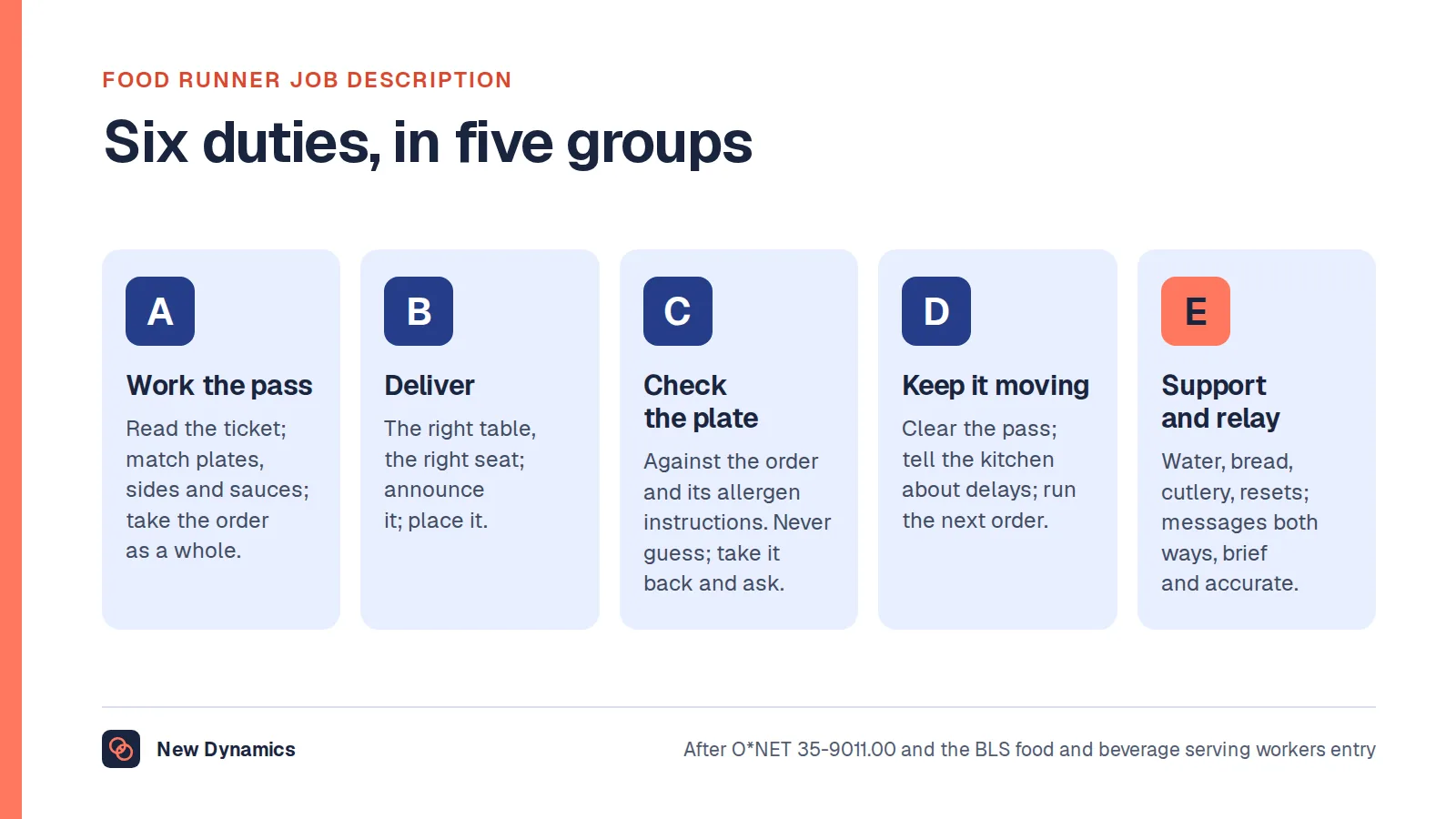
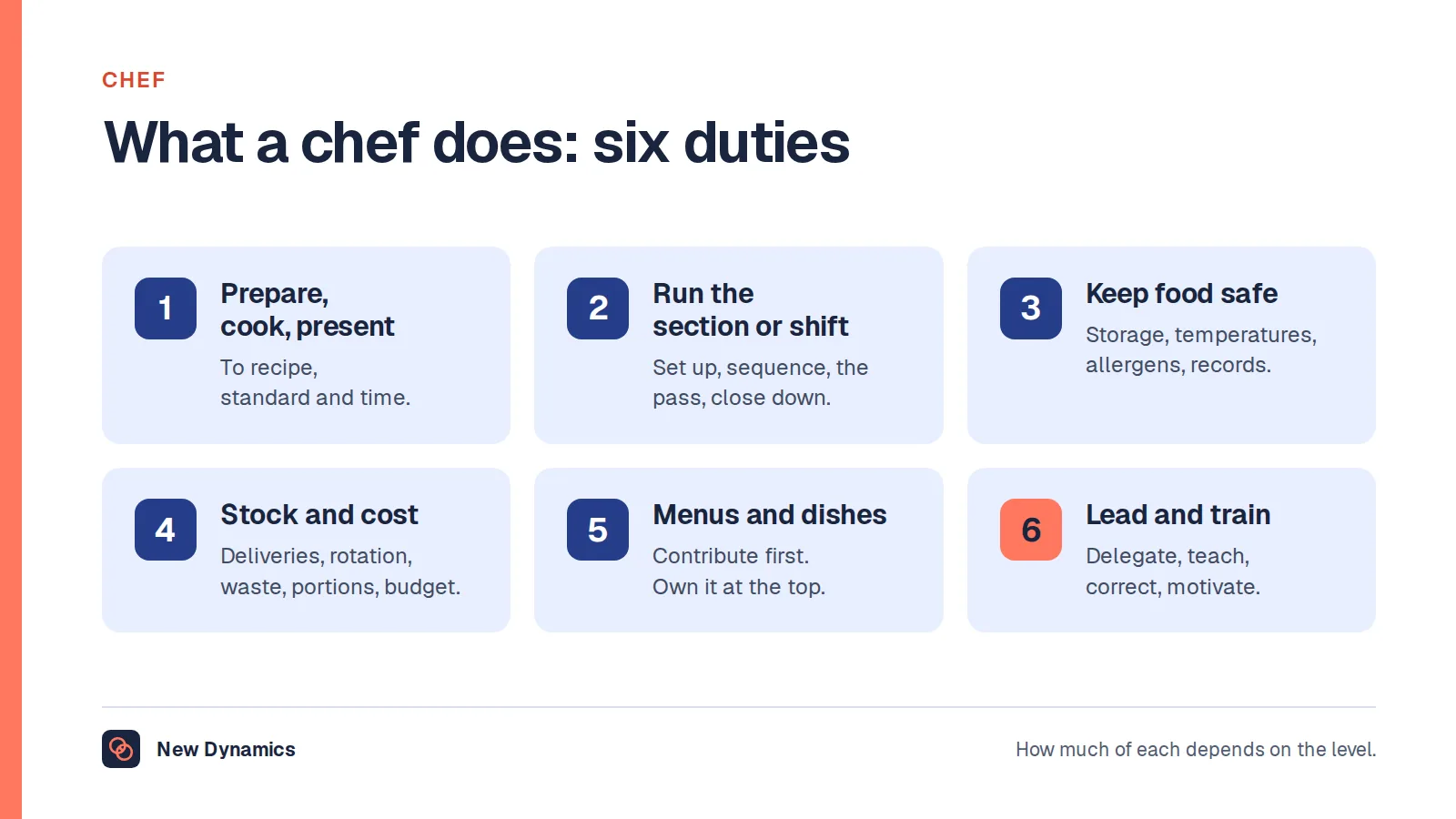
Our food runner job description covers the delivery role and the chef job description the kitchen ladder. In small operations one person may be expeditor and runner, which works until the room fills.
When a kitchen needs a dedicated expeditor
Four signals, any two of which usually justify the post:
- Tables are not eating together. Plates from one table arriving minutes apart is a timing failure at the pass, not a cooking failure.
- Mistakes reach the guest. Wrong modifications, wrong seat, missing sides; each is a check that did not happen.
- The head chef cannot cook. If the person calling the pass is also on a section, one of the two jobs is being done badly.
- Volume or menu complexity has grown. Long tickets, many modifications, tasting menus and large parties all multiply the sequencing work.

Skills
- Memory and sequencing. Holding a full board of tables and courses without losing one.
- Menu knowledge, exactly. Every dish, every component, every allergen.
- Decisiveness at speed. Hold, fire, send back, re-fire, all in seconds.
- Calm authority with chefs and servers, neither of whom reports to the expeditor in most restaurants.
- Clear, short communication. The pass is loud; sentences have to be short and unambiguous.
- Stamina and consistency, because the standard has to be the same at ten o'clock as at six.
Expeditor job description template
Job title: Expeditor (Expo), Kitchen
Reports to: Head Chef or Restaurant Manager
Scope: State the covers per service, the menu type, whether the role covers lunch, dinner or both, and whether the post also runs food.
Purpose: Run the pass so that every order leaves the kitchen complete, correct, on time and safe, and so that the kitchen and the floor stay in step through service.
Responsibilities:
- Receive and organise tickets; sequence orders by table and course.
- Call orders to sections and time components so each table's food is ready together.
- Hold and release courses to the pace of each table; keep the floor informed.
- Check every plate against the ticket for accuracy, modifications, presentation and temperature.
- Confirm allergen instructions have been followed and that allergen plates are identified to the table.
- Garnish, complete and release plates; ensure whole tables leave together.
- Communicate delays, re-fires and unavailable dishes to servers; relay guest questions to the kitchen.
- Keep the pass clean, organised and stocked through service.
About you: detailed menu knowledge or the ability to learn it fast; calm and decisive under pressure; clear communicator with chefs and servers; accurate with allergen procedure; able to stand a full service.
Working pattern: State the services covered, the days, the peak nights and the hours.
Progression: to chef de partie, junior sous chef, or floor supervision; say which the restaurant supports.
Frequently asked questions
What does an expeditor do in a restaurant?
Works the pass between kitchen and dining room: reads and sequences the tickets, calls orders to the sections so a table's food finishes together, holds and releases courses to the table's pace, checks every plate against the order including allergen instructions, garnishes and releases plates to the runners, and keeps the kitchen and the floor informed.
What is the difference between an expeditor and a food runner?
The expeditor organises, checks and releases the food at the pass; the runner carries it to the table and delivers it to the right seat. In a small restaurant one person does both. The expeditor's value is in accuracy and timing; the runner's is in speed and delivery.
Do you need to be a chef to be an expeditor?
No, but you need to know the menu as well as a chef does, including every component and allergen, and to understand how long each dish takes. Many expeditors are chefs or former chefs; others come from the floor and learn the kitchen side, which works when the head chef backs them.
Why is the expeditor important for allergens?
Because they are the last person to look at a plate before it leaves the kitchen. Confirming that the allergen instructions on the ticket were followed, and that the right plate reaches the right guest, is a second check at the point where a mistake can still be caught. The restaurant's own allergen procedure sets how this is done.
Does expeditor mean something different outside restaurants?
Yes. In manufacturing and logistics an expeditor keeps production moving: the US occupational database lists the title among production, planning and expediting clerks, who coordinate and expedite the flow of work and materials between departments according to the production schedule.
Your next step: decide who calls the pass
- Watch one busy service and write down who is actually sequencing and checking.
- Count the tables that did not eat together and the plates that came back.
- If the head chef is doing both jobs, cost a dedicated expo against the waste and the remakes.
- Write the allergen check into the role, in writing, and train it.
For a first week that gets a new expeditor useful by the second Saturday, read and download our employee onboarding guide. The guide is free to read, and the PDF uses our short download form.
Want inductions, early objectives and check-ins recorded for a team that is never at a desk? Book a New Dynamics demo and bring your current kitchen induction. You can also email contact@new-dynamics.com.