TL;DR
- A food runner carries finished dishes from the kitchen pass to the table, delivers them to the right seat, and takes back what the kitchen needs to know. O*NET groups the role with dining room attendants, whose tasks include carrying food, dishes, trays or silverware from kitchens to serving areas and serving food when servers need help; the BLS describes attendants bringing meals from the kitchen and distributing dishes to diners.
- The duties fall into six groups: working the pass, delivering to the table, checking every plate including allergens, keeping the pass and the floor moving, resetting and support, and communication between kitchen and floor. The runner is the last person to look at a plate before the guest, which makes allergen and order accuracy a runner's duty, not only the kitchen's.
- The runner differs from the busser, who clears and resets tables, and the server, who takes orders and owns the guest's experience; in many restaurants one person does two of the three. Write the job description around the volume, the shifts, the physical demands, the tips arrangement and the route to server, and give a new runner a proper first week: the menu, the seat numbers and the allergen procedure.
On a busy Saturday the kitchen can plate a table's food in ninety seconds and the server can be at the far end of the room taking an order. The food runner is the person who closes that gap: the link between the pass and the table who knows what is on every plate, which seat it goes to and what is in it. The food runner job description is short, but the job decides whether hot food arrives hot and the right food arrives at all.
This article explains what a runner does using two primary sources, the US O*NET occupational database and the Bureau of Labor Statistics handbook, sets out six duties, the difference from a busser and a server, the skills, hours and physical demands, and a job description template. The sources are American; the job is the same in a British or European restaurant.
Runners are often in their first job, and the first week decides whether they stay for the season. See how New Dynamics onboarding gives a new starter clear tasks, a buddy and planned check-ins from the first shift.
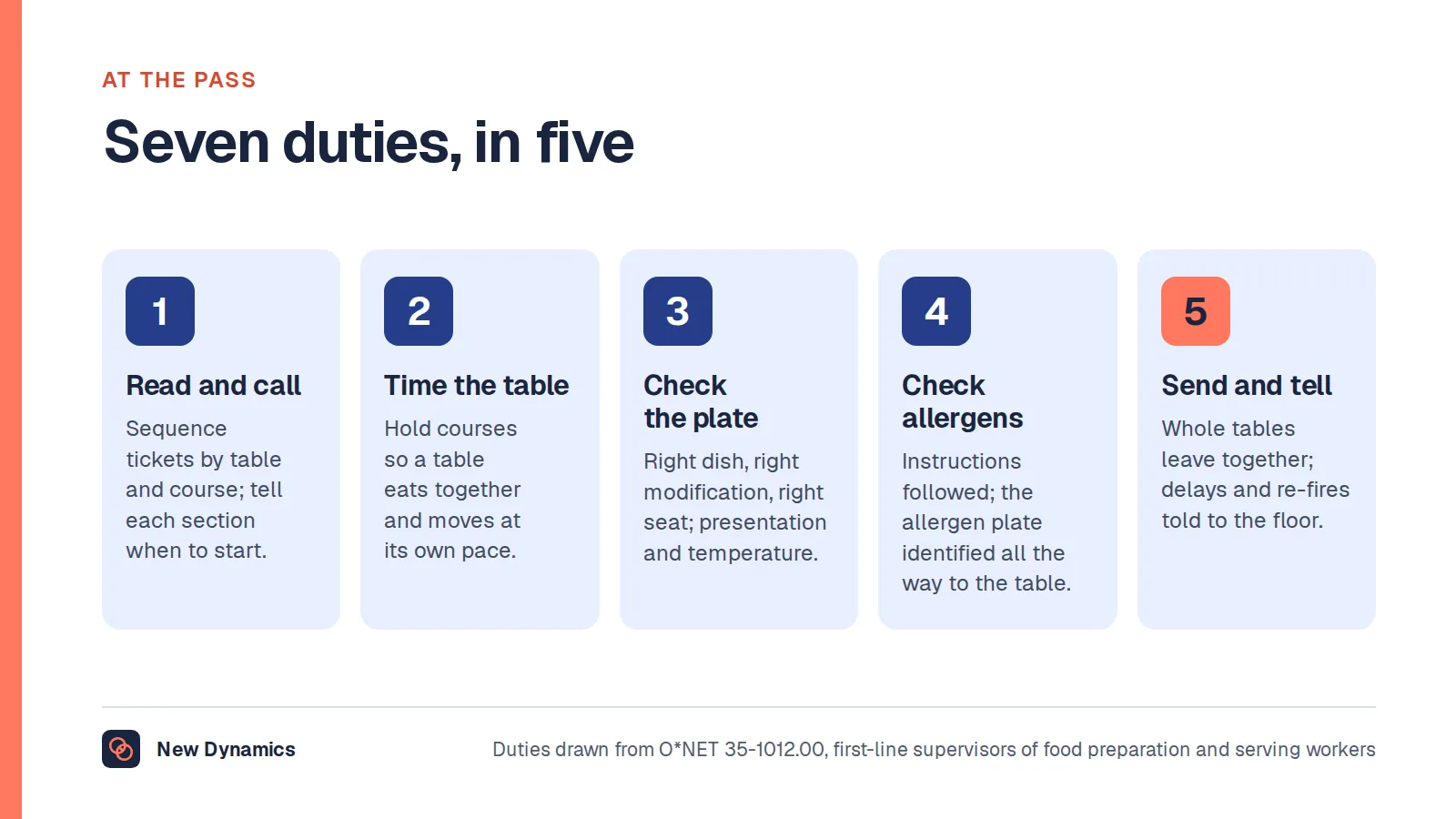
The person who hands the runner the plate has a job of their own: our guide to the expeditor in a restaurant covers the seven duties at the pass and when a kitchen needs one.
What is a food runner?
A food runner, or simply runner, takes finished dishes from the kitchen pass to the guest's table. In many restaurants the runner also announces the dish, checks it against the order, and carries messages back to the kitchen: a table waiting, a re-fire, a change. The runner does not take orders and rarely handles payment.
O*NET groups the role with dining room and cafeteria attendants and bartender helpers, whose tasks include “carry food, dishes, trays, or silverware from kitchens or supply departments to serving counters”, “serve food to customers when waiters or waitresses need assistance”, and “garnish foods and position them on tables to make them visible and accessible”. The Bureau of Labor Statistics describes attendants who help waitstaff by “bringing meals from the kitchen, distributing dishes to diners, filling water glasses” and stocking serving areas.
Food runner duties: six responsibilities
Grouped from the O*NET tasks, the BLS duties and the practice of most restaurants, the work has six parts.
- Work the pass. Stand where the kitchen puts finished plates, read the ticket, match the plates to it, collect the sides and sauces, and take the order as a whole. The pass is where the runner and the chef meet, and where mistakes are cheapest to catch.
- Deliver to the table. Carry the plates safely, find the table and the seat number, place the dish in front of the right guest, announce it briefly, and offer what goes with it. O*NET's task is to carry food from the kitchen and position it so that it is “visible and accessible”.
- Check every plate, including allergens. The runner is the last person to look at a plate before the guest. Confirm the dish matches the order, that allergen instructions on the ticket have been followed and that the guest with the allergy receives the right plate. Never guess; take it back and ask.
- Keep the pass and the floor moving. Clear the pass so the kitchen can keep plating; tell the kitchen when a table is not ready; run the next order rather than waiting. On a busy night the runner sets the pace of the room.
- Reset and support. Bring water, bread and cutlery; help clear and reset when the bussers are stretched; restock the service station. The BLS lists filling water glasses and stocking serving areas.
- Communicate. Carry information both ways: from the floor, a guest's question or a change; from the kitchen, a delay or a dish sold out. Clear, brief, accurate.

Food runner vs busser vs server
| Role | Faces the guest? | Main job |
|---|---|---|
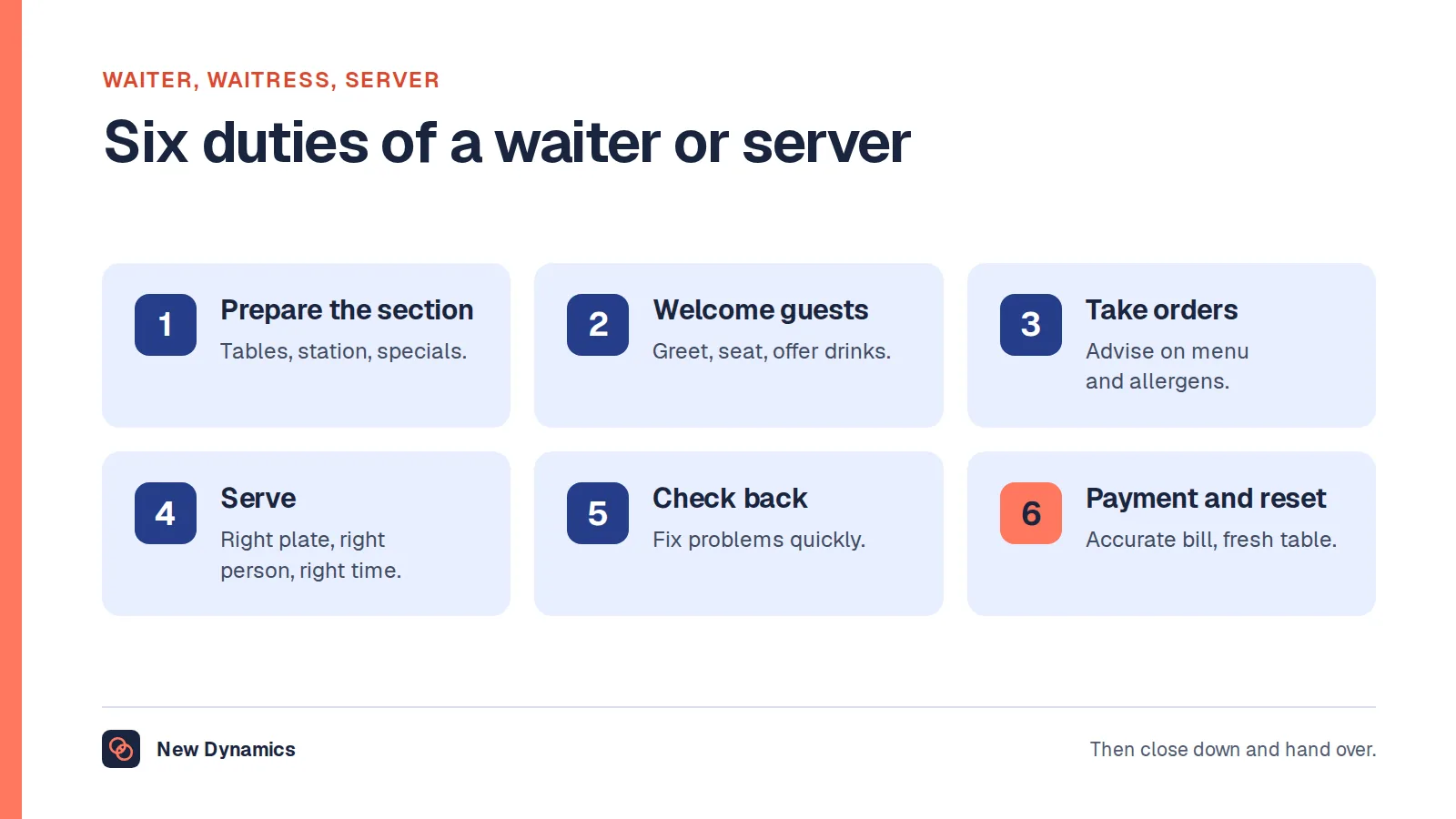
| Server | Yes, throughout | Takes orders, advises, serves drinks, handles payment, owns the table |
| Food runner | Briefly, at delivery | Moves food from pass to table; checks plates; links kitchen and floor |
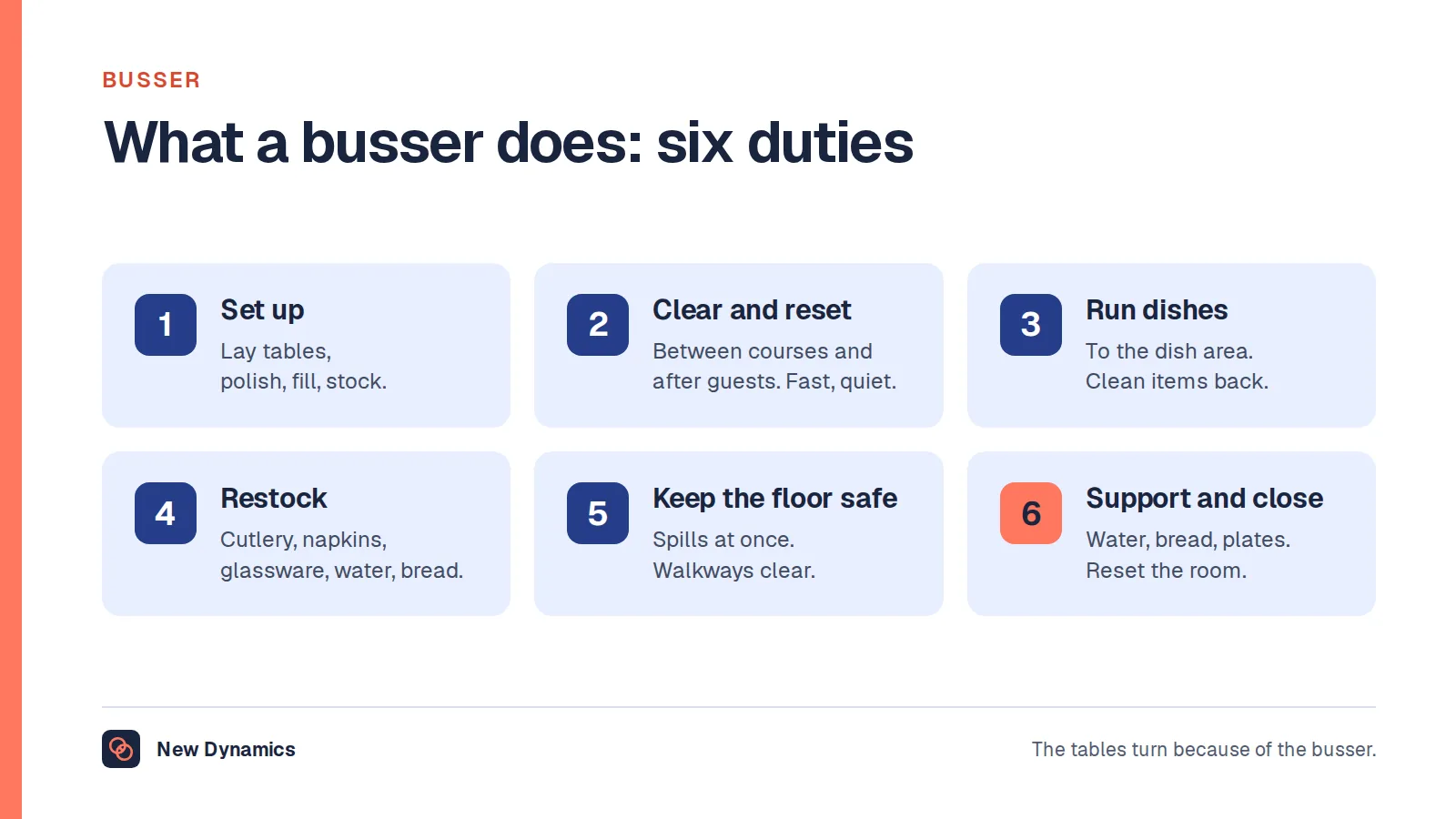
| Busser | Rarely | Clears and resets tables; supports the servers |
O*NET groups runners and bussers in the same occupation, and many restaurants combine them: a runner-busser who delivers and clears. Others have servers run their own food. State in the advert what the role covers, because a runner who expects to run food and finds themselves clearing every table will leave. The busser job description and the waiter job description cover the neighbours.

Skills, hours and physical demands
The BLS names communication skills, customer-service skills, physical stamina and physical strength as the important qualities for the occupation group, noting that workers may lift items weighing up to 50 pounds. O*NET's essential skill for the occupation is active listening, with coordination and service orientation as transferable skills.
For a runner specifically, ask for:
- Memory and attention. Table numbers, seat numbers, the menu and what is in each dish.
- Composure at speed. Carrying three plates through a full room without dropping one or bumping a guest.
- Accuracy about allergens. Reading the ticket and asking rather than guessing.
- Clear, brief communication with chefs under pressure and guests at the table.
- Reliability on the shifts that matter: Friday and Saturday nights.
Hours and environment. The BLS describes shifts spent on the feet, carrying trays that are often heavy, with slips, cuts and burns as common injuries, and schedules that include early mornings, late evenings, weekends and holidays, often part time. State the shifts and the tips or service charge arrangement in the advert; for many runners it is a large part of the pay.
Training. The BLS says no formal education is required and that workers receive short-term on-the-job training in customer service, kitchen safety, safe food handling and sanitation. Add your menu, your seat numbering and your allergen procedure; a runner who does not know them on the first Saturday is a risk.
Progression. Runner to server is the usual step, then to head waiter or supervisor. Say so in the advert and say what a runner needs to show to make it.
Food runner job description template
Job title: Food Runner (or Runner, Runner-Busser where the role includes clearing)
Reports to: Restaurant Manager, Floor Supervisor or Head Waiter
Purpose: Deliver every dish from the kitchen pass to the right guest, hot, correct and safe, and keep the kitchen and the floor talking to each other through service.
Responsibilities:
- Work the pass: read tickets, match plates and sides to the order, collect what goes with each dish.
- Carry and deliver dishes to the correct table and seat; announce the dish; place it correctly.
- Check every plate against the order and its allergen instructions before it reaches the guest; return anything in doubt.
- Keep the pass clear; tell the kitchen about delays and changes; run the next order.
- Bring water, bread, cutlery and condiments; support clearing and resetting when needed; restock the station.
- Relay guest questions and requests to servers and the kitchen accurately.
- Follow food safety and hygiene procedures; keep the pass and service areas clean.
Skills and attributes:
- Good memory for tables, seats and the menu; attention to detail.
- Physically fit; able to carry plates and trays through a busy room for a full shift.
- Calm and courteous under pressure; clear communication.
- Reliable on peak shifts; a team player.
- No experience required; food safety training provided; an interest in progressing to server welcome.
Working pattern: State the shifts, evenings, weekends and holidays; the tips or service charge arrangement; meals on shift.
Progression: Training towards server for those who show accuracy, pace and reliability; say how.

Frequently asked questions
What does a food runner do?
Carries finished dishes from the kitchen pass to the correct table and seat, checks each plate against the order and its allergen instructions, keeps the pass clear so the kitchen can keep plating, and relays messages between the kitchen and the floor. The US occupational database lists carrying food from the kitchen and serving when servers need help among the tasks of dining room attendants.
What is a runner in a restaurant?
Another name for the food runner: the person who moves plates from the pass to the table during service. Some restaurants also use runners for drinks from the bar. The role sits between the kitchen, which cooks, and the servers, who take orders and own the table.
What is the difference between a food runner and a busser?
A food runner delivers food from the kitchen to the table and checks the plates. A busser clears and resets tables. Both support the servers and belong to the same occupation in O*NET; many restaurants combine the two into a runner-busser role.
Do food runners get tips?
Often, through a tips pool or a service charge shared across the team, but arrangements vary by restaurant and by country. The advert should state how tips or service charges are shared and what the runner can expect.
Is being a food runner a good first job?
It is one of the usual routes into restaurant work: no experience is required, training is short and on the job, and the step to server is well trodden. It is physical work on evenings and weekends, so the advert should say so.
Your next step: state the shifts and the step up
- Say whether the role runs food only or runs and clears.
- State the shifts, the peak nights and the tips or service charge arrangement.
- Write down the allergen procedure and the seat numbering, and teach them in the first week.
- Describe the route to server and what a runner needs to show.
For a plan that turns a new runner's first week into a confident first month, read and download our onboarding guide. The guide is free to read, and the PDF uses our short download form.
Want every new starter on the floor to get the same clear start and the same check-ins? Book a New Dynamics demo and bring your current approach. You can also email contact@new-dynamics.com.