TL;DR
- An HR email works when the reader can see in ten seconds what it is about, what you want and by when. Use five parts: a subject line that names the topic, a first sentence that states the request or concern, the facts in date order, the specific outcome you are asking for, and a closing line that says how and when you would like a reply. Keep a copy.
- Two kinds of email have contents set by law in Great Britain. A statutory flexible working request must be in writing and, GOV.UK says, include the date, a statement that it is a statutory request, details of how and from when you want to work flexibly, and whether and when you have applied before. A formal grievance, Acas says, should be in writing to whoever is most appropriate and state what it is about, any evidence and what you want your employer to do.
- For HR, the reply matters as much as the request: acknowledge within a working day, say what will happen and when, keep the email and the reply on the person's record, and treat anything that names a health condition, a protected characteristic or a complaint as confidential from the moment it arrives.
Most people write to HR a few times in their working lives, and usually about something that matters to them: pay that looks wrong, a request to change their hours, a problem with a colleague, a resignation. The HR email that gets a useful reply is not the longest or the most careful one. It is the one that lets a busy HR officer see in ten seconds what it is about, what is being asked and by when.
This article gives a five-part structure for any email to HR, six templates for the most common ones, the two cases in Great Britain where the law sets what the email must say, what to expect back, and a short section for HR teams on replying well. The legal points come from GOV.UK and Acas; the law differs elsewhere and this is general information, not legal advice.
For HR teams, every request is a stage in a process that should run the same way for everyone. See how New Dynamics workflows let you define the stages, forms and sign-offs of your own people processes, so a request does not depend on whose inbox it lands in.
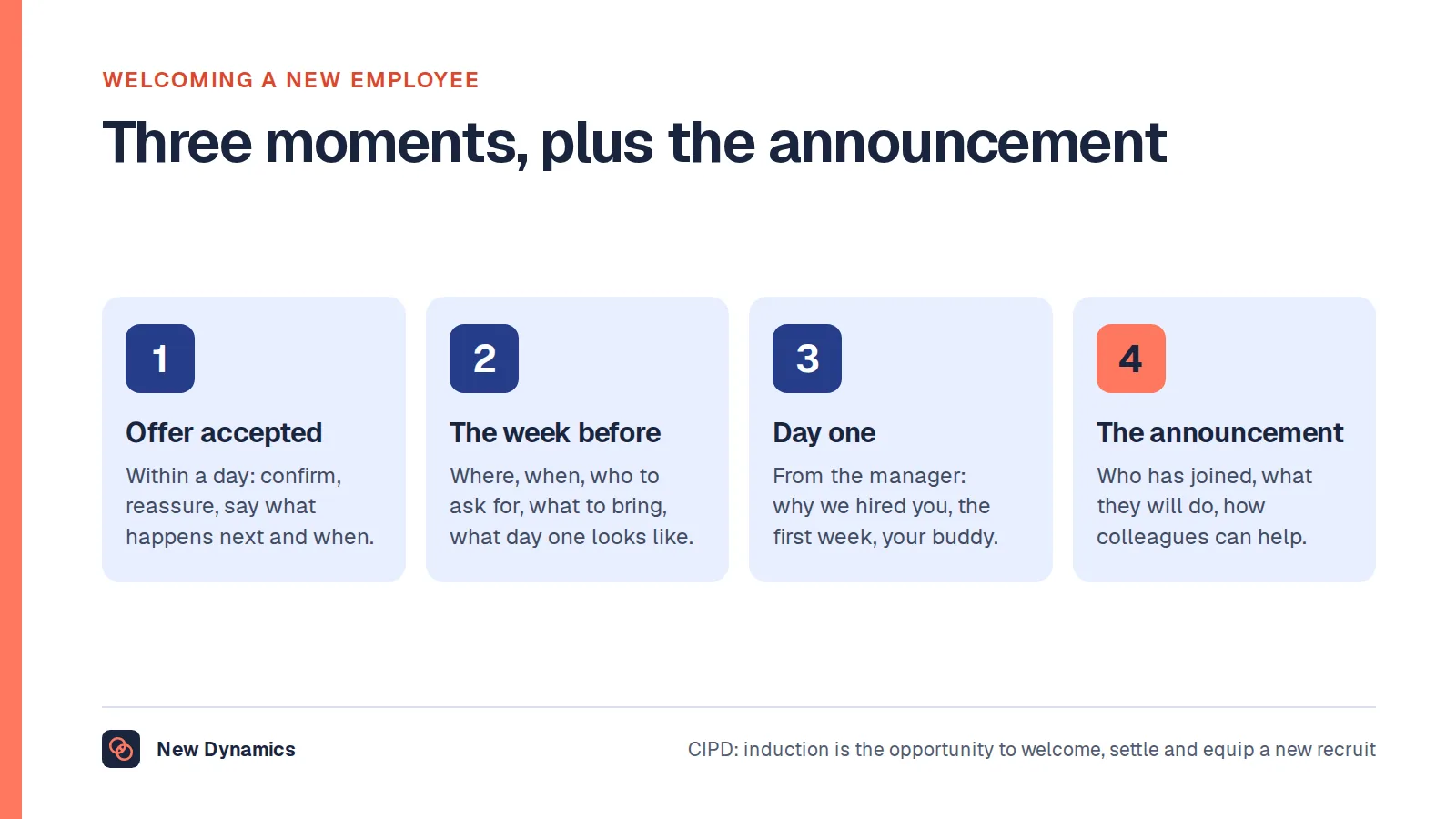
For the messages between an accepted offer and the first morning, our welcome email to a new employee gives five templates and the three moments to send them.
The five parts of a good HR email
- A subject line that names the topic. “Flexible working request: [name]”, “Query about April payslip”, “Request for a reference”. Not “Quick question”.
- A first sentence that states the request or concern. “I am writing to request a change to my working hours from [date].” The reader now knows what kind of email this is.
- The facts, in date order. What happened or what you need, when, and who else knows. Attach or name the evidence: a payslip, a rota, a contract clause.
- The specific outcome you are asking for. Acas's advice on grievances applies to every HR email: be specific. “I would like the overtime for March paid in the April payroll.”
- A closing line that says how and when you would like a reply. “Could you confirm by Friday whether this can be arranged?” Then sign off with your full name, job title and team.
Send it from your work address unless the matter is about your access to it, keep a copy, and note the date. If you do not hear back within the time you asked for, forward the original with a one-line follow-up.

Two emails the law shapes
A statutory flexible working request
In Great Britain, an employee can make a statutory request to change their hours, times or place of work. GOV.UK says the request must be in writing and include “the date of the request”, “a statement that this is a statutory request for flexible working”, “details of how the employee wants to work flexibly and when they want to start”, and “a statement saying if and when they've made a previous application”. Employees “can make 2 applications for flexible working in any 12-month period”, and the employer must decide “within 2 months - or longer if agreed with the employee”. An email that leaves out the statement that it is a statutory request may be treated as an informal one, which carries fewer rights.
A formal grievance
Acas says an employee raising a formal grievance “should put it in writing to whoever is most appropriate”, usually the line manager or HR, and that the letter or email should include “what the grievance is about”, “any evidence, for example a payslip or employment contract”, and “what they want their employer to do about it”, being specific, for example “I would like to be paid on time in future”. Raising the problem informally first is usually sensible; the written grievance is the point at which the formal procedure starts.

Six HR email templates
Adapt the wording. Each is deliberately short.
1. A question about pay
Subject: Query about [month] payslip
Dear [name],
I am writing to query my [month] payslip. My contract states [hours or rate], and I worked [hours] in the period, including [overtime or shifts], but the payslip shows [amount]. I have attached the payslip and my rota.
Could you check the calculation and let me know by [date] whether an adjustment is due and when it would be paid?
Thank you, [full name, job title, team]
2. A statutory flexible working request
Subject: Statutory flexible working request: [name]
Dear [name],
This is a statutory request for flexible working, made on [date].
I would like to change my working pattern from [current pattern] to [proposed pattern], starting on [date]. I believe this could work because [brief explanation, for example how cover or handover would be managed].
I have [not made a previous statutory request / made a previous request on (date)].
I would be glad to discuss this and any alternatives. Please let me know the next step.
Kind regards, [full name, job title, team]
3. Raising a concern informally
Subject: A concern I would like to discuss
Dear [name],
I would like to raise a concern informally before deciding whether to take it further. Over the past [period], [describe the issue factually, with dates]. I have kept notes of [what].
I would like [the outcome you want, for example a conversation with my manager facilitated by HR].
Could we arrange a time to talk this week? I would prefer this to remain confidential at this stage.
Thank you, [full name, job title, team]
4. A formal grievance
Subject: Formal grievance: [name]
Dear [name],
I am writing to raise a formal grievance. My grievance is about [what it is about, with dates and the people involved]. I have evidence in the form of [what, attached].
I would like [what you want the employer to do, specifically].
I understand this will be dealt with under the grievance procedure and would be grateful for confirmation of the next step and the timescale.
Yours sincerely, [full name, job title, team]
5. Requesting a reference or a document
Subject: Request for [employment reference / a copy of my contract / my training record]
Dear [name],
Could you provide [what], please? It is needed by [date] for [purpose, if relevant]. If it should be sent directly to a third party, the details are [name and address].
Thank you for your help, [full name, job title, team]
6. Resigning
Subject: Resignation: [name]
Dear [name],
I am writing to give notice of my resignation from my position as [job title]. My contract requires [period] notice, so my last day will be [date], unless we agree otherwise.
I would be grateful for confirmation of my final pay, outstanding holiday and the return of company property. Thank you for the support during my time here.
Yours sincerely, [full name, job title, team]
What to expect back
A good HR team acknowledges within a working day, tells you what will happen next and when, and keeps to it. A statutory flexible working request has a two-month decision deadline in Great Britain; a formal grievance has a procedure with a meeting and a written outcome. For anything else, the reply should answer the question or say when it will be answered. If nothing comes, follow up once, then copy your manager or the head of HR.
For HR: replying to an email well
The reply is part of the record and often the whole of the employee's impression of HR.
- Acknowledge within a working day. Even if the answer takes a week, say so.
- Answer the question asked. If the email asks three things, reply to three things, in the same order.
- Say what happens next and when. For anything with a procedure, name it and the timescale.
- Keep it on the record, confidentially. File the email and the reply against the person; treat anything naming a health condition, a protected characteristic or a complaint as confidential from the moment it arrives; follow your data protection rules and retention periods.
Publish in the staff handbook where to send what, who reads the HR inbox and how quickly to expect a reply; it removes most of the anxiety that produces four-paragraph emails. Our employee handbook guide covers what to include.

Frequently asked questions
How do you write an email to HR?
Name the topic in the subject line, state the request or concern in the first sentence, give the facts in date order with any evidence, say specifically what outcome you want, and close by saying how and when you would like a reply. Sign with your full name, job title and team, and keep a copy.
What should a flexible working request email include?
In Great Britain, GOV.UK says a statutory request must be in writing and include the date, a statement that it is a statutory request for flexible working, details of how you want to work flexibly and when you want to start, and whether and when you have made a previous request. Employees can make two requests in any twelve-month period.
How do you email HR about a problem with a colleague or manager?
Raise it informally first if you can, factually and with dates, saying what outcome you want. If that does not resolve it, raise a formal grievance in writing: Acas says it should state what the grievance is about, include any evidence, and say what you want your employer to do.
Should I email HR or my manager?
Your manager for most day-to-day matters, HR for anything about pay, contracts, policy, formal requests, or a problem that involves your manager. When in doubt, email HR and copy your manager, unless the matter concerns them.
How quickly should HR reply to an email?
A good HR team acknowledges within a working day and says when a full answer will follow. Some matters have legal timescales: a statutory flexible working request in Great Britain must be decided within two months unless a longer period is agreed. If you hear nothing, follow up once, then escalate.
Your next step: write the first line first
- Decide what you want before you open the email; write that as the first sentence.
- Check whether the law sets the contents: a statutory request or a formal grievance.
- Attach the evidence and ask for a reply by a date.
- Keep a copy and note when you sent it.
For the handbook page that tells staff where to send what and when to expect a reply, read and download our employee handbook guide. The guide is free to read, and the PDF uses our short download form.
Want requests, check-ins and reviews to run through the same visible process for every employee, whoever reads the inbox? Book a New Dynamics demo and bring your current process. You can also email contact@new-dynamics.com.