TL;DR
- A good staff thank-you letter names the person, says exactly what they did, explains the difference it made and thanks them sincerely. It can be five sentences long.
- The 12 templates here cover good work, a finished project, extra effort, a whole team, the end of the year, a work anniversary, a difficult period, covering for a colleague, customer praise, a new starter, a leaver and voluntary work.
- Write it soon, keep it specific, sign it yourself and do not attach a request. A letter that could have been sent to anyone will be read as if it had been.
Many people keep thank-you letters. They sit in desk drawers and email folders long after a bonus has been spent. Yet they can be hard to write, because a blank page and the word “Dear” bring on a kind of stage fright.
This article shows how to write a staff thank-you letter that means something. It sets out the five parts of a good letter, gives 12 templates for common situations, adds short email versions and lists the mistakes to avoid.
If you want thanks to be frequent, specific and visible across the organisation, explore New Dynamics employee recognition.
About these templates: all of them were written by the New Dynamics editorial team. Use and adapt them freely. The names and details in them are illustrative. Replace every detail with what really happened.
Why a letter still matters
It lasts. A word in the corridor is welcome and soon forgotten. A letter can be reread, shown to a partner or a parent and kept.
It takes effort, and people know it. Anyone can click a reaction. Writing three careful paragraphs tells the person that you stopped and thought about them.
It is good for the writer too. The NHS lists giving to others among its five steps to mental wellbeing, and its first example is “saying thank you to someone for something they have done for you”.
It creates a record. A copy on file, with the employee's agreement, is useful evidence at review time. See our positive feedback examples.
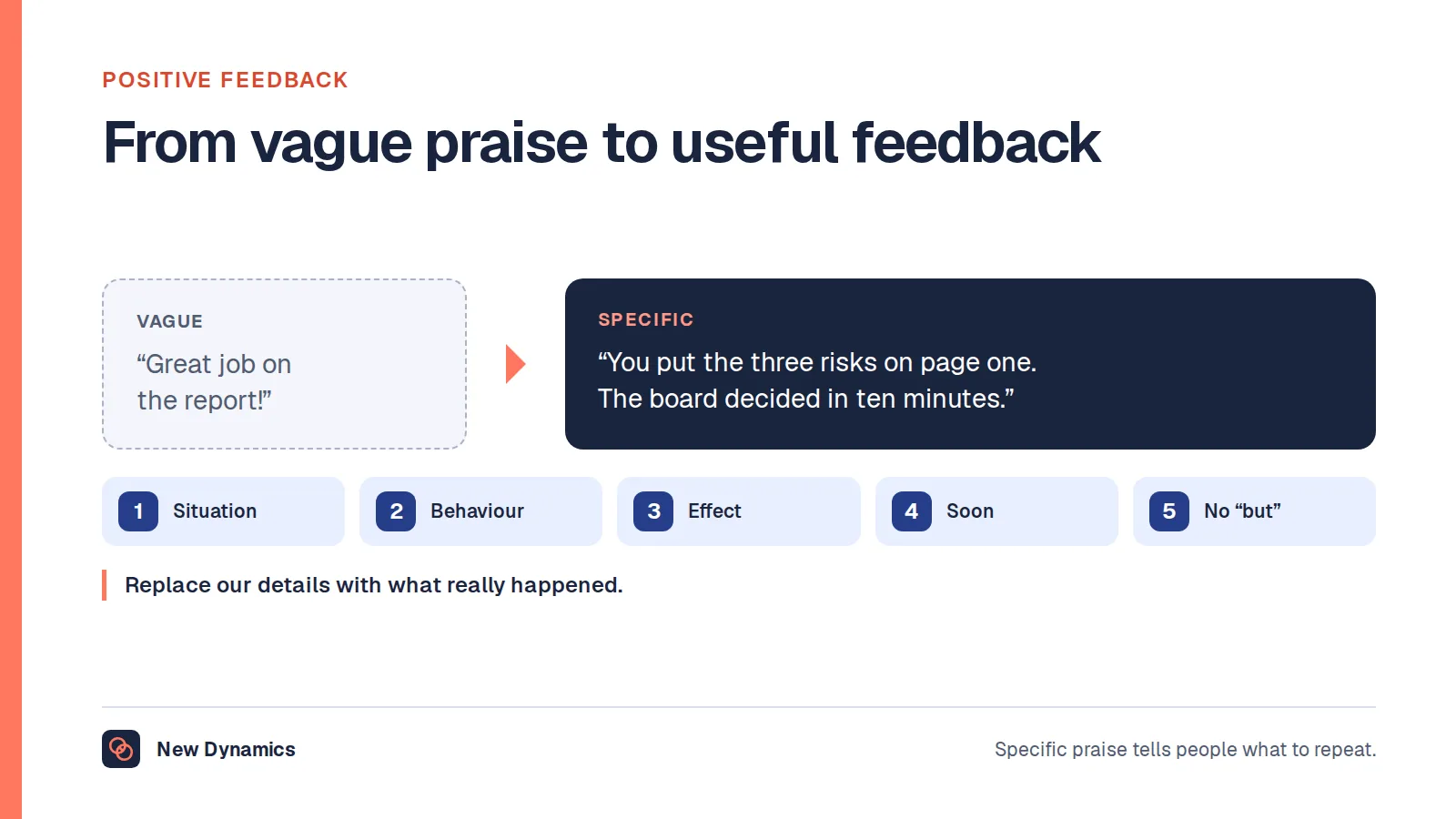
The five parts of a good thank-you letter
- Greet the person by name. Use the name they use. “Dear colleague” is for circulars.
- Say what they did. Be exact: the task, the date, the detail you noticed.
- Say the difference it made, to a customer, a colleague, the team or you.
- Say what it shows about them. Care, judgement, persistence, generosity. This is the line people remember.
- Thank them, and sign it yourself. A real signature, or your own name typed by you. Never “The Management”.
That is all. Five sentences can do it.

12 staff thank-you letter templates
1. For a piece of good work
Dear Amira,
I wanted to thank you properly for the supplier report you sent on Friday. You answered the question I asked, and two that I should have asked, and the comparison table made the decision easy.
Because of it, we signed the new contract a fortnight early, on better terms than I expected. That is a direct result of the care you took.
Thank you. It is a pleasure to rely on your work.
Kind regards, Daniel
2. For a finished project
Dear Tom,
The new booking system went live on Monday, on the date you promised in January, and I have not had a single complaint from a customer. After eight months of work, that is remarkable.
I know how many evenings of testing sat behind that quiet launch, and how calmly you handled the data problem in June. You kept the team together and kept me honestly informed throughout.
Thank you for leading it so well. I hope you are as proud of it as I am.
With thanks, Priya
3. For going beyond the job
Dear Sam,
When the delivery arrived short on Thursday, you could have logged it and gone home. You stayed, found the missing stock at the other depot and drove it over yourself, so that the customer's event went ahead on Saturday.
They have written to tell me that they will use us again because of you. I wanted you to know that, and to know that I noticed.
Thank you. Please take Friday afternoon off, with my thanks.
Best wishes, Helen
4. To a whole team
Dear all,
This quarter asked a great deal of you: two colleagues away, the office move and our busiest September on record. You met every customer deadline.
I saw how you covered for each other, how Jo rebuilt the rota three times without complaint and how the whole team stayed courteous with customers on the hardest days. That is what a good team looks like.
Thank you, each of you. I will be writing to several of you individually as well.
With gratitude, Marcus
A team letter is stronger when it names two or three specific contributions, and when individual letters follow.
5. At the end of the year
Dear Chen,
As the year ends, I wanted to put in writing what I have valued in your work. Three things stand out: the way you rebuilt the month-end process, which saves the team two days every month, your patience in training our two new starters, and your willingness to tell me when I was wrong about the forecast.
The team is better because you are in it. Thank you for a year of excellent work.
I hope you have a restful break.
Warm regards, Fiona
6. For a work anniversary
Dear Malik,
Ten years ago this week you joined us as a trainee. Today half the engineering team learned their trade from you.
I often think of the winter you kept the old plant running with borrowed parts and good humour. Beyond the work itself, you have shaped how people here treat each other.
Thank you for ten years. We are lucky to have had them.
With great respect, Ruth
For milestone messages, see our 20-year work anniversary wishes.
7. After a difficult period
Dear Nadia,
The last three months have been hard on everyone, and harder on you than most. You took on the uncertainty of the restructure, kept your team informed and kept the service running.
I know that it cost you evenings and sleep. I am sorry that it was necessary, and I am grateful that you did it with such fairness.
Thank you. Let's talk next week about how to lighten your load.
Sincerely, James
8. For covering for a colleague
Dear Lucy,
While Ben was off, you took on his accounts as well as your own for six weeks, without being asked twice and without letting a single client notice the difference.
It meant that Ben could recover without worrying, which mattered more than you may know.
Thank you for being the kind of colleague everyone hopes to have.
Best wishes, Aisha
9. Passing on a customer's praise
Dear Oli,
I am enclosing a letter we received this week from Mrs Patel. In her words, you “turned a dreadful day into a manageable one”.
She describes how you stayed on the line for forty minutes, explained each step and rang back the next day to check. That is exactly the service we want to be known for.
Thank you. I have shared her letter with the directors.
Kind regards, Grace
Always quote the customer's own words, and always say who else has seen them.
10. To a new starter, after the first months
Dear Ife,
You have been with us for three months, and I wanted to tell you how well it is going. Your question in your second week about why we produce the Monday report led us to scrap it, which has given four people their Monday mornings back.
You ask when you are unsure, and you deliver what you promise. We made a good decision when we hired you.
Thank you for a strong start.
Best, Karen
11. To someone who is leaving or retiring
Dear Pat,
After eighteen years, it is hard to imagine the front office without you. You have welcomed thousands of visitors, trained every receptionist we have and remembered every birthday.
What I will miss most is your judgement. You always knew which problem needed me at once and which could wait.
Thank you for everything. You leave this place kinder than you found it.
With affection and thanks, Stephen
12. For work beyond the role
Dear Dev,
Thank you for chairing the wellbeing group this year, on top of a full job. The lunchtime walks and the mental health training both happened because you made them happen.
More than sixty colleagues took part, and several have told me that it made a real difference to them.
That work is voluntary, and it matters. Thank you.
Kind regards, Monica
Short versions for email and chat
Sometimes two lines are right. They still need the same ingredients.
- “Thank you for staying to fix the rota on Tuesday. It meant that everyone knew their shifts before the weekend, which made a real difference.”
- “Your summary at the end of the client meeting was superb. They left knowing what happens next, and so did I. Thank you.”
- “I saw how you helped Jamie with the new system this week. Thank you for being generous with your time.”
- “The board approved the proposal, and your analysis was the reason. Thank you.”
How to write and deliver the letter: six steps
- Write it soon. Within a week of the event, while the detail is fresh.
- Gather the facts. What exactly did the person do, and what followed from it? Ask a colleague if you are unsure.
- Draft the five parts. Name, what they did, the difference, what it shows and the thanks.
- Cut the padding. Remove “I just wanted to” and “on behalf of”. Short letters are read twice.
- Choose the form. Handwritten notes feel personal. A letter or email can be kept and copied to the file. Ask before you share it publicly, because some people dislike the attention.
- Deliver it yourself where you can, and say a word as you hand it over.

Mistakes to avoid
The mail merge. “Dear [First name], thank you for your hard work this year” thanks nobody.
Thanks with a request attached. “Thank you for Saturday. Could you also do next Saturday?” turns gratitude into a transaction.
Thanks with a criticism attached. Save the feedback for another day.
Exaggeration. “You saved the company” for a routine task devalues your praise for next time.
Thanking only the visible people. Look for the person whose work made the star's success possible.
Letting someone else write it. A letter drafted by an assistant and signed unread is usually obvious.
Using a letter in place of fair pay. A thank-you letter complements fair reward. It cannot replace it.

A note on gifts and tax in the UK
If you add a gift to the letter, check the tax position. GOV.UK's guidance on trivial benefits says that you do not have to pay tax on a benefit if, among other conditions, “it cost you £50 or less to provide”, “it isn't cash or a cash voucher” and “it isn't a reward for their work or performance”.
That last condition matters here. A gift given to thank someone for their performance may not count as a trivial benefit, so it may be taxable. This is general information, not tax advice. Check with your payroll provider or accountant. Our employee recognition ideas include many options that cost nothing.
Frequently asked questions
How do you write a thank-you letter to staff?
Greet the person by name, say exactly what they did, explain the difference it made, say what it shows about them and thank them sincerely. Sign it yourself. Five sentences are enough if each one is specific.
What do you say in an employee thank-you letter?
Mention the specific work, with a date or a detail, and its effect: “Because of your report, we signed the contract a fortnight early.” Add what it shows about the person, such as care or persistence, and close with a plain, sincere thank you.
Should a staff thank-you letter be handwritten or emailed?
Either works. A handwritten note feels personal, and people often keep it. An email or a printed letter is easier to keep on file and to copy to a senior leader. What matters most is that the wording is specific and written by you.
How long should a thank-you letter to an employee be?
Three short paragraphs, or about 80 to 150 words, is plenty. A few specific sentences are better than a page of general praise. For small things, two lines in an email are enough.
When should you send a thank-you letter to staff?
Send it within a week of the event, while the detail is fresh. Good occasions include finished projects, extra effort, customer praise, anniversaries, the end of a hard period, the end of the year and when someone leaves.
Can I use these templates freely?
Yes. All the templates were written by the New Dynamics editorial team. You can use and adapt them without asking permission or adding a credit. Replace the illustrative names and details with real ones.
Your next step: write one letter this week
- Think of one person whose work made a difference in the last month.
- Write down what they did and what followed from it.
- Draft five sentences, using the five parts.
- Sign it, and hand it over yourself.
For a fuller approach to appreciation that is specific, timely and fair, read and download our employee recognition guide. The guide is free to read, and the PDF uses our short download form.
Want thanks and recognition to be part of everyday work? Book a New Dynamics demo and bring your current habits. You can also email contact@new-dynamics.com.