TL;DR
- The labour market is where people who want to work meet employers who want to hire. Its supply side is the labour force: the employed plus the unemployed, which the BLS calls all people aged 16 and over who are classified as either employed or unemployed. Its demand side is jobs: filled ones, and vacancies, which the ONS defines as positions for which employers are actively seeking recruits from outside their business or organisation.
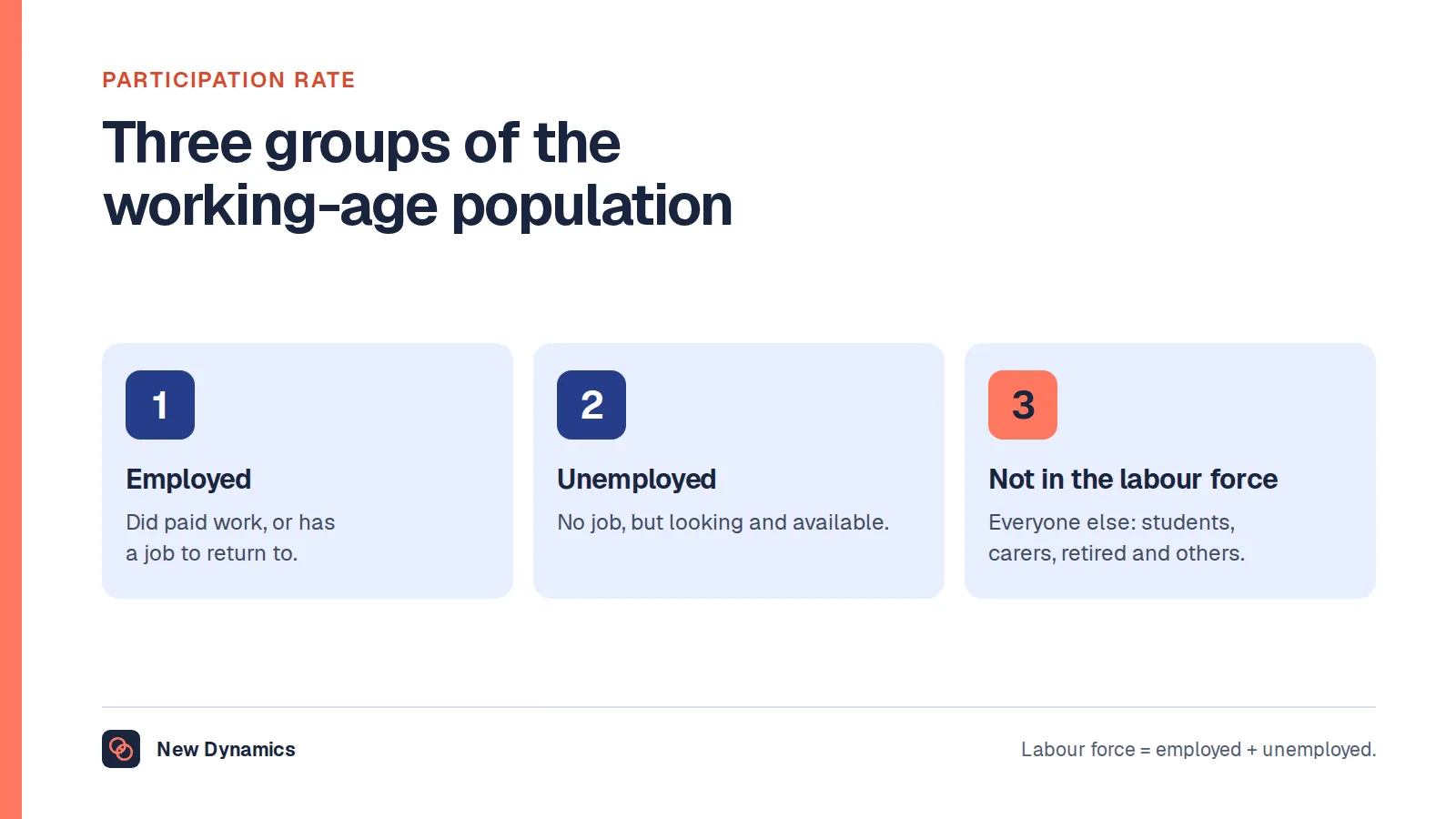
- Everyone of working age sits in one of three boxes: employed, unemployed (without a job, looking in the last four weeks and available to start soon) or economically inactive (not working and not looking). Those definitions decide what the employment rate, the unemployment rate and the participation rate mean.
- A tight labour market has more vacancies than people to fill them, so hiring is slow and pay rises; a slack one is the reverse. Employers cannot move the market, but they can read it: it decides whether the year's priority is recruiting or keeping the people they have, and how ambitious a hiring plan can be.
Every month a headline says the labour market is tight, or cooling, or slack, and an HR team is expected to know what that means for the hiring plan. The term is simpler than the commentary around it. This article gives the definition, explains who counts as in the labour market and who does not, using the wording of the UK Office for National Statistics and the US Bureau of Labor Statistics, and sets out what a tight or slack market means for an employer.
It is written for people who run hiring and retention rather than for economists, and it uses British spelling throughout; the American spelling, labor market, means the same thing.
When the market is tight, the people you already have are the hiring plan. See how New Dynamics performance reviews keep progression, feedback and development in one place, so a good person has a reason to stay.
Labour market definition
The labour market is the meeting of two things: people who want to work, and employers who want to hire them. Like any market it has supply, demand and a price. The supply is the labour force. The demand is jobs, filled and unfilled. The price is pay.
The Office for National Statistics describes its labour market statistics as measuring “many different aspects of the labour market that provide an insight into the economy”, and adds that they “are also very much about people, including: their participation in the labour force; the types of work they do; earnings and benefits they receive; their educational qualifications; and their working patterns.” That is a good working definition: the labour market is the whole picture of who is working, who wants to, what they do and what they are paid.
There is no single national labour market. There are markets by occupation, by region and by sector, and they can move in different directions at the same time. A hospital can struggle to hire nurses in a year when a retailer has more applicants than it needs.
Who is in the labour market: three boxes
Every statistic about the labour market starts by sorting the working-age population into three groups. The definitions matter because they decide what the headline rates measure.
Employed. The ONS counts as employed “people aged 16 and over who did paid work (as an employee or self-employed), those who had a job that they were temporarily away from, those placed with employers on government-supported training and employment programmes, and those doing unpaid family work.” The Bureau of Labor Statistics uses a similar test for its household survey: at least one hour of paid work in the reference week, or work in one's own business, or temporary absence from a job, or unpaid work in a family business.
Unemployed. This is narrower than “not working”. Under the International Labour Organization definition the ONS uses, the unemployed are “without a job, have been actively seeking work in the past four weeks and are available to start work in the next two weeks”, or have found a job and are waiting to start it. The BLS asks for the same three things: not employed, available for work, and at least one specific, active effort to find a job in the last four weeks, or a temporary lay-off with an expected recall.
Economically inactive, or not in the labour force. Everyone else of working age: people who are not working and are not looking, or not available. The ONS says “people without a job who have not actively sought work in the last four weeks, and/or are not available to start work in the next two weeks.” Students, retired people, carers, people who are long-term sick and people who have given up looking all sit here. The BLS calls the last group discouraged workers and counts them among the “marginally attached”: people who want a job and searched in the last twelve months, but not in the last four weeks.
The first two groups together are the labour force, which the ONS calls the economically active: “people aged 16 and over who are either in employment or unemployed.”

The measures that describe it
Three rates come straight from the three boxes. The formulas below use the BLS wording; the ONS calculates the same things, with the participation rate usually reported for people aged 16 to 64 and often as its mirror image, the inactivity rate.
| Measure | Formula | What it answers |
|---|---|---|
| Employment rate | Employed ÷ working-age population | What share of people have a job? |
| Unemployment rate | Unemployed ÷ labour force | Of those in the market, what share cannot find work? |
| Labour force participation rate | Labour force ÷ working-age population | What share of people are in the market at all? |
The BLS defines the unemployment rate as “the number of unemployed people as a percentage of the labor force” and the participation rate as “the number of people in the labor force as a percentage of the civilian noninstitutional population”. The labour force participation rate has its own explainer with a worked calculation.
Two more measures describe the demand side. Vacancies are, in the ONS definition, “positions for which employers are actively seeking recruits from outside their business or organisation”. Earnings are “the money people receive in return for work done, gross of tax”, including salaries and, unless stated otherwise, bonuses. Put vacancies beside unemployment and you have the simplest reading of the market: how many unfilled jobs there are for every person looking.
A worked example
The figures below are invented to show how the boxes and rates fit together. They are not statistics for any country or year.
- Working-age population: 1,000 people
- Employed: 740
- Unemployed: 40
- Economically inactive: 220
Labour force = 740 + 40 = 780. Participation rate = 780 ÷ 1,000 = 78 percent. Unemployment rate = 40 ÷ 780 = 5.1 percent. Employment rate = 740 ÷ 1,000 = 74 percent. If employers in this town have 60 vacancies, there are 1.5 unfilled jobs for every unemployed person: a tight market. If they have 20, there are two unemployed people for every vacancy: a slack one.
Tight and slack labour markets
A tight labour market is one where demand for workers outruns supply: vacancies are high relative to the number of people looking, jobs take longer to fill, candidates hold several offers and pay tends to rise. Employers feel it as unfilled roles, counter-offers and people leaving for more money.
A slack (or loose) labour market is the reverse: more people looking than jobs to fill, so vacancies fill quickly, applicants are plentiful and pay grows slowly if at all. Employers feel it as large applicant pools and lower turnover, because people stay where they are.
Neither is permanent, and the same economy can be tight for software engineers and slack for administrators. What matters to an employer is the market for the roles it actually hires.

External and internal labour markets
Economists also distinguish the external labour market, where employers hire from outside, from the internal labour market, the movement of people between roles inside one organisation through promotion, transfer and progression. The ONS definition of a vacancy above is explicitly external: a position filled from outside the business.
The internal market is the one an employer controls. Progression ladders, development plans and fair reviews decide whether a vacancy is filled by someone who already knows the business or has to be bought from a tight external market. That is why, when hiring gets hard, HR's attention usually turns to the internal market: strategic workforce planning starts from the people already in the building.
What an employer does with the reading
An organisation cannot change the labour market, but it can read it and plan accordingly.
- Decide the year's priority. In a tight market for your roles, retention is cheaper than recruitment, and the review cycle, progression and development plans are the retention tools. In a slack one, hiring is the opportunity and the risk is a slow process that loses good applicants.
- Size the hiring plan honestly. Time to fill and offer acceptance rates move with the market. A plan built on last year's assumptions fails quietly.
- Set pay with the market, not the payroll. Earnings data by occupation and region shows what a role costs to fill now.
- Build the internal market. Skills mapping, progression frameworks and honest development conversations turn today's employees into next year's hires.

Frequently asked questions
What is the labour market in simple terms?
It is where people who want to work meet employers who want to hire. Its supply is the labour force, everyone working or actively looking for work; its demand is jobs, filled and vacant; and its price is pay.
What is the difference between the labour market and the labour force?
The labour force is the supply side only: the employed plus the unemployed. The labour market is the whole picture, including the jobs and vacancies employers offer and the pay that clears them.
Who is not in the labour market?
People of working age who are neither working nor looking for work, or are not available to start: students, retired people, carers, people who are long-term sick and those who have stopped looking. The ONS calls them economically inactive; the BLS says not in the labor force.
What does a tight labour market mean?
More vacancies than people to fill them. Jobs take longer to fill, candidates have more choice and pay tends to rise. A slack market is the opposite: more people looking than jobs available.
Is it labour market or labor market?
Both. Labour is the British spelling used by the ONS; labor is the American spelling used by the BLS. The definitions are the same.
Your next step: read your own market
- Name the three or four roles that are hardest to fill and find the vacancy and earnings data for them.
- Decide whether this year is a hiring year or a keeping year for each.
- Map the internal market: who could fill the next vacancy from inside, and what development they need.
- Put that into the review cycle, so progression is a conversation and not a surprise resignation.
For a practical plan to keep the people a tight market will try to take, read and download our employee retention guide. The guide is free to read, and the PDF uses our short download form.
Want progression, development and reviews in one place for the people you cannot afford to lose? Book a New Dynamics demo and bring your hardest-to-fill roles. You can also email contact@new-dynamics.com.