TL;DR
- A massive open online course, or MOOC, is a course of study that is made available over the internet, usually without charge, to a very large number of people, in the Oxford Learner's Dictionary definition; the Cambridge Dictionary says a course that is made available over the internet and that can be followed by a large number of people. Each word of the name matters: massive means built for thousands, open means anyone can enrol, online means delivered on the web, and course means structured learning with a start, a sequence and usually an assessment.
- A MOOC is not a degree, though universities produce many; not an in-house course, because it is not built for your organisation; and not, in its free form, a verified credential, because the certificate usually costs extra and the platform cannot always prove who did the work. It is a cheap, flexible way to learn a defined topic at scale, with the known weakness that most people who start one do not finish.
- In a development plan a MOOC works when five things are decided in advance: the skill it is for, the course chosen against that skill, the time protected for it, the evidence of learning that will be accepted, and how the learning will be applied and reviewed at work. Without those, it is a link in a plan that nobody follows up.
An employee asks their manager to approve time for “a MOOC on data analysis”. The manager approves it, the employee starts it, and three months later nobody mentions it again. The massive open online courses definition is simple; making one count for workplace learning is not. This article gives the definition from two dictionaries, explains what each word of the name rules in and out, separates a MOOC from the things it is confused with, weighs its strengths and limits for employee development, and gives five steps for using one in a development plan.
Development goals belong in the same place as the rest of a person's objectives, where they can be seen and reviewed. See how New Dynamics Goals & OKRs keep a learning goal beside the work goals it is meant to serve.
MOOC definition
The Oxford Learner's Dictionary defines a MOOC as “a course of study that is made available over the internet, usually without charge, to a very large number of people”. The Cambridge Dictionary gives “abbreviation for massive open online course: a course of study that is made available over the internet and that can be followed by a large number of people”.
The two agree on three things: a course, delivered over the internet, to a very large number of people. Oxford adds “usually without charge”, which describes most MOOCs' basic access, though certificates and graded assessment often cost money.
What the four words mean
| Word | What it rules in | What it rules out |
|---|---|---|
| Massive | Built for thousands or more learners at once; automated marking, peer review, forums | Small cohorts with a tutor who knows your name |
| Open | Anyone can enrol; no entry requirements; basic access usually free | Selection, prerequisites, a place you have to win |
| Online | Delivered on the web: video, reading, quizzes, discussion | Classroom teaching, workshops, on-the-job coaching |
| Course | Structured learning with a start, a sequence of units and usually an assessment | A single video, an article, a library of resources |
A MOOC is the combination. A university lecture series on video is online and open but not a course if it has no structure or assessment; a company's e-learning module is online and a course but neither massive nor open.

What a MOOC is not
- Not a degree. Universities produce many MOOCs, and some stack towards a qualification, but a single MOOC is a short course, typically a few weeks of a few hours each, not an accredited programme.
- Not an in-house course. It teaches the topic as the provider sees it, not as your organisation does it. Applying it to your systems, policies and customers is the learner's and the manager's job.
- Not, in its free form, a verified credential. Certificates usually cost extra, and the platform cannot always prove who did the work. Treat a certificate as evidence of participation unless the provider verifies identity and assessment.
- Not a substitute for practice. Knowing about a skill and having it are different. A MOOC delivers the first; the workplace has to supply the second.

Strengths and limits for workplace learning
Strengths. Low or no cost. Available immediately, at any time, on any device. A wide range of topics, many taught by people who would never visit your organisation. Consistent content for a whole team. A structured route through a subject for someone who does not know where to start.
Limits. Most people who enrol in a free online course do not complete it; motivation and time are the learner's to find. The content is generic, so relevance to the job is not guaranteed. Assessment is mostly automated or peer-marked and can be shallow. Certificates vary in what they prove. And a course completed is not a skill applied: the transfer to work has to be designed, not assumed.
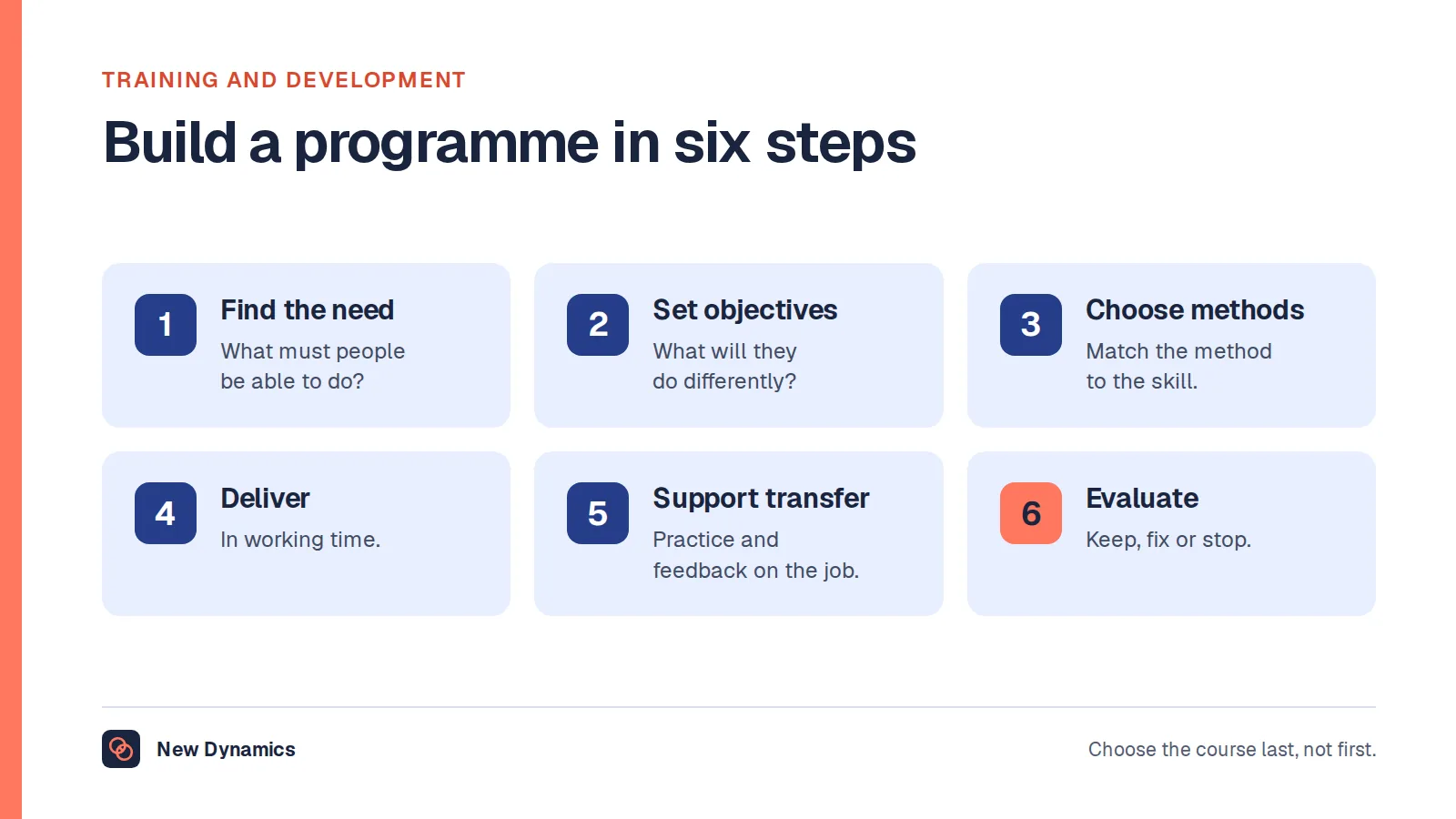
The pattern is the same as for any training: the course is a small part of the learning, and what happens before and after decides whether it sticks. Our guide to employee training and development programmes covers that design.
How to use a MOOC in a development plan
- Name the skill and the reason. What the person needs to be able to do afterwards, and which objective or role it serves. “Learn data analysis” is not a goal; “build the monthly attrition report without help” is.
- Choose the course against the skill. Read the syllabus, the time commitment and the assessment. Check who produced it and when it was last updated. Prefer a course with a practical assignment over one with quizzes alone.
- Protect the time. Agree the hours per week, when in the week, and what work moves to make room. A course with no protected time is a course that will not finish.
- Agree the evidence. What the person will show at the end: the certificate, the assignment, a short presentation to the team, a piece of real work done the new way. Evidence of application is worth more than evidence of completion.
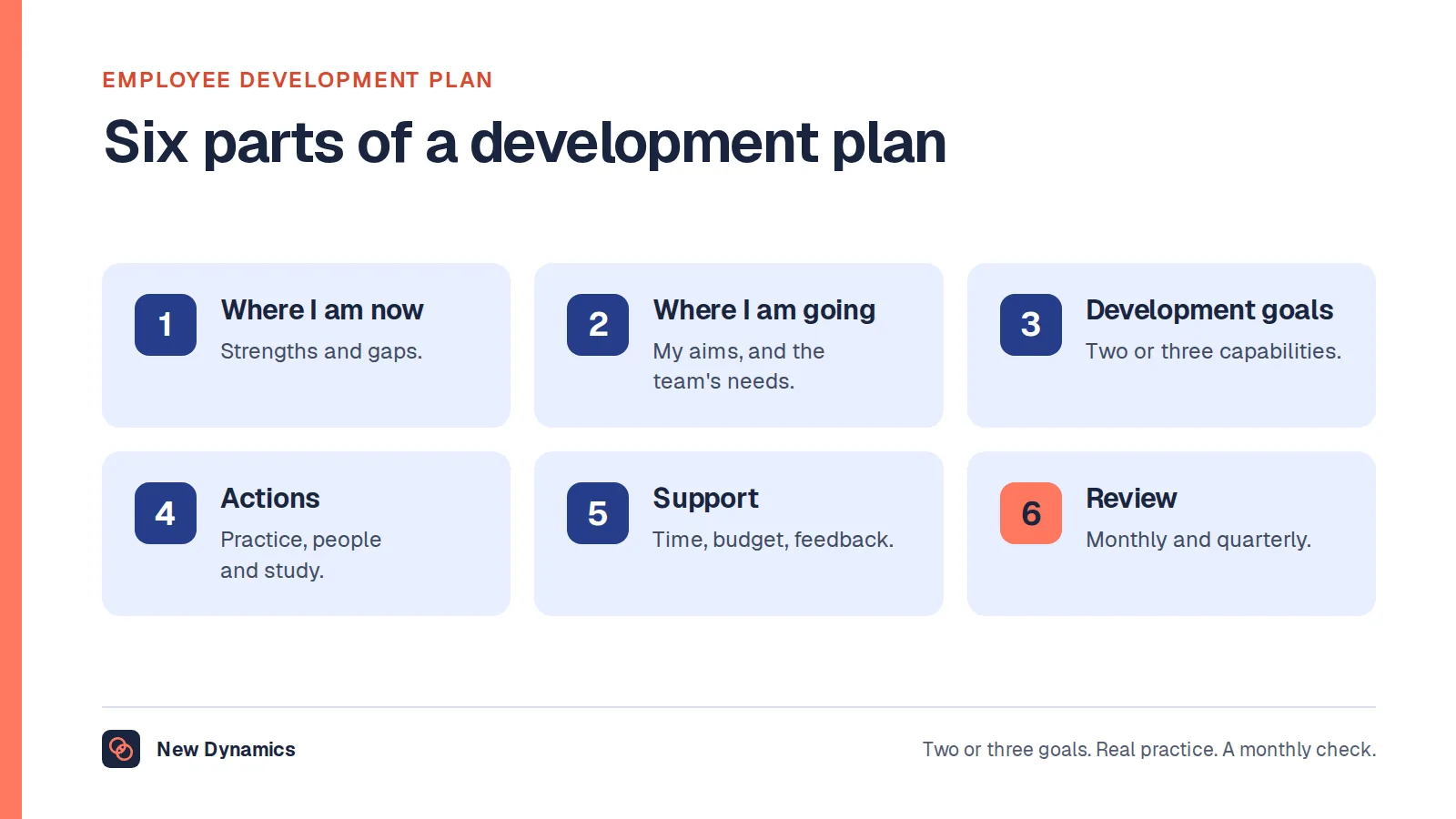
- Apply and review. Put the new skill to work within weeks, with a task that needs it, and discuss what changed at the next one-to-one and the next review. Record it in the development plan.

Frequently asked questions
What is a massive open online course?
A course of study made available over the internet, usually without charge, to a very large number of people, in the Oxford Learner's Dictionary definition. It has a structure, a sequence of units and usually an assessment, is open to anyone to enrol, and is built to teach thousands of learners at once.
What does MOOC stand for?
Massive open online course. Massive means built for very large numbers; open means anyone can enrol; online means delivered over the internet; course means structured learning with a start, a sequence and usually an assessment.
Are MOOCs free?
Basic access usually is, which is why the Oxford definition says “usually without charge”. Graded assessment, certificates and verified identity often cost extra, and some courses are now paid throughout. Check before assuming a certificate is included.
Is a MOOC certificate worth anything?
It shows participation and, where the provider verifies identity and assessment, some evidence of learning. Employers vary in how they value it. In a development plan, evidence that the skill has been applied at work is worth more than the certificate itself.
How are MOOCs different from a company's online training?
A company's e-learning is built for its own systems, policies and people and is usually compulsory and tracked. A MOOC is generic, open to anyone and self-directed, which makes it cheaper and wider in range but less relevant to a specific job and easier to abandon.
Your next step: decide five things before enrolling
- Name the skill and the work objective it serves.
- Choose the course against that skill, and check its syllabus, time and assessment.
- Protect the hours and move the work that needs moving.
- Agree the evidence of learning and the task the skill will be applied to, and put both in the review.
For a way to connect learning like this to a person's career, read and download our career development guide. The guide is free to read, and the PDF uses our short download form.
Want development goals, one-to-one notes and reviews in one place, so a course leads somewhere? Book a New Dynamics demo and bring your current development plan. You can also email contact@new-dynamics.com.