TL;DR
- Training teaches people to do their current job well. Development prepares them for what comes next. A good programme does both, and ties each activity to something the organisation needs people to be able to do.
- There are ten common types, from induction and job instruction to coaching, job rotation, apprenticeships, e-learning, simulation and leadership development. Much learning happens on the job, so design for that.
- Build a programme in six steps: find the need, set objectives, choose methods, deliver, support people in using what they learned, and evaluate at four levels, from reaction to results.
Organisations spend heavily on courses, and many managers would struggle to name one thing that their team does differently as a result. The problem is rarely the quality of the course. It is that the course was treated as the goal, when the goal was a skill used on the job.
This article explains what employee training and development programs are, describes ten types with examples, sets out six steps for building one and shows how to evaluate whether it worked.
Development sticks when it is tied to goals and followed up in regular conversations. See how New Dynamics continuous feedback keeps learning in view after the course ends.
What are training and development programs?
The open textbook Introduction to Business, published by OpenStax, gives a clear definition in its section on employee training and development:
“Training and development involves learning situations in which the employee acquires additional knowledge or skills to increase job performance.”
It adds that training objectives “specify performance improvements, reductions in errors, job knowledge to be gained, and/or other positive organizational results”, and that training “is done either on the job or off the job”.
Training and development: the difference
| Training | Development | |
|---|---|---|
| Aim | Do the current job well | Grow for future roles and challenges |
| Horizon | Now, and the next few months | One to five years |
| Typical content | Systems, procedures, products, safety | Leadership, judgement, breadth of experience |
| Typical methods | Instruction, e-learning, practice | Stretch assignments, coaching, mentoring, rotation |
| Who chooses | Mostly the organisation | Agreed between the person and their manager |
A programme is a planned set of these activities with a purpose, an audience, a budget and a way of telling whether it worked. A list of available courses is a catalogue.
Why invest in it?
- Performance. People cannot do well what they have not been shown how to do. Ability is one of the four drivers we describe in our guide to job performance.
- Safety and compliance. Some training is a legal or regulatory necessity.
- Retention. Capable people tend to stay where they are learning. That is our observation, and we are not citing a figure for it.
- Succession. Tomorrow's managers and specialists are usually already on the payroll. See our guide to strategic workforce planning.
- Adaptability. When tools and markets change, an organisation that knows how to retrain has options.
Ten types of employee training and development
OpenStax divides methods into on-the-job and off-the-job. The first six below are on the job.
1. Induction and orientation
OpenStax notes that new-employee training “usually begins with orientation”, covering company history, values, policies and customers. It adds that the specific job orientation by the supervisor, about work rules, equipment and performance expectations, is “more important”. See our 30-60-90 day plan.
2. Job instruction
Being shown how to do the task, at the workstation, by someone who does it well. It is quick and cheap, and its quality depends on the instructor.
3. Coaching
OpenStax describes coaching as “guidance given to new employees by experienced ones”. More broadly, it is a manager or a colleague helping someone to improve through questions, observation and feedback.
4. Job rotation and special assignments
Rotation is “the reassignment of workers to several different jobs over time”. Special projects and stretch assignments work in the same way: people learn by doing something new, with support.
5. Apprenticeships
An apprenticeship, OpenStax says, “usually combines specific on-the-job instruction with classroom training” and may last for several years. Apprenticeships are no longer confined to the skilled trades.
6. Mentoring
A senior or experienced colleague provides “job- and career-related information to a mentee”. OpenStax calls mentoring inexpensive and notes that it provides immediate feedback. Technology now allows it to work at a distance.
7. Classroom and workshop training
Off the job, training frequently takes place in a classroom, “where cases, role-play exercises, films, videos, lectures, and computer demonstrations are used to develop workplace skills”. It suits topics that benefit from discussion and practice with others.
8. E-learning and online employee training
OpenStax describes e-learning as “online computer presentation of information for learning new job tasks”, often self-paced and modular. It is efficient for dispersed workforces and for knowledge that everyone needs. It is weaker for skills that need practice with other people, so combine it with discussion or coaching.
9. Simulation
Practising in a realistic and safe setting, from a flight simulator to a role-played difficult conversation. OpenStax notes that a simulator “allows for more direct transfer of learning to the job”.
10. Leadership and management development
Longer programmes that combine several of the methods above: workshops, coaching, action learning projects, 360-degree feedback and mentoring. Our articles on management skills and leadership styles cover the content.
Two more categories cut across all ten: mandatory and compliance training, such as health and safety or data protection, and professional qualifications, which are usually studied part-time with the employer's support.
How to build a training and development program in six steps
- Find the need. Start from what the organisation needs people to be able to do, and compare that with what they can do now. Use performance data, customer feedback, managers' views and what employees ask for. Our skills gap analysis guide sets out a method.
- Set objectives. Say what people will do differently afterwards, and how you will know. “Reduce picking errors from 3% to 1%” is an objective. “Attend the warehouse course” is an activity.
- Choose the methods. Match the method to the skill. Knowledge suits e-learning. Practical skills need practice. Judgement needs experience with coaching.
- Deliver it. Give people time to learn during working hours. Brief their managers on what the training covers, so that they can reinforce it.
- Support transfer to the job. This is the step most often skipped. Within a week, the person should use the new skill on real work, with a manager or a coach watching and giving feedback. Build it into each person's development plan.
- Evaluate, and adjust. Check whether the objectives were met. Keep what worked, fix what did not and stop what made no difference.

How to evaluate training: four levels
A widely used framework is the Kirkpatrick Model, which evaluates training at four levels. Kirkpatrick Partners describes them as follows.
- Reaction: “the degree to which the target audience finds an experience or initiative favorable, engaging, relevant”.
- Learning: the degree to which people acquire “the intended knowledge, skills, attitude, confidence, and commitment”.
- Behavior: the degree to which people perform “the critical behaviors in its environment”, and are supported and accountable for doing so.
- Results: “the degree to which targeted organizational outcomes occur as a result”.
Many organisations measure level 1 with a feedback form and stop. The levels that matter to the business are 3 and 4. Kirkpatrick Partners advises starting with level 4, by being clear about the purpose of the programme before designing it.

Time off for training: the UK position
In the UK, some employees have a statutory right to ask for time off for training or study. GOV.UK's guide to training and study at work says that, to ask, staff must be classed as an employee, must have worked for their employer for at least 26 weeks, the training “must help staff do their job better” and “at least 250 people must work in the organisation”. It adds that time off “is usually unpaid unless the employer agrees to pay it”. This is general information, not legal advice.
Whatever the law requires, time is the practical barrier. Training that people must do in their own evenings tells them how much the organisation values it.
Common mistakes
Starting with the course. Begin with the need and the objective, and choose the course last.
No follow-up. Without practice and feedback on the job, much of what was learned can fade.
Sending the wrong people. Training cannot fix a problem caused by unclear goals, poor tools or a bad process.
Measuring attendance. Completion rates show that people turned up.
One size for everyone. New starters, experienced staff and managers need different things.
Forgetting managers. A manager who does not know what was taught cannot reinforce it, and one who mocks it will undo it.
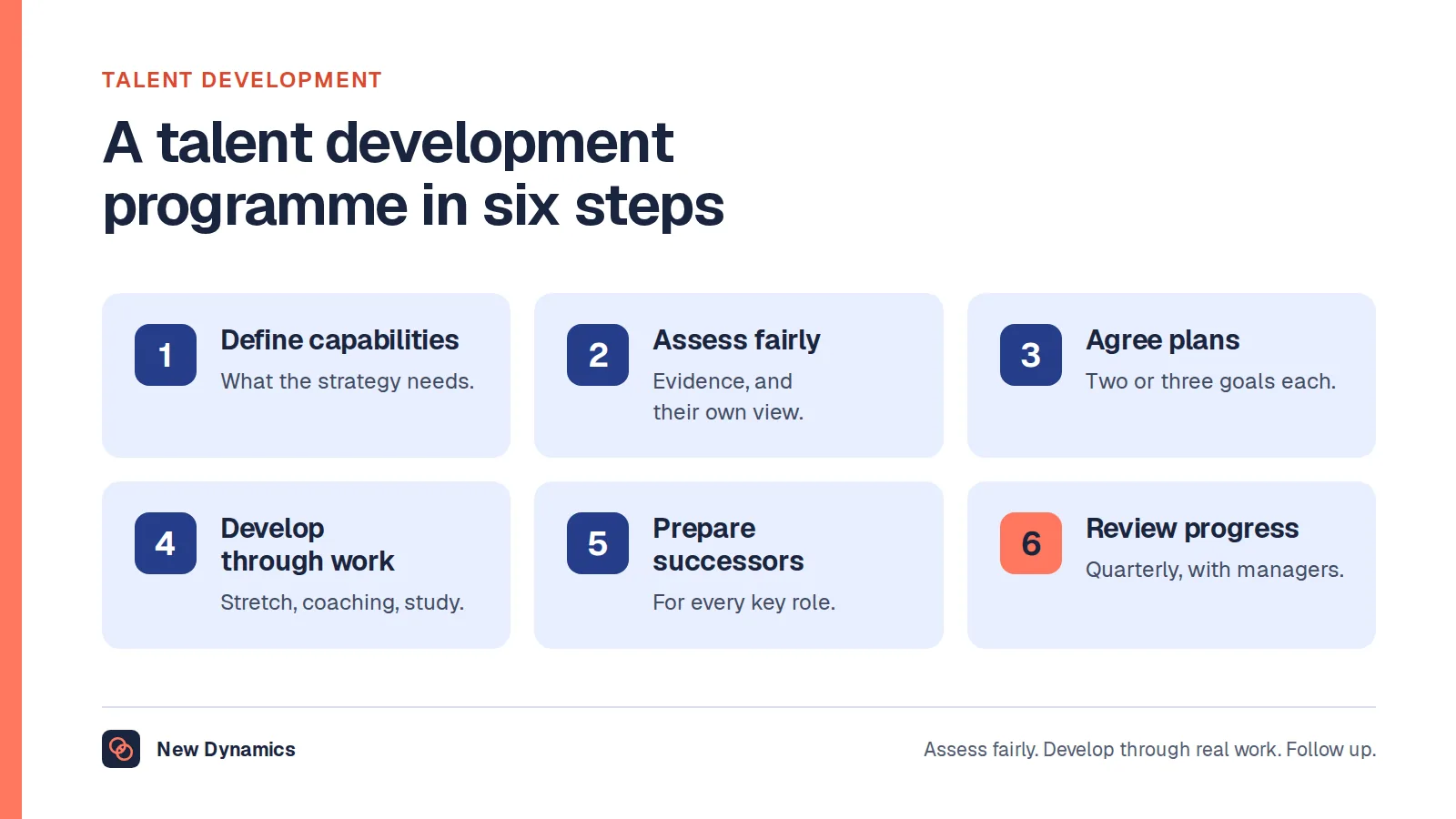
Treating development as a reward for a few. Everyone should have some, even if the form differs. See our guide to talent development.

Frequently asked questions
What is an employee training and development program?
It is a planned set of learning activities with a purpose, an audience and a way of measuring success. Training helps people to do their current jobs well, and development prepares them for future roles and challenges.
What is the difference between training and development?
Training is about the current job and the near term: systems, procedures, products and safety. Development looks further ahead, building judgement, leadership and breadth of experience through stretch work, coaching, mentoring and rotation.
What are the main types of employee training?
Common types are induction, job instruction, coaching, job rotation, apprenticeships, mentoring, classroom training, e-learning, simulation and leadership development. Mandatory compliance training and professional qualifications cut across them.
How do you create a training program for employees?
Find the need, set objectives that describe what people will do differently, choose methods that suit the skill, deliver the training in working time, support people in using it on the job and evaluate the results.
How do you measure the effectiveness of training?
The Kirkpatrick Model uses four levels: reaction, learning, behaviour and results. Feedback forms cover only the first. Look for changed behaviour on the job and for movement in the business outcome that the training was meant to improve.
Is online employee training effective?
It works well for knowledge that many people need, especially in dispersed workforces, because it is consistent and self-paced. It is weaker for skills that need practice with other people, so combine it with discussion, coaching or practice on the job.
Your next step: check one programme
- Pick one training course that your team attended in the past year.
- Ask what people were meant to do differently afterwards.
- Ask three attendees and their managers whether they do.
- If the answer is no, add follow-up and practice before you book it again.
For a structured way to connect development to career conversations, read and download our career development guide. The guide is free to read, and the PDF uses our short download form.
Want development goals, feedback and check-ins in one place, so that learning is followed through? Book a New Dynamics demo and bring your current approach. You can also email contact@new-dynamics.com.