TL;DR
- Network engineers set up, develop and maintain physical and wireless computer networks within an organisation or between organisations, in Prospects' definition. O*NET lists network engineer among the titles for network and computer systems administrators, whose work is to install, configure and maintain an organisation's local and wide area networks.
- The responsibilities fall into six groups: designing and building the network, improving its resilience, monitoring and troubleshooting performance, securing it through policies and access control, configuring routers, switches, firewalls and voice services, and supporting engineers and users, including on call outside office hours.
- Employers ask for a degree in networks, computer science or a related subject, or a degree apprenticeship, plus vendor certifications such as Cisco CCNA and CCNP or CompTIA Network+. Say in the job profile which certifications matter, what the on-call rota is, and how the role differs from the administrator, architect and security engineer around it.
Every application, phone call, payment and video meeting in an organisation travels over a network that someone designed, built and keeps running. What does a network engineer do? They are that someone: the engineer who plans the network, installs and configures the equipment, watches its performance, secures it and answers the call when it fails at two in the morning.
This article explains the job using two primary sources, the UK graduate careers service Prospects and the US O*NET occupational database, sets out six responsibilities, the skills and certifications employers ask for, how the role differs from its neighbours, what an incident looks like from the inside, and a job profile template to adapt.
An engineer who carries the on-call phone deserves objectives that reflect it. See how New Dynamics performance reviews bring projects, incidents, feedback and development into one fair conversation.
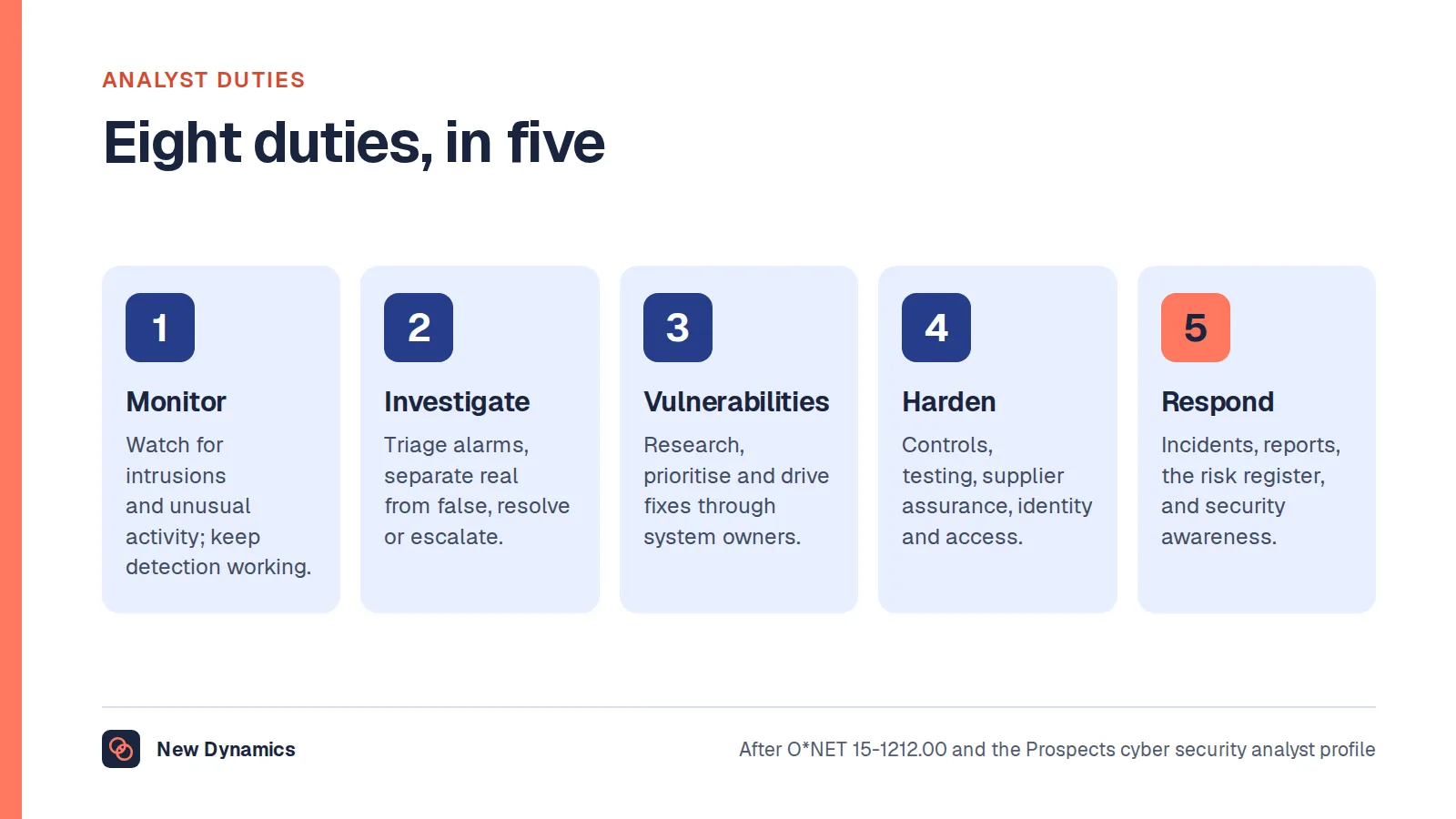
The same is true of the people watching the network for attacks: see our cyber security analyst job description.
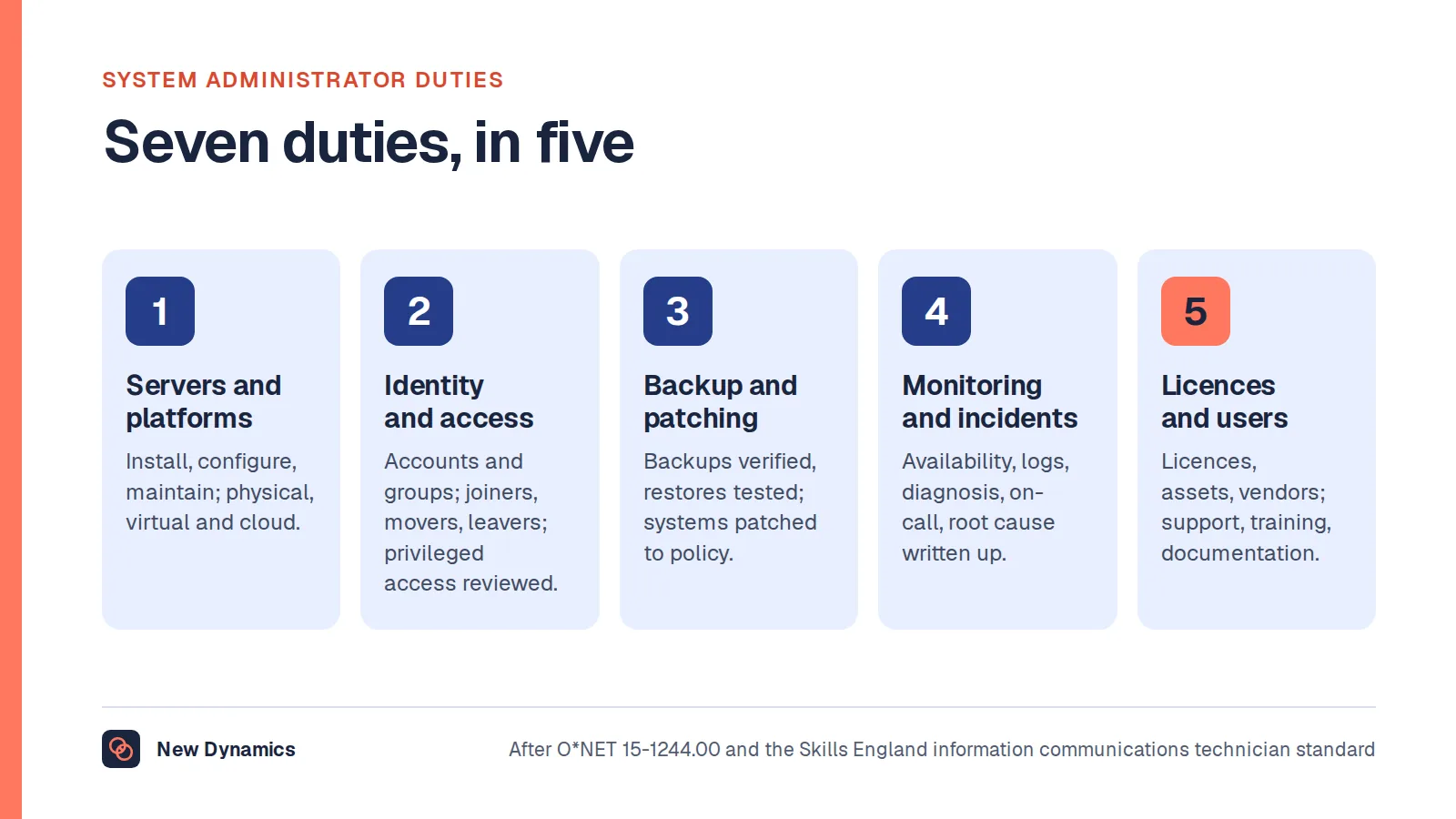
If the vacancy is for the servers, accounts and backups rather than the network, our system administrator job description sets out the seven duties, the three sizes of the job and a template.
What is a network engineer?
Prospects defines the role in one sentence: “Network engineers set up, develop and maintain physical and wireless computer networks within an organisation or between organisations.” O*NET lists Network Engineer among the sample titles for network and computer systems administrators, alongside network administrator, network analyst, network manager and systems engineer, and describes the occupation as installing, configuring and maintaining an organisation's local area network and wide area network.
The two words to notice are “develop” and “maintain”. The job is not only keeping the lights on. Prospects' responsibilities begin with designing the network and improving its resilience, and end with supporting the people who use it. A good job profile covers both ends.
Network engineer responsibilities: six areas
Grouped from Prospects' responsibilities and O*NET's tasks, the work has six parts.
- Design and build. Prospects: “establish the networking environment by designing system configuration, directing system installation”. O*NET: design, configure and test computer hardware, networking software and operating system software. The engineer plans how the network is laid out and brings new sites, links and services into it.
- Improve resilience. Prospects: “design and implement new solutions and improve the resilience of the current environment”. Redundant links, failover, capacity planning and the disaster recovery operations O*NET lists.
- Monitor and troubleshoot. Prospects: “maximise network performance by monitoring performance, troubleshooting network problems”. O*NET: monitor network performance to determine whether adjustments are needed; diagnose, troubleshoot and resolve hardware, software or other network and system problems; maintain logs of network functions, maintenance and repairs.
- Secure the network. Prospects: “secure network systems by establishing and enforcing policies, and defining and monitoring access”. O*NET's first task is to plan, coordinate and implement network security measures to protect data, software and hardware.
- Configure the equipment. Prospects: “configure routing and switching equipment, hosted IP voice services and firewalls”. This is the hands-on core of the job: the routers, switches, firewalls, wireless controllers and voice platforms the network is made of.
- Support engineers and users. Prospects: “provide remote support to on-site engineers and end users/customers during installation”; O*NET adds conferring with users about solutions to problems and keeping an inventory of parts for emergency repairs. Prospects also says plainly that “you may be on call outside office hours, at weekends or in the evenings.”

Network engineer vs administrator vs architect vs security engineer
The titles overlap and employers use them loosely. The table gives the usual division; the job profile should say which one it means.
| Role | Focus | Typical work |
|---|---|---|
| Network administrator | Keeping the existing network running | Monitoring, user access, patches, backups, tickets |
| Network engineer | Designing, building, improving and securing the network | New sites and links, resilience, configuration, incidents |
| Network architect | The network's overall design and standards, often across sites | Designs, roadmaps, vendor selection, review of others' work |
| Network security engineer | Protecting the network specifically | Firewalls, access control, monitoring for intrusion, response |
O*NET groups engineers and administrators in one occupation, and in a small organisation one person does both. In a large one, the engineer builds what the architect designs and hands it to administrators to run. Prospects lists network architecture and senior network management among the roles a network engineer progresses to.

Skills and certifications employers ask for
Prospects lists relevant technical knowledge and skills, “excellent communication skills for communicating with staff who aren't technically trained”, analytical and problem-solving skills, and “the ability to work well both on your own and in a team”. O*NET's essential skills are active listening, critical thinking, monitoring, reading comprehension, speaking, active learning, learning strategies and writing. Its technology list for the occupation includes Windows Server, Linux, Active Directory, Docker, Ansible, PowerShell and ServiceNow: the environment around the network, not only the network itself.
Qualifications. Prospects says employers look for a degree in computer networks, computer science, electrical or electronic engineering, mathematics or physics, and that degree apprenticeships are available. O*NET places the occupation in Job Zone Three, where vocational training, related experience or an associate's degree is usual and one to two years of training and experience are needed. Summer placements and IT support roles strengthen an application.
Certifications. Prospects names Cisco CCNA and CCNP Enterprise, CompTIA A+ and Network+, Google Cloud and Microsoft Azure network engineer certifications, Juniper Networks and Palo Alto Networks. Which matter depends on the equipment in your network; say so in the profile rather than listing them all.
Employers. Prospects lists banks, retail groups, government departments, educational institutions, hospitals, utility companies, management consultancies and specialist IT consulting firms. Almost every organisation of any size has a network; the question is whether it employs its own engineer or buys the service.
An incident, from the inside
A job profile should describe the whole job, and the whole job includes the night the network fails. A typical sequence:
- Alert. Monitoring reports a site unreachable; the on-call engineer is paged.
- Diagnose. Logs, the monitoring console, the last change made, a call to the site: is it the link, the router, power or a configuration error?
- Restore. Fail over to the backup link or roll back the change; confirm service is back before finding the root cause.
- Record and improve. Write up the incident, fix the cause, and feed the lesson into the resilience work so that it does not happen again.
The profile should say how often the on-call rota comes round, how it is paid or recovered in time off, and what support the engineer has at three in the morning.
Network engineer job profile template
Job title: Network Engineer (or Senior Network Engineer)
Reports to: Network Manager, Infrastructure Manager or Head of IT
Purpose: Design, build, secure and maintain the organisation's networks so that services are available, performant and protected, and support the teams and users who depend on them.
Responsibilities:
- Design and implement network configurations for new sites, links and services; direct installations.
- Improve resilience through redundancy, failover, capacity planning and disaster recovery testing.
- Monitor network performance; diagnose, troubleshoot and resolve problems; keep accurate logs.
- Implement and enforce security policies; define and monitor access; maintain firewalls.
- Configure and maintain routing, switching, wireless, firewall and IP voice equipment.
- Support on-site engineers and users during installations and incidents; maintain spares.
- Document the network and its changes; follow change control.
- Take part in the on-call rota; state the frequency and the arrangements.
Skills and experience:
- Degree or degree apprenticeship in networks, computer science or a related subject, or equivalent experience.
- Certifications relevant to the estate; state which, for example Cisco CCNA or CCNP, CompTIA Network+, or a cloud networking certification.
- Hands-on experience with the equipment and platforms in use; name them.
- Analytical and problem-solving skills under pressure.
- Clear communication with colleagues who are not technical.
Working pattern: Office or data-centre based with site visits; on-call outside office hours on a stated rota.

Frequently asked questions
What does a network engineer do day to day?
Monitors the network's performance, resolves problems, makes and documents configuration changes, works on projects to add sites, links or services and to improve resilience, enforces security policies and access, and supports engineers and users. Outside office hours they may be on call for incidents.
What is the difference between a network engineer and a network administrator?
An administrator keeps the existing network running: monitoring, access, patches and tickets. An engineer designs, builds, improves and secures it as well. The US occupational database groups both in one occupation and in small organisations one person does both jobs.
What qualifications does a network engineer need?
Prospects says employers look for a degree in computer networks, computer science, electrical or electronic engineering, mathematics or physics, or a degree apprenticeship, with vendor certifications such as Cisco CCNA and CCNP or CompTIA Network+. The US occupational database places the occupation in Job Zone Three, where vocational training or an associate's degree plus one to two years' experience is typical.
Do network engineers work on call?
Often. Prospects says a network engineer may be on call outside office hours, at weekends or in the evenings. A job profile should state the rota, how it is compensated and what support is available during an incident.
Where do network engineers progress to?
Prospects lists senior network manager, technical project management, network architecture and IT contracting. Security is another common route, into network security engineering.
Your next step: write the profile for the whole job
- Say which network role this is: administrator, engineer, architect or security.
- Name the equipment and the certifications that matter for your estate.
- State the on-call rota and how it is recognised.
- Set objectives that cover projects, resilience and incidents, not only tickets closed.
For a way to write those objectives so they can be measured, read and download our SMART goals guide. The guide is free to read, and the PDF uses our short download form.
Want engineers' objectives, on-call load, feedback and reviews in one place? Book a New Dynamics demo and bring your current job profile. You can also email contact@new-dynamics.com.