TL;DR
- A system administrator keeps an organisation's servers, systems and accounts running: installing and configuring operating systems and physical and virtual servers, monitoring them, reviewing logs and verifying that scheduled jobs including backups completed, controlling user access, installing and upgrading software and maintaining licences. Those are O*NET's own words for the occupation that covers systems and network administrators, which it places in Job Zone three, medium preparation.
- The duties fall into seven groups: servers and platforms, identity and access, backup and recovery, patching and endpoints, monitoring and incidents, licences and assets, and users and documentation. The Skills England information communications technician standard describes the wider occupation's purpose as the efficient operation and control of the IT and telecommunications infrastructure, on-premises or in the cloud, and lists duties from diagnosing faults and applying security policy to testing, documenting and escalating with a clear audit trail.
- The job comes in three sizes: the sole administrator who is the whole IT function in a smaller organisation, the member of an infrastructure team in a mid-sized one, and the platform or domain specialist in a large function. Write the advert around the estate, the size, the on-call arrangement and the cloud or on-premises mix, and set objectives that pay for prevention, not only for firefighting: patch currency, restore tests that actually restore, and the proportion of work that is planned rather than reactive.
There is a job in every organisation where success is invisible and failure is a company-wide email. The servers are up, the backups ran, the accounts for the three new starters existed on Monday morning, the licences did not lapse and nobody had to think about any of it. That is the system administrator, and the reason so many system administrator job descriptions read as a shapeless list of technologies is that the job is easier to describe by what it prevents than by what it produces.
This article gives a systems administrator position description built from three primary sources, the US O*NET occupational database, the Skills England information communications technician standard and the UK National Careers Service. It sets out seven duties, the three sizes of the job, the difference from IT support, a network engineer and a DevOps or platform engineer, the skills and certifications, the on-call question, a template and objectives that reward prevention.
A sysadmin's best work is the incident that never happened, which an annual appraisal is poorly designed to see. See how New Dynamics performance reviews bring projects, incidents, feedback and development into one fair conversation on your own form.
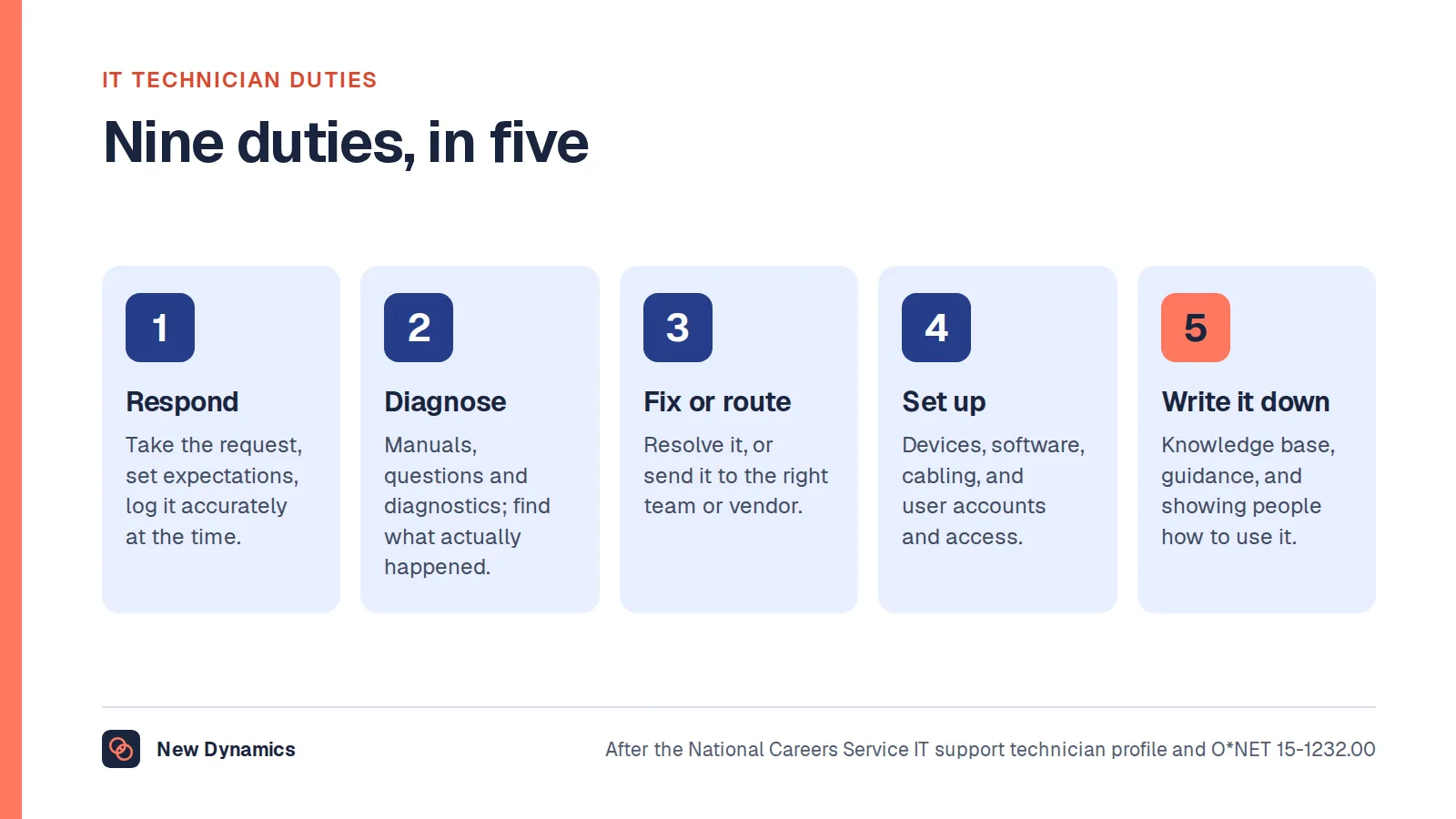
The rung below is a different job with its own rhythm: our IT technician job description covers the support lines and the account work.
What does a system administrator do?
O*NET describes the occupation as installing, configuring and maintaining “an organization's local area network (LAN), wide area network (WAN), data communications network, operating systems, and physical and virtual servers”; performing “system monitoring and verify the integrity and availability of hardware, network, and server resources and systems”; reviewing “system and application logs and verify completion of scheduled jobs, including system backups”; analysing “network and server resource consumption and control user access”; and installing and upgrading “software and maintain software licenses”. Its tasks add planning and implementing security measures, performing data backups and disaster recovery, diagnosing and resolving hardware and software problems, maintaining logs and repair records, recommending configuration changes, coordinating with vendors, training people in system use and researching new technologies.
The Skills England information communications technician standard describes the broader occupation's purpose as delivering “efficient operation and control of the IT and/or Telecommunications infrastructure (comprising physical or virtual hardware, software, network services and data storage) either on-premises or to end-users provisioned as cloud services”. Its core duties include providing technical support through a range of channels, diagnosing faults with a proper troubleshooting methodology, applying the organisation's security policies, communicating with stakeholders at all levels and managing escalation, testing hardware, software and cabling, continuous self-learning, and documenting or escalating tasks “to ensure a clear audit trail”.
System administrator duties: seven responsibilities
Grouped from the O*NET tasks and the standard's duties, the work has seven parts.
- Servers and platforms. Install, configure and maintain operating systems and physical and virtual servers; build and rebuild them repeatably; manage storage; run the on-premises, cloud or hybrid estate the organisation actually has.
- Identity and access. Create, change and remove accounts and groups; control user access, in O*NET's phrase; apply the access policy at joiners, movers and leavers; keep privileged accounts few and reviewed.
- Backup and recovery. Perform data backups and disaster recovery operations; verify completion of scheduled jobs, which is the duty most often assumed and least often checked; test restores and keep the recovery plan current.
- Patching and endpoints. Install and upgrade software; keep systems patched to the organisation's policy; manage laptops, desktops and mobile devices, their builds, encryption and antivirus.
- Monitoring and incidents. Monitor performance and availability; review system and application logs; diagnose, troubleshoot and resolve problems and replace defective components; run or take part in the on-call rota; write the incident up afterwards.
- Licences, assets and vendors. Maintain software licences; keep the asset inventory, including the spare parts O*NET mentions for emergency repairs; coordinate with vendors and company personnel to facilitate purchases; analyse performance records to decide repair or replacement.
- Users and documentation. Confer with users about solutions to system problems; train people in system use; document what was done and why, so the next person, or the auditor, can follow the trail.

The three sizes of the job
- The sole administrator. In a smaller organisation the sysadmin is the IT function: servers, laptops, phones, the website's hosting, the printer and the questions. Breadth, judgement about what to outsource, and the discipline to document alone.
- The infrastructure team member. In a mid-sized organisation, one of a few administrators covering servers, identity, backup and endpoints, with a rota and a change process. Depth in two or three areas and the ability to work to a standard.
- The platform or domain specialist. In a large IT function, responsible for one platform: directory services, virtualisation, storage, email, databases or a cloud tenancy. Depth, scale and change control.
The advert should say which size it is, because the candidate who thrives as the sole administrator and the candidate who thrives inside a change process are rarely the same person.

Sysadmin vs IT support vs network engineer vs DevOps vs IT manager
| Role | Owns | Typical measure |
|---|---|---|
| IT support technician | The user's problem, at first and second line | Tickets resolved, response times |
| System administrator | The servers, systems, accounts and the estate's health | Availability, patch currency, restores tested |
| Network engineer | The network: routing, switching, firewalls, connectivity | Network availability and performance |
| DevOps or platform engineer | The pipeline and the application platform, as code | Deployment frequency, change failure rate |
| IT manager | The function: people, budget, suppliers, roadmap | Service, cost, delivery |
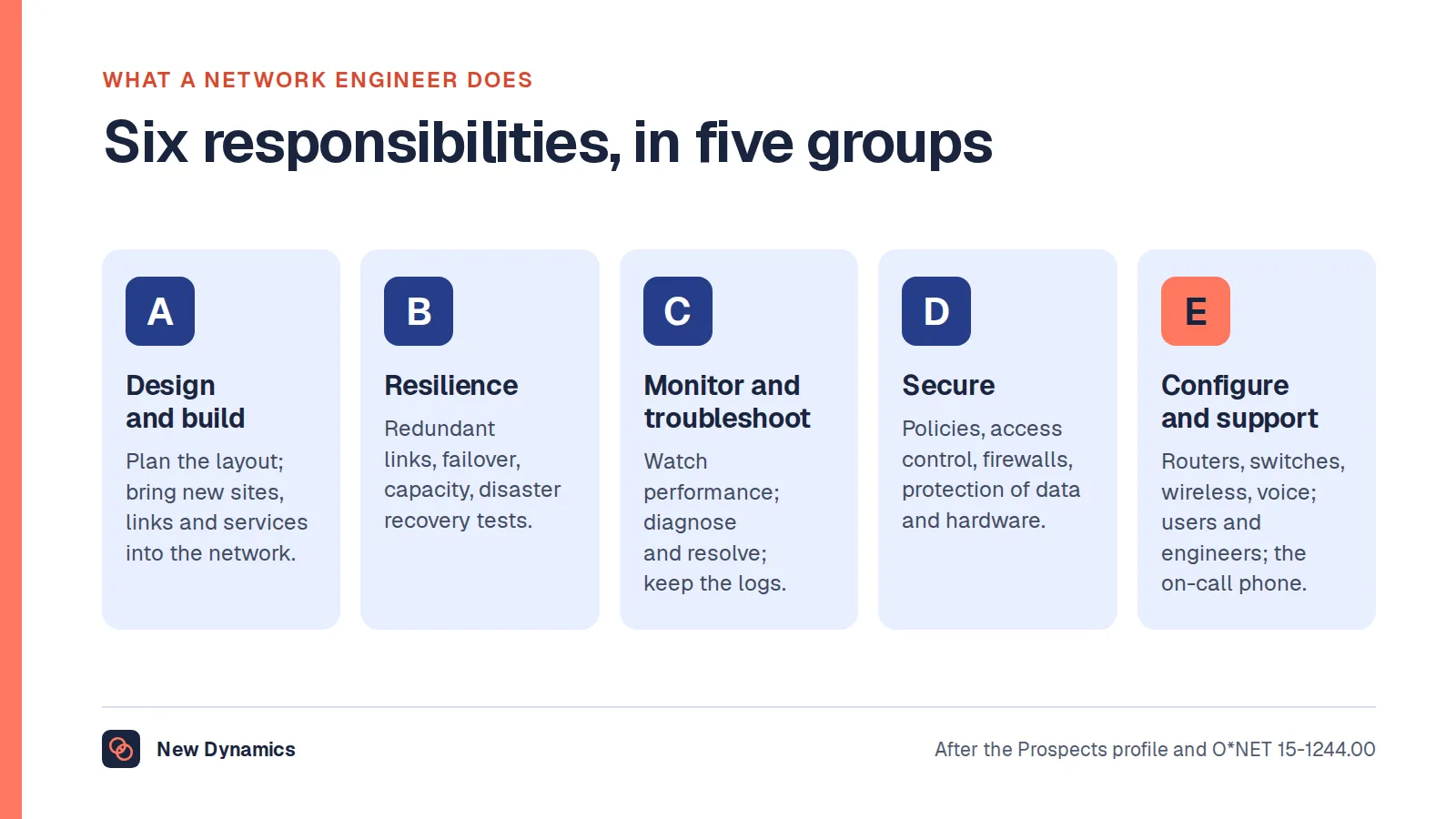
O*NET puts systems and network administration in one occupation, and in smaller organisations one person does both; our network engineer job profile covers the network side in full. The line with DevOps is blurred wherever infrastructure is defined in code, and many sysadmin adverts now ask for scripting and automation as a matter of course. Say in the advert which of the five the post is, and who holds the others.
Skills and certifications
The National Careers Service's network manager profile lists knowledge of computer operating systems, hardware and software, thoroughness and attention to detail, analytical thinking, complex problem-solving, working well with others, initiative, knowledge of systems analysis and development, customer service skills and a thorough understanding of computer systems and applications. The Skills England standard adds diagnosing with a methodology rather than by guesswork, applying security policy, communicating with stakeholders and keeping an audit trail.
For the advert, add:
- Scripting and automation, because a task done by hand three times should be a script.
- Change discipline. Knowing what changed, when and why is most of root cause analysis.
- Security instinct. Least privilege, patching and the assumption that the organisation is a target.
- Plain communication with non-technical colleagues, especially during an outage.
- Documentation, which the standard makes a duty in its own right.
Certifications. The National Careers Service says people in these roles keep skills current “through training and industry certifications”, and the Skills England standard makes continuous self-learning a duty. Vendor and vendor-neutral certifications in operating systems, cloud platforms, virtualisation and security are common; name in the advert which ones the organisation requires, which it will fund, and which experience can replace, rather than listing every certification you have heard of.
The on-call question
Most sysadmin roles carry some out-of-hours responsibility. Adverts that leave it out attract people who leave when they discover it. State the rota frequency, what triggers a call-out, the compensation or time off in lieu, the escalation path and whether remote access is sufficient to fix things. Then keep the promise: a rota that is one-in-four on paper and one-in-two in practice is the fastest way to lose the person you hired.
System administrator job description template
Job title: System Administrator (or Systems Administrator, Infrastructure Administrator; add the platform where the role is specialised)
Reports to: IT Manager, Head of Infrastructure or, in a small organisation, the Finance or Operations Director
Scope: State the estate: number of users and sites, servers physical and virtual, the cloud and on-premises mix, the operating systems and core platforms, the ticketing and monitoring tools, the size of the IT team and the on-call rota.
Purpose: Keep the organisation's systems available, secure, current and recoverable, and make sure the people who depend on them can work.
Responsibilities:
- Install, configure and maintain servers, operating systems and core platforms, on-premises and in the cloud.
- Administer accounts, groups and access; apply the access policy at joiners, movers and leavers; review privileged access.
- Run and verify backups; test restores; maintain and rehearse the recovery plan.
- Patch systems to policy; manage endpoint builds, encryption and protection software.
- Monitor availability and performance; review logs; diagnose and resolve incidents; take part in the on-call rota; document root cause.
- Maintain software licences, the asset inventory and spares; coordinate with vendors on purchases, repairs and replacements.
- Support and train users; write and maintain documentation and runbooks; keep a clear audit trail of changes.
Skills and experience:
- Experience administering comparable systems at comparable scale; state the platforms that are essential and those that can be learned.
- Scripting and automation; change discipline; a methodical approach to diagnosis.
- Working knowledge of security practice: least privilege, patching, backup integrity.
- Clear communication with non-technical colleagues; good documentation habits.
- Certifications: state which are required, which the organisation funds and what experience replaces them.
Working pattern: State the hours, the on-call rota and its compensation, the office or remote arrangement and any change windows outside normal hours.
Progression: Senior administrator, infrastructure or platform engineer, security, or IT management; say which routes the organisation supports.
Objectives that pay for prevention
If the only visible work is the outage, the only rewarded skill is firefighting. Set four objectives that make prevention countable:
- Availability and recovery. Agreed availability met, and restores tested on a schedule, from real backups, with the time to restore recorded.
- Currency. Systems patched within the policy window; supported versions maintained; the list of exceptions shrinking.
- Planned versus reactive. The proportion of the administrator's time spent on planned work, rising over the year.
- Documentation and handover. Runbooks current for the systems that matter, so that any competent colleague could take the on-call phone.

Frequently asked questions
What does a system administrator do?
Installs, configures and maintains servers, operating systems and core platforms; monitors them and verifies that scheduled jobs including backups completed; controls user access; patches and upgrades software; maintains licences; diagnoses and resolves problems; and supports and documents. The US occupational database describes the occupation in those terms and adds security measures, disaster recovery, vendor coordination and training users.
What is the difference between a system administrator and IT support?
IT support resolves the user's problem at first and second line; the system administrator owns the servers, systems, accounts and the health of the estate behind those problems. In small organisations one person does both, which the advert should say.
What is the difference between a system administrator and a network engineer?
The administrator owns servers, systems and accounts; the network engineer owns routing, switching, firewalls and connectivity. The US occupational database places both in one occupation because the work overlaps, and in smaller organisations it is one job.
What qualifications does a system administrator need?
No single qualification. The US occupational database places the occupation in Job Zone three, meaning vocational training, related experience or an associate's degree; in England the information communications technician apprenticeship is a common route, and the National Careers Service points to foundation degrees, HNDs, degrees and higher apprenticeships as well as industry certifications. Most employers hire on demonstrated experience with comparable systems.
Do system administrators work on call?
Usually some of the time, because systems fail outside office hours. The advert should state the rota frequency, what triggers a call-out, the compensation or time off in lieu and the escalation path, and the employer should keep to it.
Your next step: describe the estate, not the technologies
- Write down the estate: users, sites, servers, cloud and on-premises mix, core platforms and tools.
- Say which of the three sizes the job is and who holds the neighbouring roles.
- State the on-call rota and its compensation in the advert.
- Set objectives on availability, restores tested, patch currency and planned-versus-reactive work.
For a way to write objectives an administrator can be measured against fairly, read and download our SMART goals guide. The guide is free to read, and the PDF uses our short download form.
Want objectives, incident reviews and development for a technical team in one place, on your own review form? Book a New Dynamics demo and bring your current appraisal form. You can also email contact@new-dynamics.com.