TL;DR
- An office coordinator keeps an office running: the routines, the suppliers, the space, the visitors and often a small team, without carrying the budget or the appraisals that define a manager. O*NET lists Office Coordinator among the reported job titles for First-Line Supervisors of Office and Administrative Support Workers, who “directly supervise and coordinate the activities of clerical and administrative support workers”.
- The useful way to write the role is as a rung on a ladder. An administrative assistant does the work; a coordinator owns the routines and the standard, and may schedule and check others' work; an office manager owns the budget, the appraisals and the office's relationship with the rest of the business.
- Two areas land on this role and rarely appear in the advert. Facilities and health and safety, including HSE's display screen equipment duties, employers must “do a DSE workstation assessment”, reduce risks, “provide an eye test if a worker asks for one” and “provide training and information for workers”, and everything to do with people arriving: new starters, visitors, contractors and desks.
"Office coordinator" is the title employers reach for when "assistant" sounds too junior and "manager" implies a budget they do not intend to hand over. That is a legitimate job, and it deserves a job description that says what it is rather than one borrowed from either neighbour.
This article sets out an office coordinator job description: where the role sits, eight duties, the facilities and safety work that lands on it, what it is not, how to level it, and a template. It is general information about the role, not legal advice.
Coordinating an office is mostly running the same processes over and over with different people in them. See how New Dynamics workflows let you define your own stages, forms and approvals, with a completion view instead of a spreadsheet.
Where the role sits

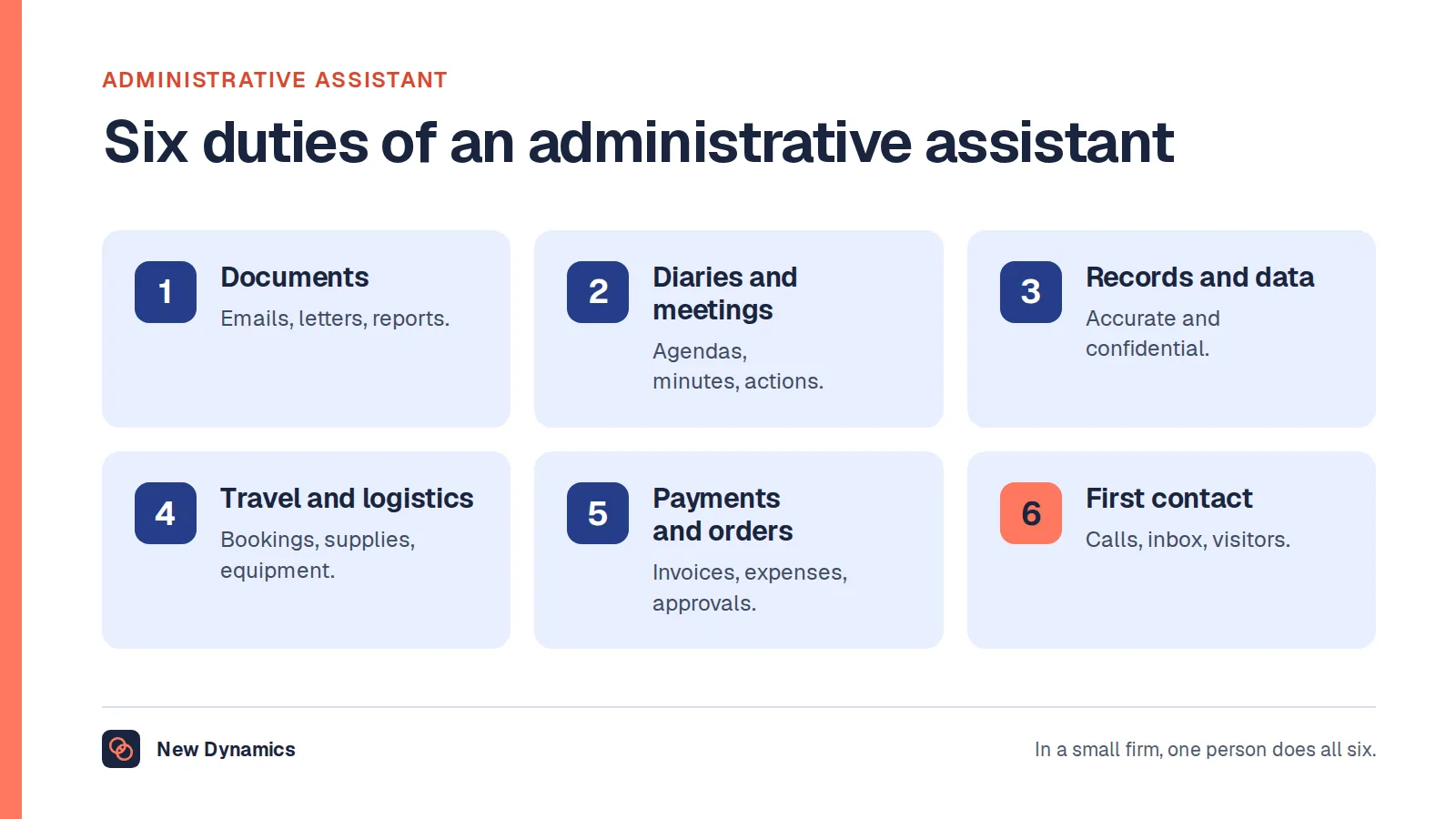
- Administrative assistant. Does the work: correspondence, filing, scheduling, calls, data entry. Our administrative assistant job description covers it.
- Office coordinator. Owns the routines and the standard. Still does plenty hands-on, but is the person who notices the process is broken and fixes it, and who may schedule and check other people's work. O*NET lists Office Coordinator among the reported job titles for First-Line Supervisors of Office and Administrative Support Workers, who "directly supervise and coordinate the activities of clerical and administrative support workers".
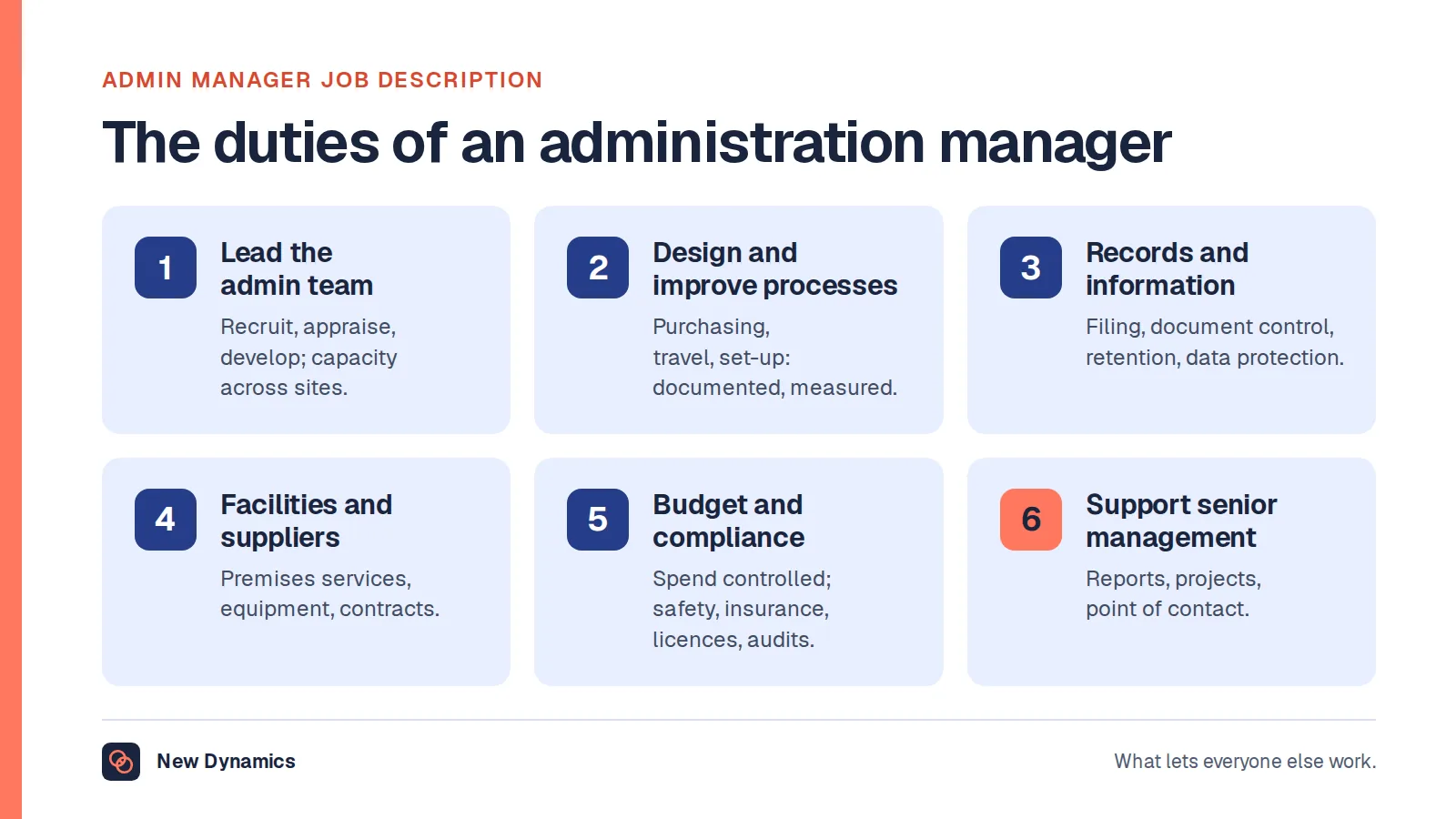
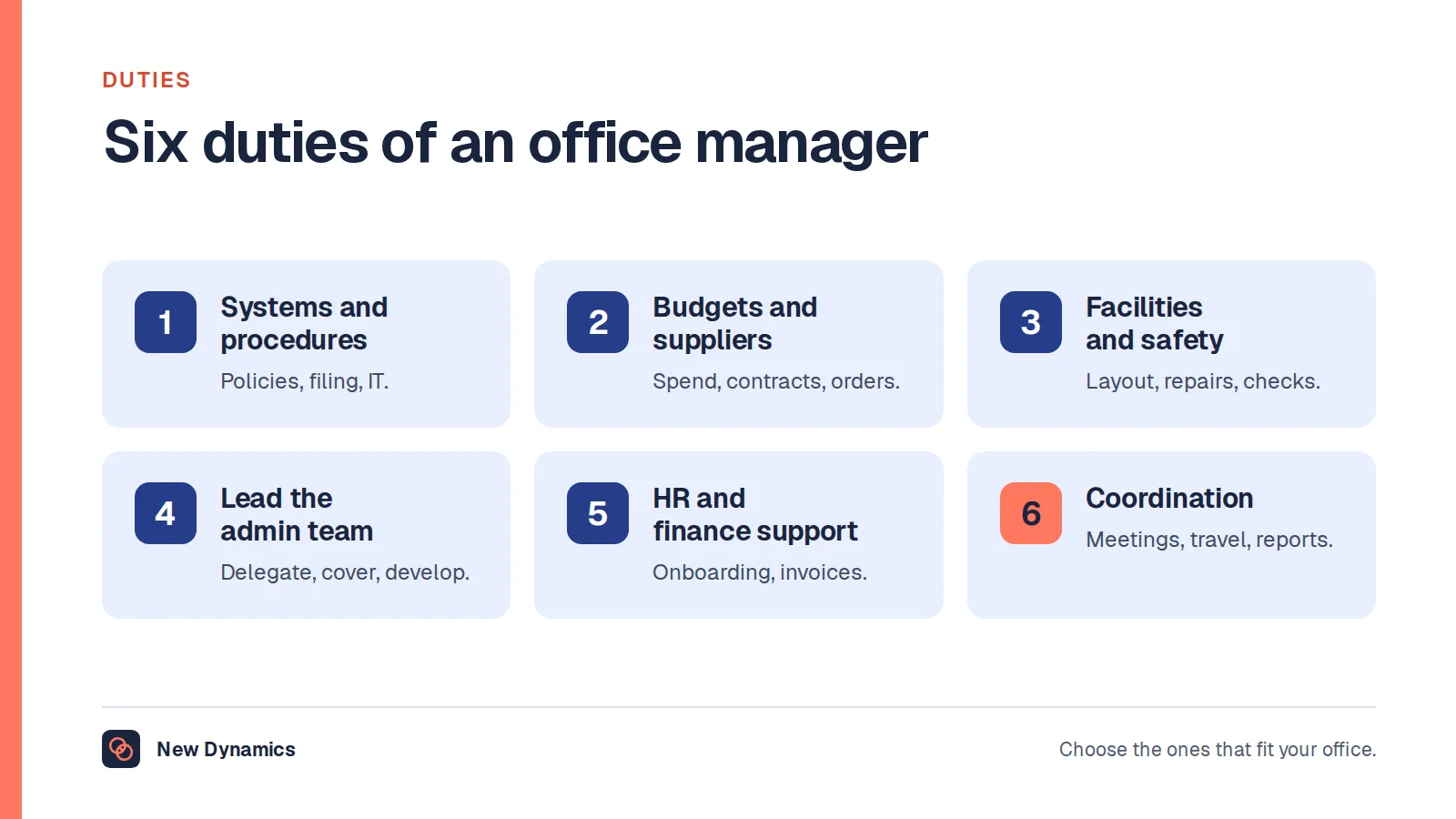
- Office manager. Owns the budget, the appraisals and the relationship with the rest of the business. The National Careers Service's office manager profile includes managing "an office budget and expenses", carrying out "staff appraisals and monitor performance", dealing with disciplinary issues and preparing reports for the senior management team. See our office manager job description.
The clean test for an advert: does this person decide how the money is spent, and do they hold appraisals? If yes, it is a manager's job with a coordinator's title, and it should be paid accordingly.
Eight duties

- Run the routines. The recurring work that keeps an office functioning (post, meeting rooms, deliveries, bookings, expenses, the weekly and monthly cycles) and the standard they are done to.
- Coordinate people's work. Where the role includes it: "prepare and issue work schedules, deadlines, and duty assignments for office or administrative staff", "supervise the work of office, administrative, or customer service employees to ensure adherence to quality standards, deadlines, and proper procedures, correcting errors or problems", and "provide employees with guidance in handling difficult or complex problems".
- Suppliers and stock. Stationery, refreshments, cleaning, couriers, equipment, and the contracts behind them. Also, in O*NET's words for the hands-on side, "operate office equipment, such as fax machines, copiers, or phone systems and arrange for repairs when equipment malfunctions".
- The space. Desks, moves, access, keys and passes, storage, and liaison with the landlord or facilities provider.
- Front of house. "Greet visitors or callers and handle their inquiries or direct them to the appropriate persons according to their needs", and "answer telephones and give information to callers, take messages, or transfer calls".
- Information and records. "Set up and manage paper or electronic filing systems", "create, maintain, and enter information into databases", and "operate electronic mail systems and coordinate the flow of information, internally or with other organizations".
- Reporting and documents. "Research, compile, and prepare reports, manuals, correspondence, or other information required by management or governmental agencies", and "compose, type, and distribute meeting notes, routine correspondence, or reports".
- Events and calendars. "Maintain scheduling and event calendars", "schedule and confirm appointments", and run the internal events the office actually needs.
The facilities and safety work
This lands on office coordinators almost everywhere and appears in almost no advert.
HSE's guidance on working safely with display screen equipment is a good example. It states that as an employer "you must protect your workers from the health risks of working with display screen equipment (DSE), such as PCs, laptops, tablets and smartphones", and that the regulations apply to workers who use DSE daily "for continuous periods of an hour or more", described as "DSE users". In law employers must:
- "do a DSE workstation assessment";
- reduce risks, "including making sure workers take breaks from DSE work or do something different";
- "provide an eye test if a worker asks for one";
- "provide training and information for workers".
HSE notes the law applies to workers at a fixed workstation, mobile workers, home workers and people hot-desking, adding that those who change desks regularly "should carry out a basic risk assessment".
Around that sit the first aiders, the fire marshals, the evacuation drills, the accident book and the contractor sign-in. The duty rests with the employer, not with the coordinator personally, but the coordination almost always does, so the job description should say so and the training should be funded.
The arrivals work
Anything involving a person arriving tends to reach this role:
- New starters: desk, pass, kit request to IT, induction logistics, the tour, the first lunch.
- Visitors and contractors: booking in, sign-in, escorting, safety briefing.
- Interviews: rooms, greeting, timing, and rescuing a panel that is running late.
- Leavers: passes, keys, equipment, and the desk that needs clearing.
A coordinator who does this well makes a company feel organised on the day people judge it.
What the role is not
- Not an HR function. A coordinator may administer records or schedule reviews. Owning policy, cases or pay is a different job.
- Not the budget holder, unless you say otherwise and pay accordingly.
- Not the IT department, though the role will be the first person asked about the printer.
- Not a catch-all. "And other duties as required" is fine as a line; it is not a job design.
Levelling and paying it
Because the title is used at two or three different levels, compare roles on factors rather than names:
- how much of the work is owning a process versus performing a task;
- whether the person schedules, checks or appraises anyone else;
- what they can commit or spend without approval;
- how many sites, suppliers or systems they cover;
- what happens if it is done badly.
That is what a structured job evaluation is for, and our job evaluation guide sets out how to do it without relying on titles.
Skills
- Organisation with visible follow-through. Everyone can see whether the thing happened.
- Plain, quick writing. Notices, instructions, confirmations.
- Supplier handling. Chasing, comparing and saying no politely.
- Judgement about interruption. The job is interrupt-driven, and deciding what waits is most of it.
- Discretion. Coordinators see a great deal: post, visitors, diaries, conversations.
An office coordinator job description template
Job title: Office coordinator
Reports to: [office manager / operations manager / head of business services]
Scope: [sites], [approximate headcount supported], [whether anyone reports in], [spending authority, if any]
Purpose: Keep the office running smoothly, so that colleagues, visitors and suppliers all find it easy to deal with.
Responsibilities
- Run the office's recurring routines and maintain the standard they are done to.
- Order and manage supplies, and manage day-to-day relationships with office suppliers and contractors.
- Coordinate desks, moves, access, keys and passes, and liaise with the landlord or facilities provider.
- Welcome visitors and contractors, and manage sign-in and safety requirements.
- Coordinate new starter and leaver logistics with IT, HR and managers.
- Maintain filing, records and shared information.
- Prepare routine reports, notes and correspondence.
- Maintain meeting room and event calendars and support internal events.
- Coordinate health and safety routines, including first aid and fire marshal cover, and support DSE assessments in line with the employer's duties.
- [Where applicable: schedule, check and support the work of administrative colleagues.]
You will need: organisation and follow-through; clear written English; the ability to deal calmly with interruptions; discretion.
What the advert should say

- The level. Whether the person owns budget or appraisals, and who reports in.
- The scope. Sites, headcount supported, and which services are in scope.
- The facilities and safety expectations, with the training funded.
- The interruption profile. Front of house all day, or a desk with protected time.
Frequently asked questions
What does an office coordinator do?
Keeps an office running: the recurring routines, suppliers and stock, desks and space, front of house, records and filing, routine reports and correspondence, meeting rooms and events, and usually a share of the health and safety coordination. In some organisations the role also schedules and checks the work of administrative colleagues.
What is the difference between an office coordinator and an office manager?
Budget and people. An office manager typically owns the office budget and expenses, carries out appraisals, handles disciplinary issues and reports to senior management. A coordinator owns the routines and the standard, often coordinates others' work, and escalates the decisions that cost money. If a role does both, it is a manager's job whatever the title says.
Is an office coordinator the same as an administrative assistant?
No. An administrative assistant performs administrative tasks; a coordinator owns the processes those tasks belong to, decides how they are run and usually handles suppliers, space and events as well. The two overlap heavily in small organisations, where one person does both.
What skills does an office coordinator need?
Organisation with visible follow-through, plain and quick writing, confidence in handling suppliers, judgement about which interruption to take first, and discretion. Employers also look for competence with the usual office software and any building or booking systems in use.
Does an office coordinator handle health and safety?
Usually the coordination of it rather than the legal duty, which rests with the employer. In practice that means first aid and fire marshal cover, drills, the accident book, contractor sign-in and support for display screen equipment assessments, which HSE requires employers to carry out for anyone using DSE daily for continuous periods of an hour or more. This is general information, not legal advice.
How should an office coordinator role be levelled?
On factors rather than the title: how much of the job is owning a process rather than doing a task, whether the person schedules or checks others' work, what they can commit or spend without approval, how many sites and systems they cover, and the consequence of the work being done badly.
Your next step: settle the level before you advertise
- Decide whether the role holds budget or appraisals, and write the answer in the advert.
- List the services in scope (space, suppliers, front of house, events, safety) and the ones that are not.
- Fund the first aid, fire marshal and DSE assessor training the role will need.
- Level the role by factors rather than by the word "coordinator".
For comparing roles on what they actually carry rather than what they are called, read and download our job evaluation guide. The guide is free to read, and the PDF uses our short download form.
Want recurring office routines, checklists and approvals in one place, with a completion view instead of a spreadsheet? Book a New Dynamics demo and bring your current office checklist. You can also email contact@new-dynamics.com.