TL;DR
- An administrative assistant supports a team or a manager by arranging meetings, producing documents, keeping records and dealing with enquiries, so that other people's work runs smoothly.
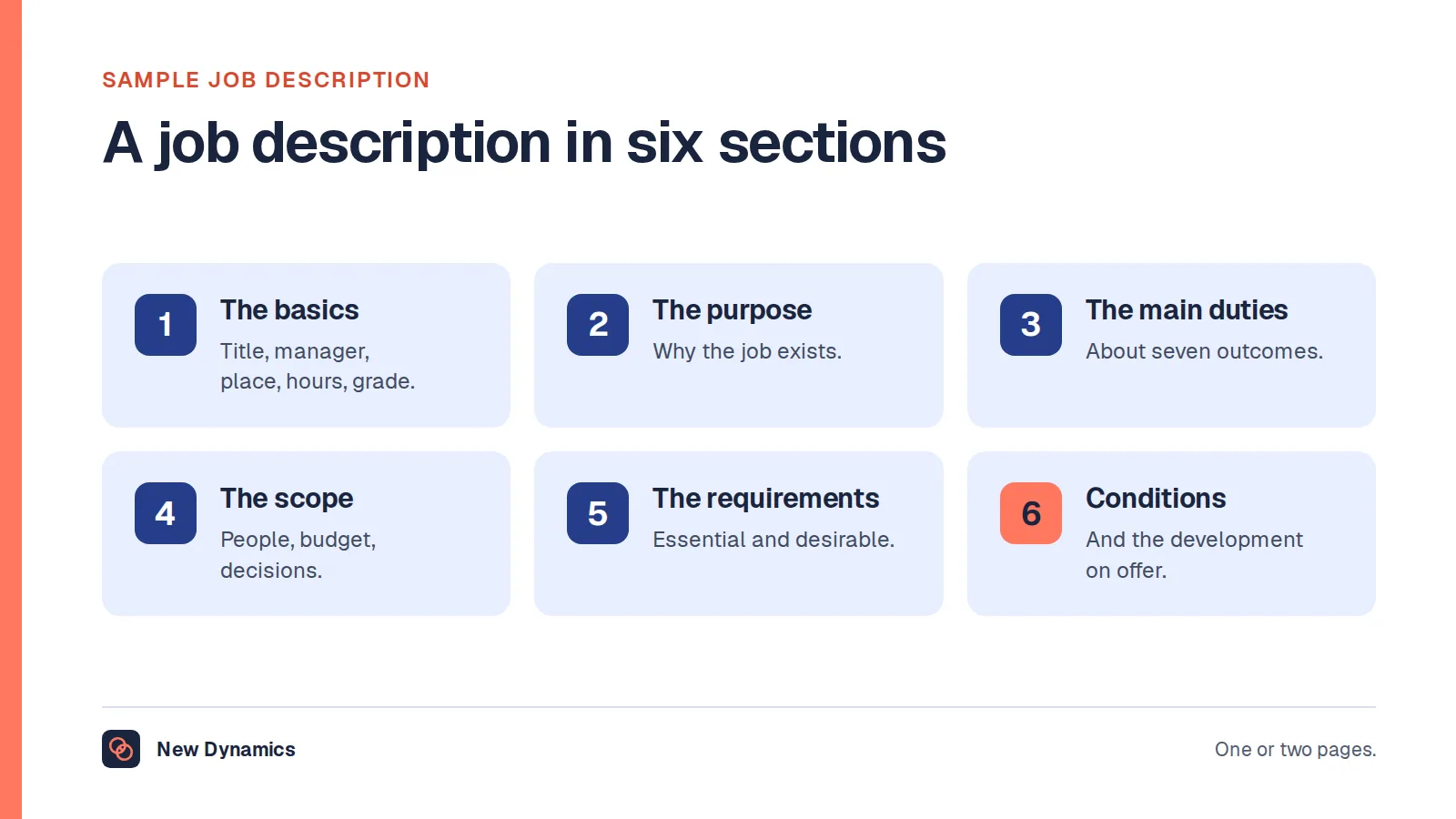
- The six main duties are correspondence and documents, diaries and meetings, records and data, travel and logistics, payments and orders, and being a first point of contact.
- The skills that matter are IT, communication, planning, judgement and discretion. A good job description names the people supported, the systems used and the decisions that the post holder can take alone.
When an administrative assistant is good, nobody notices the administration. Meetings have rooms and agendas. Invoices are paid on time. The contract that everyone needs is in the folder where it should be. When the post is empty, managers discover how much of their week it was quietly saving.
This article gives an administrative assistant job description: what the role is, the six main duties, the skills that matter, how it differs from similar jobs and a template that you can adapt. For job seekers, there is a section on describing admin work on a CV or resume. Many employers shorten the title to admin assistant. The job is the same.
A new assistant has to learn people, systems and routines quickly. See how New Dynamics onboarding brings tasks, early goals and manager conversations into a clear path for a new starter.
What is an administrative assistant?
The Cambridge Dictionary defines an administrative assistant as “someone whose job is to do tasks such as arranging meetings, typing letters, etc. for someone”.
In England, the nearest occupational standard is the business administrator, a Level 3 apprenticeship with a typical duration of 18 months. Skills England's business administrator standard sums up the role in one sentence: “The responsibilities of the role are to support and engage with different parts of the organisation and interact with internal or external customers.”
The standard adds that the role “contributes to the efficiency of an organisation, through support of functional areas, working across teams and resolving issues as requested”. It notes that these skills are highly transferable and can be applied in all sectors, in small and large organisations alike.
That is the heart of it. An administrative assistant makes other people's work easier and the organisation more efficient.
Administrative assistant duties: six responsibilities
The details vary by employer. Most posts include these six, which draw on the skills listed in the Skills England standard.
- Correspondence and documents. Drafting emails and letters, formatting reports and proposals, and checking other people's documents. The standard expects an administrator to produce “accurate records and documents including: emails, letters, files, payments, reports and proposals”.
- Diaries and meetings. Managing calendars, booking rooms, preparing agendas and papers. The standard lists the core of it: “Organises meetings and events, takes minutes during meetings and creates action logs as appropriate.”
- Records and data. Keeping files and databases up to date, recording information and producing simple analysis. This includes handling confidential information in line with the organisation's procedures.
- Travel and logistics. Booking travel and accommodation, and managing equipment, supplies and facilities.
- Payments and orders. Raising purchase orders, processing invoices and expenses, and chasing approvals.
- First point of contact. Answering the telephone and the shared inbox, welcoming visitors and dealing with questions from inside and outside the organisation.
In a small organisation, one person does all six. In a large one, the post may concentrate on two or three.

Five skills of a good administrative assistant
- IT skills. The standard asks for skill in “multiple IT packages and systems relevant to the organisation”, used to write letters or emails, create proposals, perform financial processes, and record and analyse data. It also asks for the ability to choose the most appropriate IT solution for the problem.
- Communication. Clear writing, a good telephone manner and confidence with people at every level. The standard describes “good communication skills, whether face-to-face, on the telephone, in writing or on digital platforms”.
- Planning and organisation. Managing priorities and time to meet deadlines, and managing the expectations of colleagues. Much of the job is deciding what to do first when everything is urgent.
- Judgement. The standard puts it briefly: “Exercises proactivity and good judgement.” It adds that a good administrator seeks advice from more experienced colleagues when appropriate. Knowing when to decide and when to ask is a skill in itself.
- Discretion. Administrative assistants see salaries, contracts, complaints and diaries. The standard expects them to understand the laws and regulations that apply to the role, including data protection. Our employee data protection guide covers the principles.
Behaviour matters as much as skill. The standard lists integrity, reliability, self-motivation and adaptability, which it describes as being able to accept and deal with changing priorities.

How the role differs from similar jobs
Titles overlap, and employers use them differently. This table shows the usual distinctions.
| Title | Usual focus |
|---|---|
| Administrative assistant | Supports a team or department with general administration |
| Receptionist | Front desk, visitors and the switchboard |
| Secretary | Correspondence and diary for one or more managers |
| Personal assistant (PA) | Supports one person closely, including diary, travel and some personal organisation |
| Executive assistant | Supports a senior executive, often with projects and delegated authority |
| Office manager | Runs the office: facilities, suppliers, budgets and sometimes the administrative team |
Some sectors add specialist knowledge. A legal, medical or real estate administrative assistant does the same six duties, with the documents, terms and systems of that field: case files, patient records, or property listings and tenancy paperwork. In a job description, add the sector duties to the general list. Do not replace it.
The role is a common way into office work and a base for progression. The Skills England standard says that business administrators develop skills and behaviours “to support their own progression towards management responsibilities”. For what entry level means in an advert, see our guide to the meaning of entry level.
Administrative assistant job description template
Adapt the wording to your organisation. Replace the text in square brackets.
Job title: Administrative assistant
Reports to: [Office manager or head of department]
Location and hours: [Site, and whether any home working is possible]. [Hours per week and working pattern].
Purpose of the job: To provide efficient administrative support to the [name] team, so that meetings, documents, records and payments are accurate and on time.
Main duties
- Draft, format and check correspondence, reports and presentations.
- Manage the diaries of [number] managers, arrange meetings, prepare agendas, take minutes and follow up actions.
- Keep paper and electronic records up to date, and handle confidential information in line with company procedures.
- Book travel and accommodation, and order supplies and equipment.
- Raise purchase orders, process invoices and expenses, and resolve queries with the finance team and suppliers.
- Answer telephone and email enquiries, welcome visitors and direct questions to the right person.
- Suggest and carry out improvements to administrative processes.
Scope: Supports a team of [number]. May approve orders up to [amount]. No direct reports.
Essential requirements
- Confident use of [word processing, spreadsheets, email, calendar and any named system].
- Clear written and spoken English.
- Experience of organising your own workload to deadlines, in work, study or volunteering.
- Accuracy with figures and documents.
- Discretion with confidential information.
Desirable
- Experience of [sector or system].
- A business administration qualification or apprenticeship.
Conditions: [Pay range], [holiday], [benefits].
Keep the essential list short and genuine. Every extra requirement narrows your field. Our guide to job requirements explains how to separate what is essential from what is merely familiar. For the general format, see our sample job description.
How to describe administrative work on a CV or resume
“Responsible for general admin duties” tells a recruiter nothing. Five details turn it into evidence.
- Scale. How many people, diaries, calls or invoices? “Managed diaries for three directors.”
- Systems. Name the software that you used, because recruiters search for it.
- Accuracy. Give a fact that shows care: error-free month-end files, or minutes issued within a day.
- Improvement. Describe one thing that you made better, such as a new filing structure or a tracker that ended duplicate orders.
- Trust. Mention confidential work, handling of payments or cover for a manager.
Use your own real figures. An honest small number is better than a vague claim.

Common mistakes
A list of every task that anyone can think of. Seven or eight duties are enough. Group the small ones.
“Any other duties as required” doing the real work. If a duty matters, name it.
Asking for a degree out of habit. Test whether the job truly needs one.
Hiding the people. Say whom the post supports and who sets the priorities when they conflict.
Forgetting judgement. State which decisions the post holder can take alone.
Never updating it. Systems change quickly. Review the description when the post holder changes or once a year.
Frequently asked questions
What is the job description of an administrative assistant?
An administrative assistant supports a team or manager by drafting correspondence and documents, managing diaries and meetings, keeping records, booking travel, processing invoices and orders, and acting as a first point of contact for enquiries.
What are the main duties of an admin assistant?
The six main duties are correspondence and documents, diaries and meetings, records and data, travel and logistics, payments and orders, and being the first point of contact for callers, visitors and colleagues.
What skills does an administrative assistant need?
The main skills are IT, communication, planning and organisation, judgement and discretion. England's business administrator standard also lists behaviours such as integrity, reliability, self-motivation and adaptability.
What is the difference between an administrative assistant and a personal assistant?
An administrative assistant usually supports a team or department with general administration. A personal assistant supports one person closely, managing the diary, travel and correspondence, and often acts on that person's behalf.
Is administrative assistant an entry-level job?
It often is. Many employers hire people with good general skills and train them, and in England the business administrator apprenticeship is a Level 3 route into the work. Senior and specialist administrative posts ask for experience.
How do I describe admin assistant experience on a resume?
Give the scale of the work, the systems that you used, a fact that shows accuracy, one improvement that you made and an example of trust, such as confidential files or payments. Use real figures.
Your next step
If you are hiring, copy the template, fill in the square brackets and ask the current post holder or a colleague what is missing. If you are applying, rewrite your three most recent admin duties with the five details above.
For the whole hiring process, from the job description to the offer, read and download our recruitment and selection guide. The guide is free to read, and the PDF uses our short download form.
Want every new starter to have clear tasks and goals from the first day? Book a New Dynamics demo and bring your current approach. You can also email contact@new-dynamics.com.