TL;DR
- An open interview is one that anyone can attend without an appointment, during hours the employer advertises, usually at the workplace. Candidates arrive, complete a short application if they have not already, and are interviewed in turn, often briefly and often with a decision or a next step the same day. Employers use it when they need to hire many people quickly for roles where attitude and availability matter more than a long CV.
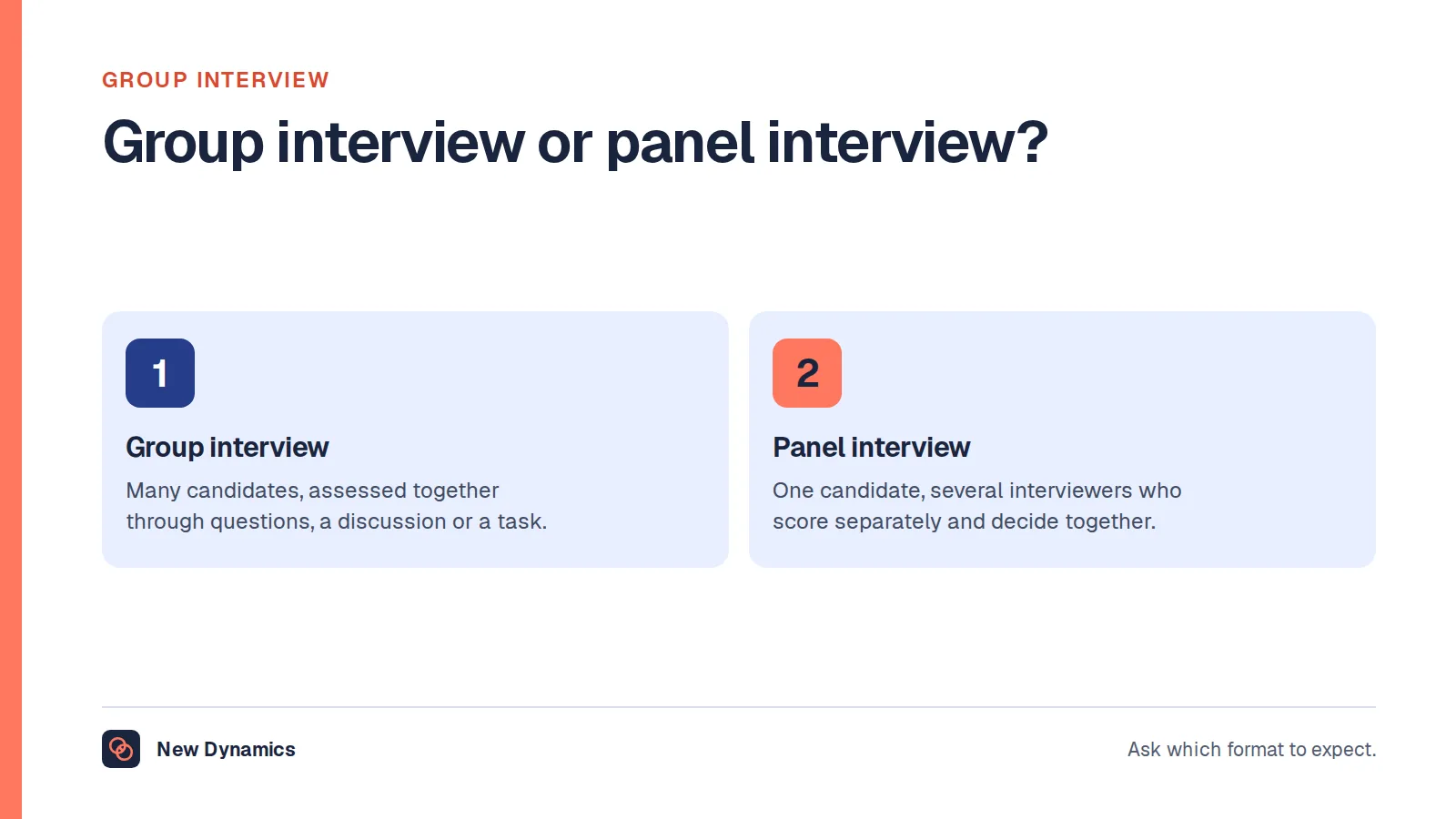
- It differs from a scheduled interview (an appointment for a shortlisted candidate), a group interview (several candidates assessed together) and a job fair (many employers, usually no formal interview). An open interview day can include a group exercise, but its defining feature is that the door is open.
- Speed does not excuse unfairness. Acas advises that more than one person should interview, that each applicant should be asked the same questions where possible, that decisions should be scored against the job description and person specification, that adjustments should be offered, and that notes be stored securely. A run-sheet and a scoresheet make an open day both fast and defensible.
A poster in the window says “Open interviews, Tuesday 10am to 4pm, bring your CV.” A new store, a hotel before the season or a warehouse before peak needs forty people, and the usual process of advert, shortlist, appointment and panel would take two months it does not have. So what is an open interview, and how do you run one that is quick without being careless?
This article defines the format, compares it with the interviews it is often confused with, explains when it suits, gives a run-sheet for the day and the rules that keep it fair, drawn from Acas guidance for employers in Great Britain, and ends with a checklist for candidates. The fairness principles apply anywhere; employment law differs by country and this is general information, not legal advice.
The people hired at an open day start in a group, often within a week. See how New Dynamics onboarding gives every new starter the same clear tasks, buddy and check-ins from day one, however many join at once.
Open interview definition
An open interview is an interview that anyone may attend without an appointment, during hours the employer advertises, usually at the place of work. The employer sets aside a day or a block of hours, publicises it, and interviews whoever turns up, in the order they arrive. Candidates who have not applied in advance complete a short application on the spot. Interviews are short, often ten to twenty minutes, and the employer frequently gives a decision or a next step the same day.
Other names for the same thing are walk-in interview, open hiring day, open house hiring event and, in some sectors, recruitment open day. The defining feature is not the length or the format of the conversation but that the door is open: no shortlisting happens before the candidate is in the room.
Open interview vs scheduled, group and job-fair interviews
| Format | Who attends | How it runs | Where you see it |
|---|---|---|---|
| Open interview | Anyone who turns up in the hours | Short one-to-one interviews in arrival order; quick decisions | Retail, hospitality, logistics, care, seasonal hiring |
| Scheduled interview | Shortlisted candidates, by appointment | A prepared panel, longer questions, a decision later | Most professional and office roles |
| Group interview | Several invited candidates together | Exercises, discussion and observation; individuals scored | Customer-facing roles, graduate schemes |
| Job fair | Many employers, many candidates | Conversations at stands; applications collected; interviews later | Universities, sectors, regions |
The formats mix. An open day often includes a group exercise, and a job fair sometimes offers on-the-spot interviews. The group interview has its own guide; this article is about the open door.

When an open interview suits, and when it does not
It suits hiring at volume for roles where the person specification is short and observable: reliability, availability, customer manner, willingness to learn, the right to work and, where required, a licence or a qualification. New sites, seasonal peaks, high-turnover teams and roles that attract people who do not have a polished CV or a quiet hour for an online application all fit.
It does not suit roles with a long specification that needs evidence, where a fifteen-minute conversation cannot assess the requirements, or hiring where you expect far more candidates than you can see, which turns the open door into a queue that most people leave. It also does not remove the need for the checks that follow: right to work, references, vetting where relevant and, in regulated work, the qualifications the law requires.
How to run an open interview day: a run-sheet
- Before the day. Decide the roles, the number of hires and the person specification. Write four to six questions that test it and a scoresheet with a short scale. Book the room, the interviewers and someone to run the door. Advertise the hours, the location, what to bring and what to expect. Say how to ask for an adjustment.
- On arrival. Greet each candidate, take or check their application, explain the process and the wait, and give them the job details to read. Note the arrival order and keep to it.
- The interview. Two interviewers where possible, the same questions for everyone, a score and a sentence of evidence per question, and a clear statement of what happens next. Ten to twenty minutes is enough for a short specification; do not pretend to assess more than that.
- After each interview, and at the end. Decide from the scoresheet, not from memory. Make offers, conditional on the checks, or say honestly that the candidate will hear by a date and then keep it. Store the applications and scoresheets securely and follow your privacy notice for retention.

Keeping it fair when it is fast
Speed is the point of an open interview and the risk. The Acas guidance for employers on choosing who to interview and on interviewing job applicants was written for conventional recruitment, and applies with more force when decisions are taken in minutes.
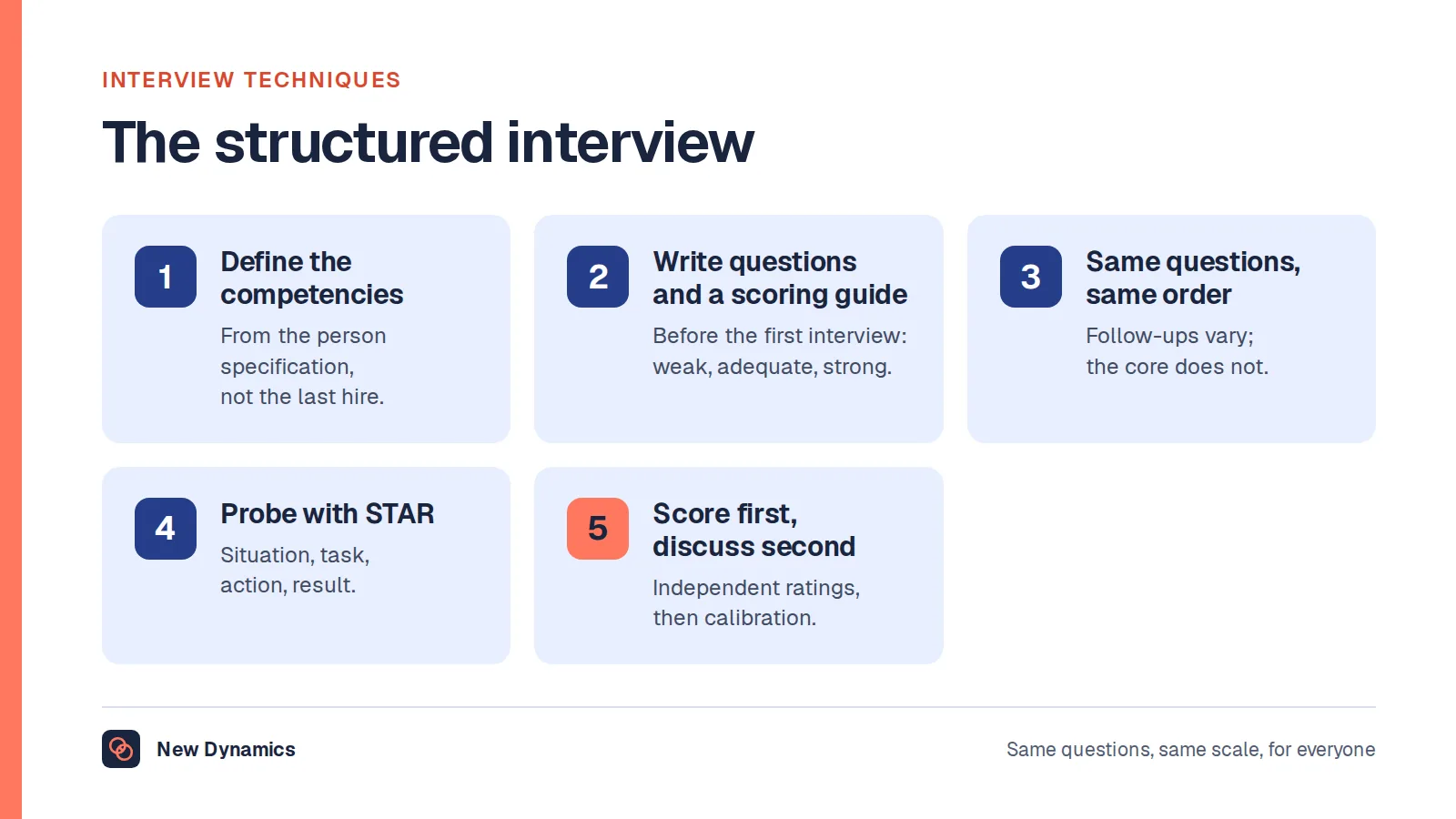
- Two interviewers. Acas: “If possible, each interview should be carried out by more than 1 person to reduce the risk of discriminating.” On an open day, pair interviewers and rotate.
- The same questions. Acas: “When interviewing it's a good idea to ask each applicant the same questions where possible. This is to ensure you're treating applicants in the same way.” Print them.
- Score against the specification. Acas recommends “a consistent decision-making process, such as a scoring system”, with decisions based on how each applicant met each point in the job description and person specification. A first-impression decision is the thing a scoresheet exists to prevent.
- Offer adjustments. Acas says to ask candidates whether they need adjustments to attend; its examples include an accessible venue, more time for a written test and a sign language interpreter. An open day that only works for people who can stand in a queue for two hours excludes people who could do the job.
- Keep the records properly. Acas: notes and recordings must be stored “securely and confidentially”, following data protection rules. A box of CVs left on the counter is neither.
- Interviewers who know the law. Acas advises checking that interviewers understand discrimination law before they interview. On an open day, a briefing at 9am is the minimum.

For candidates: how to prepare for an open interview
- Arrive early in the advertised hours. Interviews run in arrival order and the queue grows.
- Bring what the advert asks for. Usually a CV or completed application, identification and proof of the right to work, and any licence or certificate the role needs.
- Dress for the job you are applying for, one step smarter.
- Prepare three short examples: a time you were reliable, a time you dealt with a difficult customer or colleague, and why you want this job at this employer.
- Know your availability by day and hour; for many open-day roles it is the first question.
- Ask what happens next and when you will hear, and note the name of the person who interviewed you.
Frequently asked questions
What is an open interview?
An interview anyone can attend without an appointment, during hours the employer advertises, usually at the workplace. Candidates are interviewed in arrival order, often briefly, and frequently receive a decision or a next step the same day. It is also called a walk-in interview or an open hiring day.
What is the difference between an open interview and a group interview?
An open interview is defined by access: no appointment and no shortlisting beforehand. A group interview is defined by format: several invited candidates are assessed together through exercises and discussion. An open day can include a group exercise, but many open interviews are short one-to-one conversations.
Do you get hired on the spot at an open interview?
Often a conditional offer or a next step is given the same day, because speed is the reason employers use the format. Any offer is normally conditional on checks such as the right to work, references and, where relevant, qualifications or vetting.
How long does an open interview take?
The interview itself is usually short, around ten to twenty minutes, because the person specification for the roles involved is short. The wait can be much longer, so candidates should arrive early in the advertised hours and employers should tell people how long the queue is.
How do employers keep open interviews fair?
By following the same rules as any interview: two interviewers where possible, the same questions for every candidate, scores against the job description and person specification, adjustments for candidates who need them, and secure records, as Acas advises. A run-sheet and a printed scoresheet make this practical at speed.
Your next step: write the scoresheet before the poster
- Decide the person specification for the roles and write four to six questions that test it.
- Print the questions and a scoresheet with a short scale and space for evidence.
- Brief the interviewers on the questions, the scale and discrimination law.
- Plan the onboarding for the group you will hire before you hire them.
For the fair process from advert to offer, read and download our recruitment and selection guide. The guide is free to read, and the PDF uses our short download form.
Want the people you hire on Tuesday to have the same clear start on Monday? Book a New Dynamics demo and bring your hiring plan. You can also email contact@new-dynamics.com.