TL;DR
- The interview techniques that predict performance share one design: a structured interview, which the US Office of Personnel Management describes as an assessment method that measures job-related competencies by systematically inquiring about behaviour in past experiences or proposed behaviour in hypothetical situations, with the same questions in the same order and the same rating scale for everyone.
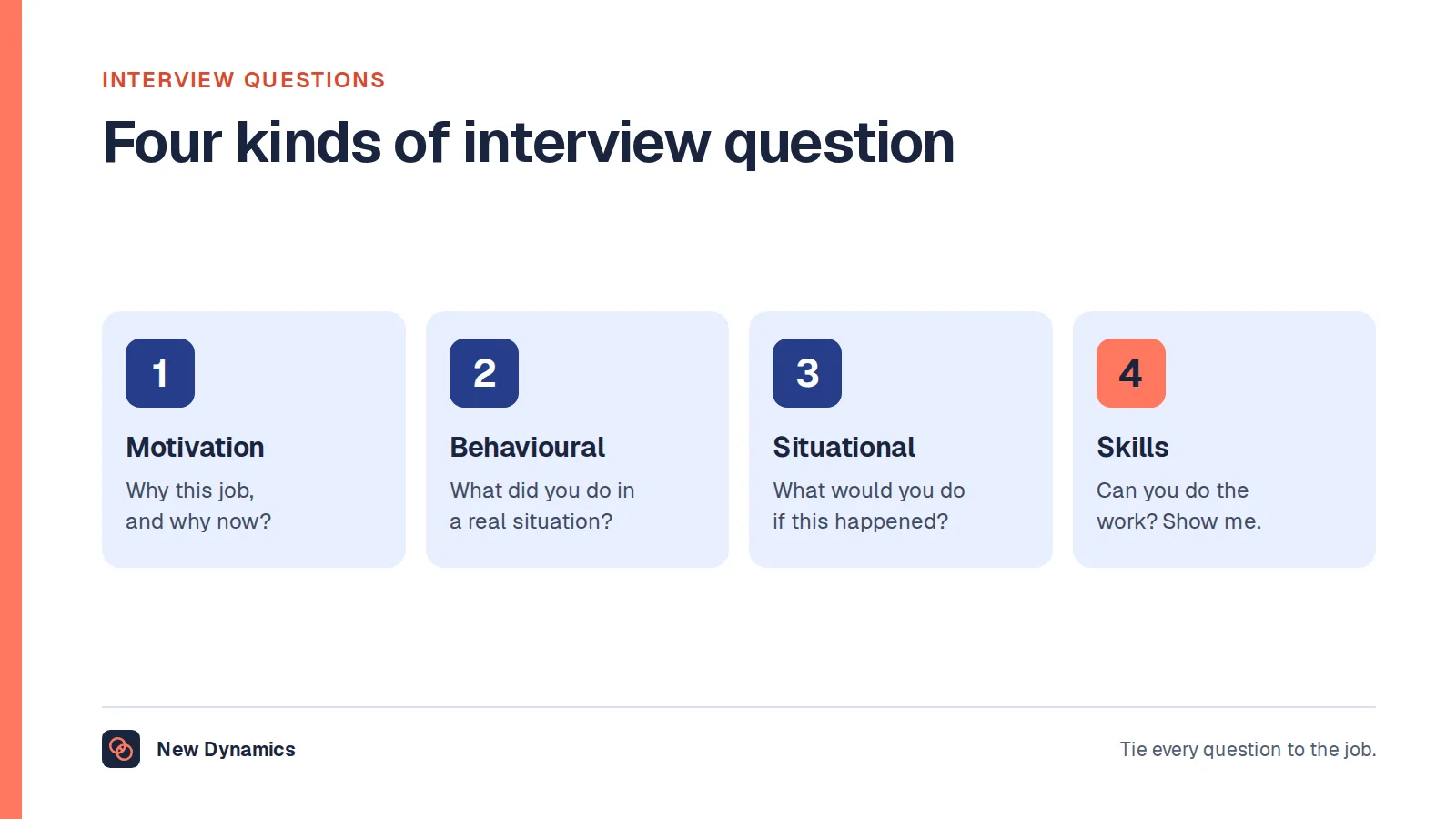
- A behavioural interview asks for past examples and probes them with STAR: situation, task, action, result. A situational interview asks what the candidate would do in a realistic scenario. Both work best with a scoring guide written before the first interview.
- Fairness is a technique too. Acas advises the same questions for each applicant where possible, more than one interviewer, asking every applicant about reasonable adjustments, and deciding against the job description and person specification. This is general guidance, not legal advice.
Most interviews are conversations that end in an impression. The candidate who was likeable, articulate and similar to the interviewer gets the job, and six months later nobody can remember why. The interview techniques that do better are not clever questions or tricks; they are ways of collecting the same evidence from every candidate and judging it against the same standard.
This article sets out those techniques for interviewers: the structured interview and why it works, what a behavioural interview is and how behavioral interviewing is done well, situational interviewing, the STAR method for probing, panel and multi-stage formats, scoring, and the fairness rules that Acas and the law set out in the UK. It is general guidance, not legal advice.
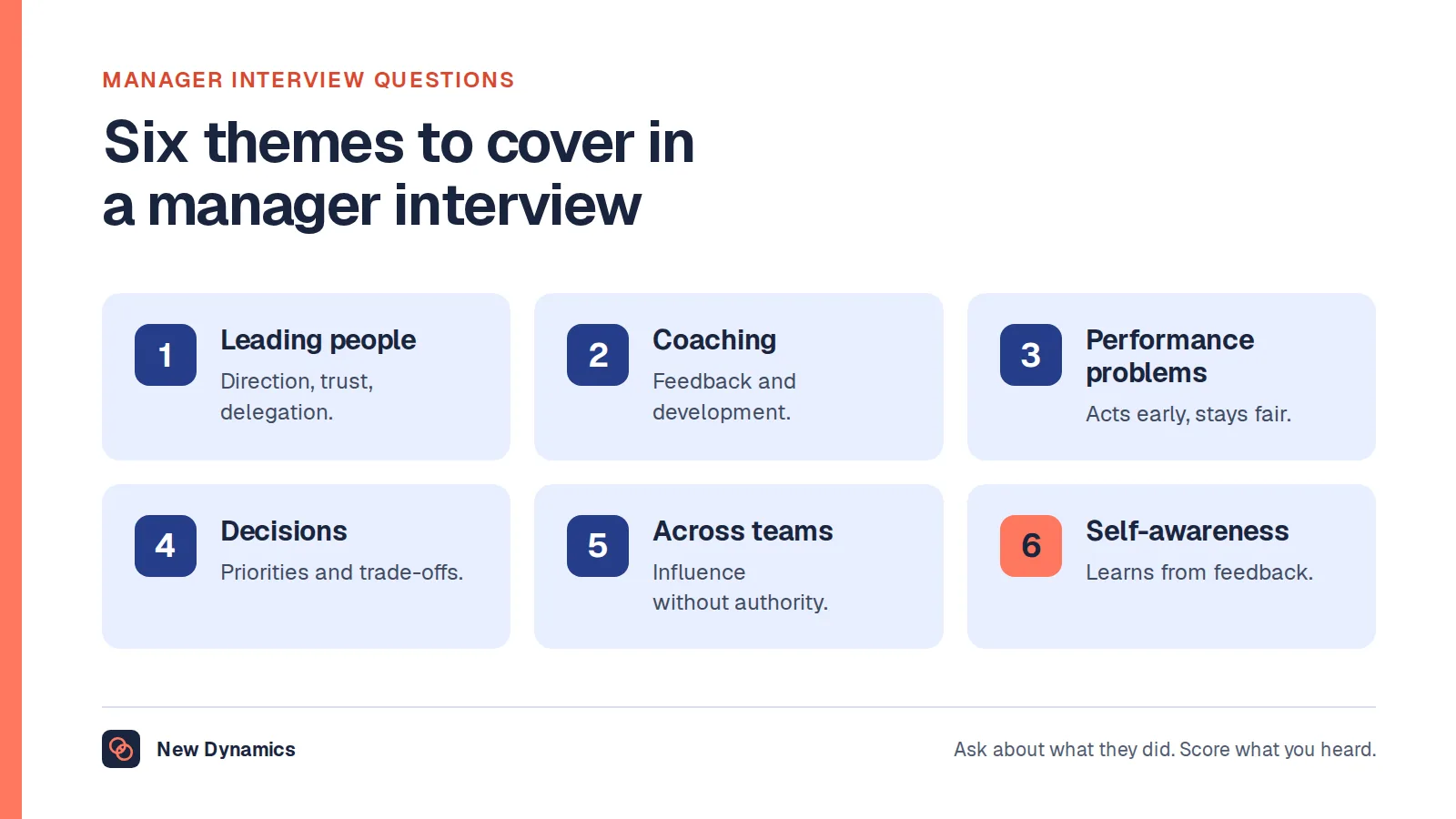
Interviews are one input to a hiring decision that a new employee then has to live up to. See how New Dynamics onboarding brings tasks, early goals and manager conversations into a clear path for a new starter. For question banks, see our interview questions for candidates and manager interview questions.
The technique behind the techniques: structure
The US Office of Personnel Management, which selects for the federal workforce, describes the structured interview as “an assessment method designed to measure job-related competencies of candidates by systematically inquiring about their behavior in past experiences and/or their proposed behavior in hypothetical situations”. It says structured interviews “ensure candidates have equal opportunities to provide information and are assessed accurately and consistently”, and lists two features that define them: “All candidates are asked the same predetermined questions in the same order” and “All responses are evaluated using the same rating scale and standards for acceptable answers”.
Everything below is a way of adding structure. The steps are the same whichever question style you use.
- Define the competencies. Take them from the job description and person specification, not from what the last good hire was like. Our guide to core competencies explains how to write them.
- Write the questions and the scoring guide before the first interview. For each competency, one or two questions and a description of what a weak, adequate and strong answer looks like.
- Ask everyone the same questions in the same order. Follow-ups can vary; the core cannot.
- Probe for evidence. See STAR below.
- Score independently, then discuss. Each interviewer rates each competency before hearing the others' views.

What is a behavioural interview?
A behavioural interview asks candidates for specific examples of what they have done, on the premise that past behaviour is the best available evidence of future behaviour. The UK Civil Service, which recruits against a published set of behaviours, explains the logic: “As behaviours can be observed and measured, they can help us to predict what your performance in the role could be.” It says candidates may be asked “to give examples of when you have demonstrated a particular behaviour”, at work or elsewhere, such as work experience, volunteering or a hobby.
Behavioral interviewing, in the American spelling, is the same technique. The questions begin with phrases like "Tell me about a time when…", "Describe a situation where…" and "Give me an example of…". Good behavioural questions:
- name one competency, not three;
- ask for a specific occasion, not a general approach;
- do not signal the answer ("Tell me about a time you showed great leadership" invites a story titled leadership);
- allow examples from outside paid work, so that career changers and early-career candidates can answer.
Probing with STAR
The technique that makes behavioural interviewing work is the follow-up. Candidates give summaries; interviewers need the detail, and STAR is the standard shape for it.
| Letter | Ask for | Probe |
|---|---|---|
| S | Situation: the context | "Where was this? Who was involved? What was at stake?" |
| T | Task: what the candidate had to do | "What was your responsibility, as opposed to the team's?" |
| A | Action: what they actually did | "What did you do first? Then what? Why that?" |
| R | Result: what happened | "What was the outcome? What would you do differently?" |
Two habits separate good behavioural interviewers from the rest. They keep asking "what did you do?" until the candidate's own contribution is clear, and they treat a well-told story with no result, or a result with no action, as an incomplete answer rather than a good one.
Situational interviewing
A situational interview asks what the candidate would do in a realistic scenario from the job: "A customer calls to say the delivery you promised has not arrived and they have a client waiting. What do you do?" OPM's definition covers this too, as "proposed behavior in hypothetical situations", and the Civil Service says candidates may be asked "how you would behave in a given situation", through situational judgement tests or situational interview questions.
Situational questions suit candidates without a track record in the role, and they test judgement directly. Their weakness is that people know the right answer more often than they do it. Use them alongside behavioural questions, and score them against a guide that describes the good answer in advance.

Other techniques, and what they add
- Work sample and task interviews. The candidate does a slice of the job: a short presentation, a coding exercise, a written analysis, a role-play. The Civil Service lists presentations, in-tray exercises, written exercises, group exercises and role-plays among its methods. These are often the most predictive technique of all, provided the task is the job and not a puzzle.
- Panel interviews. Two or three interviewers, each scoring independently. Acas says that if possible each interview should be carried out by more than one person, to reduce the risk of discriminating.
- Phone or video screening. A short structured call to check essentials before the main interview. Our guide to the phone screening interview has a script.
- Group interviews. Several candidates at once, observed on a task. Useful for volume hiring, weak for individual assessment; see our guide to the group interview.
- Strengths-based questions. What the candidate enjoys and does well. The Civil Service assesses strengths alongside behaviours. They tell you about fit and energy, less about competence.
- Unstructured conversation. The default, and the least predictive. If you want a relaxed chat, put it after the structured part and do not score it.
Scoring and deciding
A scoring guide turns answers into evidence. For each competency, write what a 1, 3 and 5 look like before the interviews, score every candidate on every competency, and only then compare. Acas advises that when deciding who should get the job, you check that your decisions are based on how each applicant met each point in the job description and person specification.
Three rules keep scoring honest.
- Score first, discuss second. Independent ratings, then a calibration conversation.
- Evidence, not adjectives. "Gave a specific example of resolving a billing dispute, with the result" scores; "seemed confident" does not.
- Record it. Notes and scores are what you rely on if a decision is challenged. Acas says interview notes and recordings must be stored securely and confidentially and follow data protection rules. Our recruitment and selection guide includes a scoring template.
Fairness and the law: what Acas says
The Acas guidance on interviewing job applicants sets the UK baseline. Questions must not discriminate. Acas says that when interviewing “it's a good idea to ask each applicant the same questions where possible”, to ensure you are treating applicants in the same way. It states that “By law you must ask anyone coming to an interview to tell you if they need reasonable adjustments so they can attend”, giving examples such as an accessible office, more time for a written test or a sign language interpreter. Online interviews should be held in the same way as in-person ones, with a backup plan for connectivity problems, and if you need to record an interview you must get the person's permission first.
At the end of each interview, Acas says, ask the applicant if they have any questions, tell them when and how you will let them know the outcome, how they can ask follow-up questions and what feedback to expect. On work trials, it says an unpaid trial should be for a reasonable amount of time, for example two hours or a shift, and should not usually last longer than one day.
Our guide to interview questions for candidates lists the questions to avoid.

A one-page interview technique checklist
Before: competencies from the job description; questions and scoring guide written; interviewers briefed and trained on discrimination law; every applicant asked about adjustments.
During: same questions, same order; STAR probes; notes on evidence, not impressions; time for the candidate's questions; next steps explained.
After: independent scores, then discussion; decision against the person specification; notes stored securely; feedback offered.
Frequently asked questions
What are the most effective interview techniques?
Structured interviewing: the same job-related questions for every candidate, in the same order, scored on the same scale against a guide written in advance. Within that structure, behavioural questions about past examples, situational questions about realistic scenarios and work-sample tasks give the most useful evidence.
What is a behavioural interview?
An interview that asks candidates for specific examples of what they have done, on the basis that past behaviour predicts future performance. Questions start with "Tell me about a time when…" and the interviewer probes for the situation, the candidate's task, the actions they took and the result.
What is behavioral interviewing?
The same technique in American spelling. Interviewers define the behaviours or competencies the job needs, ask every candidate for past examples of each, probe with STAR and score the answers against a guide.
What is the STAR method?
A structure for probing behavioural answers: Situation (the context), Task (what the candidate had to do), Action (what they did) and Result (what happened). Interviewers use it to move a candidate from a summary to specific evidence of their own contribution.
What is the difference between a behavioural and a situational interview?
A behavioural interview asks what the candidate did in a past situation; a situational interview asks what they would do in a hypothetical one. The first gives evidence of track record; the second tests judgement and suits candidates new to the role. Most structured interviews use both.
Do interviewers have to ask everyone the same questions?
Acas says it is a good idea to ask each applicant the same questions where possible, to ensure you treat applicants the same way, and the US Office of Personnel Management lists it as a defining feature of structured interviews. Follow-up questions can vary with the answers.
Your next step: structure your next interview
- Take four to six competencies from the person specification.
- Write one behavioural and one situational question for each, with a scoring guide.
- Brief your co-interviewer, and ask every applicant about adjustments.
- Score independently, discuss, decide against the specification, and keep the notes.
For a full process from advert to offer, read and download our recruitment and selection guide. The guide is free to read, and the PDF uses our short download form.
Want the goals you set at interview to carry into the first ninety days? Book a New Dynamics demo and bring your current interview format. You can also email contact@new-dynamics.com.