TL;DR
- Four common pay frequencies, four different counts: weekly gives 52 paydays a year, fortnightly (biweekly) 26, semi-monthly 24 and monthly 12. Fortnightly and semi-monthly sound alike and behave differently.
- Whichever is used, the employer has to write it down. GOV.UK states that the principal statement given on the first day of employment must include “how much and how often an employee or worker will get paid”, and that changes must be notified within one month.
- There is also a limit on paying rarely. For minimum wage purposes, GOV.UK says a pay reference period “can cover any period of time up to 1 calendar month, but never more than that”.
"Are we weekly or biweekly?" is a question with more consequences than it sounds: it decides how many payslips arrive a year, how deductions land, and whether some months feel unexpectedly good.
This article explains weekly, biweekly and the other pay frequencies: how many paydays each produces, how fortnightly pay behaves across a year, the difference between fortnightly and semi-monthly, and what UK rules require.
Telling a new starter exactly when they will be paid belongs in their first day, not their first month. See how New Dynamics onboarding brings those details into one clear path.
The four frequencies

- Weekly: 52 paydays a year. Common in hourly and shift work. Money arrives quickly after it is earned, and the payroll runs 52 times.
- Fortnightly, called biweekly in the US: 26 paydays. Every two weeks, on the same weekday.
- Semi-monthly: 24 paydays. Twice a month, usually on fixed dates such as the 15th and the last working day.
- Monthly: 12 paydays. The UK norm for salaried work, usually on a fixed date or the last working day.
The counts are arithmetic rather than policy: 52 weeks in a year, half that if you pay every second week, 24 if you pay twice in each of twelve months.
How fortnightly pay behaves

A year is 52 weeks and one or two days, so a fortnightly cycle does not sit neatly inside a calendar year.
- Normally 26 paydays. Every second Friday, or whichever weekday is used.
- Occasionally 27. Because of the extra day or two each year, a calendar year sometimes contains 27 fortnightly pay dates, the same way weekly payrolls sometimes contain 53.
- Two months a year contain three paydays. Most months have two; when the cycle lines up, a month gets three, which feels like a bonus and is not one.
- Deductions and allowances need checking in those months, particularly anything calculated per pay period rather than annually.
For someone budgeting, the useful framing is that fortnightly pay is a little less than half the monthly amount each time, with the difference returning in the three-payday months.
Fortnightly or semi-monthly?
This is the confusion worth clearing up, because the words are used interchangeably and mean different things.
- Fortnightly (biweekly) means every 14 days. Pay dates move around the month, and the weekday is fixed.
- Semi-monthly means twice a month. Pay dates are fixed to the calendar (the 15th and the last day, for example) and the weekday moves.
The consequences: semi-monthly gives 24 slightly larger payments; fortnightly gives 26 slightly smaller ones with the occasional third in a month. Semi-monthly is common in the United States and rare in the UK, where the practical choice is usually weekly or monthly.
What UK rules require

Three things constrain the choice.
- It must be written down. GOV.UK's guidance on the written statement of employment particulars says the employer must provide a principal statement "on the first day of employment", and it must include at least "how much and how often an employee or worker will get paid". Employers "must tell employees or workers about any changes to the written statement" and "must do this within one month of making the change".
- There is a limit on paying rarely. For minimum wage purposes, GOV.UK's guidance on calculating the minimum wage explains that a pay reference period "is the period of time for which someone is paid. It can cover any period of time up to 1 calendar month, but never more than that", with a week for weekly pay and two weeks for fortnightly. It adds that "the actual date of payment does not affect the pay reference period", and that employers "must ensure all workers are paid at least the minimum wage for the hours worked in each pay reference period".
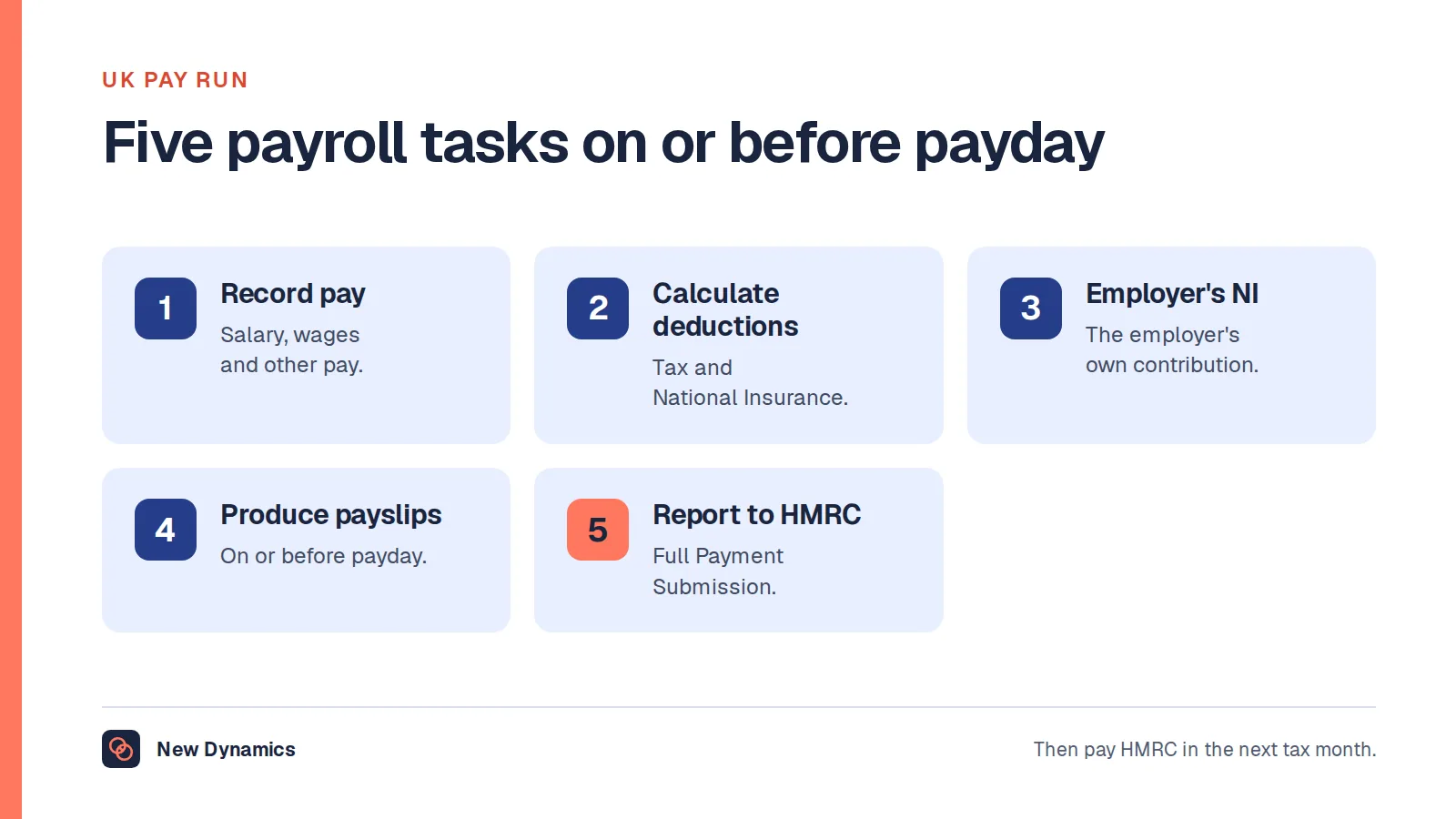
- Payslips come with every payment. Acas states in its guidance on payslips that they "are given on or before the day someone gets paid", and that "by law (Employment Rights Act 1996), employers must give all their employees and workers payslips from their first payday", including zero-hours and agency workers. Employers must also keep "a record of any hours worked or payments made in the last 6 years".
More frequent pay means more payroll runs, more payslips and more minimum wage checks. That is a cost, and it is the main reason employers hesitate. This is general information rather than legal advice.
How employers choose
- Sector norms. Hourly, shift and seasonal work tends to be weekly or fortnightly; salaried work monthly.
- Cash flow, both ways. Weekly pay helps people who are paid hourly and varies little for the employer; monthly pay concentrates the outflow.
- Payroll effort. Every extra run costs time, and errors multiply with frequency rather than with headcount.
- Variable hours. Where hours change weekly, a shorter cycle reduces the lag between working and being paid, and reduces the size of any correction.
- What people actually want, which is worth asking rather than assuming.
Our payroll definition post covers what a payroll run involves each time.
Changing pay frequency
Changing when people are paid is a change to their terms, and it is felt as a pay cut even when the annual amount is identical, because the transition usually leaves a longer gap before the first new payday.
Four practical points:
- Consult properly, and early. People need to plan around the gap.
- Deal with the transition, whether through a bridging payment, an advance or a phased move.
- Update the written statement, and tell people within a month of the change.
- Check the knock-on effects: standing orders and direct debits, benefit payments, pension contributions and anything calculated per period.
Take advice before making the change; the mechanics vary with the contract and the workforce.
Frequently asked questions
How many paydays are there in a year if you are paid biweekly?
Normally 26. Because a year is 52 weeks plus a day or two, some calendar years contain 27 fortnightly pay dates, in the same way that weekly payrolls occasionally have 53.
How does biweekly pay work?
You are paid every 14 days, on the same weekday. The date moves through the month, so most months contain two paydays and, twice a year or so, one contains three. Each payment is slightly less than half a monthly salary, with the difference returning in the three-payday months.
What does semi-monthly mean?
Twice a month, on fixed dates such as the 15th and the last day, giving 24 payments a year. The weekday varies. It is different from fortnightly pay, which is every 14 days and gives 26 payments.
What is the difference between weekly and biweekly pay?
Weekly pay arrives 52 times a year, biweekly or fortnightly 26 times. Weekly shortens the gap between working and being paid, which matters most for variable hours; fortnightly halves the number of payroll runs and payslips.
Can an employer pay monthly rather than weekly?
Generally yes, provided the contract says so and the written statement records how much and how often someone is paid. For minimum wage purposes the pay reference period can be any period up to one calendar month, but never longer, so paying less often than monthly is not an option.
Can an employer change pay frequency?
It is a change to terms, so it needs consultation and agreement, careful handling of the transition gap, and an updated written statement notified within a month of the change. Take advice, because the position depends on the contract.
Your next step: write the cycle down
- State the frequency and the payday in the principal statement on day one.
- Check the three-payday months for anything calculated per pay period.
- Confirm every payment has a payslip on or before payday.
- If you are changing frequency, plan the transition before you announce it.
For setting pay practice down in one document people can read, read and download our compensation policy guide. The guide is free to read, and the PDF uses our short download form.
Want a first day that tells someone exactly what they are paid, when, and by whom? Book a New Dynamics demo and bring your current induction checklist. You can also email contact@new-dynamics.com.