TL;DR
- A project engineer in construction is the engineer who turns a design into a built structure: planning and coordinating the work on site, checking drawings and quantities, managing subcontractors and materials, inspecting progress and quality, and answering the technical questions the site raises. O*NET lists project engineer among the reported titles of civil engineers, whose tasks include managing and directing construction activities at the project site and inspecting sites to monitor progress and conformance to design specifications.
- The duties fall into seven groups: design and buildability, setting out and survey, programme and coordination, materials and cost, quality and specification, health and safety, and reporting to the client. Adverts use construction engineer, site engineer and project engineer loosely for the same work; the usual distinction is that the site engineer sets out and supervises one site, the project engineer coordinates a project or several packages, and the project manager owns the contract, the budget and the client.
- Employers ask for a degree or HNC/HND in civil, structural or construction engineering, a driving licence, knowledge of CDM 2015 and construction safety law, and progress towards incorporated or chartered status. The advert should state the project type, the split between site and office, the hours, and the route to senior engineer, site manager and project manager. Appraise the engineer on programme, cost, quality and safety outcomes, not on hours on site.
A construction project has a design on one side and a finished structure on the other, and somebody has to carry it across: check that the drawings can be built, set the work out on the ground, get the materials there in the right order, keep the subcontractors moving, and prove to the client that what was built is what was specified. That somebody is the project engineer. The project engineer job description is harder to write than most because the same job appears under three or four names, and because the role sits between two others, the site engineer and the project manager, whose boundaries move from one contractor to the next.
This article explains what a project engineer does in construction using three primary sources, the US O*NET occupational database, the Prospects graduate careers service and the UK National Careers Service, groups the duties into seven, separates the role from its neighbours, lists the skills, qualifications and progression, and gives a job description template with objectives for the appraisal.
Engineers are appraised against outcomes that are easy to name and hard to measure fairly: a programme met, a cost held, a defect avoided. See how New Dynamics performance reviews let you run the review cycle on your own form, so an engineer's objectives and evidence sit in one place.
What is a project engineer in construction?
A project engineer is the engineer responsible for the technical delivery of a construction project or a package of work within it. On a contractor's side, the project engineer plans the works, coordinates the design information, manages the subcontractors and materials, checks quality and reports progress. On a consultant's or client's side, the title can mean the engineer who oversees the contractor on the client's behalf.
O*NET lists “Project Engineer” among the sample of reported job titles for civil engineers, and its tasks for the occupation include “manage and direct the construction, operations, or maintenance activities at project site”, “inspect project sites to monitor progress and ensure conformance to design specifications and safety or sanitation standards”, “estimate quantities and cost of materials, equipment, or labor to determine project feasibility”, and “direct or participate in surveying to lay out installations or establish reference points, grades, or elevations to guide construction”.
The National Careers Service describes the day-to-day tasks of a civil engineer as working closely with clients to understand what they need, creating design plans and models, assessing the risks and environmental impact of projects, monitoring progress at each construction stage, and leading a team of engineers, coordinating work and managing a budget. The project engineer's job is the site-facing end of that list.
Construction engineer, project engineer, site engineer: what the names mean
Adverts use the names loosely. What does a construction engineer do? In most job adverts, the same as a project engineer or site engineer: the technical delivery of building and civil engineering work on site. Some employers use construction engineer for the person who plans construction methods and temporary works before and during the build. The usual pattern:
- Site engineer. Sets out, levels and surveys one site; the main technical adviser to the trades on that site.
- Project engineer. Coordinates a project or several packages: design information, programme, subcontractors, materials, quality and reporting, often across more than one site engineer.
- Construction engineer. Either of the above, or a methods and temporary works specialist. Read the duties, not the title.
Whatever the title, say in the advert which of the three jobs you mean.
Project engineer duties: seven responsibilities
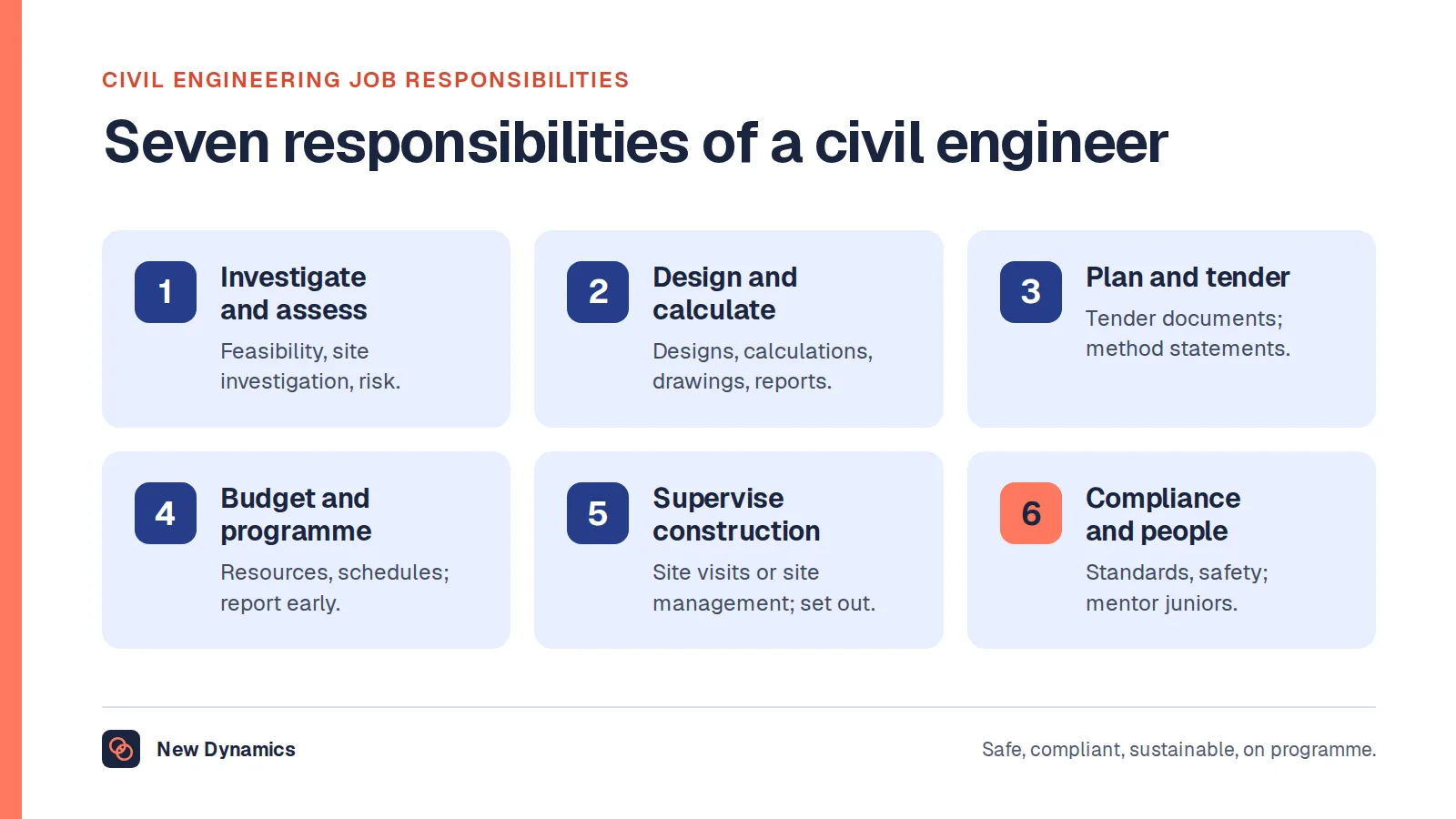
Grouped from the O*NET tasks, the Prospects site engineer profile and the National Careers Service, the work has seven parts.
- Design and buildability. Check plans, drawings and quantities for accuracy and buildability; manage, monitor and interpret the contract design documents from the client or architect; raise technical queries and get them answered before the work is built wrong.
- Setting out and survey. Set out, level and survey the site, or direct the site engineers who do; establish reference points, grades and levels, in O*NET's words, to guide construction.
- Programme and coordination. Plan the work and organise the plant, labour and site facilities to meet agreed deadlines; coordinate subcontractors, suppliers and the site team; adjust the plan when weather, ground or design changes force it.
- Materials and cost. Oversee the selection and requisition of materials; agree prices; estimate quantities and costs; propose cost-effective alternatives; track spend against the estimate.
- Quality and specification. Ensure that all materials used and work performed are in accordance with the specifications; inspect progress and conformance to the design; keep as-built information and quality records.
- Health and safety. Oversee health and safety on site, including documentation and reporting; know the construction safety law that applies, which in Britain includes the CDM Regulations and the Building Safety Act, as Prospects notes; stop work that is unsafe.
- Reporting and the client. Prepare progress reports; attend client and design team meetings; liaise with the local authority where needed; resolve unexpected technical difficulties and keep everyone informed.

Project engineer vs site engineer vs construction project manager
| Role | Scope | Owns |
|---|---|---|
| Site engineer | One site, day to day | Setting out, technical advice to the trades, site quality |
| Project engineer | A project or several packages | Design coordination, programme, subcontractors, materials, quality, reporting |
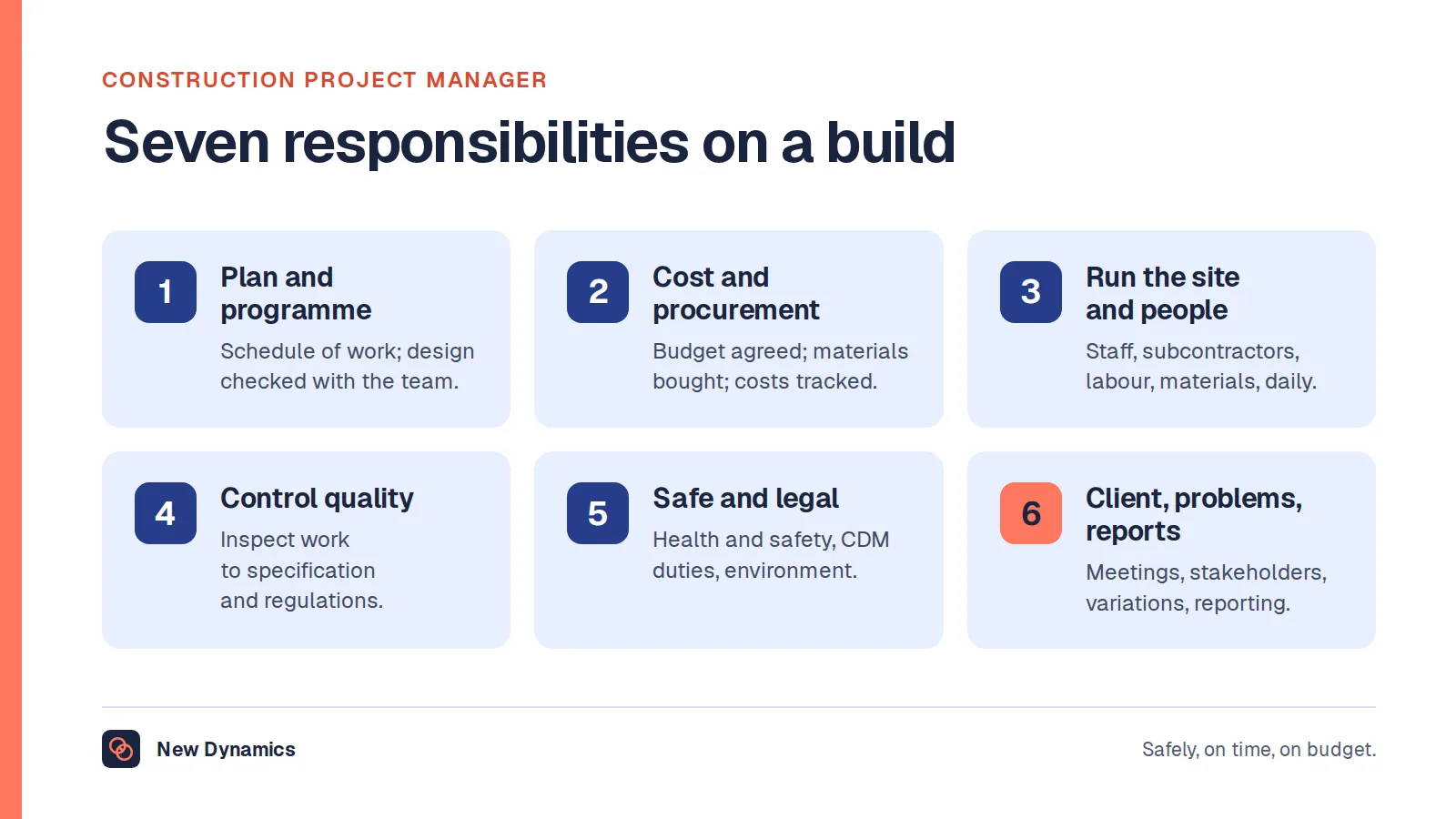
| Construction project manager | The contract | Budget, client, contract, the whole team |
Prospects gives the usual route of advancement as site engineer, senior engineer, site manager, project manager and contracts manager; the project engineer sits between the second and third of those in most contractors. The civil engineer job description covers the profession as a whole, and the construction project manager job description covers the role above.

Skills employers look for
Prospects lists the evidence employers want from a site or project engineer: good written and oral communication with construction managers, quantity surveyors, subcontractors, architects and other engineers; organisation and a methodical approach; analytical and problem-solving skills; accuracy and attention to detail; negotiation; teamworking; IT skills including digital drawings and models and reporting tools; flexibility; project management skills; knowledge of building and health and safety legislation; and, usually, a driving licence.
For the project engineer specifically, add:
- Reading a design critically. Spotting the clash, the missing dimension or the unbuildable detail before it reaches the site.
- Sequencing. Knowing what has to be finished before the next trade can start, and planning the site around it.
- Commercial awareness. Understanding how a variation, a delay or a substitution changes the cost and who pays.
- Composure with subcontractors and clients when the programme is slipping and both want an answer.
Working environment. Prospects describes a job that is both on site and office based, with inspections outdoors in all weathers, early starts or late finishes and some weekend working to meet deadlines, and a reasonable level of fitness because inspections can involve ladders and difficult access. The National Careers Service adds protective clothing and outdoor work in all weathers. Say so in the advert.
Qualifications and progression
Entry. Employers usually ask for a degree or HNC/HND in a construction-related or engineering discipline, Prospects says: building engineering, building surveying, civil engineering, construction studies or structural engineering. Entry without a degree is possible through an apprenticeship or a trainee technician role with further study. The National Careers Service lists the university, college and apprenticeship routes. O*NET places civil engineers in Job Zone four, meaning considerable preparation, usually a bachelor's degree.
Professional status. Progress to incorporated or chartered engineer status through the Institution of Civil Engineers, the Institution of Structural Engineers or, in construction management, the Chartered Institute of Building. The National Careers Service says chartered status opens positions with more responsibility, such as senior management roles on large projects. State whether you support it and how.
Progression. Senior engineer, site manager or project manager, then contracts manager; or a specialist route in temporary works, planning or commercial management. Prospects notes that construction, unlike many sectors, allows people to reach senior positions while remaining in a hands-on role.
Project engineer job description template
Job title: Project Engineer (state Construction Engineer or Site Engineer if that is the job you mean)
Reports to: Project Manager or Construction Manager
Scope: State the project type (housing, commercial, infrastructure, rail, water), the contract value band, the number of site engineers and subcontractors, and the split between site and office.
Purpose: Deliver the technical side of the project from design information to handover: buildable drawings, accurate setting out, a workable programme, the right materials at the right cost, work that meets the specification, a safe site and a well-informed client.
Responsibilities:
- Check drawings, specifications and quantities for accuracy and buildability; manage the contract design documents; raise and close technical queries.
- Set out, level and survey, or direct the site engineers who do.
- Plan the works and organise plant, labour and site facilities to meet the programme; coordinate subcontractors and suppliers.
- Select and requisition materials; agree prices; estimate quantities and costs; propose cost-effective alternatives.
- Inspect work for conformance to the specification; keep quality records and as-built information.
- Oversee health and safety on site, including documentation and reporting; apply the CDM Regulations and the company's procedures.
- Prepare progress reports; attend client and design team meetings; liaise with the local authority where required; resolve technical problems.
Skills and experience:
- Degree or HNC/HND in civil, structural or construction engineering, or an apprenticeship route with equivalent experience.
- Experience as a site engineer or assistant project engineer on comparable projects.
- Confident with digital drawings and models, setting-out equipment and reporting tools.
- Clear communication with trades, subcontractors, designers and clients; a methodical approach; attention to detail.
- Knowledge of construction health and safety law; a driving licence.
- Working towards incorporated or chartered status, supported by the company.
Working pattern: State the hours, the early starts and weekend work the programme may need, travel between sites and any lodging arrangement.
Progression: Senior engineer, site manager or project manager; say what the engineer needs to show.
Objectives for the appraisal
Set the project engineer's objectives against the project, and review them at the milestones, not once a year:
- Programme. Sections of work delivered against the agreed programme, with the reasons for any slippage recorded at the time.
- Cost. Materials and subcontract spend within the estimate; alternatives proposed and accepted.
- Quality. Non-conformances raised and closed; as-built records complete at handover.
- Safety. Inspections done, documentation kept, incidents investigated and acted on.

Frequently asked questions
What does a project engineer do in construction?
Delivers the technical side of a construction project: checks that the design can be built, sets out the works, plans and coordinates the programme, subcontractors and materials, inspects quality against the specification, oversees health and safety on site and reports progress to the client. The US occupational database lists project engineer among the titles of civil engineers, with tasks including managing construction activities at the project site.
What does a construction engineer do?
In most job adverts, the same work as a project engineer or site engineer: the technical delivery of building and civil engineering work on site, from drawings and setting out to quality and handover. Some employers use the title for the engineer who plans construction methods and temporary works. Read the duties in the advert rather than relying on the title.
What is the difference between a project engineer and a project manager?
The project engineer owns the technical delivery: design coordination, programme, subcontractors, materials and quality. The project manager owns the contract as a whole: the budget, the client, the commercial position and the team. Prospects gives the usual route as site engineer, senior engineer, site manager, project manager and contracts manager.
What qualifications does a project engineer need?
Usually a degree or HNC/HND in civil, structural or construction engineering, or an apprenticeship with further study, plus site experience. Employers value progress towards incorporated or chartered status with the Institution of Civil Engineers, the Institution of Structural Engineers or the Chartered Institute of Building, and usually require a driving licence.
Is a project engineer a site-based job?
Mostly. Prospects describes the role as both on site and office based, with inspections outdoors in all weathers, early starts or late finishes and some weekend work to meet deadlines. The advert should state the split, the travel and any lodging away from home.
Your next step: name the job and the milestones
- Decide whether you are hiring a site engineer, a project engineer or a project manager, and use that title.
- State the project type, the split between site and office, the hours and the travel.
- Set objectives for programme, cost, quality and safety, and review them at the project milestones.
- Say how the company supports the route to chartered status and to project manager.
For a review cycle that fits engineers who are appraised on projects rather than on a calendar year, read and download our performance review guide. The guide is free to read, and the PDF uses our short download form.
Want objectives, milestone reviews and appraisal forms for engineers in one place, without chasing? Book a New Dynamics demo and bring your current appraisal form. You can also email contact@new-dynamics.com.