TL;DR
- Civil engineers design and manage construction projects such as buildings, bridges, flood defences, transport links and water systems. The job splits into consulting civil engineers, who advise, design and approve, and contracting civil engineers, who build on site.
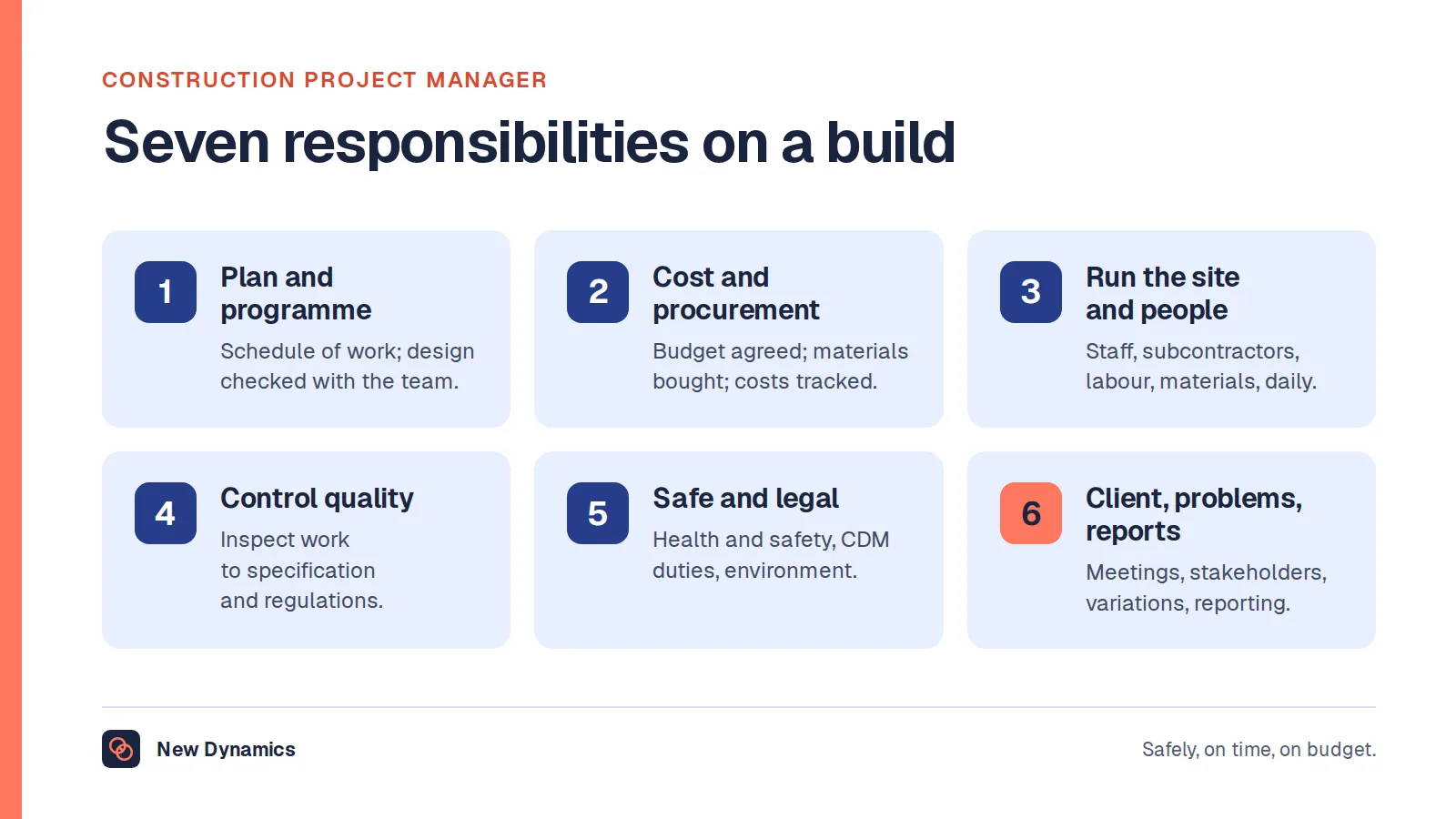
- The job has seven responsibilities: investigate and assess, design and calculate, plan and tender, manage budgets and programmes, supervise construction, ensure compliance and safety, and lead and mentor engineers.
- In the UK the route is an accredited civil engineering degree or a level 6 degree apprenticeship, then professional registration as an incorporated or chartered engineer through the Institution of Civil Engineers against the UK-SPEC standard.
Every road, bridge, reservoir, railway and tall building was a civil engineer's problem before it was anyone's asset. The discipline is old, broad and split into two working lives, one at the drawing board and one in the mud, and a civil engineer job description has to say which of the two it is hiring for.
This article gives a job profile for a civil engineer: what the discipline covers, how consulting and contracting roles differ, seven responsibilities, the skills employers look for, the qualifications and the route to chartered status in the UK, a template and wording for a CV.
Engineers work to specifications, and their own objectives should be as clear. See how New Dynamics Goals & OKRs keep targets and progress in one place.
Job profile: what is a civil engineer?
The UK National Careers Service's civil engineer profile puts it in one line: “Civil engineers design and manage construction projects, such as buildings, bridges, flood defences and transport links.” Typical hours are 40 to 42 a week, with occasional evenings and weekends, in an office or on site and sometimes outdoors in all weathers.
Prospects, the UK graduate careers service, profiles the two halves of the profession separately. Its consulting civil engineer profile says consulting civil engineers “help shape the built and natural environment, from transport and water systems to buildings, energy projects and flood defences”, advising clients “on how to plan, design and deliver safe, sustainable infrastructure projects”. Its contracting civil engineer profile says contracting civil engineers “manage construction on site, turning civil engineering designs into safe, practical infrastructure projects”.
Prospects lists the specialisms: buildings and structures, coastal and marine, dams, canals and reservoirs, environmental, geotechnical, highways and transportation, energy, rail, structural, tunnelling, waste, and water and wastewater. A job description should name the specialism and the sector.
Consulting or contracting: two versions of the job
| Version | Where they work | What they mainly do |
|---|---|---|
| Consulting civil engineer | Design office, with site visits | Feasibility studies, designs, calculations, tenders, technical advice, approvals |
| Contracting civil engineer | Site, with office time | Setting out, managing site activities and subcontractors, method statements, progress against programme |
Prospects describes the contracting role as “practical, fast-paced and often site based”, and notes that on design-and-build projects contracting engineers may also contribute to planning, technical decisions and buildability reviews. Many engineers move between the two during a career, and the construction project manager role sits alongside the contracting engineer on site.

Civil engineer responsibilities: seven areas
Drawing on both Prospects profiles and the NCS list, the job breaks into seven responsibilities.
- Investigate and assess. Undertake technical and feasibility studies, site investigations and risk assessments; the NCS adds assessing the risks and environmental impact of projects and working closely with clients to understand what they need.
- Design and calculate. Develop, review and approve detailed designs, calculations, technical reports and project drawings, using CAD, modelling and engineering software.
- Plan and tender. Prepare tender documents and proposals, contribute to contractor selection, and, on the contracting side, prepare construction information, method statements and risk assessments.
- Manage budget and programme. Manage budgets, schedules, materials and other project resources; monitor progress against programme and budget and report delays or cost pressures.
- Supervise construction. Monitor construction through site visits and advise on technical or design issues; on site, set out the work using drawings, survey information and digital equipment, manage site activities, labour, subcontractors, materials and equipment, and check work meets the specification.
- Ensure compliance and safety. Ensure projects comply with technical standards, planning requirements, environmental regulations and health and safety legislation, and identify and resolve design, quality, construction and safety problems.
- Lead and mentor. Supervise, mentor and coordinate junior engineers and the project team; the NCS lists leading a team of engineers, coordinating work and managing a budget.

Skills employers look for
Prospects lists for consulting engineers civil engineering design and technical knowledge “including an understanding of structures, materials and construction methods”, numeracy and data analysis for calculations and modelling, CAD and engineering software, knowledge of building, environmental, health and safety and planning regulations, project management for budgets, deadlines, resources and risks, clear communication for explaining technical information to clients, contractors and colleagues, and problem solving “to identify practical, safe and sustainable solutions”. The NCS adds engineering science and technology, building and construction knowledge, maths, design, thinking and reasoning, complex problem solving, attention to detail and verbal communication.
For an advert, six things: engineering fundamentals, design and software, regulatory knowledge, project and commercial management, communication and site sense. The NCS also identifies civil engineering as a potential green job, through sustainable materials, energy-efficient design and minimising waste.
Qualifications and the route to chartered status
Degree. The NCS says you can do a foundation degree, HND or degree in civil engineering, with universities specialising in areas such as transport, environmental or coastal engineering, and that accredited courses can be found through the Institution of Civil Engineers. Prospects says an accredited civil engineering or related degree “provides the most direct route into graduate employment and towards professional registration with the ICE”, with courses accredited on behalf of the Engineering Council by the Joint Board of Moderators.
Degree apprenticeship. The NCS lists the civil engineer level 6 degree apprenticeship, taking around five years, and notes that a civil engineering technician can study on the job for a degree or apprenticeship.
Professional registration. Prospects says that for chartered engineer registration “the standard educational requirement is usually an accredited integrated MEng degree or an accredited BEng (Hons) or BSc (Hons) degree followed by further learning to Masters level”. The NCS says incorporated or chartered engineer status would allow a move into positions with more responsibility such as senior management on large-scale projects. Registration is assessed against UK-SPEC, the UK Standard for Professional Engineering Competence and Commitment; our chemical engineer job description explains how its five competence areas double as a review framework, and our mechanical engineer job description covers the same route in that discipline.
Progression. The NCS says a civil engineer could specialise, work in research, become an engineering consultant, or work with international development organisations or disaster relief agencies.
Requirements differ in other countries. Check the rules where you work.

Civil engineer job description template
Adapt the template to your organisation. Keep every line true.
Job title: Civil engineer [consulting / contracting], [specialism]
Reports to: Principal engineer or project manager
Location and hours: [Office with site visits / site with office days]; [40] hours a week; [travel or nights away as required]
Purpose of the role: To [design / deliver] safe, compliant and sustainable [highways / water / structures] projects for [clients], from investigation to completion, to the required standards, programme and budget.
Main responsibilities:
- Carry out feasibility studies, site investigations and risk assessments
- Produce and check designs, calculations, drawings and technical reports in [software]
- Prepare tender and construction information, method statements and specifications
- Monitor budget and programme; report delays and cost pressures early
- Visit or manage site; set out works, check compliance with the design and resolve technical problems
- Ensure compliance with technical standards, planning, environmental and health and safety requirements
- Mentor graduate and junior engineers and coordinate the project team
Skills and experience:
- Accredited civil engineering degree or level 6 civil engineer degree apprenticeship
- [Years] of experience in [specialism], with projects delivered
- Proficient in [CAD / analysis software]
- Working towards or holding incorporated or chartered status with the ICE
- Clear written and spoken communication with clients, contractors and the public
We provide: Support towards chartership with the ICE, structured CPD, [hybrid working where the work allows] and a route to senior and principal engineer.
State the specialism, the sector and whether the role is consulting or contracting. Engineers search by them. Our job description template explains the overall structure.
How to describe civil engineering work on a CV
Write what you designed or built and the scale. The lines below are our own examples.
- “Design engineer on a [£40m] highways scheme: drainage and earthworks design, [software] models and technical reports.”
- “Site engineer for a [rail] project: set out [n] km of track works and managed [n] subcontractors to programme.”
- “Prepared tender documents for [three] water infrastructure schemes, contributing to contractor selection.”
- “Mentored two graduate engineers through their first ICE professional review preparation.”
- “Chartered with the ICE in [year].”
Common mistakes in civil engineer job adverts
Consulting or contracting unstated. They are different daily lives and different candidates.
Specialism missing. A geotechnical engineer and a highways engineer are not interchangeable.
Software over problems. A list of tools says less than a paragraph about the projects.
Registration support silent. Chartership decides careers; say whether you fund and mentor it.
Site conditions understated. Weather, travel and nights away belong in the advert.
Frequently asked questions
What is the job profile of a civil engineer?
A civil engineer designs and manages construction projects such as buildings, bridges, flood defences, transport links and water systems. Consulting civil engineers investigate, design, tender and advise; contracting civil engineers manage construction on site. Both work to technical standards, budgets and programmes and progress towards chartered status.
What are the job responsibilities of a civil engineer?
Seven areas: investigate and assess, design and calculate, plan and tender, manage budget and programme, supervise construction, ensure compliance and safety, and lead and mentor engineers. The balance depends on whether the role is consulting or contracting.
What is the difference between a consulting and a contracting civil engineer?
Prospects profiles them separately. Consulting civil engineers advise clients on planning, designing and delivering projects, mostly from a design office with site visits. Contracting civil engineers manage construction on site, turning designs into built infrastructure, in a practical, fast-paced and often site-based role.
What qualifications does a civil engineer need?
In the UK, an accredited civil engineering degree, foundation degree or HND, or the level 6 civil engineer degree apprenticeship. Chartered status usually requires an accredited MEng, or a BEng or BSc plus further learning to master's level, followed by professional review with the Institution of Civil Engineers against UK-SPEC.
What skills does a civil engineer need?
Engineering design and technical knowledge, numeracy and data analysis, CAD and engineering software, knowledge of building, environmental, health and safety and planning regulations, project management, clear communication and problem solving for practical, safe and sustainable solutions.
What is a civil engineering career like?
It usually starts as a graduate or apprentice engineer in a consultancy or contractor, progresses through chartership to senior and principal engineer, and can lead to project management, specialist consultancy, research or international development work. The National Careers Service also identifies it as a potential green job.
Your next step
- Write the first line: consulting or contracting, specialism and sector.
- Weight the seven responsibilities to match, and name the projects.
- State the degree and registration requirements and the support you give towards chartership.
- Plan how the engineer's first-year objectives will be set and reviewed.
For a method for that last step, read and download our SMART goals guide. The guide is free to read, and the PDF uses our short download form.
Want engineering objectives, feedback and development in one place? Book a New Dynamics demo and bring your current job description. You can also email contact@new-dynamics.com.