TL;DR
- Accounts receivable is the money customers owe a business. An accounts receivable clerk, or AR clerk, raises invoices, records payments, chases what is overdue, resolves disputes and reports on who owes what and for how long.
- The job has six duties: raise and send invoices, record and allocate payments, reconcile customer accounts, chase overdue debt, resolve queries and disputes, and report on the ledger. In the UK the collections side overlaps with the credit controller role.
- Employers should build controls into the job, state how collections are done and measured, and know the UK rules on late commercial payments, under which interest and recovery costs can be claimed.
A business can be profitable on paper and still run out of cash. The gap is accounts receivable: sales that have been invoiced but not paid. The person who closes that gap, invoice by invoice and phone call by phone call, is the accounts receivable clerk. An AR clerk job description that reads “process invoices and payments” misses the half of the job that keeps the business solvent.
This article explains what accounts receivable is, sets out six duties of an AR clerk, lists the skills employers ask for, covers the controls and the UK late-payment rules the job works within, and gives a template, interview questions and wording for a CV.
Receivables run on a cycle of invoices, reminders, escalations and approvals. See how New Dynamics workflows let you shape forms, stages and approvals around the way you work.
What is accounts receivable?
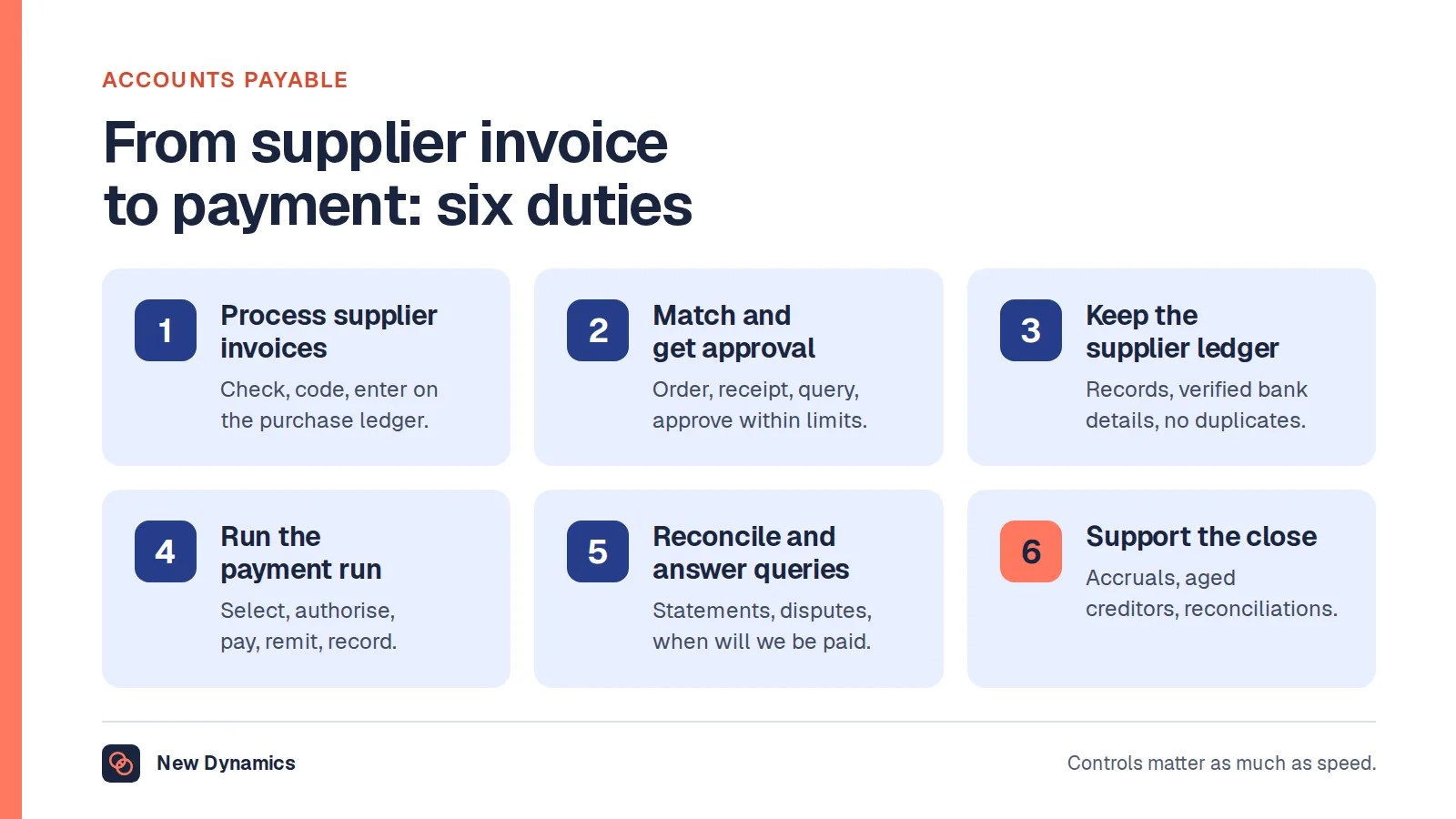
The Cambridge Business English Dictionary defines accounts receivable as “the amounts in a company's accounts that show money that is owed to the company by its customers”. It notes the UK term debtors and the US term receivables. Accounts payable is the mirror image: what the company owes its suppliers. Our accounts payable job description covers that side.
An accounts receivable clerk, also called an AR clerk, AR assistant, AR specialist, sales ledger clerk or billing clerk, keeps the receivables ledger accurate and turns invoices into cash. In the UK, the chasing part of the job is often a separate role. The National Careers Service profiles the credit controller, who it says manages “the money given to customers and recover debts owed by businesses and individuals”, with tasks including checking customer credit ratings, speaking with customers to organise repayments, processing payments, keeping customer records up to date and producing credit reports for management. In a small finance team one person does both; in a large one, AR clerks bill and allocate while credit controllers collect. Say which your vacancy is.
Accounts receivable clerk duties: six responsibilities
- Raise and send invoices. Prepare accurate invoices from sales orders, contracts or timesheets, with the right customer details, tax treatment, references and payment terms, and issue them promptly. A late invoice is a late payment.
- Record and allocate payments. Post receipts from bank, card and other channels to the right customer and invoice, deal with part payments and unallocated cash, and keep the ledger current daily.
- Reconcile customer accounts. Match the ledger to bank statements and customer statements, send statements, and investigate differences.
- Chase overdue debt. Run the aged debt report, send reminders, telephone customers, agree payment dates and escalate according to the credit policy, staying courteous and persistent.
- Resolve queries and disputes. Handle pricing, delivery and invoice queries with sales and operations, issue credit notes when justified, and keep a record of what was agreed.
- Report on the ledger. Produce the aged debtors report, days sales outstanding, cash forecasts and bad-debt provisions for the finance manager, and flag risks early.

Skills employers ask for
The NCS lists the skills for a credit controller: customer service, thoroughness and attention to detail, maths knowledge, administration, excellent verbal communication, active listening, “persistence and determination”, “patience and the ability to remain calm in stressful situations” and confidence with computers and software.
For an AR clerk advert, six things.
- Accuracy. Wrong invoices are the commonest cause of late payment.
- Persistence with courtesy. Chasing money from people you need to keep as customers.
- Numeracy and reconciliation. Finding the difference between two totals and explaining it.
- Systems. The accounting package, the bank portal and spreadsheets.
- Organisation. A ledger of hundreds of accounts, each on its own terms and timetable.
- Judgement. Knowing when to escalate, when to hold an order and when to refer a dispute to sales.
Our guide to analytical thinking covers the reconciliation habit in depth.

Controls and the late-payment rules
Controls. Receivables handle cash, so the job description should build in separation of duties: the person who raises credit notes should not be the person who approves them; write-offs need a manager's sign-off; customer bank details are changed only on verified instruction; and cash allocation is reviewed. Say so in the duties, not in a footnote.
UK late-payment rules. GOV.UK's guide to late commercial payments says: “You can claim interest and debt recovery costs if another business is late paying for goods or a service.” If a payment date is agreed, it must usually be within 30 days for public authorities or 60 days for business transactions, and a longer period for business transactions “must be fair to both businesses”. If no date is agreed, the law says the payment is late 30 days after the customer gets the invoice or the goods or service are delivered, if later. An AR clerk should know these rules and the business's own policy on applying them. This is general information about UK guidance, not legal advice, and rules differ elsewhere.
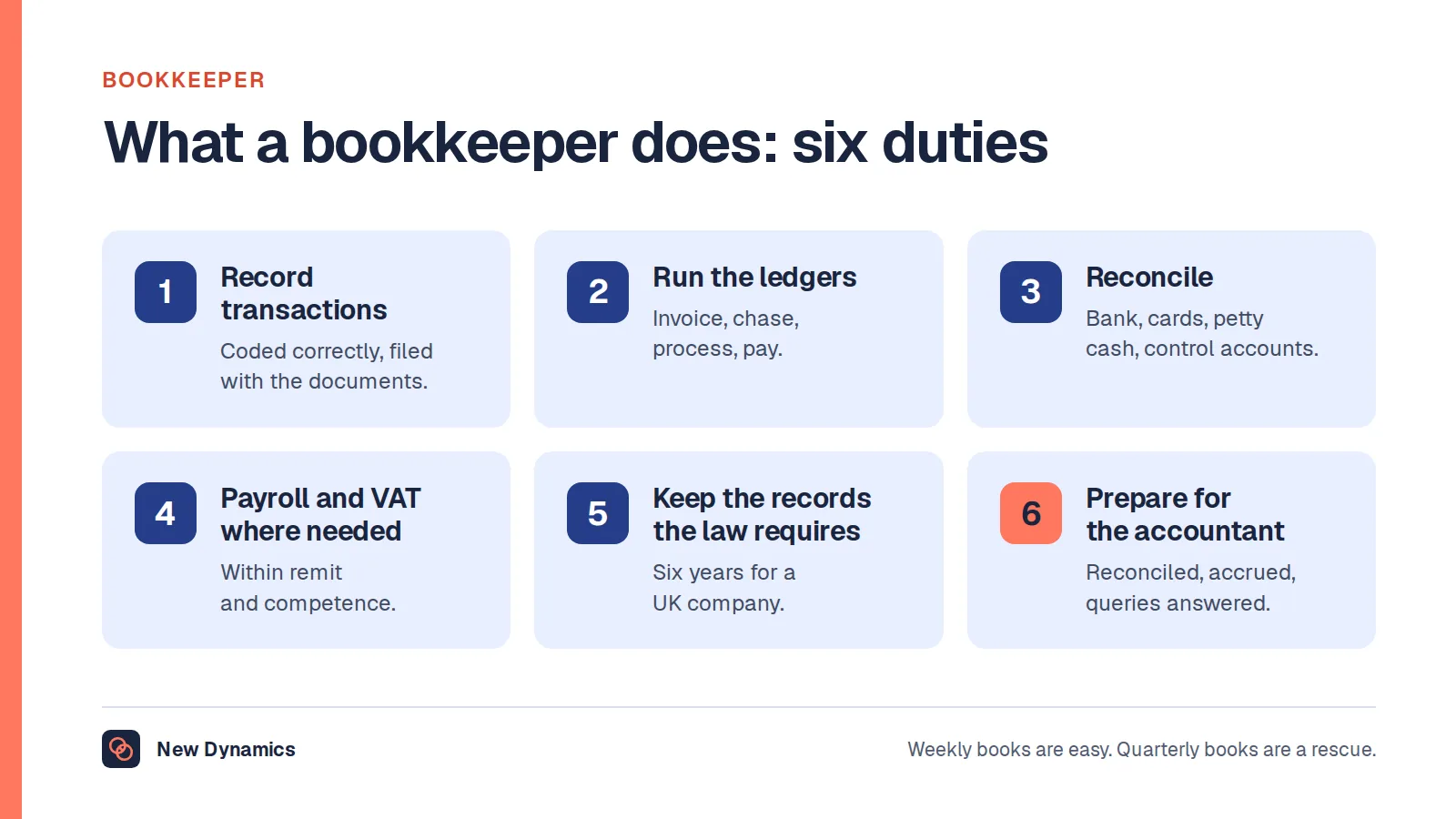
Qualifications. No qualification is required to start. The NCS lists the credit controller and collector level 2 and credit controller and debt collection specialist level 3 apprenticeships, taking one to two years, and an accounting and finance manager level 6 degree apprenticeship for those aiming at management. Bookkeeping and accounting technician qualifications are common routes; our bookkeeper job description describes the wider ledger role.
Accounts receivable clerk job description template
Adapt the template to your finance team. Keep every line true.
Job title: Accounts receivable clerk (sales ledger clerk)
Reports to: Finance manager or credit control manager
Hours: [37.5] hours a week, [hybrid]
Purpose of the role: To keep the sales ledger accurate and current, invoice customers promptly and collect what is owed on time, so that the business has the cash it has earned.
Main duties:
- Raise and issue accurate invoices and credit notes from [orders, contracts, timesheets]
- Post and allocate receipts daily and clear unallocated cash
- Reconcile customer accounts and the ledger to the bank; send monthly statements
- Chase overdue accounts by email and telephone to the credit policy; agree payment plans; escalate as required
- Resolve invoice queries with sales, operations and customers, and record outcomes
- Produce the weekly aged debt report, DSO and cash forecast inputs
- Follow controls on credit notes, write-offs and changes to customer details
Skills and experience:
- [One] year or more in accounts receivable, credit control or a finance office
- Accurate, numerate and organised, with reconciliation experience
- Confident and courteous on the telephone with customers
- Experience of [accounting system] and spreadsheets
- Working towards a bookkeeping or credit management qualification, or willing to
We provide: Study support for [AAT or credit management qualifications], a clear credit policy and escalation route, and a path to senior AR or credit controller.
State the number of customer accounts, the invoicing volume and the systems. Our job description template explains the overall structure.
Accounts receivable interview questions
The questions are ours; the notes say what a good answer shows.
- A customer says they never received the invoice and it is 45 days overdue. What do you do? Resend, confirm receipt, agree a date, note it.
- A receipt arrives with no reference and does not match any invoice. How do you allocate it? Investigate before posting; never force a match.
- Talk me through how you would prioritise chasing on a Monday morning. Aged debt report, largest and oldest first, promised dates due.
- Sales asks you to issue a credit note to keep a customer happy. What do you check? Reason, evidence, authority to approve.
- What does a rising DSO tell you? Cash is arriving more slowly; look at invoicing, disputes and collections.
- A customer is angry about a reminder they say is wrong. How do you handle the call? Listen, verify, correct if wrong, stay courteous.

How to describe accounts receivable work on a CV
Write what you did and what it produced. The lines below are our own examples.
- “Managed a sales ledger of around [n] active accounts, invoicing about [n] lines a month.”
- “Reduced debt over 60 days from [x] percent to [y] percent of the ledger in a year through structured chasing.”
- “Allocated daily receipts across bank and card channels with unallocated cash cleared within [n] days.”
- “Resolved invoice disputes with sales and operations, cutting credit notes by [x] percent.”
- “Produced the weekly aged debtors report and DSO for the finance manager.”
Common mistakes in AR clerk job adverts
Billing without collecting. If the role includes chasing, say so and say how it is measured.
No controls. A finance role that does not mention separation of duties is a risk.
Silence on volume. A hundred accounts and ten thousand are different jobs.
Targets without authority. Collection targets with no escalation route or credit policy behind them produce frustration.
No route onward. Senior AR, credit controller and credit manager roles come from this desk.
Frequently asked questions
What does an accounts receivable clerk do?
An AR clerk raises and sends invoices, records and allocates customer payments, reconciles customer accounts, chases overdue debt, resolves queries and disputes and reports on the ledger, so that money the business is owed is collected on time.
What is the difference between accounts receivable and accounts payable?
Accounts receivable is money owed to the business by its customers; accounts payable is money the business owes its suppliers. AR clerks invoice and collect; accounts payable clerks process and pay supplier invoices.
What is the difference between an AR clerk and a credit controller?
They overlap. An AR clerk keeps the sales ledger: invoicing, allocation and reconciliation. A credit controller, as the National Careers Service describes the role, sets up credit accounts, organises repayments and recovers debts. Small teams combine them; larger ones split billing from collections.
What skills does an AR clerk need?
Accuracy, persistence with courtesy, numeracy and reconciliation, confidence with accounting systems and spreadsheets, organisation across many accounts and the judgement to know when to escalate or refer a dispute.
What qualifications does an accounts receivable clerk need?
None to start. Bookkeeping and accounting technician qualifications are common, and in England the credit controller and collector level 2 and credit controller and debt collection specialist level 3 apprenticeships lead into the role.
Can a UK business charge interest on late invoices?
Yes. GOV.UK says a business can claim interest and debt recovery costs when another business pays late, with payment normally due within 30 days for public authorities or 60 days for business transactions unless a longer fair period is agreed. Apply the business's own policy, and treat this as general information rather than legal advice.
Your next step
- Decide whether the role bills, collects or both, and write the purpose statement accordingly.
- Put the controls into the duties: credit notes, write-offs, customer detail changes.
- State the ledger size, invoicing volume and systems.
- Agree the first quarter's measures: DSO, debt over 60 days, unallocated cash.
For writing those measures well, read and download our SMART goals guide. The guide is free to read, and the PDF uses our short download form.
Want collection targets, approvals and reviews for the finance team in one place? Book a New Dynamics demo and bring your current job description. You can also email contact@new-dynamics.com.