TL;DR
- A bookkeeper keeps an exact record of the money a business spends and receives: sales and purchase invoices, receipts and payments, bank transactions, payroll entries and the ledgers they post to. The accountant works from the bookkeeper's records; the bookkeeper works from the documents.
- The job has six duties: record transactions, run the sales and purchase ledgers, reconcile the bank and the control accounts, process payroll and VAT where the business needs it, keep the records the law requires, and prepare the books for the accountant at period end.
- UK companies must keep accounting records for six years, and self-employed people must keep records for their tax return. Bookkeepers in practice must be supervised for anti-money laundering. Employers look for accuracy, systems skills, discretion and the discipline to keep the books current every week.
Ask a small business owner what their bookkeeper does and the answer tends to be some version of everything with the money that the owner does not do themselves. That is close to right, and it is not a job description. The bookkeeper's work is defined by the records the business must keep and the accountant's need for them to be complete and correct.
This bookkeeper job description explains what the job involves, sets out six duties, separates the bookkeeper from the accountant and the finance assistant, summarises the UK record-keeping rules the bookkeeper works within, lists the skills and qualifications employers ask for, gives a template that you can adapt and suggests how to describe the work on a CV.
Bookkeeping runs on a weekly rhythm of tasks, and the rhythm should be visible. See how New Dynamics workflows let you shape forms, stages and approvals around the way you work.
What is a bookkeeper?
The Cambridge Dictionary defines a bookkeeper as “someone whose job is keeping an exact record of the money that has been spent or received by a business or other organization”, and bookkeeping as “the job or activity of keeping an exact record of the money that has been spent or received by a business or other organization”.
The word exact is the whole job. A bookkeeper records what happened, when, for how much, to whom and against which account, so that the records agree with the bank, the suppliers, the customers and the tax authority. Bookkeepers work in-house for one business, in a practice serving many clients, or self-employed. In a small business the bookkeeper is often the whole finance function; in a larger one the same work is split among ledger clerks and finance assistants, and our accounts payable job description describes those roles.
Bookkeeper duties: six responsibilities
- Record transactions. Enter sales invoices, purchase invoices, receipts, payments, expenses and journals into the accounting system, coded to the right accounts, with the documents filed so that any entry can be traced back.
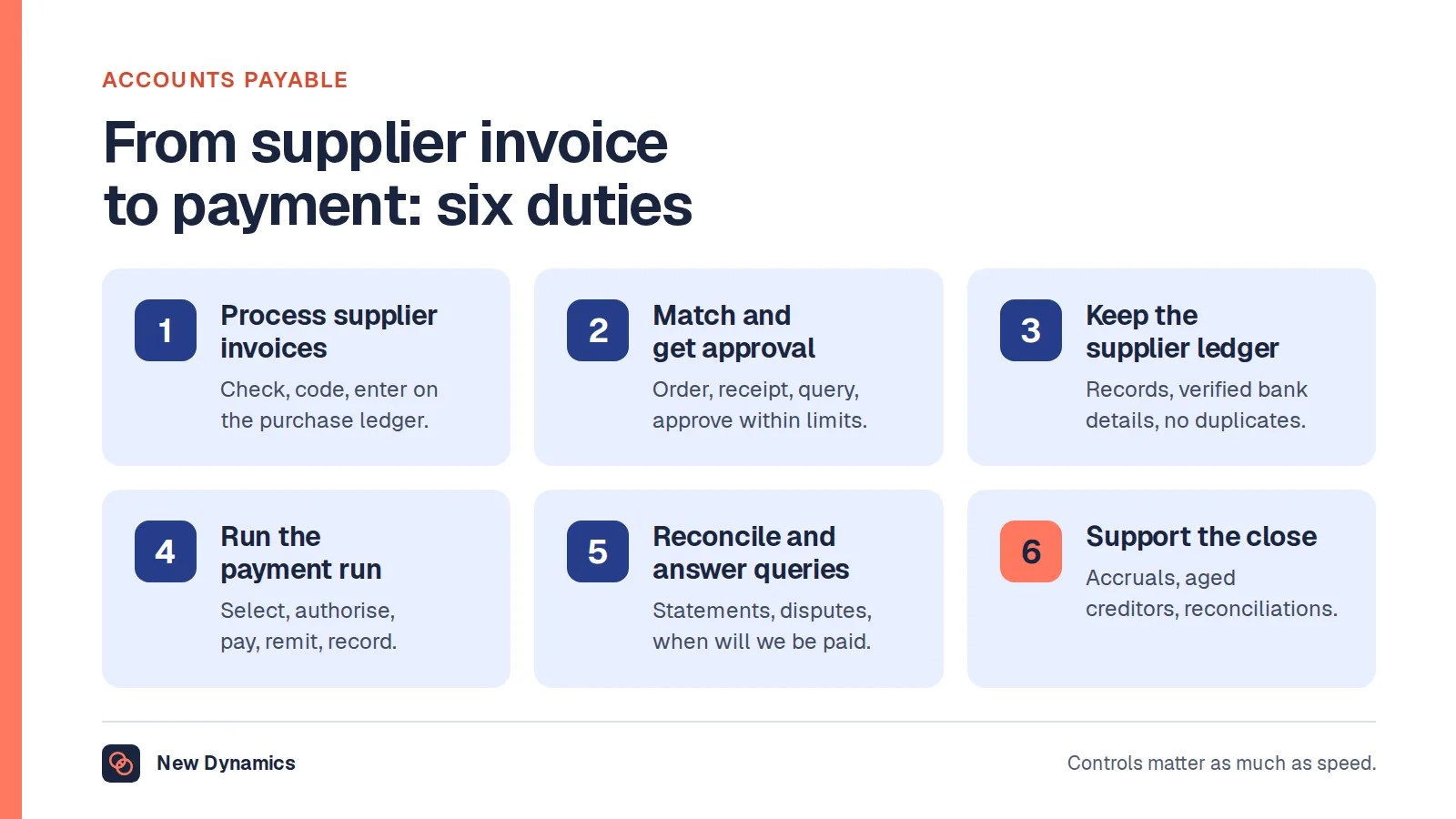
- Run the sales and purchase ledgers. Raise and send customer invoices, chase overdue accounts, process supplier invoices, prepare payments and keep both ledgers current and clean.
- Reconcile. Reconcile the bank accounts, credit cards, petty cash and the control accounts regularly, and investigate every difference until it is explained.
- Process payroll and VAT where needed. Run or prepare the payroll and its submissions, and prepare VAT returns, where the business is registered and the work is within the bookkeeper's remit and competence.
- Keep the records the law requires. Maintain the accounting records, receipts, invoices and bank statements the business must keep, for as long as it must keep them.
- Prepare for the accountant. Close the period with the ledgers reconciled, the accruals and prepayments listed and the queries answered, so that the accountant can prepare the accounts and the tax return from clean books.

Bookkeeper, accountant and finance assistant
| Role | What they do |
|---|---|
| Bookkeeper | Records the transactions and keeps the ledgers reconciled and current |
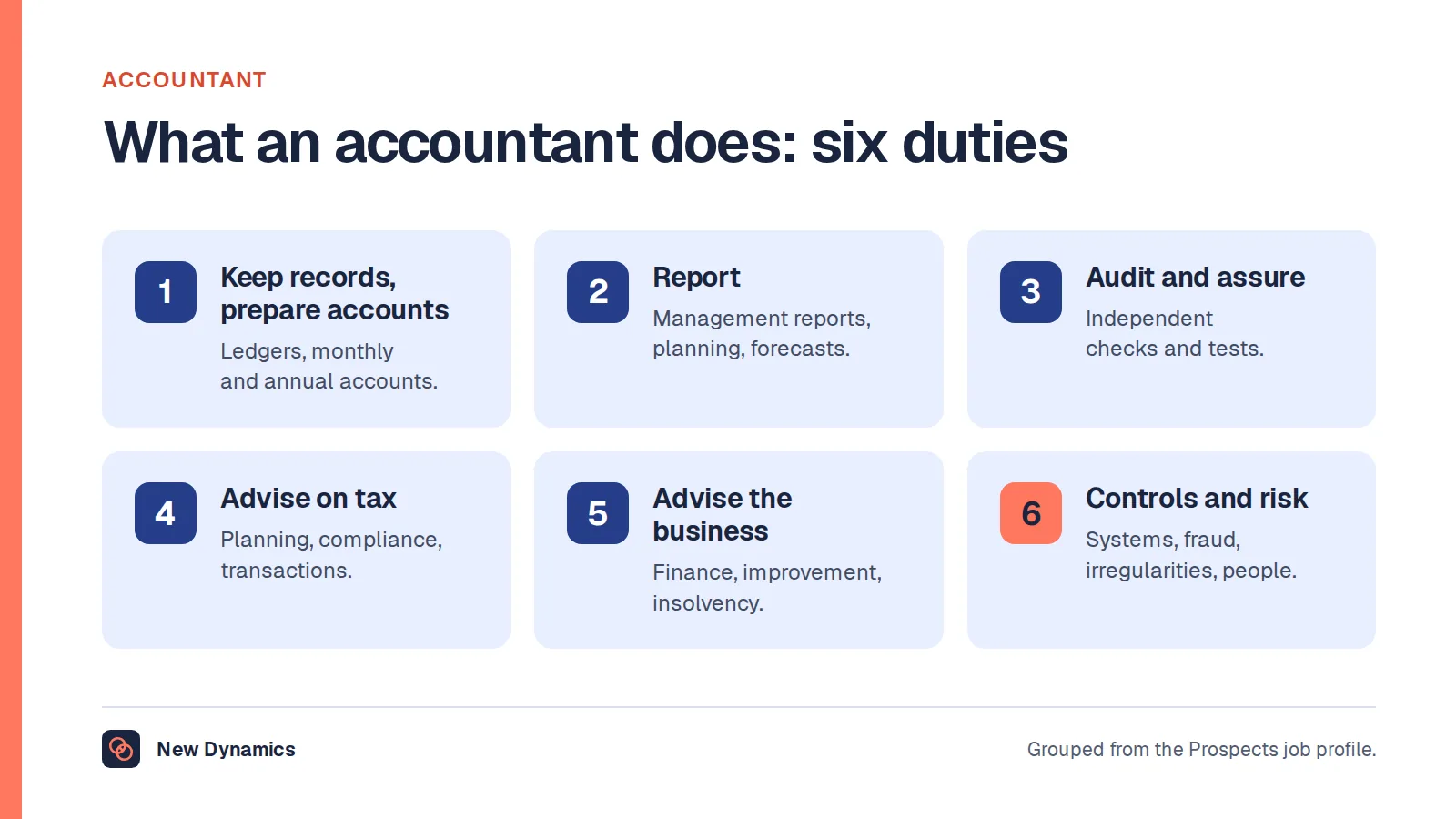
| Accountant | Prepares the accounts, financial statements and tax returns from the records, examines them and advises |
| Finance assistant | An entry-level role in a larger finance team, doing part of the bookkeeping, usually one ledger, under an accountant or manager |
The line between bookkeeper and accountant is the line between recording and reporting. A bookkeeper who also prepares the accounts and tax returns for clients is doing accountancy work, which in the UK carries its own regulation. Our accountant job description covers the reporting side and the professional routes.

UK record-keeping rules the bookkeeper works within
The bookkeeper's duties are shaped by what the business is legally required to keep. GOV.UK's guide to company and accounting records says a limited company must keep accounting records that include “all money received and spent by the company”, details of assets, debts owed and owing, stock and stocktakings, and “all goods bought and sold”, plus the records needed to prepare the annual accounts and Company Tax Return, such as receipts, invoices, orders, delivery notes, bank statements and correspondence. Records must be kept for six years from the end of the financial year they relate to, and longer in some cases. GOV.UK warns: “You can be fined £3,000 by HMRC or disqualified as a company director if you do not keep accounting records.”
For sole traders and partners, GOV.UK's guide to business records if you're self-employed requires records of business income and expenses for the Self Assessment return, and explains the choice between cash basis accounting, the default from the 2024 to 2025 tax year, and traditional accounting.
Bookkeepers who offer their services to the public are also covered by the anti-money laundering rules. GOV.UK's guide to anti-money laundering registration lists accountants, tax advisers, auditors and insolvency practitioners among those who must register with a supervisory authority, names the bookkeeping bodies among the supervisors, and says: “You're breaking the law if you carry on a business activity covered by the regulations but do not register with a supervisory authority.”
This is general information about the UK, not legal advice. Businesses elsewhere have their own record-keeping and registration rules.
Skills employers ask for
- Accuracy and consistency. The same transaction coded the same way every time.
- Double-entry bookkeeping. Understanding what each entry does to the ledgers, not only which button to press.
- Systems. Fluency in the accounting software, the bank feed and the spreadsheets around them.
- Reconciling. The patience to find the difference and the judgement to know when it matters.
- Discretion. The bookkeeper sees the pay, the debts and the cash position. Confidentiality is part of the job.
- Rhythm. Books that are updated weekly are easy; books that are updated quarterly are a rescue.
- Communication. Chasing customers courteously, querying managers clearly and giving the accountant what they need.
Qualifications
No qualification is required by law for in-house bookkeeping, and many bookkeepers learn on the job. In the UK the bookkeeping bodies and the accounting technician bodies offer recognised qualifications, and in England the level 2 accounts or finance assistant apprenticeship covers the ground. Bookkeepers in practice must be supervised for anti-money laundering, usually through a professional body or HMRC.
Bookkeeper job description template
Adapt the ledgers, the software and the frequency to your business.
Job title: Bookkeeper
Reports to: Owner, finance manager or external accountant
Hours: [Full time, part time or a fixed number of days a month]
Purpose of the role: To keep the business's financial records complete, accurate and current, so that the owner knows the position, the accountant can prepare the accounts and the business meets its record-keeping obligations.
Main duties:
- Record sales, purchases, receipts, payments, expenses and journals in [accounting system], coded correctly and filed with their documents
- Raise customer invoices, chase overdue accounts, process supplier invoices and prepare payment runs
- Reconcile bank accounts, credit cards, petty cash and control accounts [weekly]
- Prepare [payroll and VAT returns] within agreed limits, or provide the information for them
- Maintain the accounting records the business is required to keep
- Close each period with reconciled ledgers, listed accruals and prepayments, and answered queries for the accountant
Skills and experience:
- Experience of bookkeeping for a business of similar size, with double-entry understanding
- Fluent in [accounting system] and spreadsheets
- Accurate, organised and discreet
- Clear and courteous with customers, suppliers and colleagues
- Bookkeeping or accounting technician qualification, or level 2 apprenticeship [desirable]
We provide: Training on our systems, support for a bookkeeping or technician qualification, and a route to assistant accountant roles.
For the layout of the whole document, use our job description template.
How to describe bookkeeping on a CV
Employers want the size of the business, the ledgers, the software and the rhythm. The lines below are invented examples, to show the form.
- Show the scope. “Sole bookkeeper for a £2 million turnover engineering firm, all ledgers and payroll for 25 staff.”
- Show the rhythm. “Bank and control accounts reconciled weekly; month-end books to the accountant by working day five.”
- Show the systems. “Migrated the books to a new cloud system and set up bank feeds and invoice automation.”
- Show the result. “Reduced overdue customer debt by a third through weekly statements and calls.”
- Show compliance. “Prepared quarterly VAT returns and payroll submissions with no penalties in four years.”
Common mistakes in bookkeeper adverts
No software named. The system is half the job. Say which one.
Accountant duties on bookkeeper pay. If the job includes preparing accounts and tax returns, it is more than bookkeeping.
No frequency. Weekly, monthly or a rescue job? Say how current the books are and how current you want them.
No sense of the business. Turnover, number of transactions, staff on payroll and VAT status tell candidates what they are taking on.

Frequently asked questions
What does a bookkeeper do?
A bookkeeper keeps an exact record of a business's money: recording transactions, running the sales and purchase ledgers, reconciling the bank and control accounts, preparing payroll and VAT where needed, keeping the records the law requires and preparing the books for the accountant at period end.
What is the difference between a bookkeeper and an accountant?
The bookkeeper records the transactions and keeps the ledgers reconciled. The accountant prepares the accounts, financial statements and tax returns from those records, examines them and advises. Recording is bookkeeping; reporting and advising are accountancy.
What qualifications does a bookkeeper need?
None are required by law for in-house work. Recognised bookkeeping and accounting technician qualifications exist in the UK, and the level 2 accounts or finance assistant apprenticeship is a route in England. Bookkeepers in practice must be supervised for anti-money laundering.
What records must a UK business keep?
GOV.UK says a limited company must keep records of all money received and spent, assets, debts, stock and goods bought and sold, plus the documents needed for its accounts and tax return, for six years from the end of the financial year. Self-employed people must keep records of business income and expenses for Self Assessment. This is general information, not legal advice.
What skills does a bookkeeper need?
Accuracy, double-entry understanding, fluency in the accounting software, patience in reconciling, discretion with confidential information, the discipline to keep the books current every week and clear communication with customers, suppliers and the accountant.
What should a bookkeeper job description include?
The size of the business and its transaction volumes, the ledgers and tasks covered, the accounting software, the frequency of reconciliations and period-end, whether payroll and VAT are included, the reporting line, the qualifications required and the route to assistant accountant roles.
Your next step: describe the books, not just the bookkeeper
- State the software, the turnover, the transaction volumes and the payroll headcount.
- List the ledgers and tasks the job covers, and say whether payroll and VAT are included.
- Say how current the books are now and the rhythm you expect.
- Ask for evidence of reconciling, chasing and closing a period.
A bookkeeper's first month should end with a reconciled set of books. Read and download our employee onboarding guide. The guide is free to read, and the PDF uses our short download form.
Want the weekly bookkeeping tasks, approvals and period-end checks to run as one workflow? Book a New Dynamics demo and bring your current checklist. You can also email contact@new-dynamics.com.