TL;DR
- An associate attorney is a qualified lawyer employed by a law firm on a salary who is not a partner. The Cambridge Dictionary explains the word associate in job titles: someone who does the job described but does not have all the responsibilities of the main position, as in associate lawyer. Attorney is the American word for a lawyer.
- Associates do the legal work of the firm under partners' supervision: research, drafting, client meetings, negotiations, court preparation and, with seniority, running matters and supervising juniors. The track runs from junior to mid-level and senior associate, then to partner, counsel or an in-house move.
- In England and Wales the equivalent is the associate solicitor. Prospects says a newly qualified solicitor typically works on a fixed salary under the supervision of a partner or senior solicitor, taking on increasing responsibility. A job description should name the practice area, the level, the billable expectation and the supervision and review arrangements.
In an American law firm the lawyers come in two kinds: partners, who own the firm and share its profits, and associates, who are employed by it. Ask what is an associate attorney and the short answer is the second kind: a qualified lawyer on the firm's payroll, doing the legal work under partners' supervision and, usually, hoping to become one. Law firms in the UK use the same word for the same rung, with solicitor in place of attorney.
This article explains what an associate attorney is, how the associate track works, what associates do day to day, how the role differs from partner, counsel, paralegal and trainee, the UK equivalent as Prospects describes it, and what a law firm's job description for an associate should say. It is general information about roles and titles, not legal or careers advice.
Associates are reviewed against hours, quality and development every year. See how New Dynamics performance reviews bring goals, feedback and development into one fair discussion.
What is an associate attorney?
Two words. The Cambridge Dictionary defines an attorney, a US term, simply as “a lawyer”. It explains associate as an adjective “used in some job titles where someone does the job described but does not have all the responsibilities of the main position”, with the examples “associate editor / director / lawyer”.
Put together: an associate attorney is a fully qualified, licensed lawyer who does the work of a lawyer at a law firm but does not have a partner's responsibilities or ownership. Associates are employees. They are paid a salary, often with a bonus tied to hours billed or the firm's results; they do not share in the firm's profits or its liabilities, and they do not vote on how it is run. In most firms the title is simply associate; associate attorney is the fuller form used in job adverts and on business cards.
The associate track
Firms grade associates by years since qualification. Titles vary, but the shape is common.
| Stage | Typical years | What changes |
|---|---|---|
| Junior associate | 1 to 3 | Research, drafting, document review, due diligence, first client contact |
| Mid-level associate | 3 to 6 | Runs pieces of matters, drafts the main documents, supervises juniors |
| Senior associate | 6 or more | Runs matters day to day, manages client relationships, develops business, is assessed for partnership |
| Counsel, of counsel | Varies | A senior lawyer outside the partnership track, often a specialist |
| Partner | After the track | Owns a share of the firm, brings in work, is liable for the firm |
Not every associate becomes a partner, and not every associate wants to. Common alternatives are a counsel role, a move in-house to a company's legal department, government or public-interest work, or a smaller firm with a faster route to ownership. The track is a pyramid by design: a firm needs more associates than partners.

What associates do
The duties of an associate are the duties of a lawyer, distributed by seniority. Prospects' list for the UK solicitor describes the same work in any common-law jurisdiction. In our words, it includes meeting and interviewing clients and taking their instructions; advising on the law and the legal issues in the case; drafting documents, letters and contracts; negotiating with clients and other professionals; researching and analysing documents and case law; corresponding with clients and opposing lawyers; attending meetings and negotiations; acting for clients in disputes and representing them in court or at tribunals where appropriate; preparing papers for court; working in a team; supervising and delegating work to trainees, paralegals and legal secretaries; checking documentation before signing; and administrative duties such as completing time sheets so that charges can be calculated and clients billed.
Grouped by level:
- Junior associates research, draft, review documents, prepare bundles and take notes at meetings; they learn the firm's standards and the client's business.
- Mid-level associates own workstreams inside a matter, draft the main documents, deal directly with clients and the other side, and supervise juniors and paralegals. Our paralegal job description shows the support role they draw on.
- Senior associates run matters, manage clients, price and scope work, begin to bring in business, and are measured against partnership criteria.
And all of them record their time. Prospects' mention of time sheets is the daily reality of the job: an associate's hours are billed to clients, and the billable-hours target is usually the number that matters most in their review.
Associate, partner, counsel, paralegal, trainee
| Role | Qualified lawyer? | Employed or owner? | Main distinction |
|---|---|---|---|
| Partner | Yes | Owner (or salaried partner) | Shares profits and liability; brings in work; runs the firm |
| Counsel | Yes | Employed | Senior specialist outside the partnership track |
| Associate | Yes | Employed | Does the legal work under partner supervision |
| Trainee or newly qualified | Trainee: not yet; NQ: yes | Employed | In training, or in the first year after qualifying |
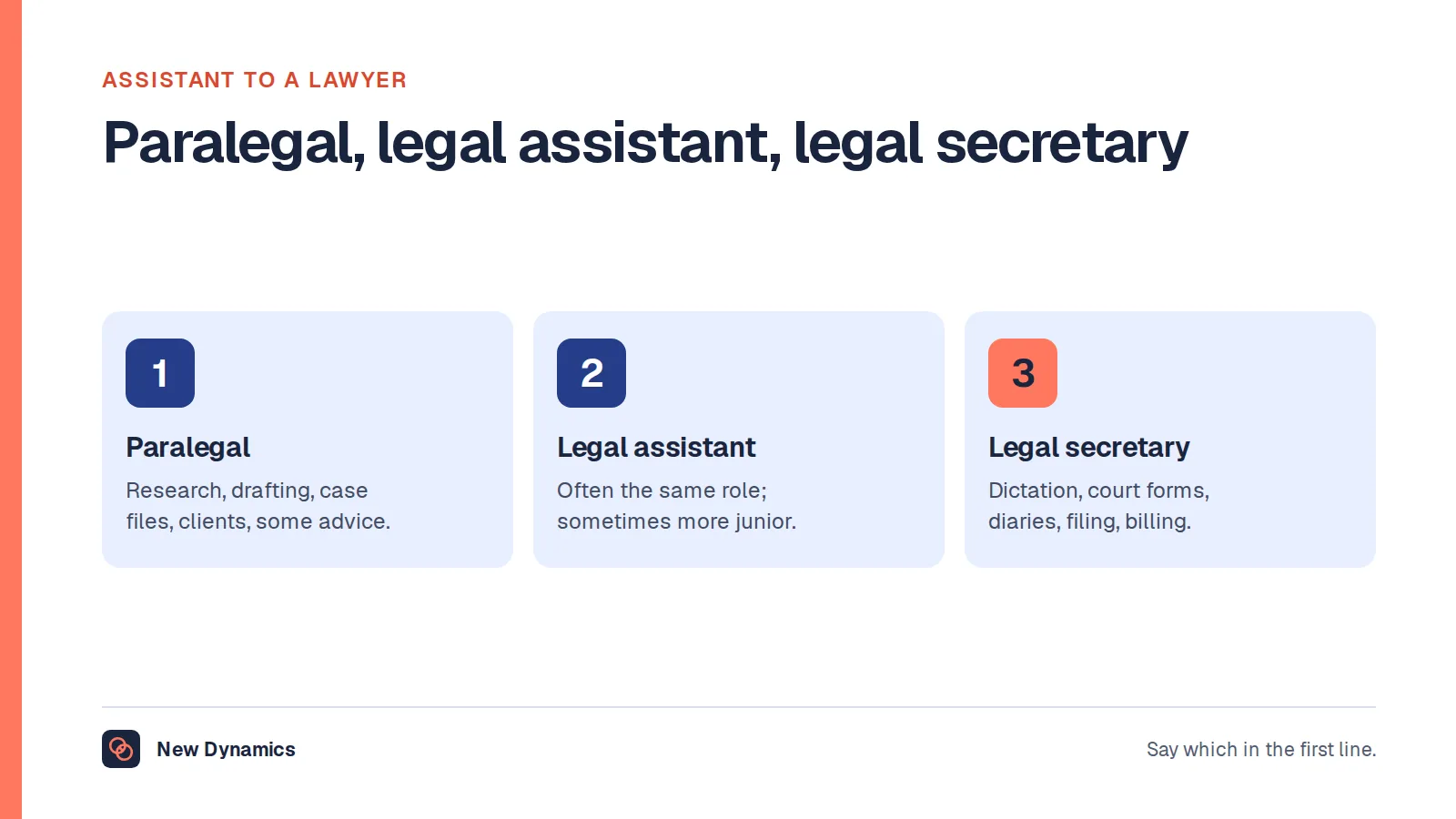
| Paralegal | No | Employed | Legal support tasks; cannot provide reserved legal services |
The line that matters legally is qualification: associates, counsel and partners are licensed to practise; paralegals are not. The line that matters financially is ownership: partners own, everyone else is paid.
The UK equivalent: associate solicitor
Law firms in England and Wales use the same rung with a different noun. Prospects says solicitors “provide expert legal support and advice on a range of personal and commercial issues”, and describes the early career in terms any American associate would recognise: “As a newly qualified solicitor, you'll typically work on a fixed salary, usually under the supervision of a partner or senior solicitor. You'll take on increasing levels of responsibility and a heavier workload and will get involved with more complex cases.” Firms typically promote solicitors to associate after a few years post-qualification, then to senior associate, then to partner; the criteria and the timing are the firm's own. Barristers, who are self-employed advocates in chambers, are a separate profession with no associate rung.
The reserved legal services that Prospects lists elsewhere, litigation, probate, advocacy, mediation and conveyancing, are the reason the associate must be qualified: the paralegal cannot provide them.

What a law firm's job description for an associate should say
Law firms often advertise associate roles with a practice area and a years-of-qualification range and little else. A better description states:
- Practice area and the work. Corporate, litigation, employment, real estate, private client: and the kinds of matters and clients.
- Level. Junior, mid-level or senior associate, with the years of qualification expected.
- Supervision and review. Who the associate reports to, how work is allocated and how performance is reviewed.
- Billable expectation and how it is measured. The target hours and what counts.
- Development. Training, secondments, business development support and the partnership criteria, so that the associate knows what the track looks like.
- Requirements. Admission to the bar or the roll, jurisdiction, any language or sector experience.
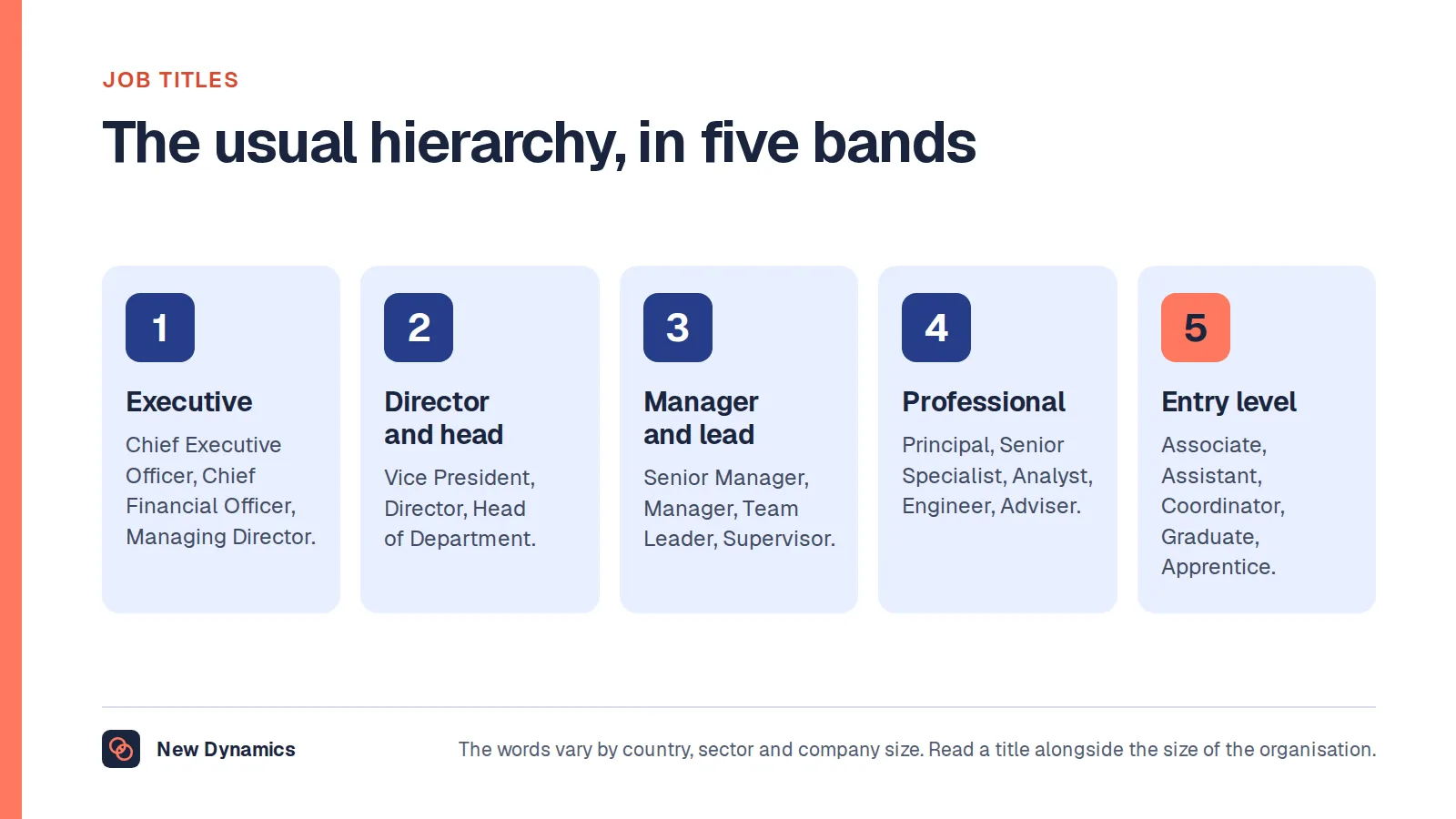
Our guide to job titles explains how levels and titles fit together across organisations, and our performance calibration guide covers the fair comparison of associates at review time.

Frequently asked questions
What is an associate attorney?
A qualified, licensed lawyer employed by a law firm on a salary who is not a partner. The Cambridge Dictionary explains associate in job titles as someone who does the job described without all the responsibilities of the main position; attorney is the American word for a lawyer. Associates do the firm's legal work under partners' supervision.
What is the difference between an associate and a partner?
A partner owns a share of the firm, shares its profits and liabilities and brings in work; an associate is an employee paid a salary. Both are qualified lawyers. Associates usually work towards partnership over a track of several years, though many move to counsel roles or in-house instead.
How long is the associate track?
Typically six to ten years from qualification to partnership consideration, moving through junior, mid-level and senior associate stages. The length and the criteria are set by each firm, and not every associate is promoted or wants to be.
What does an associate attorney do?
The work of a lawyer: research, drafting documents and contracts, advising clients, negotiating, preparing for court, supervising paralegals and juniors, and recording billable time, with responsibility growing by seniority from document review to running whole matters and client relationships.
Is an associate attorney a real lawyer?
Yes. Associates are fully qualified and licensed to practise. The word associate describes their position in the firm, not their qualification; a paralegal, by contrast, is not a licensed lawyer.
What is the UK equivalent of an associate attorney?
An associate solicitor. Prospects describes the newly qualified solicitor working on a fixed salary under the supervision of a partner or senior solicitor and taking on increasing responsibility; firms promote to associate, senior associate and partner on their own criteria.
Your next step: describe the track
- State the practice area, the level and the years of qualification expected.
- Name the supervising partner and the review process.
- Put the billable expectation and the development support in writing.
- Explain the partnership criteria, even if partnership is years away.
For a fair way to compare associates at review time, read and download our performance calibration guide. The guide is free to read, and the PDF uses our short download form.
Want associates' objectives, feedback and reviews in one place across the firm? Book a New Dynamics demo and bring your current review form. You can also email contact@new-dynamics.com.