TL;DR
- An assistant to a lawyer is usually one of three roles: a paralegal, who carries out legal tasks such as research, drafting and some advice; a legal assistant, often the same job under another title; or a legal secretary, who provides administrative support to solicitors and legal executives.
- A paralegal's job has seven duties: research the law, draft and prepare documents, manage case files and evidence, deal with clients, support court and tribunal work, keep records and billing, and handle correspondence and diaries. Paralegals cannot provide the services reserved for regulated professionals.
- The paralegal profession in the UK is unregulated, so there are no fixed entry requirements, but a law degree, a vocational qualification, the paralegal apprenticeship or membership of a professional body improves the odds. A job description should say which of the three roles it is and which practice area.
Search for “assistant to lawyer job description” and you will find three different jobs wearing similar titles. One researches the law and drafts documents. One runs the lawyer's diary, dictation and filing. One is somewhere between, depending on the firm. Hiring the wrong one wastes a salary; applying for the wrong one wastes a career move.
This article sets out a paralegal and legal assistant job description: the three roles that assist lawyers and how they differ, seven duties of a paralegal, what a paralegal cannot do, the skills employers look for, the routes into the role in the UK, a template and wording for a CV.
Legal support roles are developed through supervised work and feedback on it. See how New Dynamics continuous feedback supports check-ins between managers and their teams.
Three roles that assist a lawyer
| Role | What they do | Reports to |
|---|---|---|
| Paralegal | Legal research, drafting, case management, client contact and some legal advice | Solicitor, legal executive or partner |
| Legal assistant | Often the same as a paralegal; in some firms a more junior or administrative version | Solicitor or team |
| Legal secretary | Administrative support: documents, dictation, court forms, diaries, billing | Solicitor, legal executive or office manager |
Prospects, the UK graduate careers service, says in its paralegal profile that paralegals “have a strong knowledge and understanding of the law and play a vital role in the provision of legal services”, carrying out “certain legal tasks and services, such as undertaking legal research, drafting and preparing legal documents, and giving some legal advice”. It notes that job titles vary and roles “may see roles advertised as caseworker, compliance officer, contracts manager, legal secretary, volunteer adviser or legal assistant”. The UK National Careers Service's paralegal profile lists legal assistant, property assistant and contracts assistant as alternative titles.
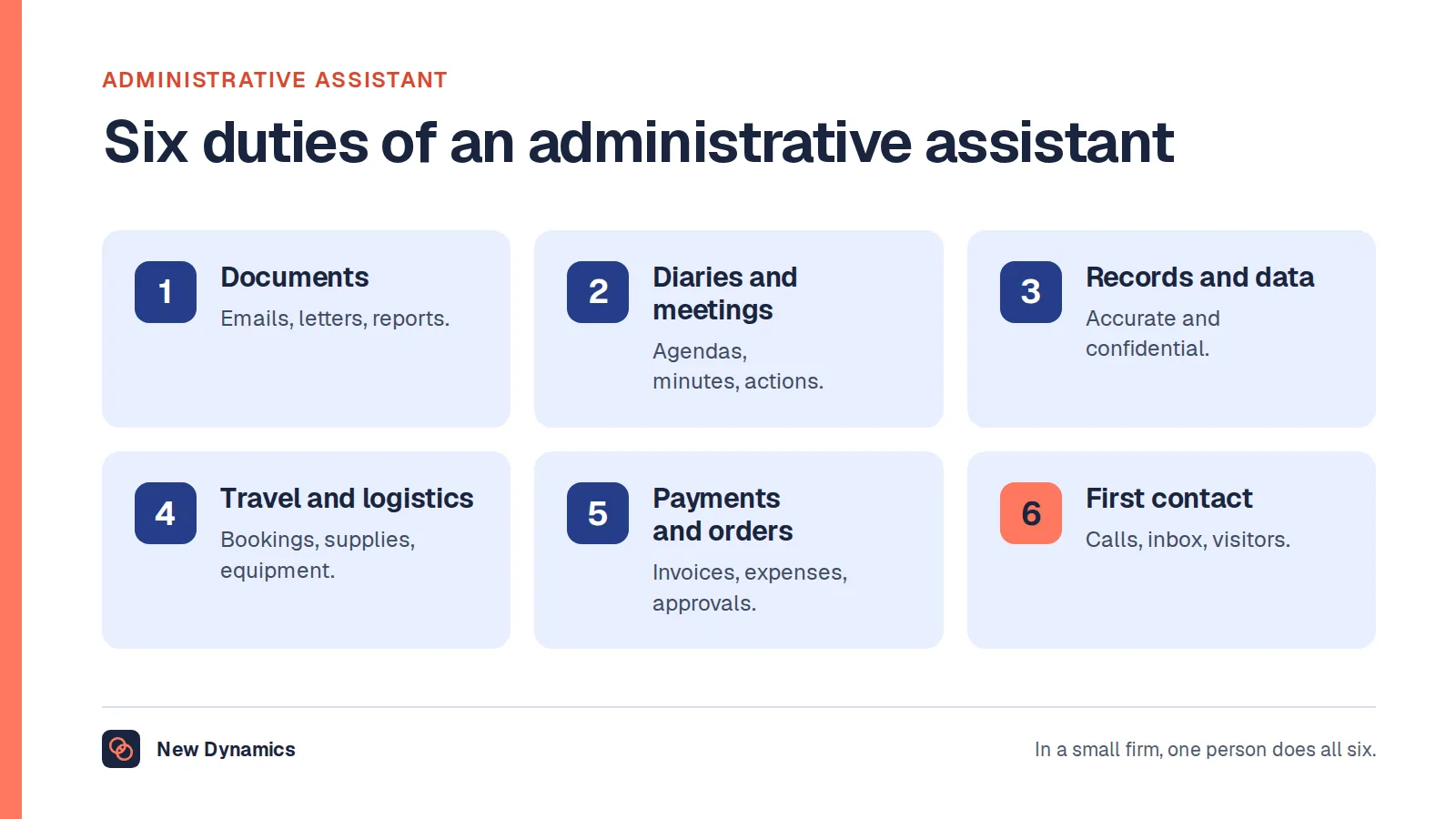
The legal secretary is a distinct role. The NCS's legal secretary profile says legal secretaries “provide administrative support for legal executives and solicitors”, with tasks including drafting, checking and editing reports, preparing court forms and statements, working from solicitors' written notes and audio dictation, managing diaries, accompanying solicitors to court or police stations, filing documents and handling billing and invoices. Our administrative assistant job description covers the general version of that role.
A job description should say which of the three it is in the first line.

Paralegal duties: seven responsibilities
Prospects lists the typical responsibilities. Grouped into seven:
- Research the law. Conduct legal research, analyse and input legal data, and keep up with case law, legislation and procedure.
- Draft and prepare documents. Draft and prepare legal documents, complete official documentation, write reports and, in some roles, negotiate contracts and legal documents.
- Manage case files and evidence. Organise case files and evidence, prepare case materials, legal briefings and litigation bundles, and file documents with the court.
- Deal with clients. Keep clients informed, meet them to take instructions where appropriate, and provide legal advice in certain circumstances.
- Support court and tribunal work. Attend court hearings, inquests and tribunals, take witness statements and prepare case summaries.
- Keep records and billing. Maintain accurate, organised records and arrange payments and billing.
- Handle correspondence and diaries. Deal with correspondence and client enquiries, organise diaries and schedule meetings, and attend meetings with legal experts, clients or claimants.
The NCS adds handling a caseload of clients and giving them legal information, interviewing clients and witnesses, and managing confidential client information.
What a paralegal cannot do
Prospects is clear about the limit: although paralegals have some legal training, “they can't provide services that are reserved for regulated legal professionals such as solicitors, barristers, chartered legal executives and licenced conveyancers”, and it lists the reserved services: “litigation, probate, advocacy and mediation, and conveyancing”. Paralegals do not have an automatic right of audience in court, though they can advise litigants who represent themselves and may speak on their behalf at the judge's discretion.
A job description should therefore describe supervised work. The paralegal prepares, researches and drafts; the regulated professional advises on reserved matters, signs and appears. This is general information about the position in England and Wales as Prospects describes it, not legal advice; rules differ elsewhere.

Skills employers look for
Prospects lists strong written and verbal communication “to draft legal documents, liaise with clients and present information clearly”, the ability to manage multiple tasks and caseloads, attention to detail “for analysing files, reviewing contracts and maintaining accurate records”, legal research skills, time management under pressure and tight deadlines, administrative and organisational skills for case files and correspondence, teamwork across departments and with senior legal professionals, negotiation and client handling, flexibility, commercial awareness and professionalism and discretion.
For an advert, six things: precision, research, drafting, organisation across a caseload, discretion with confidential information and calm with clients under stress.
Routes into the role in the UK
No fixed entry requirements. Prospects says: “The paralegal profession is unregulated, which means there's no fixed entry requirements.” It adds that competition is fierce and that a related legal qualification or paralegal experience improves the odds.
Law graduates. Prospects notes that solicitors' firms sometimes prefer law graduates, and that many graduates work as paralegals to gain qualifying work experience towards becoming a solicitor or before training as a barrister.
Vocational courses and apprenticeships. Applicants who have completed a vocational course teaching the practicalities of legal work are also valued. The NCS lists the paralegal level 3 and advanced paralegal level 5 apprenticeships, usually taking around two years, and a legal technician level 4 apprenticeship for those specialising in conveyancing or probate.
Professional bodies. Prospects says membership of a body such as the National Association of Licensed Paralegals or CILEX “shows your commitment to the profession and reassures employers and clients that you have the required skills and knowledge”.
Progression. The NCS says a paralegal could qualify as a legal executive or solicitor with further study, or become self-employed or set up a paralegal practice; a legal secretary could become a senior secretary, PA or office manager, or train as a paralegal, legal executive, licensed conveyancer or solicitor.
Requirements differ in other countries. Check the rules where you work.

Paralegal job description template
Adapt the template to your firm or department. Keep every line true.
Job title: Paralegal, [practice area] [or: Legal assistant / Legal secretary]
Reports to: [Supervising solicitor / partner / head of legal]
Location and hours: [Office / hybrid]; [37.5] hours a week
Purpose of the role: To support the [practice area] team by researching, drafting, managing case files and dealing with clients, so that fee earners can advise, sign and appear with everything prepared and correct.
Main duties:
- Carry out legal research and summarise findings
- Draft and prepare documents, forms and correspondence for review by a fee earner
- Open, organise and maintain case files, evidence and bundles; file documents with the court
- Take instructions and keep clients informed under supervision
- Support hearings, tribunals and meetings; take witness statements
- Maintain accurate records, time recording and billing
- Manage correspondence, diaries and enquiries
Skills and experience:
- Law degree, vocational legal qualification, paralegal apprenticeship or equivalent experience
- [One] year in a legal environment [or: strong graduate with placement experience]
- Precise drafting and research; confident with [case management system]
- Discreet, organised and calm with clients
- Membership of, or willingness to join, a professional body
We provide: Supervision by a named solicitor, [support towards CILEX / qualifying work experience], and a route to senior paralegal or a training contract.
State the practice area, the supervising lawyer and whether the role offers qualifying work experience. Our job description template explains the overall structure.
How to describe legal support work on a CV
Write what you did and the scale. The lines below are our own examples.
- “Paralegal in a [commercial property] team, managing a caseload of [n] matters under supervision.”
- “Drafted [leases, contracts, witness statements] for review; prepared litigation bundles for [n] hearings.”
- “Police station accredited; attended [n] interviews as a representative.”
- “Maintained time recording and billing for a team of [three] fee earners.”
- “Member of [professional body]; working towards [qualification].”
Common mistakes in legal support job adverts
Paralegal or secretary? Say which. The skills and pay differ.
Practice area missing. Family, property, litigation and corporate work need different knowledge.
Reserved work implied. A paralegal advert that promises advocacy or conveyancing responsibility misdescribes the role.
Supervision unstated. Name the supervising lawyer and how work is reviewed.
No route onward. Say whether the post counts as qualifying work experience and whether you support professional study.
Frequently asked questions
What is the job description of an assistant to a lawyer?
It depends on the role. A paralegal researches the law, drafts documents, manages case files, deals with clients and supports court work under a lawyer's supervision. A legal assistant is often the same role under another title. A legal secretary provides administrative support: documents, dictation, court forms, diaries and billing.
What does a paralegal do?
Prospects says paralegals carry out legal tasks such as research, drafting and preparing legal documents and giving some legal advice. Seven core duties: research, drafting, case file management, client contact, court and tribunal support, records and billing, and correspondence and diaries.
What is the difference between a paralegal and a legal secretary?
A paralegal does legal work: research, drafting, case management and some advice. A legal secretary does administrative work for lawyers: preparing documents from dictation, court forms, diaries, filing and billing. The National Careers Service profiles them separately and notes that a legal secretary can train to become a paralegal.
What can a paralegal not do?
Paralegals cannot provide services reserved for regulated legal professionals. Prospects lists litigation, probate, advocacy and mediation, and conveyancing, and notes that paralegals have no automatic right of audience in court.
What qualifications does a paralegal need?
None are fixed, because the profession is unregulated in the UK. A law degree, a vocational legal qualification, a paralegal apprenticeship or membership of a professional body such as NALP or CILEX improves the chances, and firms often prefer law graduates.
Is paralegal a route to becoming a solicitor?
It can be. Prospects notes that many graduates work as paralegals to gain qualifying work experience towards becoming a solicitor, and the National Careers Service says a paralegal could qualify as a legal executive or solicitor with further study.
Your next step
- Write the first line: paralegal, legal assistant or legal secretary, and the practice area.
- Describe the work as supervised, and name the supervising lawyer.
- State the qualifications you will accept and whether the post counts as qualifying work experience.
- Plan the first month: systems, precedents, a mentor and a first review.
For that first month, read and download our employee onboarding guide. The guide is free to read, and the PDF uses our short download form.
Want supervision notes, objectives and reviews for every paralegal in one place? Book a New Dynamics demo and bring your current job description. You can also email contact@new-dynamics.com.