TL;DR
- “Banker” covers at least five different jobs: the personal banker in a branch or on the phone, the business banker, the corporate or commercial banker, the investment banker and the private banker. The day, the customers, the targets and the regulation all differ, so an advert that just says “banker” has told the reader very little.
- The version most people mean is the personal banker. O*NET lists Personal Banker among the job titles for its financial services sales agents occupation, whose tasks include interviewing clients “to determine clients' assets, liabilities, cash flow, insurance coverage, tax status, or financial objectives” and determining “customers' financial services needs” in order to “prepare proposals to sell services that address these needs”.
- Two things shape the job more than the products do. The FCA's Certification Regime covers functions that “can have a significant impact on customers and/or the firm”, and requires firms to check and certify that staff are fit and proper “on appointment and at least once a year”. And the targets: a role that sells regulated products to people who trust it needs its incentives and its conduct expectations designed together.
"Banker" is one of those job titles that sounds specific and is not. It covers the person who opens a current account in a high street branch and the person who structures a bond issue, and almost nothing about their weeks is comparable.
This article sets out a banker job description that starts by saying which banker: the five versions of the job, then eight duties for the version most people mean, the regulated layer, the target problem, and a template. It is general information about the role, not financial or regulatory advice.
Branch and telephone banking roles run on targets, and targets in a regulated sales job have to be designed with conduct in mind rather than bolted on afterwards. See how New Dynamics Goals & OKRs keep targets and progress in one place.
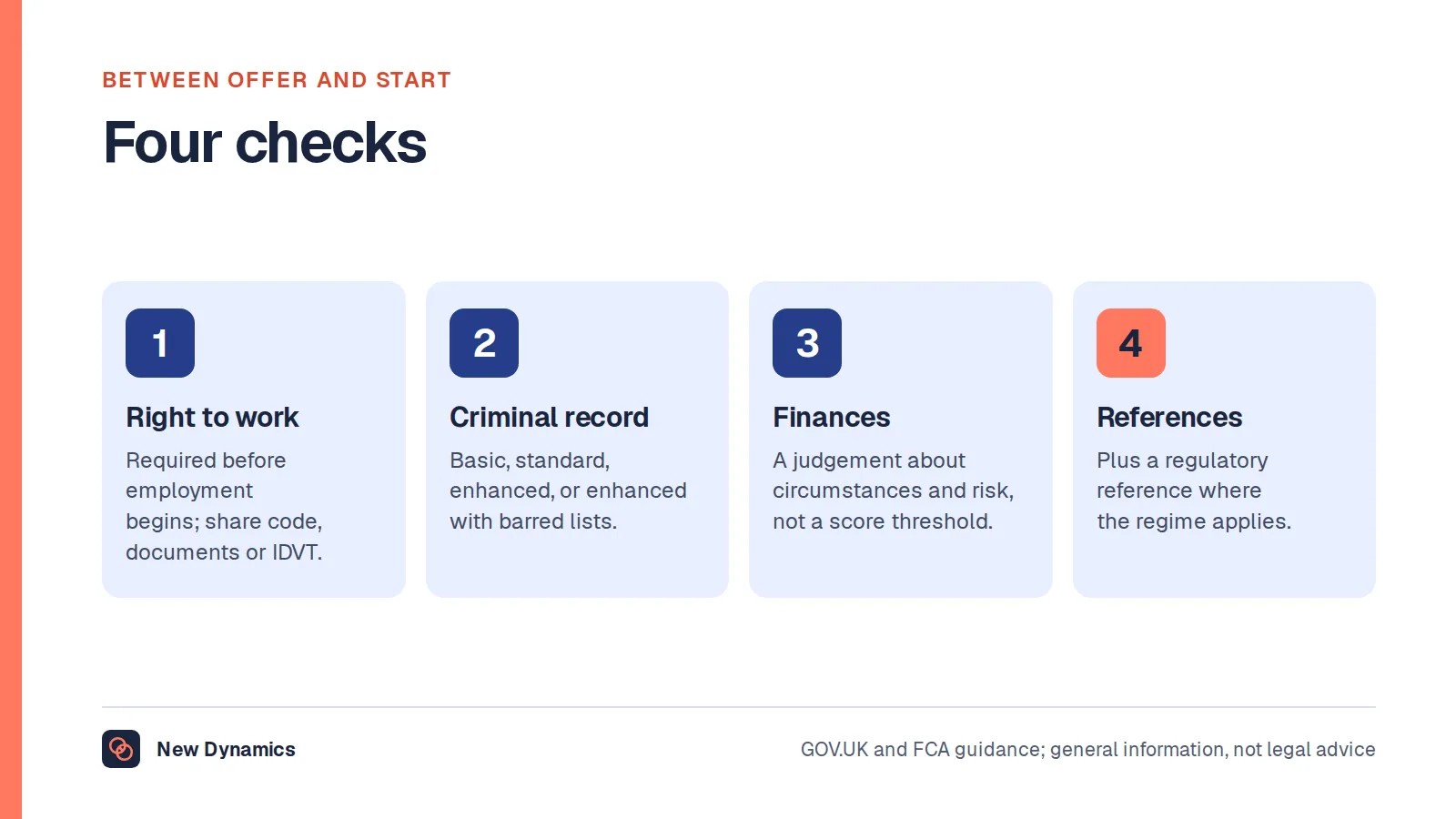
Before any of that comes the screening: our post on what you need to work at a bank covers the four checks and the fit and proper test.
Five jobs, one word

- Personal banker. Branch, telephone or video. Day-to-day banking, savings, cards, overdrafts, simple lending, referrals to specialists. This is what most "banker job description" searches mean, and O*NET lists Personal Banker among the reported job titles for its financial services sales agents occupation.
- Business banker. Small and medium-sized business customers: accounts, payments, working capital, small loans.
- Corporate or commercial banker. Larger companies, larger credit, longer relationships. O*NET's Loan Officers occupation lists Commercial Banker and Corporate Banking Officer among its titles, covering those who "evaluate, authorize, or recommend approval of commercial, real estate, or credit loans".
- Investment banker. Capital markets and advisory. A different industry in practice, with different hours and different qualifications.
- Private banker. Wealthy individuals: banking, credit and access to investment management.
Then the branch leadership layer. The National Careers Service's bank manager profile (alternative titles "building society manager, retail bank manager") describes overseeing the day-to-day running of a branch, putting business, marketing and sales plans into practice, monitoring sales targets and budgets, assessing lending risk, promoting products, motivating staff to meet targets, making sure staff follow financial regulations, developing relationships with the local community, and dealing with complaints.
Eight duties of a personal banker

- Serve the customer in front of you. Transactions, queries, problems, and the ordinary work of making someone's banking function.
- Find out what they actually need. O*NET's task is to "interview clients to determine clients' assets, liabilities, cash flow, insurance coverage, tax status, or financial objectives". Done properly this is a conversation, not a script.
- Recommend and explain. "Determine customers' financial services needs and prepare proposals to sell services that address these needs", and "discuss financial options with clients and keep them informed". Explaining what a product does not do is part of the job.
- Open and administer. Accounts, cards, standing orders, switches, identification and verification checks, and everything that follows from a change of address or a bereavement.
- Lend within limits. Simple lending decisions and referrals: in the loan officer's terms, "approve loans within specified limits, and refer loan applications outside those limits to management for approval", and "explain to customers the different types of loans and credit options that are available, as well as the terms of those services".
- Keep records. "Keep accurate records of transactions", complete the file properly, and write the note that the next colleague will rely on.
- Follow the rules. "Review all securities transactions to ensure accuracy of information and conformance to governing agency regulations", complete mandatory training, and apply financial crime and vulnerability procedures as written.
- Build the relationship. Contact customers, follow up, and work with the specialists (mortgages, protection, investments, business) that a personal banker refers to rather than replaces.
The day
- Appointments and walk-ins, or a queue of calls, with the mix set by the channel.
- Interruptions: a card blocked, a payment gone wrong, a customer in distress. These do not wait for the appointment slot.
- Admin between customers, which is where the file either gets completed or does not.
- Targets visible all day, on products, referrals, appointments or customer satisfaction, depending on the bank.
- Training and attestations, recurring, mandatory and time-boxed.
The regulated layer
A personal banker is not usually a senior manager, but the role sits inside a regulated firm and often inside the certification part of the regime.
The FCA's Certification Regime "covers specific functions that aren't Senior Management Functions, but can have a significant impact on customers and/or the firm". Certification staff "are not approved by the FCA. Instead, firms need to check and certify that they are fit and proper to perform their role on appointment and at least once a year".
For the job description that means three things worth writing down. Whether the role is a certification function at that firm. What qualifications or accreditations are required before the person can advise on anything. And that the annual fitness and propriety assessment is a real, scheduled piece of work rather than a form. Which functions apply is a question for the firm's compliance team and the FCA Handbook.
Targets and conduct, which are one problem
This is the part a job description usually splits and should not.
A personal banker sells regulated products to people who trust them, often people who cannot easily judge what they are being sold. Four practical points:
- Volume targets on individual products push behaviour towards the product rather than the need.
- Measures of quality matter as much as measures of sale: file completeness, later cancellations, complaints, and whether the customer still holds the product a year on.
- Referral targets can be gamed by referring everyone, which wastes the specialist's time and the customer's.
- The scheme has to be explainable to the person it applies to and to a regulator, in the same words.
Our compensation policy guide covers writing variable pay so that it can be explained to the person it applies to.
How it differs from three nearby jobs
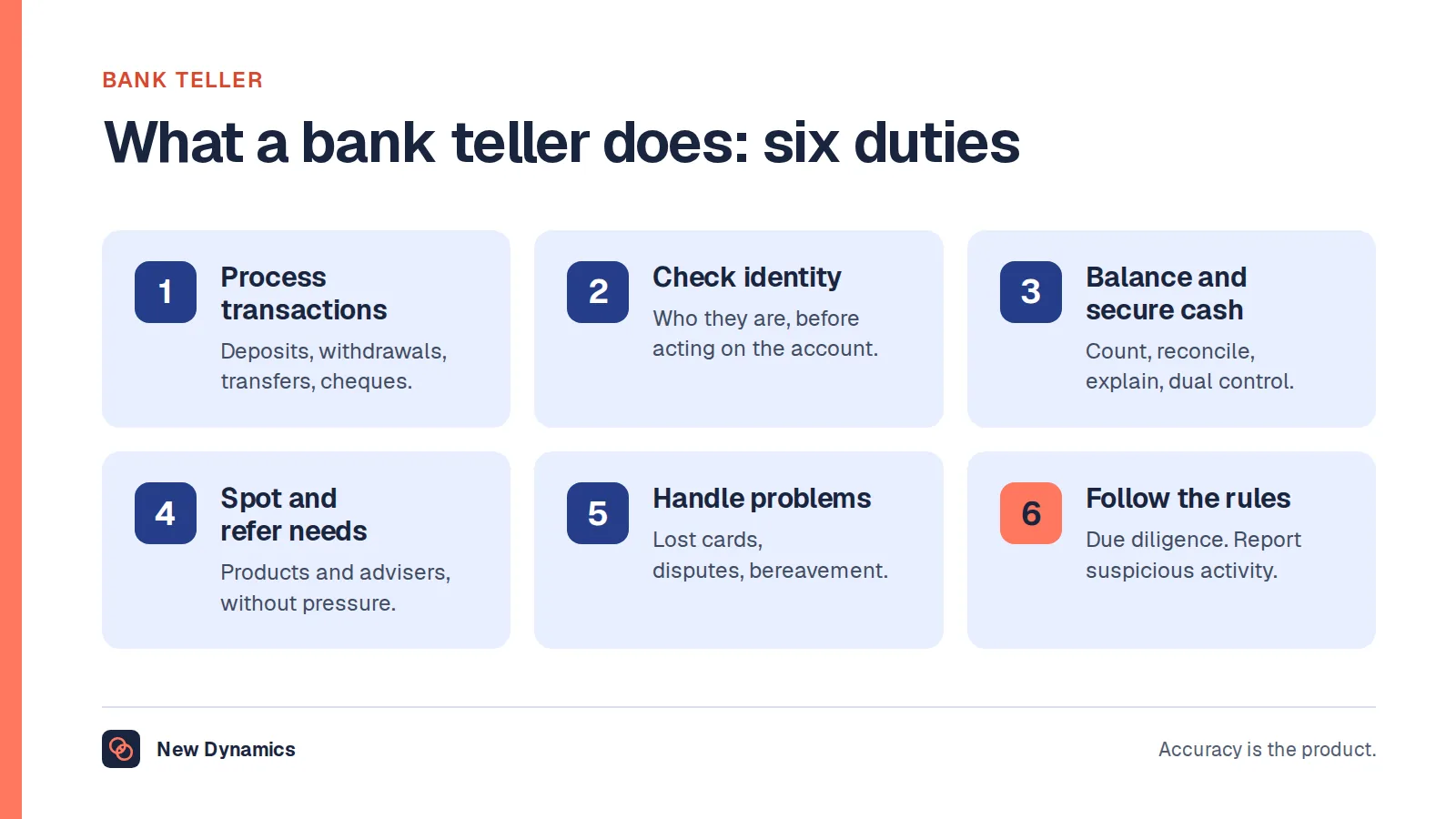
- Bank teller or cashier. Transactional, counter-based, with referrals rather than advice. See our bank teller job description.
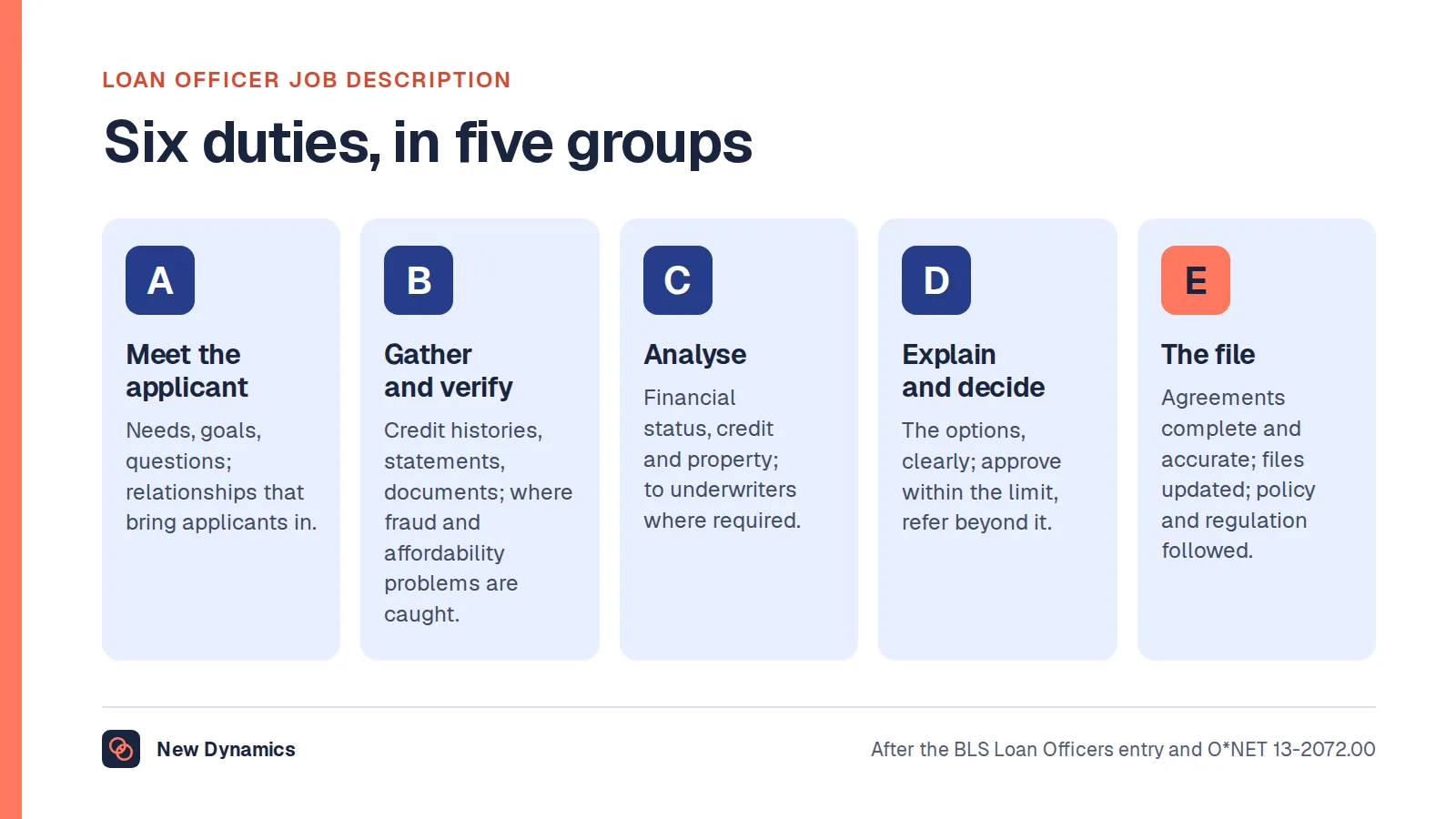
- Loan officer. Lending as the whole job, with credit assessment at its centre. See our loan officer job description.
- Financial adviser. Advises on a client's whole financial position, under a different qualification and advice framework; a personal banker usually refers to one rather than being one.
Skills, routes in and progression
The National Careers Service lists the skills for the branch management version, and they apply downwards: business management skills; knowledge of finance, economics and accounting; customer service skills; the ability to sell products and services; excellent verbal communication; leadership; clear thinking using logic and reasoning; thoroughness and attention to detail; and confident use of a computer and the main software packages.
Routes in are usually a customer service or teller role, an apprenticeship, or direct application with retail or service experience. Progression runs from personal banker to senior or premier banker, to branch or area management, or sideways into mortgages, business banking, complaints, financial crime or training. The National Careers Service also notes that you could work towards Chartered Banker status through the Chartered Banker Institute, and that experience can lead to responsibility for several branches, head office operations, an overseas division, or corporate and investment banking.
A banker job description template
Job title: Personal banker [branch / telephone / video]
Reports to: Branch manager / team manager
Regulatory status: [whether the role is a certification function; what qualifications are required; what the person may and may not advise on]
Purpose: Help customers with their day-to-day banking and match them to products that genuinely suit their circumstances, accurately and within the bank's rules.
Responsibilities
- Serve customers across the supported channels, resolving queries and problems.
- Carry out needs conversations covering circumstances, income, commitments and objectives.
- Explain products, including their limits and costs, and recommend only what is suitable.
- Open, amend and administer accounts and services, completing identification and verification requirements.
- Make lending decisions within your authority and refer those outside it.
- Refer customers to specialists for mortgages, protection, investments and business needs.
- Complete records and files accurately at the time.
- Apply financial crime, vulnerability and complaints procedures, and complete mandatory training on time.
How the role is measured: [sales or referral measures] alongside [quality, retention and complaint measures].
Hours: [branch hours, Saturdays, any evening cover].
What the advert should say

- Which banker. Personal, business, corporate, investment or private.
- Channel and customers. Branch, phone or video; personal customers, small businesses or larger ones.
- The regulatory position. Certification function or not, and which qualifications are required or funded.
- How it is measured and paid, including the quality measures alongside the sales ones.
Frequently asked questions
What does a banker do?
It depends which banker. A personal banker serves customers in a branch or on the phone, establishes what they need, explains and recommends products, opens and administers accounts, makes small lending decisions, refers to specialists and keeps the records. A commercial or corporate banker evaluates and recommends lending for businesses. An investment banker works in capital markets and advisory, which is a different industry in practice.
What does a personal banker do?
Day-to-day banking for personal customers: transactions and queries, needs conversations that cover assets, income, commitments and objectives, recommending and explaining suitable products, opening and administering accounts, simple lending within set limits, referrals to mortgage, protection and investment specialists, record keeping, and following the bank's financial crime and vulnerability procedures.
What is the difference between a bank teller and a personal banker?
A teller handles transactions at the counter and refers customers on. A personal banker holds the conversation about what the customer needs, recommends and sells regulated products, opens and administers accounts, and may make small lending decisions. The teller role is transactional; the personal banker role is advisory and target-carrying.
What qualifications do you need to be a banker?
None to enter a branch role: banks generally recruit on customer service aptitude and train the products and rules. Advising on specific products requires the firm's own accreditation and, for some products, a regulated qualification. The National Careers Service notes that Chartered Banker status through the Chartered Banker Institute can broaden options at senior management level.
Is a personal banker a regulated role?
The role sits inside a regulated firm, and firms often treat customer-facing banking roles as certification functions. The FCA's Certification Regime covers functions that are not Senior Management Functions but can have a significant impact on customers or the firm, and requires firms to check and certify that staff are fit and proper on appointment and at least once a year. Which functions apply depends on the firm and the role. This is general information, not legal advice.
How should a personal banker's performance be measured?
Not on product volumes alone. Pair the sales and referral measures with quality measures: file completeness, whether products are cancelled shortly after sale, complaints, and whether customers still hold and use what they were sold a year later. A scheme that cannot be explained in the same words to the banker and to a regulator is the wrong scheme.
Your next step: name the banker in the advert
- Put the version of the role in the job title: personal, business, corporate, investment or private.
- State the channel, the customers and the products the person can actually handle.
- Say whether the role is a certification function and what qualifications are required or funded.
- Publish the quality measures alongside the sales measures, in the same document.
For writing variable pay that can be explained to the person it applies to, read and download our compensation policy guide. The guide is free to read, and the PDF uses our short download form.
Want targets, check-ins and reviews in one place, so sales and conduct measures sit side by side rather than in different systems? Book a New Dynamics demo and bring your current scorecard. You can also email contact@new-dynamics.com.