TL;DR
- A bank teller, called a bank cashier or customer service adviser in the UK, is the person in a branch who receives and pays out money, processes customers' transactions, checks identities and balances the cash drawer at the end of the day.
- The six duties are processing transactions, checking identity and documents, balancing and securing cash, spotting and referring customer needs, handling queries and problems, and following the rules on money laundering and fraud.
- Employers look for accuracy, honesty, calm with customers and care with rules. In the UK, staff must verify customers' identities and report suspicious activity, and the branch role is increasingly a customer adviser role as routine transactions move online.
The teller's window is where a bank meets most of its customers face to face. Deposits, withdrawals, transfers, a lost card, a confused relative, a cheque that looks wrong: the person behind the counter handles them all, accurately, quickly and within rules that carry criminal penalties if broken.
This bank teller job description explains what the job involves, gives the UK titles for the same role, sets out six duties, describes the accuracy, identity and money laundering standards the work must meet, lists the skills employers look for, gives a template that you can adapt and suggests how to describe the work on a CV.
Tellers are measured on accuracy, balanced drawers and referrals, and the targets should be fair and visible. See how New Dynamics Goals & OKRs keep targets and progress in one place, so that a branch team knows what it is working towards.
What is a bank teller?
The Cambridge Dictionary defines a teller, in US and Australian English, as “a person employed in a bank to receive and pay out money”. In the UK the same role is usually called a bank cashier, customer service adviser or customer service officer, and the counter is often called the till or the front line.
The title matters less than the work, which has changed. Many routine deposits and withdrawals have moved to cash machines, apps and online banking, so the person at the counter tends to spend more time on the transactions that need a human being: identity checks, problems, vulnerable customers and referrals to advisers. In England the role sits within the apprenticeship standards that Skills England lists for financial services customer advisers, a level 3 standard of typically 18 months, alongside the level 2 customer service practitioner standard.
Three things define the job.
- Accuracy is the product. A teller who is fast and wrong is worse than one who is slow and right.
- Trust is assumed and checked. Tellers handle cash and personal data all day, under cameras, counts and audits.
- The rules are the law. Identity checks and suspicious activity reporting are legal duties, not house style.
Bank teller duties: six responsibilities
- Process transactions. Deposits, withdrawals, transfers, cheque handling, foreign currency, bill payments and card services, entered accurately and receipted.
- Check identity and documents. Verify who the customer is before acting on the account, check signatures and documents, and refuse politely when something does not match.
- Balance and secure cash. Count the drawer at the start and end of the day, reconcile it with the system, record and explain any difference, and follow the branch's rules on limits, safes and dual control.
- Spot and refer needs. Notice when a customer would benefit from a product or an adviser's help, explain the basics and make the referral, without pressure.
- Handle queries and problems. Lost cards, disputed transactions, bereavement, powers of attorney and customers in difficulty, with patience and by the book.
- Follow the rules on money laundering and fraud. Apply customer due diligence, watch for unusual patterns and report suspicious activity to the nominated officer.
Branches vary. Some tellers also open accounts, run the ATM replenishment or cover the reception desk. The advert should say which.

The standards the job must meet
Identity and money laundering. UK businesses covered by the Money Laundering Regulations must carry out customer due diligence. HMRC's guidance on money laundering responsibilities, written for the businesses it supervises, sets out the principle that applies across the regulated sector: “If you have doubts about a customer's identity, you must stop dealing with them until you're sure.” It describes verifying a customer's name, photograph on an official document, residential address and date of birth, and the importance of staff “promptly reporting any suspicious activity to the nominated officer”. Banks have their own regulator and their own detailed procedures, and every teller is trained in them.
Accuracy and balancing. The drawer must balance. Unexplained differences are investigated, and repeated ones are treated seriously. Good branches measure differences, not just totals, and treat the first one as a training matter.
Conduct. Tellers see customers' balances, transactions and personal circumstances. Confidentiality, and not looking at accounts without a business reason, are conditions of the job.
This is general information about the UK, not legal advice. Other countries have their own rules, and each bank's procedures are the ones that apply on the day.

Skills and qualities employers look for
- Accuracy with numbers and data, under time pressure and with a queue.
- Honesty and integrity, demonstrated through references and, often, credit and criminal record checks.
- Calm, clear communication, including with customers who are anxious, angry or confused.
- Care with rules, and the confidence to say no politely when a check fails.
- Awareness, for both the sales referral and the suspicious transaction.
- Teamwork in a small branch where everyone covers everyone else.

No degree is needed. Employers often ask for GCSE-level maths and English or equivalent, and train tellers on their systems, products and compliance.
Checks before starting
Because tellers handle money and personal data, banks run thorough pre-employment checks, typically identity, right to work, references covering several years, a criminal record check and often a credit check. Adverts should say so, and candidates should expect it.
Bank teller job description template
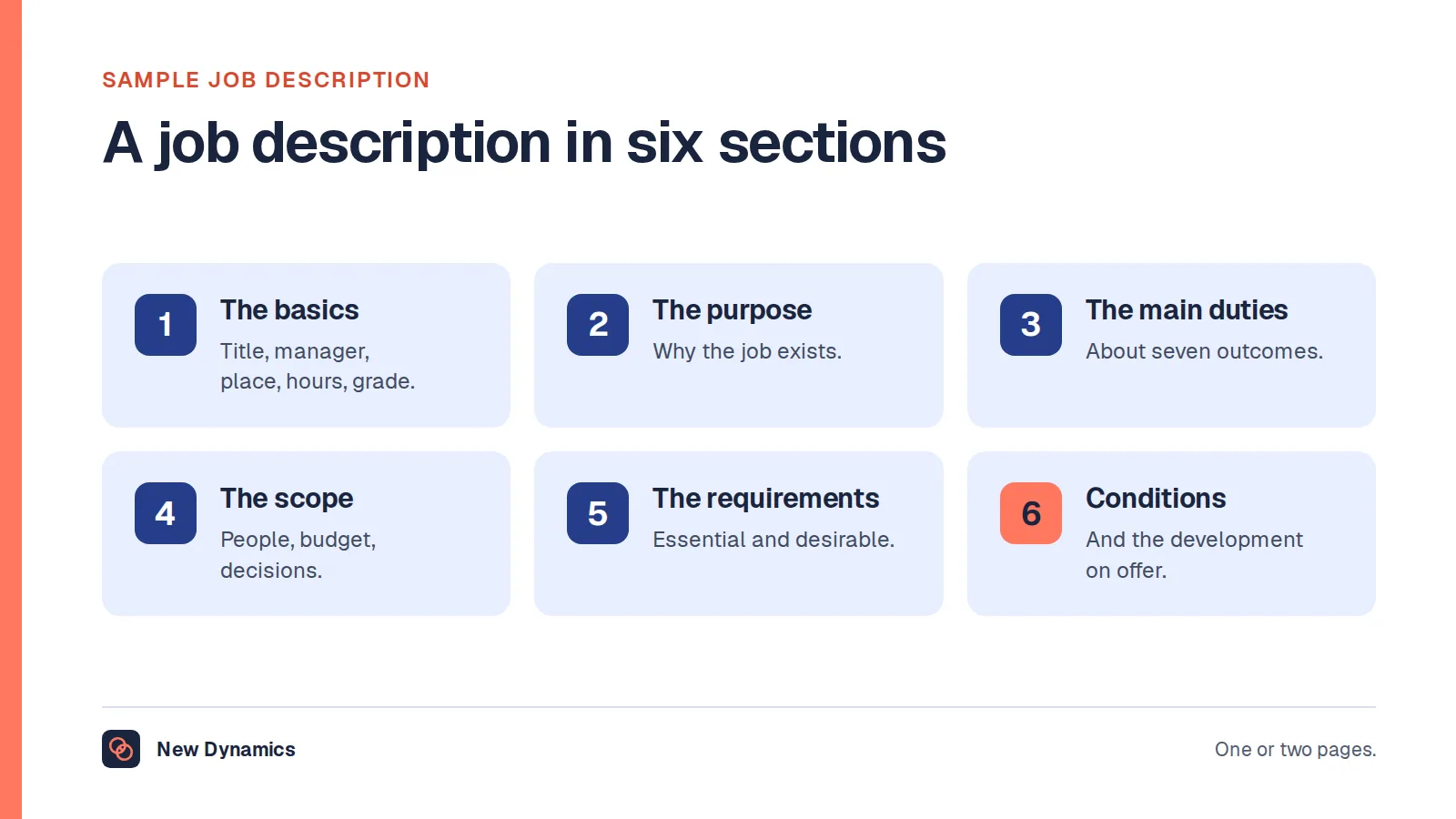
Adapt the template to your bank or branch. Keep every line true.
Job title: Bank teller (customer service adviser)
Reports to: Branch manager or customer service manager
Hours: [Full-time or part-time], including Saturdays where the branch opens
Purpose of the role: To serve customers at the counter accurately, securely and within the bank's rules, and to make sure every customer leaves with what they came for or a clear next step.
Main duties:
- Process deposits, withdrawals, transfers, cheques and payments accurately
- Verify customers' identity and documents before acting on accounts
- Balance the cash drawer daily and follow cash security procedures
- Identify customer needs and refer to advisers and products appropriately
- Resolve queries and problems, escalating where required
- Apply customer due diligence and report suspicious activity
- Keep customer information confidential
Skills and experience:
- Accurate with numbers and careful with detail
- Clear, patient communication with the public
- Honest, reliable and comfortable following procedures
- Experience of cash handling or customer service welcome but not required
- GCSE maths and English at [grade] or equivalent
Checks: Identity, right to work, references, criminal record and credit checks
We provide: Full training on systems, products and compliance, a structured route to adviser roles, and objectives reviewed each quarter.
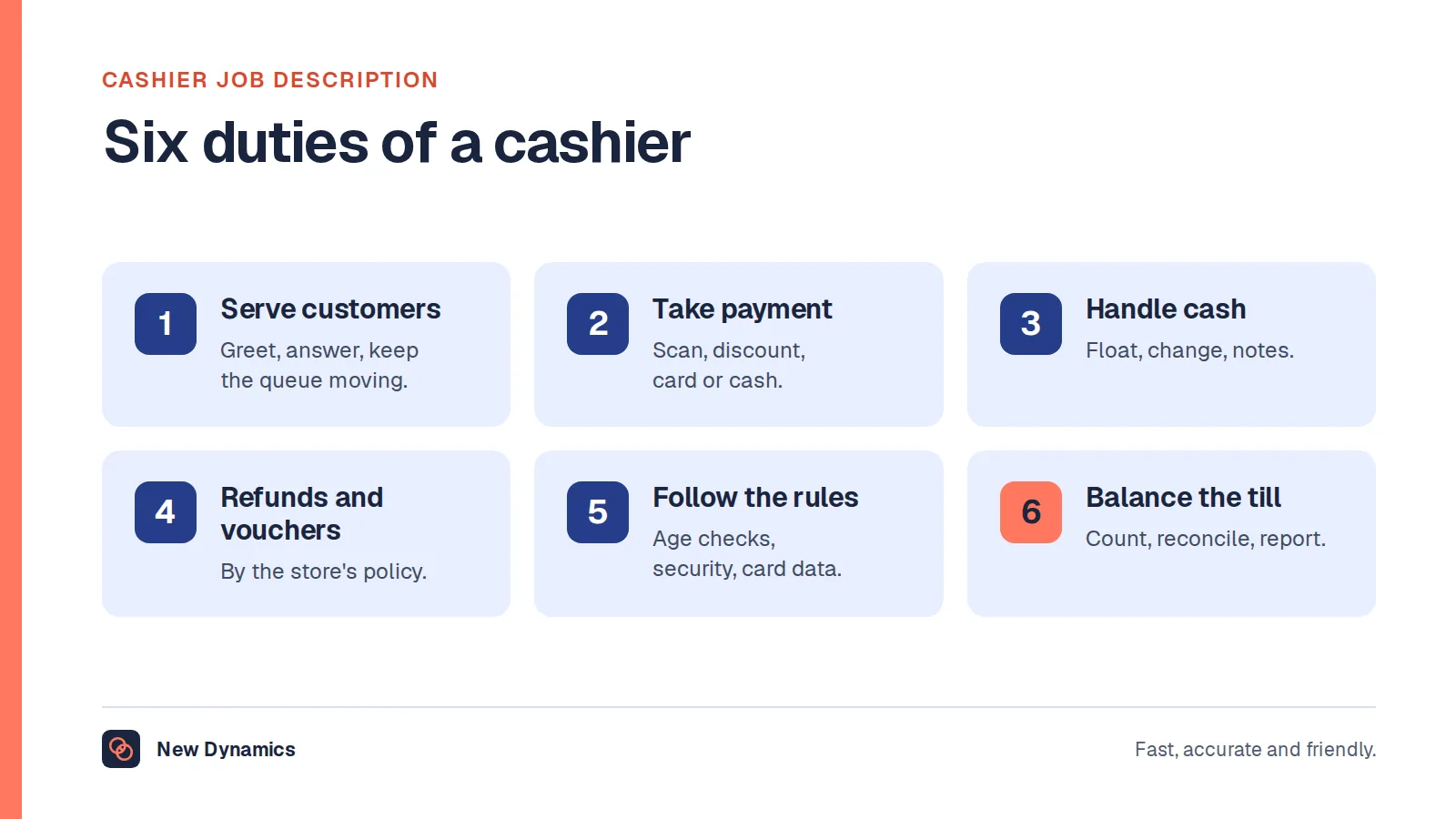
Say which branches, which days and which extra duties apply. Our job description template explains the structure, and our guide to the cashier job description covers the retail cousin of the role.
Bank teller duties for a CV
Employers want evidence of accuracy, trust and customers handled well. The lines below are invented examples, to show the form.
- State the volume and accuracy. “Processed around 150 counter transactions a day with a balanced drawer on 98% of days over two years.”
- Show compliance. “Completed customer due diligence on every new account and raised suspicious activity reports in line with procedure.”
- Show customers. “Resolved lost card and disputed transaction queries at the counter, escalating fraud cases the same day.”
- Show referrals. “Referred customers to mortgage and savings advisers, meeting branch referral targets.”
- Name the training. Anti-money laundering, fraud awareness, vulnerable customers, data protection.
If you have no banking experience, describe cash handling, reconciliation or customer service from any job, with numbers.
Common mistakes in bank teller adverts
Selling the job as pure customer service. It is, and it is also cash, checks and compliance. Say both.
Hiding the checks. Candidates who learn about the credit check at offer stage feel ambushed.
Referral targets without context. Say what the targets are and how they are reviewed, or the advert reads as a sales job in disguise.
No route onward. Many advisers and managers started at the counter. Say so.
Frequently asked questions
What does a bank teller do?
A bank teller processes customers' transactions at the counter, such as deposits, withdrawals, transfers and cheques; checks customers' identities and documents; balances and secures the cash drawer; spots and refers customer needs; resolves queries and problems; and applies the rules on money laundering and fraud.
What is a bank teller called in the UK?
Usually a bank cashier, customer service adviser or customer service officer. Teller is the US and Australian term. The work is the same, and in England the role sits within the financial services customer adviser apprenticeship standard.
What skills does a bank teller need?
Accuracy with numbers and data, honesty and integrity, calm and clear communication with the public, care with rules and procedures, awareness of both customer needs and suspicious activity, and teamwork in a small branch.
What qualifications do you need to be a bank teller?
No degree. Employers usually ask for GCSE-level maths and English or equivalent and train tellers on systems, products and compliance. Expect identity, right to work, reference, criminal record and credit checks before you start.
How do you describe bank teller duties on a resume?
As results with numbers: transactions processed and drawer accuracy, compliance completed, customer problems resolved and referrals made. Name the training you have had, such as anti-money laundering and fraud awareness.
What should a bank teller job description include?
The title and its local equivalent, who the teller reports to, hours including Saturdays, the purpose of the role, six or seven main duties covering transactions, checks, cash, referrals, problems and compliance, the skills and qualifications needed, the pre-employment checks, and the training and progression offered.
Your next step
If you are hiring, list the transactions, checks and referral expectations of your counter as it works today, and build the advert from that. If you are applying, rewrite one line of your CV with a transaction volume and an accuracy figure.
For a standard of conduct that covers cash, confidentiality and customers, read and download our code of conduct guide. The guide is free to read, and the PDF uses our short download form.
Want branch targets, feedback and development in one place? Book a New Dynamics demo and bring your current approach. You can also email contact@new-dynamics.com.