TL;DR
- Banker names at least four jobs: the teller or customer adviser at the counter, the personal banker who opens accounts and lends to individuals, the relationship or commercial banker who manages business customers, and the specialist in areas such as credit, treasury or investment banking. The questions differ by role, so decide which one the advert means before writing the interview.
- Banking hiring carries a layer other sectors do not. The FCA's Senior Managers and Certification Regime “consists of three parts: the Senior Managers Regime, the Certification Regime, and the Conduct Rules”, and grew from a recommendation that “firms take more responsibility for employees being fit and proper, and that there be better standards of conduct at all levels in banking firms”. That makes conduct, honesty and judgement interviewable subjects rather than assumptions.
- These 35 questions are original lines in six groups: customers and needs, accuracy and controls, conduct and judgement, sales and targets without mis-selling, risk and credit, and resilience and teamwork. Score them the way you would any structured interview, with the same questions in the same order and an agreed standard for an acceptable answer, and follow the Acas fairness rules on non-discriminatory questions, more than one interviewer and reasonable adjustments.
A bank advertises for a "banker". One applicant has spent four years on a counter balancing a drawer; another has run a portfolio of commercial customers; a third has priced derivatives. All three are bankers, and an interview written for one will tell you almost nothing about the others.
This article sets out banker interview questions that are worth asking: 35 of them in six groups, with what a strong answer contains, plus the conduct questions that banking specifically needs and generic lists leave out. It covers which of the four banking roles the advert means, how to score answers consistently, and the fairness rules to follow. It describes the UK regulatory context as background and is general information, not regulatory or legal advice.
An interview is one stage in a process with owners, dates and records. See how New Dynamics workflows run your own hiring stages with a completion view, so nobody waits three weeks for a decision that was made on day two.
First, which banker?
| Role | Works with | What the interview must test |
|---|---|---|
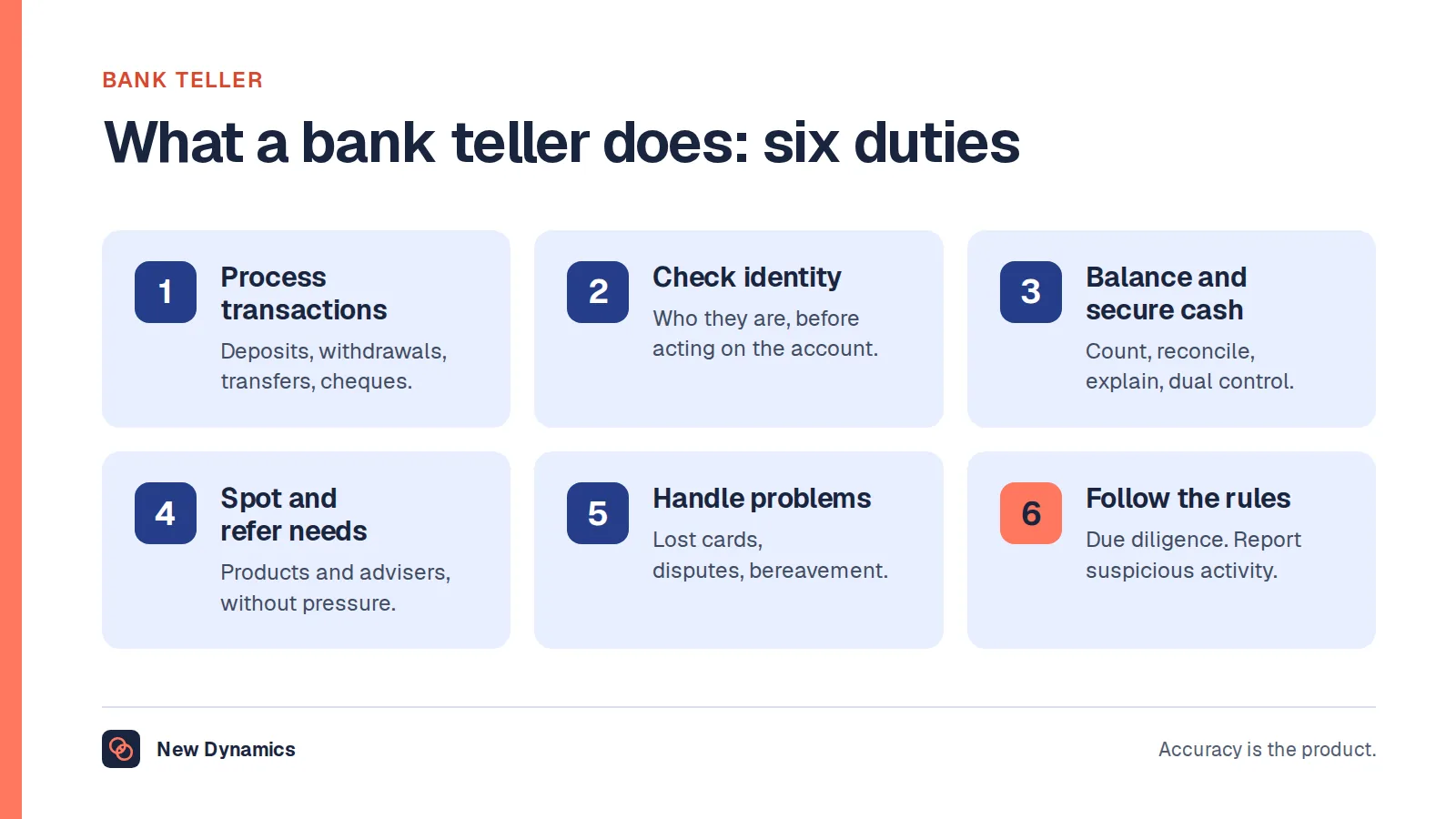
| Teller or customer adviser | Customers at a counter or by phone | Accuracy, cash handling, controls, service under queue pressure |
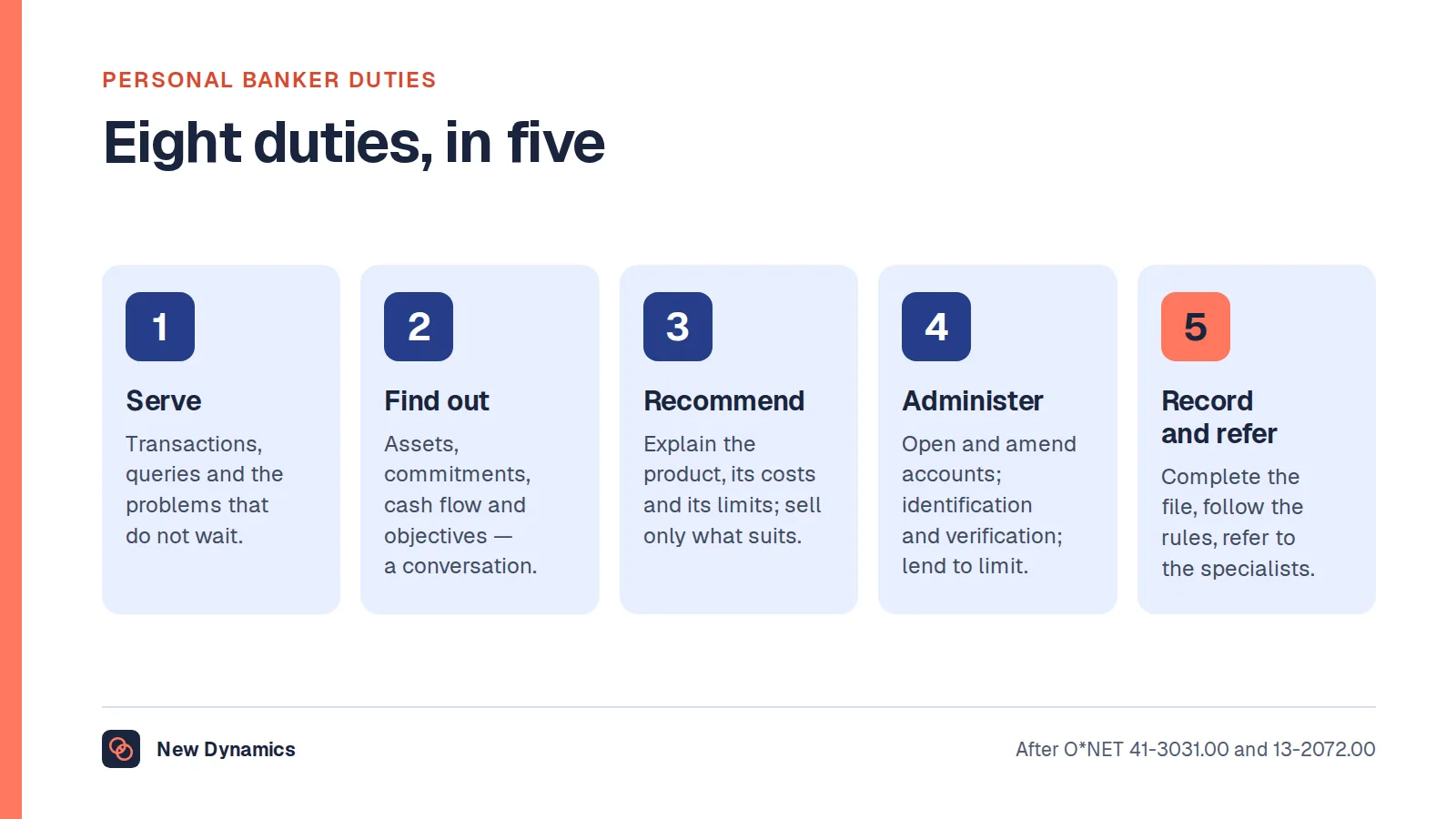
| Personal banker | Individual customers, accounts, lending | Needs analysis, suitability, regulated advice boundaries, sales conduct |
| Relationship or commercial banker | Business customers, credit | Commercial judgement, credit reasoning, relationship management |
| Specialist | Markets, treasury, credit risk, corporate finance | Technical depth, risk awareness, escalation behaviour |
Write the interview for the role, not the sector. Our bank teller job description and loan officer job description set out the duties the first two are hired against.

Why conduct questions belong in a banking interview
The Financial Conduct Authority's Senior Managers and Certification Regime exists because of conduct failures. The FCA explains that the Parliamentary Commission on Banking Standards recommended “that firms take more responsibility for employees being fit and proper, and that there be better standards of conduct at all levels in banking firms”, and that the resulting regime “consists of three parts: the Senior Managers Regime, the Certification Regime, and the Conduct Rules”. Its aims are to “encourage staff to take personal responsibility for their actions”, “improve conduct at all levels” and “make sure firms and staff clearly understand and can show who does what”.
Whatever the firm's own obligations are for a particular post, the practical implication for an interview is the same: honesty, judgement and the willingness to escalate are part of competence in banking, not a bonus, and they can be assessed with the same rigour as product knowledge. Which roles fall into which part of the regime is a matter for the firm's own arrangements.
35 banker interview questions
Ask every candidate for a role the same questions in the same order. Follow each answer with "what did you do?" and "what happened next?".
Customers and needs
- Tell me about a customer whose need was different from what they first asked for. How did you work that out?
- Describe a time you explained a financial product to someone who found it confusing. What did you change about how you explained it?
- How do you handle a customer who wants something the bank cannot give them?
- Tell me about a vulnerable or distressed customer you dealt with. What did you do differently?
- What do you do when you do not know the answer to a customer's question?
- Describe a complaint you handled from start to finish.
Accuracy and controls
- Walk me through how you balance at the end of a shift and what you do when it does not balance.
- Tell me about an error you made with money, a transaction or a record. How was it found and what happened?
- How do you check a document or an instruction before you act on it?
- Describe a time you had to follow a control that slowed you down. What did you do?
- What would make you stop a transaction you had been asked to process?
- How do you keep accurate records when the branch or the phone queue is busy?
Conduct and judgement
- Tell me about a time you were asked to do something you thought was wrong. What did you do?
- Describe a situation where the easy option and the right option were different.
- Who would you tell if you saw a colleague breaking a rule, and what would you say?
- Tell me about a time you escalated something. How did you decide it needed escalating?
- What would you do if a customer asked you to do something that would help them but break a procedure?
- Describe a time you had to admit a mistake to a manager or a customer.
- What does treating a customer fairly mean in practice, in your own words?
Sales, targets and not mis-selling
- Tell me about a time you decided not to sell a product to a customer. Why?
- How do you handle a month where you are behind target?
- Describe how you introduce a product to a customer who has not asked about one.
- What is the difference between a needs-based conversation and a pitch?
- Tell me about a customer who took a product on your recommendation. How did you check it was right for them?
- What would you do if your manager pushed you to sell something you did not think suitable?
Risk and credit
- Talk me through how you would assess whether a customer can afford a borrowing request.
- Tell me about a lending or credit decision you were involved in that turned out badly. What did you learn?
- What would make you decline an application that looked fine on paper?
- Describe a time you spotted something that did not add up in a customer's information.
- How would you explain a declined application to a customer?
Resilience and teamwork
- Describe your busiest day in a branch or on a desk. What did you prioritise?
- Tell me about working with a colleague you found difficult. How did the work get done?
- How do you keep your product and regulatory knowledge current?
- What did you change about how you work after feedback in the last year?
- Why this bank, and what would make you leave one?

What strong answers look like
- Specific, with a decision in them. A named situation, what the candidate did, what happened. "I always put the customer first" is not an answer.
- Honest about mistakes. In banking the candidate who has never made an error either has not worked long or is not saying. What matters is what they did next and who they told.
- Escalation as a normal act. Strong candidates escalate early and without drama. Weak ones either never escalate or escalate everything.
- Customer outcome and bank risk held together. The best answers show someone who can hold both, not one who treats them as opposites.
- Declining as well as selling. An answer to question 20 that describes a real declined sale is worth more than any number of closed ones.
Duty-based questions from the role itself
For counter and customer-adviser roles, derive questions from the actual duties. O*NET lists among tellers' tasks: balancing currency, coin and cheques in cash drawers at the end of shifts and calculating daily transactions; receiving cheques and cash for deposit, verifying amounts and checking the accuracy of deposit slips; cashing cheques “after verifying that signatures are correct, that written and numerical amounts agree, and that accounts have sufficient funds”; examining cheques for endorsements and to verify information such as dates, bank names and the legality of documents; resolving “problems or discrepancies concerning customers' accounts”; and entering transactions into computers. Each of those is a question: how do you do it, when did it go wrong, what did you do.
Scoring, and keeping it fair
Use the structured approach: the same predetermined questions in the same order, an agreed description of an acceptable answer written before the first interview, and the same rating scale applied immediately after each answer with the evidence noted rather than an impression.
Acas's guidance on interviewing job applicants sets the fairness rules: questions “must not discriminate”; “if possible, each interview should be carried out by more than 1 person to reduce the risk of discriminating”; interviewers should be prepared and understand discrimination law; ask each applicant the same questions where possible; you must ask candidates coming to interview to tell you if they need reasonable adjustments; and notes or recordings must be stored securely and confidentially under data protection rules.
Questions to avoid: anything about age, health, family or financial circumstances that is not a documented requirement of the role; hypotheticals with no right answer used as a personality test; and brain-teasers, which measure practice at brain-teasers.

What to let the candidate ask you
Good bankers interview the bank. Expect, and answer honestly: how targets are set and what happens when they are missed; what the firm does when a colleague raises a concern; how long the training is and who delivers it; what the first ninety days look like; and how performance is reviewed. A candidate who asks none of these has either done no preparation or does not care which bank they join.
Frequently asked questions
What questions are asked in a banker interview?
Questions about customer needs and difficult conversations; accuracy, cash and controls; conduct and judgement, including what the candidate did when asked to do something wrong; sales conversations and when they declined to sell; credit and affordability reasoning; and resilience and teamwork. The mix depends on whether the role is counter, personal banking, relationship banking or a specialism.
What should I look for in a banking candidate's answers?
Specific situations with a decision in them, honesty about mistakes and what followed, escalation treated as normal, an ability to hold customer outcome and bank risk together, and at least one example of declining a sale or a request that was not right.
Why do banking interviews ask about conduct?
Because conduct is part of competence in a regulated sector. The FCA explains that the Senior Managers and Certification Regime followed a recommendation that firms take more responsibility for staff being fit and proper and for better standards of conduct at all levels, and that the regime aims to encourage personal responsibility and improve conduct. What applies to a given role depends on the firm's arrangements.
How many questions should a banker interview include?
Six to ten, asked of every candidate in the same order, with follow-up probes. Thirty-five here is a bank to choose from, not a script; a forty-question interview tests stamina rather than suitability.
What interview questions should you not ask?
Anything touching a protected characteristic or personal circumstances that is not a documented requirement of the job. Acas says interview questions must not discriminate, that more than one interviewer reduces the risk, that applicants must be asked about reasonable adjustments, and that notes must be stored securely.
Your next step: choose eight and write the standard
- Decide which of the four banking roles you are hiring and pick eight questions.
- Write what an acceptable answer contains for each, before the first interview.
- Book two interviewers and agree the rating scale.
- Keep one conduct question in every interview, whatever the role.
For the fair, consistent process these questions sit inside, read and download our recruitment and selection guide. The guide is free to read, and the PDF uses our short download form.
Want interview stages, scores and decisions recorded in one place, on your own forms? Book a New Dynamics demo and bring your current interview pack. You can also email contact@new-dynamics.com.