TL;DR
- Clerical duties are the routine tasks that keep an office running: answering phones and emails, handling mail, filing and updating records, typing and formatting documents, data entry, scheduling and receiving visitors, ordering supplies and operating office equipment. O*NET describes general office clerks as performing duties too varied and diverse to be classified in any specific office clerical occupation; the BLS says they handle varying responsibilities based on the organisation's daily needs.
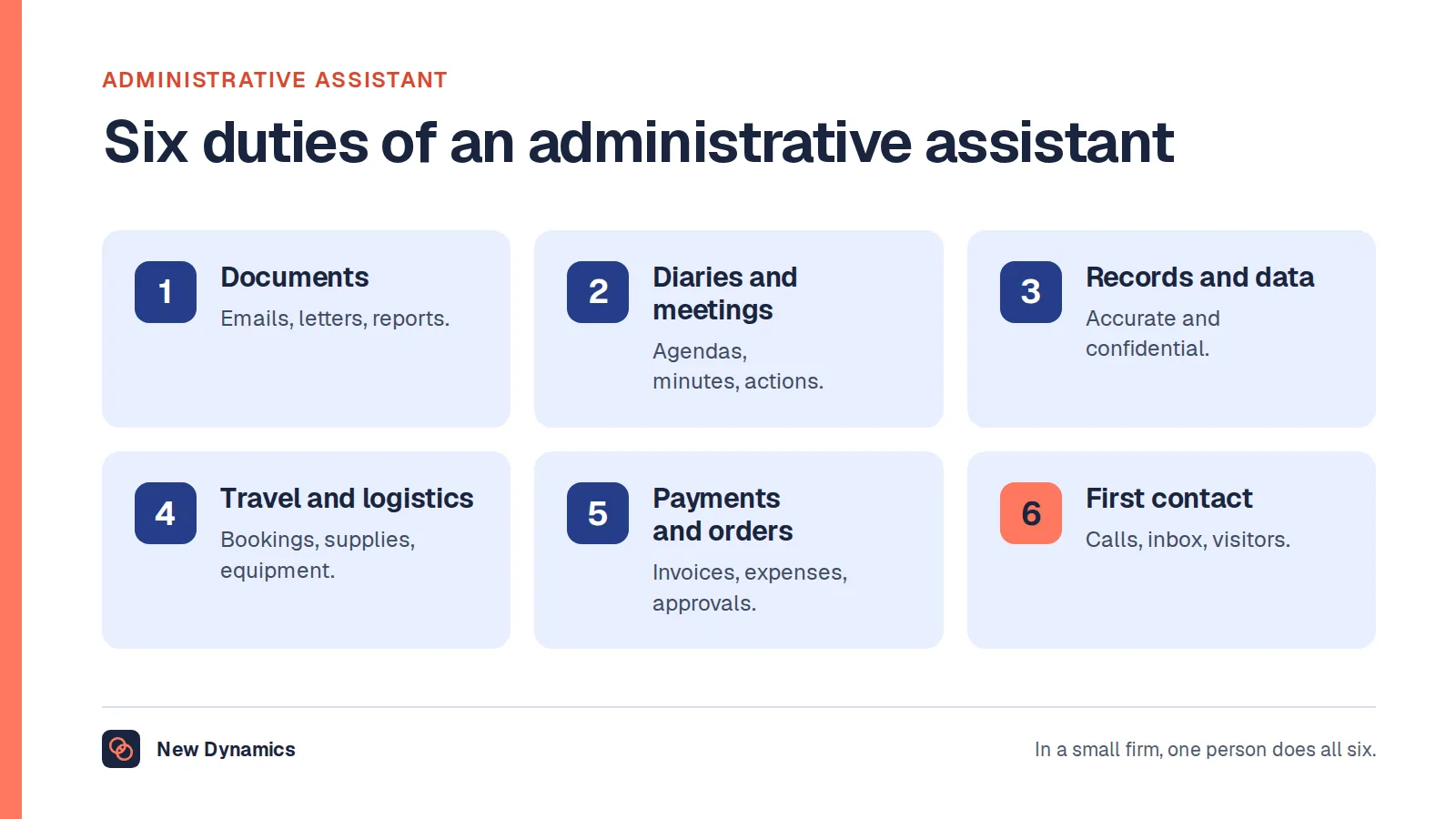
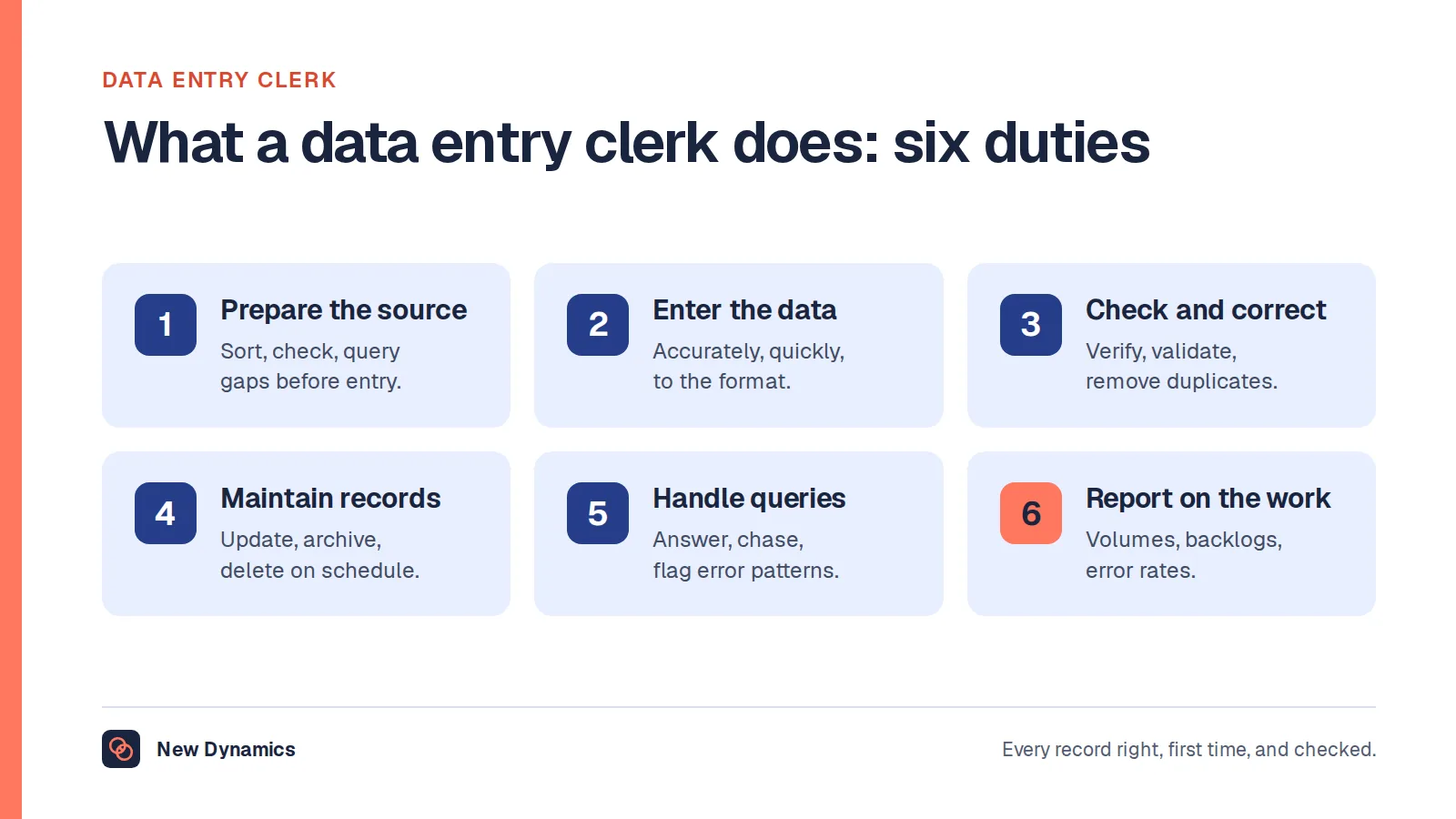
- Grouped for a job description, the duties fall into seven parts: communication, mail and documents, records and filing, data and figures, scheduling and reception, supplies and equipment, and support to others. The clerical role sits beside two neighbours: the administrative assistant, who supports named people or a team and takes on more judgement, and the data entry clerk, who specialises in one of the seven.
- The job changes by sector: a school clerk processes applications, a hospital clerk manages medical records, a law firm clerk handles files and court documents. Entry needs a high school education and up to a month's training, with communication, attention to detail, interpersonal and organisational skills; the advert should say which of the seven duties matter most and which systems are used.
Every office has work that belongs to nobody in particular and has to be done by somebody every day: the phone, the post, the filing, the forms, the diary, the printer that has stopped. Clerical duties and responsibilities are that work, and the clerical role exists so that it is done reliably rather than by whoever is nearest. The difficulty in writing the advert is that the list is long and different in every office.
This article sets out the duties in seven groups using two primary sources, the US O*NET occupational database and the Bureau of Labor Statistics handbook, separates the clerical role from its two nearest neighbours, shows how it varies by sector, lists the skills and training, and gives a job description template. The sources are American; the work is the same in any office.
Clerical roles are often first office jobs, and the first week decides whether the person stays. See how New Dynamics onboarding gives a new starter clear tasks, a buddy and planned check-ins from day one.
What are clerical duties?
O*NET describes general office clerks as performing duties “too varied and diverse to be classified in any specific office clerical occupation, requiring knowledge of office systems and procedures”, and lists the typical ones: answering telephones, bookkeeping, typing or word processing, operating office machines and filing. Its sample titles include administrative clerk, clerical aide, clerical assistant, general clerk, office assistant and office services specialist.
The Bureau of Labor Statistics lists the core duties: “answer telephone calls, take messages, and respond to emails”; “sort and deliver incoming mail and send outgoing mail”; “schedule appointments and receive customers or visitors”; “type, format, or edit routine memos or other reports”; “copy, file, and update paper and electronic documents”; and “collect information and perform data entry”. It adds that, rather than specialising in one task, clerks handle varying responsibilities based on the organisation's daily needs.
Variety is the defining feature. The advert should say which duties dominate in your office, because a clerk who expects a mix and finds eight hours of data entry, or the reverse, will not stay.
Clerical duties and responsibilities: seven groups
Grouped from the O*NET tasks and the BLS duties, the work has seven parts.
- Communication. Answer and direct phone calls, take messages, respond to emails, deal with customers and colleagues in person and in writing, deliver messages.
- Mail and documents. Open, sort and distribute incoming mail; prepare outgoing mail and parcels; type, format, proofread and edit letters, memos, forms and reports; copy and scan.
- Records and filing. Set up and maintain paper and electronic filing systems; file and retrieve documents; update databases; compile, sort and check records; keep confidential records secure.
- Data and figures. Enter data; compute, check and proofread figures; handle petty cash and simple bookkeeping; process invoices, bills and contracts where the role includes it.
- Scheduling and reception. Schedule appointments and meetings; receive visitors; keep diaries and room bookings; take minutes at meetings.
- Supplies and equipment. Order and maintain supplies; operate and troubleshoot photocopiers, scanners, printers and other office equipment; keep the office tidy and stocked.
- Support to others. Prepare materials for meetings and mailings; help colleagues with routine tasks; in some roles, train or supervise junior clerks.

Clerical clerk vs administrative assistant vs data entry clerk
| Role | Focus | Judgement expected |
|---|---|---|
| Clerical or office clerk | A mix of routine office tasks for the office as a whole | Follow procedures; escalate the unusual |
| Administrative assistant | Support to named managers or a team: diaries, correspondence, travel, meetings | Prioritise, draft, decide within a brief |
| Data entry clerk | One of the seven duties, at volume and speed | Accuracy and consistency above all |
The BLS notes that clerks may progress to secretarial or administrative assistant roles with experience. The administrative assistant job description and the data entry clerk job description cover the neighbours.

How clerical duties vary by sector
The BLS gives the pattern: a college clerk processes student applications, a hospital clerk manages medical records. Add:
- Schools and colleges. Admissions, attendance records, parent communication, exam administration.
- Healthcare. Patient records, appointment booking, referrals, confidentiality under health data rules.
- Legal. Files, court documents, bundles, deadlines, billing support.
- Construction and property. Site paperwork, timesheets, supplier invoices, compliance records.
- Local government and charities. Correspondence, case files, committee papers, public enquiries.
Name the sector's systems and records in the advert; they decide the training needed.
Skills, training and progression
The BLS names communication skills, being detail oriented, interpersonal skills and organisational skills as the important qualities. O*NET's essential skills are active listening, reading comprehension, speaking, writing and critical thinking; its technology list runs from word processing and spreadsheets to email, calendar, database and document management systems, and accounting packages where bookkeeping is included.
Entry and training. The BLS says a high school diploma or equivalent is typically required, that computer literacy in word processing and spreadsheets helps, and that new clerks receive up to a month of on-the-job training in office procedures, phone etiquette and equipment. O*NET places the occupation in Job Zones one to two.
Progression. Administrative assistant, then office manager or a specialist route such as finance, HR or records management, as our post on the administration manager job description describes.
Clerical job description template
Job title: Office Clerk (or Clerical Assistant, Administrative Clerk, General Clerk)
Reports to: Office Manager, Administration Manager or Team Leader
Scope: State the office or department, the number of people supported, the systems used and which of the seven duty groups dominate.
Purpose: Keep the office's routine administration running accurately and on time: communication, mail and documents, records, data, scheduling, supplies and support to colleagues.
Responsibilities:
- Answer and direct calls, take messages and respond to routine emails and enquiries.
- Sort and distribute incoming mail; prepare outgoing mail; type, format, copy and scan documents.
- Maintain paper and electronic filing and records; update databases; keep confidential information secure.
- Enter and check data; handle petty cash, invoices or simple bookkeeping where required.
- Schedule appointments and meetings; receive visitors; take minutes.
- Order supplies; operate and troubleshoot office equipment; keep the office stocked and tidy.
- Support colleagues with routine tasks and prepare materials for meetings and mailings.
Skills and experience:
- Office experience or a strong record of accurate, organised work; a high school education or equivalent.
- Confident with word processing, spreadsheets, email and calendars; state the systems in use.
- Attention to detail; clear written and spoken communication; courtesy with the public and colleagues.
- Reliability, discretion and the ability to switch between tasks.
Working pattern: State the hours and any part-time or hybrid arrangement.
Progression: State the route to administrative assistant or a specialist role.

Frequently asked questions
What are clerical duties?
The routine tasks that keep an office running: answering phones and emails, handling mail, typing and formatting documents, filing and updating records, data entry, scheduling and reception, ordering supplies and operating office equipment. The US occupational database describes general office clerks' duties as too varied and diverse to belong to any single clerical occupation.
What is a clerical job description?
A description of a general office clerk or clerical assistant role: the seven duty groups, the systems used, the office or department supported, the skills and the reporting line. Because clerical work varies so much between offices, the description should say which duties dominate.
What is the difference between clerical and administrative work?
Clerical work is the routine office tasks done for the office as a whole, following procedures. Administrative work, in the sense of an administrative assistant, supports named managers or a team and involves more judgement: prioritising, drafting and deciding within a brief. Clerks often progress to administrative assistant roles.
What skills are needed for clerical work?
The BLS names communication, attention to detail, interpersonal and organisational skills. Add confidence with word processing, spreadsheets, email and the office's own systems, discretion with confidential records and the ability to switch between tasks.
What qualifications do you need for a clerical job?
The BLS says a high school diploma or equivalent is typically required, with up to a month of on-the-job training. Computer literacy helps; sector-specific systems and records are usually taught on the job.
Your next step: say which duties dominate
- List the seven duty groups and mark the two or three that fill most of the week.
- Name the systems and the sector's records the clerk will work with.
- State the hours and whether the role is a mix or mostly one task.
- Plan the first month: procedures, phone etiquette, equipment and a named person to ask.
For a plan that turns a new clerk's first week into a confident first month, read and download our onboarding guide. The guide is free to read, and the PDF uses our short download form.
Want every new starter in the office to get the same clear start and the same check-ins? Book a New Dynamics demo and bring your current approach. You can also email contact@new-dynamics.com.