TL;DR
- A data entry clerk puts information into a computer database: from forms, documents, calls and other systems, accurately, quickly and to a set format. The work is the foundation of every report and decision that uses the data.
- The six duties are preparing source material, entering data, checking and correcting, maintaining records, handling queries and reporting on the work. Accuracy is the measure, and in the UK the data protection principles make it a legal duty where the data is personal.
- Employers look for accuracy, speed, attention to detail, discretion and stamina for screen work. The HSE requires employers to assess workstations, plan breaks and offer eye tests to screen-based workers.
Every dashboard, invoice run and customer record starts with someone typing it in. When that person is accurate, nobody notices. When they are not, the errors surface months later in the wrong place. The data entry clerk is the least visible and most consequential job in many offices.
This data entry clerk job description explains what the job involves, sets out six duties, describes the accuracy and data protection standards the work must meet, summarises the health rules for screen work, lists the skills that employers look for, gives a template that you can adapt and suggests how to describe the work on a CV.
Data entry is measured, and the measures should be fair and visible to the person doing the work. See how New Dynamics Goals & OKRs keep targets and progress in one place, so that accuracy and volume are agreed rather than imposed.
What does a data entry clerk do?
The Cambridge Dictionary defines data entry as “the work or process of putting information into a computer database”. A data entry clerk does that work as a job: taking information from paper forms, scanned documents, emails, phone calls or other systems and entering it into a database, spreadsheet or business system, accurately and to a set format.
The title varies. Data entry operator, data entry assistant, data processor, records clerk and input clerk describe the same work. It sits within the wider family of administration. Skills England's business administrator apprenticeship standard, at level 3, expects an administrator to be “Able to update and review databases, record information and produce data analysis where required”. Data entry is the first of those three.
Three things make data entry a distinct job rather than a task.
- Volume. Hundreds or thousands of records a day, to a deadline.
- Format. Each field has a rule, and the clerk applies it every time.
- Accountability. The clerk's name is on the record, and the error rate is measured.
Data entry clerk duties: six responsibilities
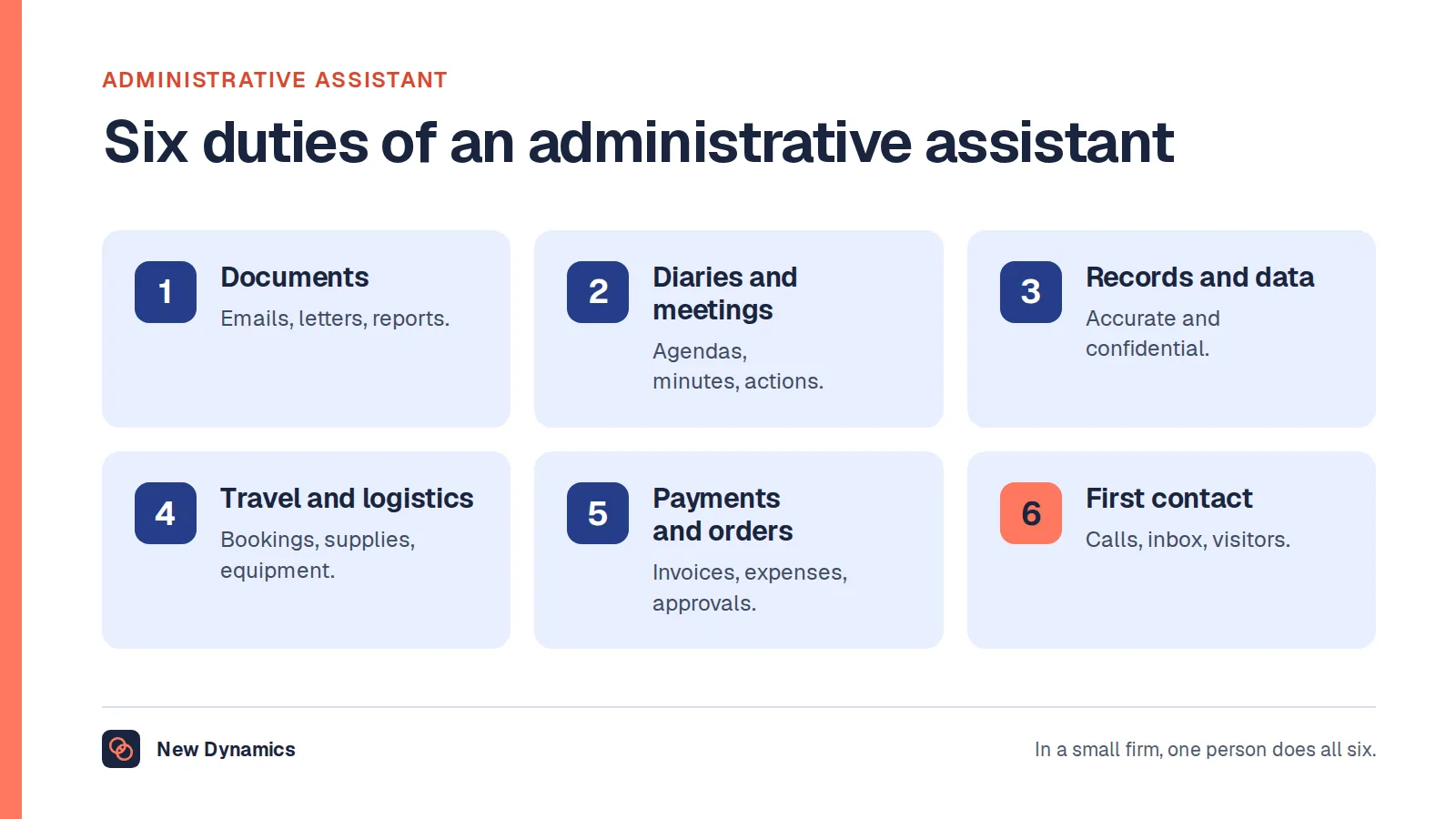
- Prepare the source material. Collect, sort and check forms, documents and files, and query anything illegible or incomplete before entry.
- Enter the data. Key information into the database or system accurately, quickly and in the required format, following the data standards for each field.
- Check and correct. Verify entries against the source, run validation checks, find duplicates and correct errors, and record what was changed.
- Maintain records. Update existing records, archive or delete data in line with retention rules and keep the filing of source documents in order.
- Handle queries. Answer questions from colleagues about records, chase missing information and flag patterns of error to the person who owns the process.
- Report on the work. Keep a log of volumes, backlogs and error rates, and produce simple reports or extracts when asked.
Some roles add scanning and document management, basic bookkeeping, customer contact or transcription. The advert should say which.

The standards the work must meet
Accuracy. In the UK, where the data is about people, accuracy is a legal principle as well as a quality measure. The Information Commissioner's Office, in its guide to the data protection principles, sets out the requirement in UK GDPR that personal data shall be “accurate and, where necessary, kept up to date; every reasonable step must be taken to ensure that personal data that are inaccurate, having regard to the purposes for which they are processed, are erased or rectified without delay”. The ICO lists seven principles in all, including data minimisation, storage limitation and security, each of which touches data entry.
Confidentiality. Clerks see personal, financial and commercial information all day. The role should carry a clear confidentiality duty and access limited to what the work needs.
Speed with accuracy. Many employers measure keystrokes or records per hour and an error rate. Publish both targets and how they are measured, and measure them from a sample checked by a second person, not from a supervisor's impression.
This section describes UK law in general terms and is not legal advice. Other countries have their own rules.

Screen work and health
Data entry is display screen equipment work all day, and the UK Health and Safety Executive's guidance on working with display screen equipment sets out what employers must do. In its words, employers must “do a DSE workstation assessment”, reduce risks “including making sure workers take breaks from DSE work or do something different”, “provide an eye test if a worker asks for one” and “provide training and information for workers”. The HSE warns that incorrect use of DSE or poorly designed workstations can lead to pain in necks, shoulders, backs, arms, wrists and hands as well as fatigue and eye strain.
On breaks, the HSE's page on work routine and breaks advises: “Take short breaks often, rather than longer ones less often.” It adds that if there are no natural changes of activity in a job, employers should plan rest breaks. Data entry is exactly such a job, so the rota should plan them.

Skills and qualities employers look for
- Accuracy and attention to detail. The first and last requirement.
- Typing speed and confident use of the keyboard, including the numeric keypad.
- Familiarity with spreadsheets and databases, and the ability to learn a new system quickly.
- Concentration and stamina for repetitive screen work.
- Discretion with confidential information.
- Communication to query unclear source material and report problems.
- Method. Following the standard for every field, every time.
No formal qualifications are usually required. Employers often test typing speed and accuracy at interview, and a short practical test on real forms tells you more than any certificate.
Data entry clerk job description template
Adapt the template to your organisation. Keep every line true.
Job title: Data entry clerk
Reports to: Office manager or data team lead
Hours and location: [Full-time or part-time], [office, hybrid or remote]
Purpose of the role: To enter, check and maintain data in [the systems] accurately and on time, so that colleagues can rely on it.
Main duties:
- Prepare and check source documents and query gaps before entry
- Enter data into [systems] to the agreed format and standards
- Verify entries, correct errors and remove duplicates
- Update and archive records in line with retention rules
- Answer colleagues' queries about records and chase missing information
- Log volumes, backlogs and error rates and produce simple extracts
- Keep personal and commercial data confidential and secure
Skills and experience:
- Accurate, fast keyboard skills [state any test used and the standard]
- Confident with spreadsheets and able to learn new systems
- Concentration, method and discretion
- Clear written and spoken communication
- Experience of [the sector or systems] welcome but not required
We provide: Training on our systems and data standards, a workstation assessment, planned breaks, an eye test on request, and clear accuracy and volume targets reviewed together each month.
Say what the data is, how it arrives and what the targets are. "Data entry clerk" alone could mean anything from invoices to patient records. Our job description template explains the structure, and our guide to the administrative assistant job description covers the broader role that data entry often grows into.
How to describe data entry work on a CV
Employers want evidence of accuracy, volume and systems. The lines below are invented examples, to show the form.
- State the volume and accuracy. “Entered around 400 customer records a day with an audited error rate below 0.5%.”
- Name the systems. The database, spreadsheet and business systems you have used.
- Show checking. “Ran weekly duplicate checks and corrected 1,200 records during a migration.”
- Show discretion. “Handled payroll and medical data under a confidentiality agreement.”
- State your typing speed if you have been tested, with the test used.
If you have no data entry experience, describe any work where accuracy and volume mattered: stock counts, cash handling, transcribing or form processing.
Common mistakes in data entry job adverts
Targets without measurement. An advert that promises "high accuracy" without saying how it is measured invites disputes later.
No word on the data. Candidates need to know whether they will be entering invoices, survey responses or medical records.
Ignoring the screen. An advert that mentions no breaks, no workstation assessment and no eye tests is telling candidates something.
Treating it as unskilled. The best data entry clerks spot the wrong postcode in a thousand. Pay and respect them accordingly.
Automating without asking. The clerk knows where the source data is bad. Involve them before buying software that assumes it is good.
Frequently asked questions
What does a data entry clerk do?
A data entry clerk puts information from forms, documents, calls and other systems into a computer database or business system, accurately and to a set format. The job also involves checking and correcting entries, maintaining and archiving records, answering queries about the data and logging volumes and error rates.
What skills do you need for data entry?
Accuracy and attention to detail, fast and confident typing including the numeric keypad, familiarity with spreadsheets and databases, concentration for repetitive screen work, discretion with confidential information, clear communication and a methodical approach.
Do you need qualifications to be a data entry clerk?
Usually not. Employers typically test typing speed and accuracy and train clerks on their own systems. In England the level 3 business administrator apprenticeship covers updating and reviewing databases as part of a wider administrative role.
How is data entry performance measured?
Many employers measure volume, such as records or keystrokes per hour, and an error rate found by checking a sample against the source. Both targets should be published, agreed and measured by a second person, not estimated.
Are there health rules for data entry work?
In the UK, yes. The HSE's display screen equipment guidance says employers must assess workstations, make sure workers take breaks or change activity, provide an eye test on request and provide training and information. It advises short, frequent breaks rather than longer, rarer ones.
What should a data entry job description include?
The title, who the clerk reports to, hours and location, the systems and the kind of data, the purpose of the role, six or seven main duties, the accuracy and volume targets and how they are measured, the skills needed, the confidentiality duty, and the training, workstation assessment and breaks provided.
Your next step
If you are hiring, write down what data arrives, in what form, how much of it and how you will measure accuracy, and build the advert from that. If you are applying, rewrite one line of your CV with a volume and an error rate.
For a plain guide to handling the personal data that clerks work with every day, read and download our employee data protection guide. The guide is free to read, and the PDF uses our short download form.
Want accuracy and volume targets agreed, tracked and reviewed with the people who meet them? Book a New Dynamics demo and bring your current approach. You can also email contact@new-dynamics.com.