TL;DR
- A direct report is an employee whose position sits directly below a manager's and who is managed by that person. The manager is the direct report's line manager, and the direct report reports to them.
- Direct reports differ from indirect reports, who sit further down the same chain, and from dotted-line reports, who take work from a manager without being managed by them. The number of direct reports a manager has is their span of control.
- There is no single right number of direct reports. It depends on how similar and self-directed the work is. Whatever the number, every direct report is owed clear expectations, regular one-to-ones, feedback, development and a fair review.
“How many direct reports do you have?” is one of the first questions asked in a management interview, and one of the first things a new manager counts. The phrase is so common that few people define it, and the confusion shows up in org charts with dotted lines nobody can explain and in managers who are not sure whether the contractor in their team counts.
This article gives the meaning of direct report in plain terms, with dictionary definitions, explains the difference between direct, indirect and dotted-line reports, covers span of control and how many direct reports a manager should have, and sets out what every direct report is owed.
Reporting lines should be visible to everyone, not reconstructed from email threads. See how New Dynamics org charts show roles, reporting lines and the relationships between them.
What is a direct report?
The Cambridge Business English Dictionary defines a direct report as “an employee whose position at work is directly below that of another person, and who is managed by that person”. Its example makes the point that the number is smaller than it looks: “She has a dozen direct reports, but manages many more people.”
The definition has two parts, and both are needed.
- Position directly below. On the organisation chart, the direct report's box hangs from the manager's box, with nothing in between.
- Managed by that person. The manager sets the direct report's work, reviews it, holds the one-to-ones, signs off leave and conducts the appraisal.
The relationship has a name from each side. The manager is the direct report's line manager, which Cambridge defines as “the person who is directly responsible for managing the work of someone else in a company or business, and who is one level above that person”. The direct report reports to the manager; Cambridge's entry for report to someone says that the person you report to at work “is the person in authority over you who gives you tasks and checks that you do them”.
Direct reportee is an informal variant of the same term. Some organisations use it; most style guides prefer direct report.
Direct, indirect and dotted-line reports
| Term | What it means |
|---|---|
| Direct report | Sits directly below you and is managed by you |
| Indirect report | Sits below one of your direct reports. You are responsible for their work through their manager, but you do not manage them day to day |
| Dotted-line report | Takes some work or direction from you, usually on a project or a specialism, but is managed and appraised by someone else |
| Skip-level | Your relationship with an indirect report when you meet them without their manager, for example in a skip-level one-to-one |
A head of department with four team leaders, each with six staff, has four direct reports and twenty-four indirect reports. A project manager who directs the daily work of an analyst from another team has a dotted-line report. Our guide to org charts shows how these lines are usually drawn.
The distinction matters for four things: who conducts the appraisal, who approves leave and expenses, who is accountable when work goes wrong, and who the employee should go to first. Where two people both believe they manage someone, or nobody does, all four break down.

Span of control: how many direct reports?
The number of direct reports a manager has is their span of control. The open textbook Principles of Management, published by OpenStax, describes it in its section on organizational structures and design as one of five elements of structure, alongside specialization, command-and-control, centralization and formalization. Command-and-control, it says, “refers to the way in which people report to one another or connect to coordinate their efforts in accomplishing the work of the organization”, and span of control is “the scope of the work that any one person in the organization will be accountable for”.
OpenStax connects the span to the shape of the organisation. Tall structures with many levels of management tend to have narrow spans and strong central control. Flat structures have few levels and broad spans: “A manager in an organic structure usually has a broad span of control, forcing her to rely more on subordinates to make decisions.” It adds a plain limit: “Any manager's ability to attend to responsibilities has limits; indeed, the amount of work anyone can accomplish is finite.”
There is no single right number. A wider span suits work that is similar across the team, routine, measurable and done by experienced people. A narrower span suits work that is varied, novel, risky or done by people who are new or need coaching. A manager of eight experienced sales representatives doing the same job can give each what they need; a manager of eight people in eight different roles, three of them new, usually cannot.
Rules of thumb are just that. If a manager cannot hold a proper one-to-one with each direct report at least fortnightly, know what each is working on and give them timely feedback, the span is too wide for that manager in that job, whatever the number.

What every direct report is owed
Being someone's direct report is a relationship with duties on the manager's side. Six things are non-negotiable.
- Clear expectations. What the job is for, what good looks like this quarter, and how it will be judged. Our guide to performance goals examples shows how to write them.
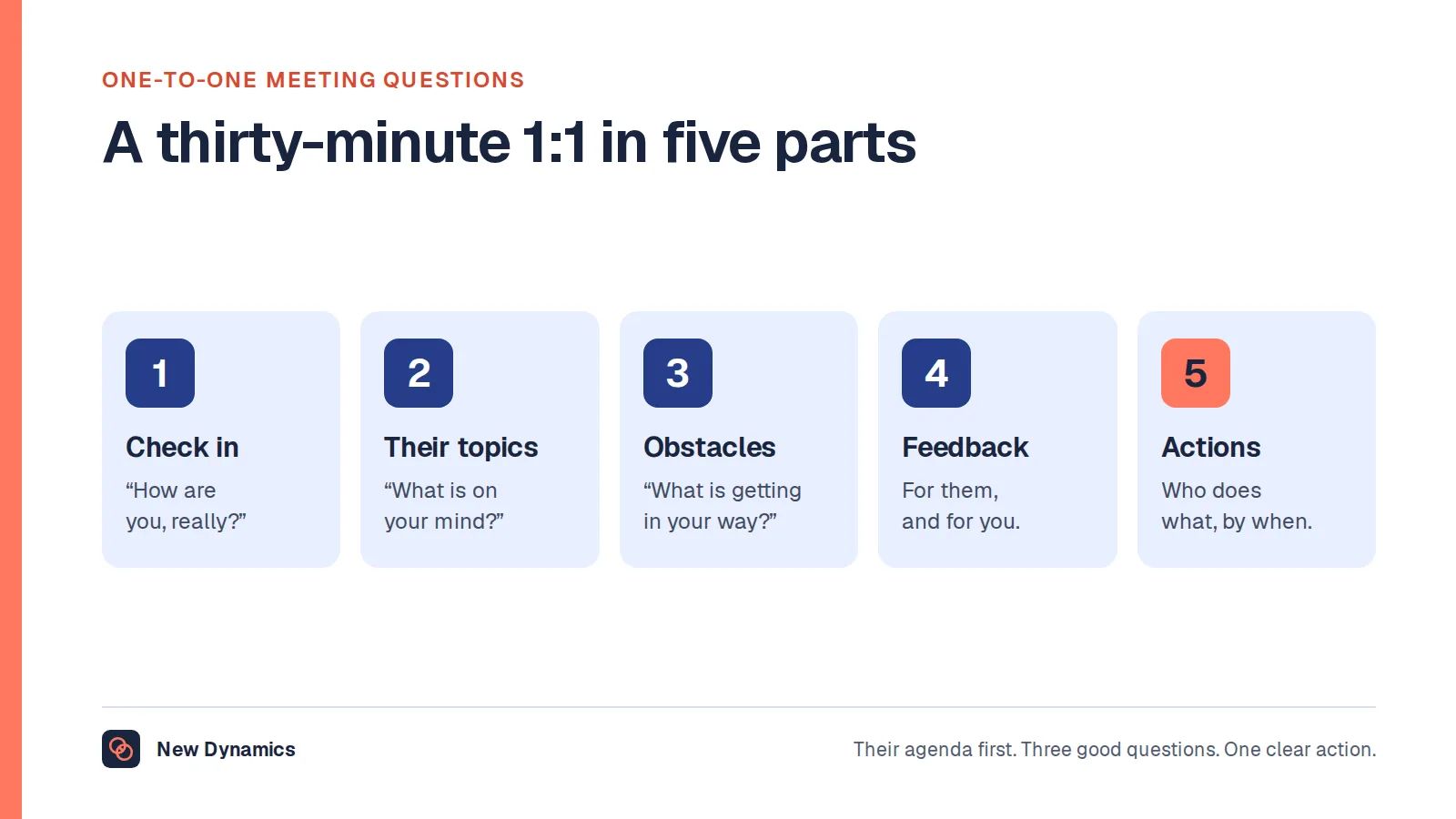
- A regular one-to-one. Time that belongs to the direct report, not the manager's status update. Our one-to-one meeting questions give a structure.
- Feedback in both directions, close to the event, specific and kind.
- Development. A conversation about where the person wants to go and what they need to get there.
- A fair review, based on evidence from the whole period, not the last month.
- Cover and support: approving leave, removing obstacles, backing the person in public and correcting them in private.
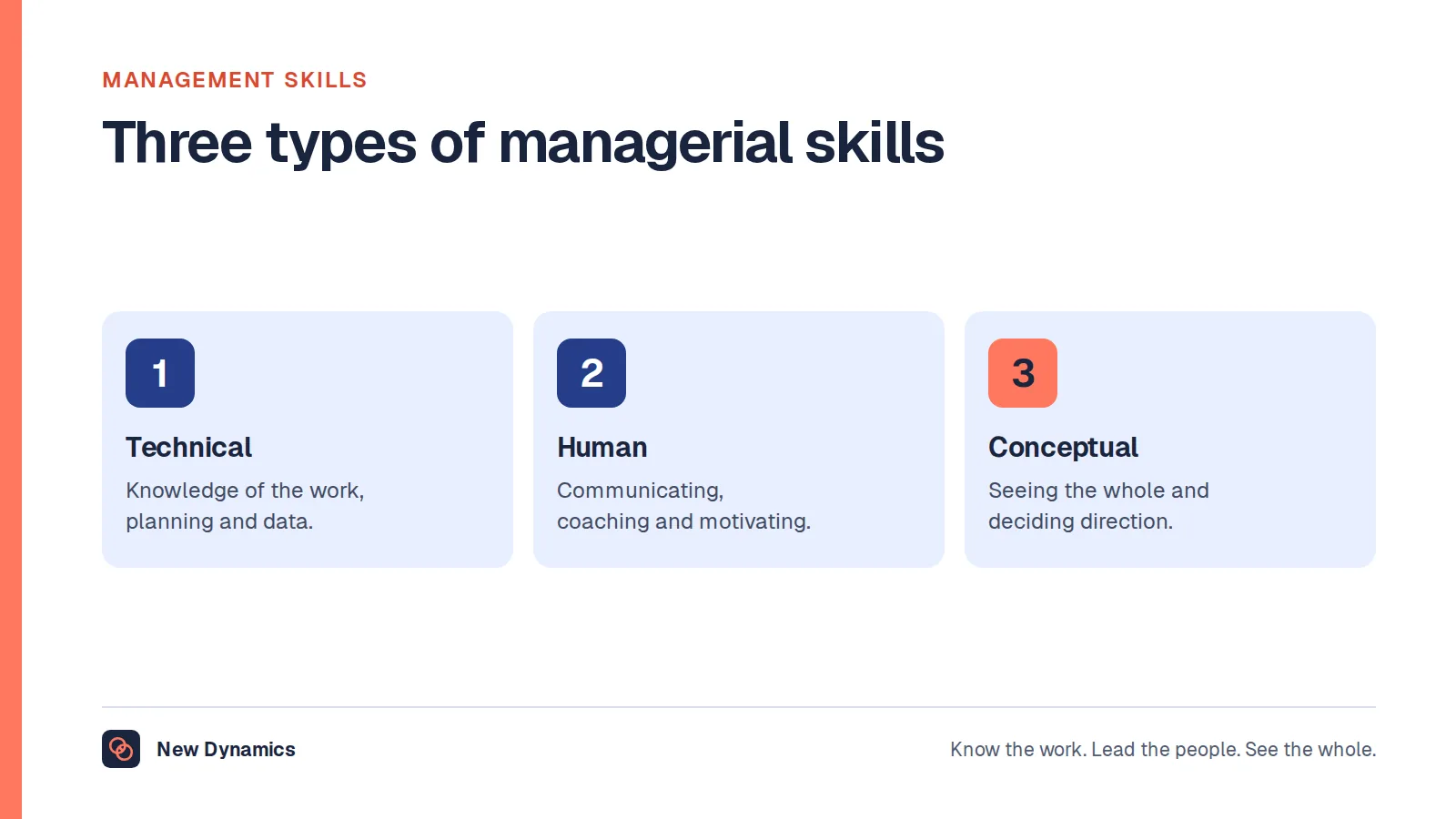
The skills behind these are described in our guide to management skills.
For managers: five habits with direct reports
- Know the list. Be able to name your direct reports, their roles and their current priorities without looking.
- Fix the lines. If a dotted line has become a real one, or someone has two managers, agree who manages them and write it down.
- Meet the indirect reports too. A skip-level conversation once or twice a year tells you what the chain is filtering out.
- Do not manage contractors as employees. A contractor may work in your team, but in most jurisdictions the legal relationship is different, and treating them as a direct report can have employment and tax consequences. Check with HR.
- Watch the span. When a team grows, add a team leader before the one-to-ones start slipping.

Frequently asked questions
What is a direct report?
A direct report is an employee whose position sits directly below a manager's on the organisation chart and who is managed by that person. The manager sets and reviews their work, holds their one-to-ones and conducts their appraisal.
What is the difference between a direct report and an indirect report?
A direct report is managed by you. An indirect report is managed by one of your direct reports. You are accountable for an indirect report's work through their manager, but you do not run their day-to-day work or their appraisal.
What does it mean to report directly to someone?
It means that person is your line manager: the person in authority over you who gives you tasks, checks that you do them, and is responsible for your work. You are their direct report.
What is a dotted-line report?
A dotted-line report takes some direction from a manager, usually on a project or a specialism, while being managed and appraised by someone else. The dotted line on an org chart shows the working relationship; the solid line shows who manages the person.
How many direct reports should a manager have?
There is no fixed number. Wider spans suit similar, routine work done by experienced people; narrower spans suit varied or novel work and newer staff. OpenStax notes that any manager's capacity is finite. If regular one-to-ones and timely feedback are slipping, the span is too wide.
Is a direct reportee the same as a direct report?
Yes. Direct reportee is an informal variant. Direct report is the standard term and the one used in most job descriptions and HR systems.
Your next step: check your lines
- Write down your direct reports, and check the list against the org chart and the HR system.
- Mark any dotted lines and any person with two managers, and agree who manages them.
- Check that each direct report has a one-to-one in the diary within the next two weeks.
- Ask each one what they need from you that they are not getting.
For a method for the one-to-one itself, read and download our manager one-to-one guide. The guide is free to read, and the PDF uses our short download form.
Want reporting lines, one-to-ones, goals and reviews for every direct report in one place? Book a New Dynamics demo and bring your org chart. You can also email contact@new-dynamics.com.