TL;DR
- Management skills are the abilities a manager uses to get results through other people. Textbooks group them into three types: technical skills, human skills and conceptual skills.
- The mix changes with seniority. First-line managers lean on technical skills, senior leaders on conceptual skills. In our view, human skills matter at every level.
- Most new managers are promoted for technical skill and then succeed or fail on human skill. Assess yourself against the 15 skills in this article, pick one, and practise it in real work.
The best analyst becomes the analytics manager. The top salesperson becomes the sales manager. It is a familiar kind of promotion, and it carries a catch. The skills that earned the promotion are not the ones the new job needs most.
This article explains what management skills are, the three types that textbooks describe, 15 specific managerial skills with examples, how the mix changes as you rise, and how to assess and build your own.
Many management skills are practised in one place: the regular conversation between a manager and each member of the team. See how New Dynamics continuous feedback supports check-ins, coaching and recognition.
What are management skills?
Management skills are the abilities a manager uses to get results through other people. The open textbook Introduction to Business, published by OpenStax, defines a skill as “the ability to do something proficiently”. In its section on managerial skills, it says: “Managerial skills fall into three basic categories: technical, human relations, and conceptual skills.”
It remains the simplest useful map.
The three types of managerial skills
Technical skills
OpenStax describes technical skills as “specialized areas of knowledge and expertise and the ability to apply that knowledge”. Its examples include preparing a financial statement, programming a computer and analysing market research.
For a manager, technical skill means knowing the work well enough to plan it, to judge its quality, to coach people and to be credible. It does not mean being the best practitioner in the team. OpenStax notes that these skills are “especially important for supervisory managers because they work closely with employees who are producing the goods and/or services of the firm”.
Human skills
Human relations skills are “the interpersonal skills managers use to accomplish goals through the use of human resources”. OpenStax says this includes “the ability to understand human behavior, to communicate effectively with others, and to motivate individuals to accomplish their objectives”. Its examples are giving positive feedback, being sensitive to individual needs and showing a willingness to empower people.
It adds a warning: “A manager with little or no people skills can end up using an authoritarian leadership style and alienating employees.”
Conceptual skills
Conceptual skills “include the ability to view the organization as a whole, understand how the various parts are interdependent, and assess how the organization relates to its external environment”. They allow managers “to evaluate situations and develop alternative courses of action”. OpenStax says that they are especially necessary at the top of the management pyramid, where strategic planning takes place.
In plain terms: technical skills are about the work, human skills are about the people, and conceptual skills are about the whole.

How the mix changes with level
OpenStax says that the degree to which each type of skill is used “depends upon the level of the manager's position”. It singles out technical skills for supervisory managers and conceptual skills for those at the top. The table below is our summary of the usual pattern, including our own view that human skills stay important throughout.
| Level | Technical | Human | Conceptual |
|---|---|---|---|
| First-line manager | High | High | Lower |
| Middle manager | Moderate | High | Moderate |
| Senior leader | Lower | High | High |
Two lessons follow.
Human skills never stop mattering. Whatever the level, a manager's results come through other people.
Each promotion asks you to let go of something. The new team leader has to stop doing the work and start enabling it. The new director has to stop running one function and start thinking about the whole business. People who cannot let go become bottlenecks.
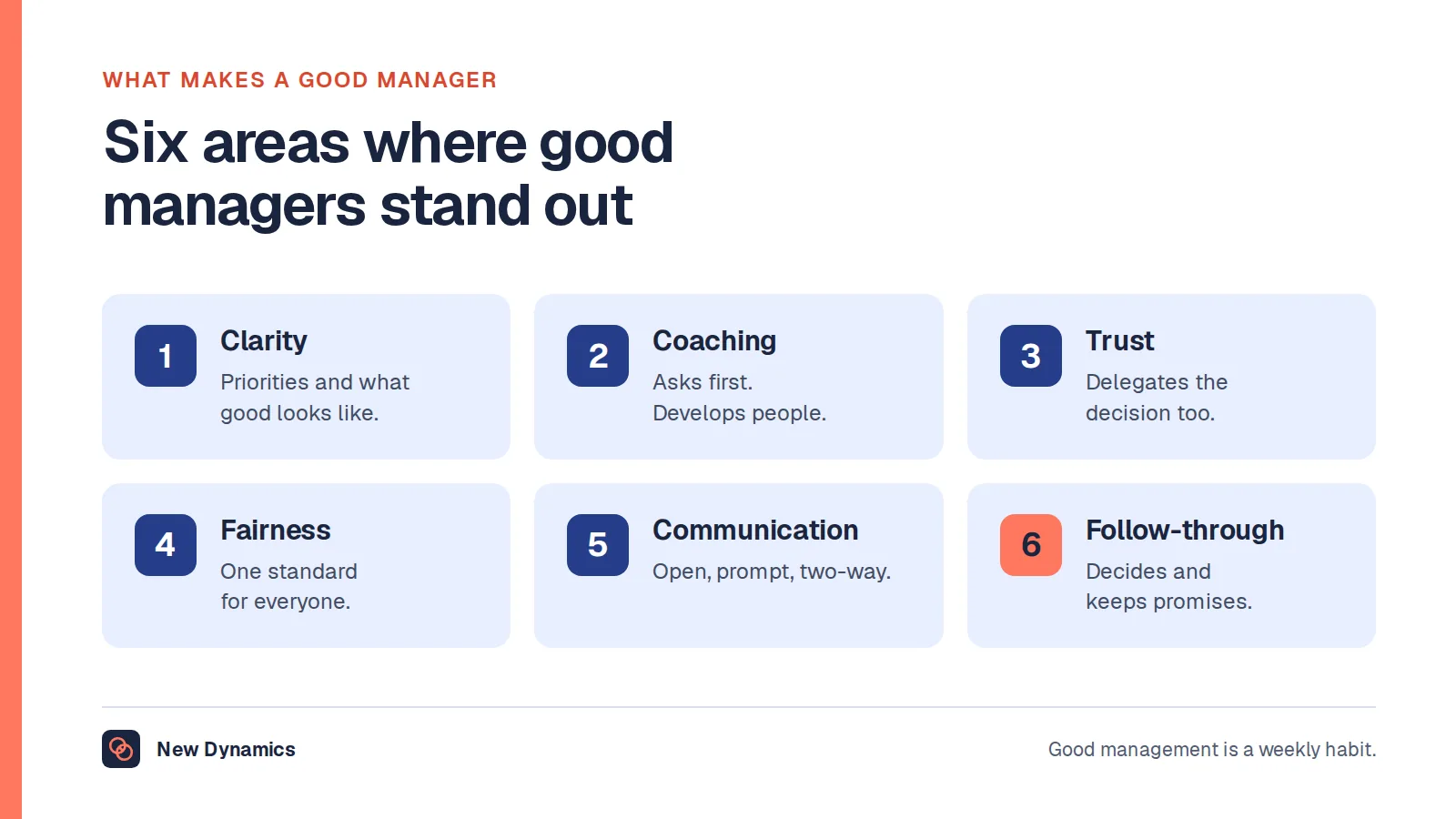
Google's research on its own managers points the same way. Its guide to the research behind great managers lists ten behaviours of effective managers. The list begins with “Be a good coach” and “Empower the team without micromanaging”. “Have key technical skills” is on the list too, as one item of ten. We summarise that research in what makes a good manager.
15 management skills with examples
Technical
- Knowledge of the work. You understand the team's processes, tools and standards well enough to spot a problem in a piece of work and to explain what good looks like.
- Planning and organising. You break goals into tasks, sequence them, assign them and track progress. Example: a quarterly plan with owners and dates that the team actually uses.
- Budgeting and resources. You can read a budget, forecast costs and make a case for what the team needs.
- Using data. You choose a few measures that matter and use them to make decisions. See our success indicator examples.
- Process improvement. You find the cause of recurring problems and fix the process, so that they stop recurring.
Human
- Communication. You explain priorities and reasons clearly, in writing and in person, and you listen. See formal vs informal communication.
- Coaching. You help people to think by asking questions before offering answers.
- Feedback. You give specific praise and criticism promptly, and you ask for both in return. See our negative feedback examples.
- Delegation. You hand over the authority along with the task, agree check-in points and resist the urge to take it back.
- Motivation and recognition. You know what each person values, and you notice good work by name.
- Handling conflict and poor performance. You raise problems early, fairly and privately, and you follow the procedure when that is needed.
- Hiring. You define what the role needs, ask every candidate the same core questions and judge evidence. See our manager interview questions.
Conceptual
- Seeing the whole. You understand how your team's work affects customers, other teams and the finances, and you make trade-offs with that in mind.
- Decision-making. You weigh options, decide in good time with imperfect information and explain your reasoning.
- Setting direction and leading change. You turn the organisation's strategy into clear goals for the team, and you help people through change. See how to cascade goals at work.

Assess your own management skills
Rate yourself from 1 (rarely) to 5 (consistently) on each statement. Then ask your manager, or better still your team, to do the same for you.
Technical
- I can explain what good work looks like in my team's area.
- My team has a plan with clear owners and dates.
- I use a small number of measures to guide decisions.
Human
- Every member of my team knows what I expect of them.
- I hold regular one-to-ones, and I rarely cancel them.
- I gave each person specific feedback in the past fortnight.
- I have delegated a real decision in the past quarter.
- I deal with performance problems within weeks, not months.
Conceptual
- I can explain how my team's work contributes to the organisation's goals.
- I make time to think beyond this week.
- I can describe the main risks and opportunities facing my team in the next year.
Look for your lowest scores, and for the biggest gaps between your view and other people's. Those gaps are your blind spots.
How to build management skills
- Pick one skill at a time. Choose the one that would make the most difference to your team now.
- Practise in real work. Skills grow through doing. If you want to delegate better, delegate something this week.
- Get feedback. Ask the people on the receiving end how it went.
- Find a model. Watch a manager who does it well, and ask how they learned.
- Use training to give you frameworks, then apply them within days, before they fade.
- Reflect. Ten minutes on a Friday: what did I try, what happened, and what will I change?
- Find a mentor or a peer group. Other managers face the same problems, and they are usually glad to compare notes.
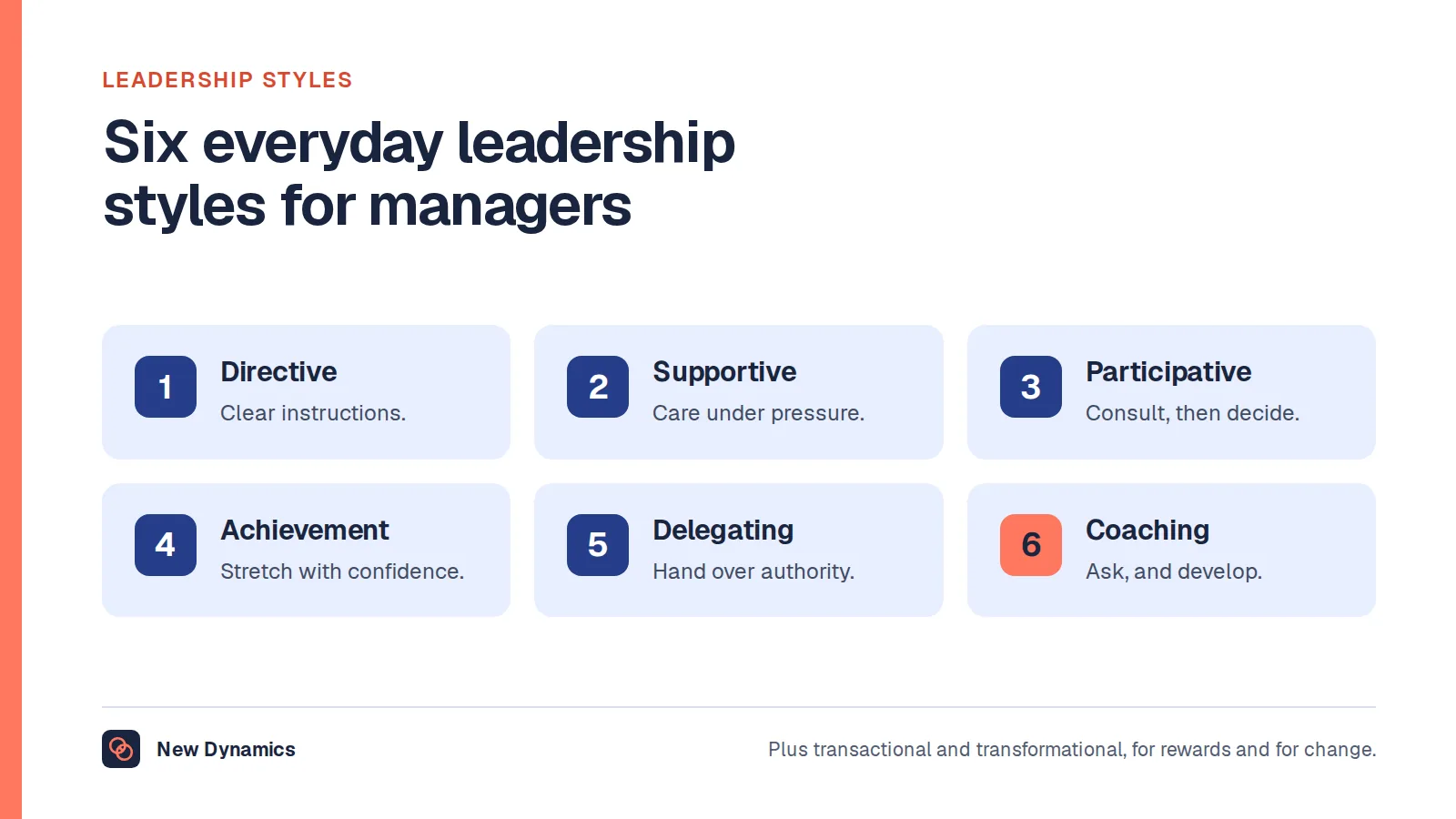
Write the skill as a development goal, with actions and evidence. Our personal development goals examples show how. For a description of the different ways to apply these skills, see our guide to leadership styles for managers.
Common mistakes of new managers
Staying the expert. Doing the hardest work yourself feels productive, and it starves the team of growth and you of time.
Avoiding the difficult conversation. Problems that are not discussed grow.
Managing everyone the same way. A new starter and a veteran need different things.
Neglecting upward and sideways relationships. Your team needs you to represent it well to others.
No time to think. A calendar full of meetings leaves no room for conceptual work. Block time for it.
Waiting to be trained. Most management skill is learned on the job, by paying attention.

Frequently asked questions
What are management skills?
Management skills are the abilities a manager uses to get results through other people. They are usually grouped into three types: technical skills, which concern the work; human skills, which concern people; and conceptual skills, which concern the organisation as a whole.
What are the three types of managerial skills?
They are technical skills, human relations skills and conceptual skills. Technical skills are specialised knowledge and the ability to apply it. Human skills are interpersonal skills, such as communicating and motivating. Conceptual skills are the ability to see the organisation as a whole.
What are technical skills in management?
They are the specialised knowledge and expertise of the field, such as preparing financial statements, programming or analysing market research, along with planning, budgeting and using data. They matter most for first-line managers, who work closely with the people doing the work.
Which management skill is most important?
In our view, human skills matter at every level of management, so they are the safest investment. Technical skills matter most for first-line managers, and conceptual skills for senior leaders. Most new managers need to build human skills first: communication, feedback, coaching and delegation.
What are examples of management skills?
Examples include planning and organising, budgeting, using data, communicating clearly, coaching, giving feedback, delegating, recognising good work, handling conflict, hiring, decision-making, seeing how the parts of the organisation fit together, and leading change.
How can I improve my management skills?
Choose one skill that would help your team most. Practise it in real work this week, ask the people affected for feedback, watch a manager who does it well, and reflect for ten minutes each Friday. Training helps when you apply it straight away.
Your next step: rate yourself, then ask your team
- Complete the self-assessment above.
- Ask two or three members of your team to rate you on the same statements.
- Choose the one skill with the biggest gap.
- Practise it in your next one-to-ones, and ask again in a month.
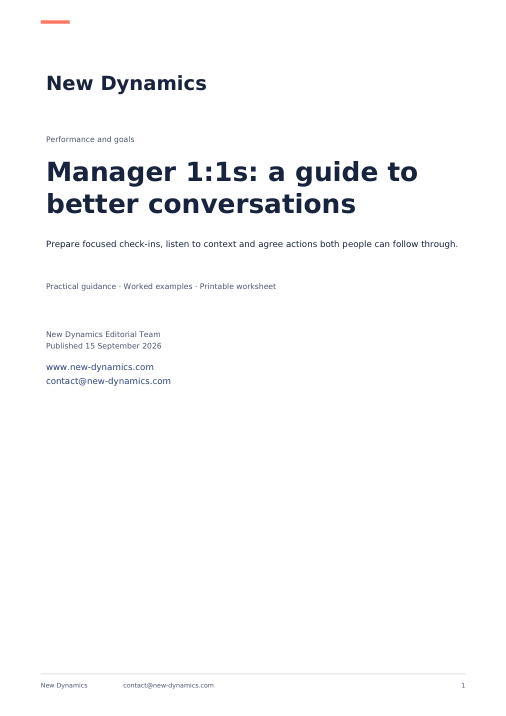
For an agenda and prompts for the conversation where most management skills are practised, read and download our one-to-one meeting guide. The guide is free to read, and the PDF uses our short download form.
Want every manager to coach, check in and give feedback as a habit? Book a New Dynamics demo and bring your current management routines. You can also email contact@new-dynamics.com.