TL;DR
- EEO stands for equal employment opportunity: the principle that decisions about hiring, pay, promotion, training and dismissal must not be based on a person's race, colour, religion, sex, national origin, age, disability or genetic information.
- In the United States the principle is enforced by the Equal Employment Opportunity Commission (EEOC). Most employers with 15 or more employees are covered, and the laws apply to every type of work situation.
- EEO is a duty, not a programme. Employers must not discriminate or retaliate, must post a notice of the law, keep records and, above a certain size, report workforce data. Making it real means fixing the decisions where bias hides.
Three letters appear at the foot of many American job adverts: “EEO employer”. They are often the only mention of the idea that the advert makes, and few candidates or managers could say what they oblige the employer to do.
This article gives the EEO definition in plain words, lists the characteristics that United States federal law protects, explains who is covered, sets out six duties that follow, describes the equivalent idea in Great Britain and shows the practical decisions where equal opportunity is won or lost.
Most of those decisions happen in reviews, pay and promotion. See how New Dynamics performance reviews bring goals, feedback and development into one fair discussion, with a record of how each decision was reached.
What does EEO mean?
EEO stands for equal employment opportunity. It is the principle that employment decisions must be made on a person's ability to do the job, and not on characteristics that the law protects.
In the United States the principle is enforced by the Equal Employment Opportunity Commission, the EEOC. Its overview explains that the Commission “is responsible for enforcing federal laws that make it illegal to discriminate against a job applicant or an employee because of the person's race, color, religion, sex (including pregnancy, childbirth, or related conditions, transgender status, and sexual orientation), national origin, age (40 or older), disability or genetic information.”
Two points in that sentence matter in practice.
- Applicants are protected, not just employees. EEO begins with the job advert and the application form.
- The list is specific. The characteristics it names are often called the protected bases. Treating someone badly for another reason may be unfair or a breach of contract, but it is not a breach of these laws.
The EEOC states its mission as being to “Prevent and remedy unlawful employment discrimination and advance equal opportunity for all.”
Who is covered, and which decisions
The EEOC's overview says: “Most employers with at least 15 employees are covered by EEOC laws (20 employees in age discrimination cases). Most labor unions and employment agencies are also covered.” It adds that the laws “apply to all types of work situations, including hiring, firing, promotions, harassment, training, wages, and benefits.”
So EEO is not confined to recruitment. It covers who gets trained, who is promoted, how pay is set, how harassment is dealt with and who is dismissed. State and local laws often protect further characteristics and cover smaller employers, so check the rules where you operate.
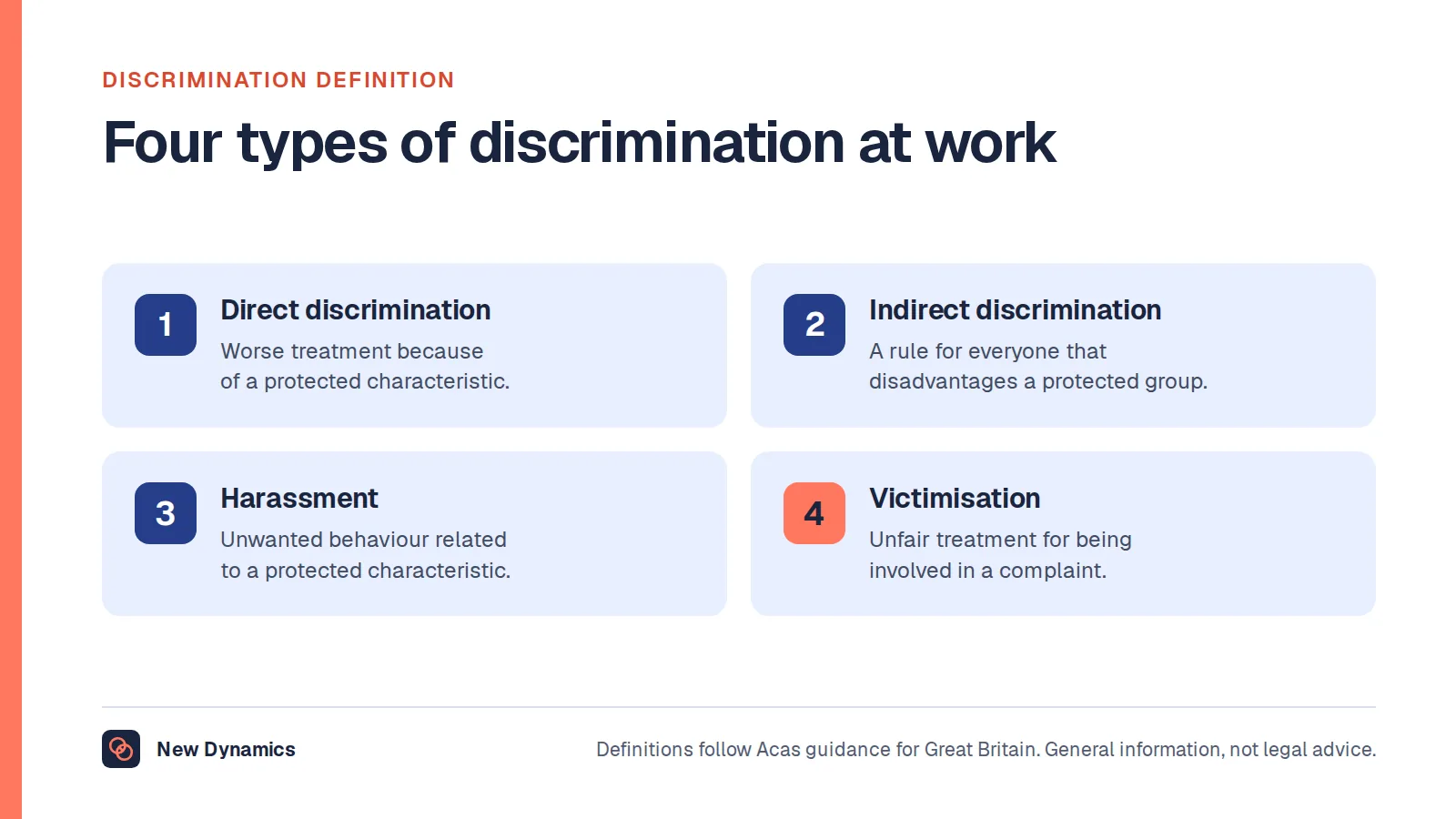
For the difference between direct, indirect and other forms of unfair treatment, see our plain guide to the definition of discrimination at work. For age in particular, see our guide to the definition of ageism.
Six things EEO requires of an employer
- Do not discriminate. No employment decision may rest on a protected basis, at any stage from advert to exit.
- Do not retaliate. The EEOC's poster page lists retaliation “for filing a charge, reasonably opposing discrimination, or participating in a discrimination lawsuit, investigation, or proceeding” among the things the law prohibits.
- Post the notice. The EEOC's “Know Your Rights” poster page states that the law “requires an employer to post a notice describing the Federal laws prohibiting job discrimination”, and that Title VII of the Civil Rights Act of 1964 imposes a monetary penalty on covered employers who fail to post it.
- Keep records. The EEOC's recordkeeping requirements page says: “EEOC Regulations require that employers keep all personnel or employment records for one year.” Once a charge is filed, the records must be kept until the charge and any lawsuit are finally disposed of.
- Report workforce data, above a certain size. The EEOC's EEO-1 data collection page describes the EEO-1 Component 1 report as “a mandatory annual data collection that requires all private sector employers with 100 or more employees, and federal contractors with 50 or more employees meeting certain criteria, to submit workforce demographic data”.
- Act on complaints. Investigate promptly and fairly, protect the person who complained and fix what you find. The EEOC has the authority to investigate charges, and says that it tries to settle a charge where it finds discrimination and can file a lawsuit where settlement fails.
This is general information, not legal advice. Federal guidance is being revised in places at the time of writing, and the details of coverage and reporting change, so check the EEOC's current pages or take advice.

EEO, equality and affirmative action
Three phrases sit close together and are often muddled.
- Equal employment opportunity is the legal principle, in the United States, that decisions must not rest on a protected basis. It tells you what not to do.
- Equality, the term used in Great Britain, means much the same. Acas, the public body that advises on workplace relations, says in its guidance on improving equality, diversity and inclusion that equality in the workplace “means equal job opportunities and fairness for employees and job applicants”, and that employers must not treat people unfairly because of protected characteristics under the Equality Act 2010.
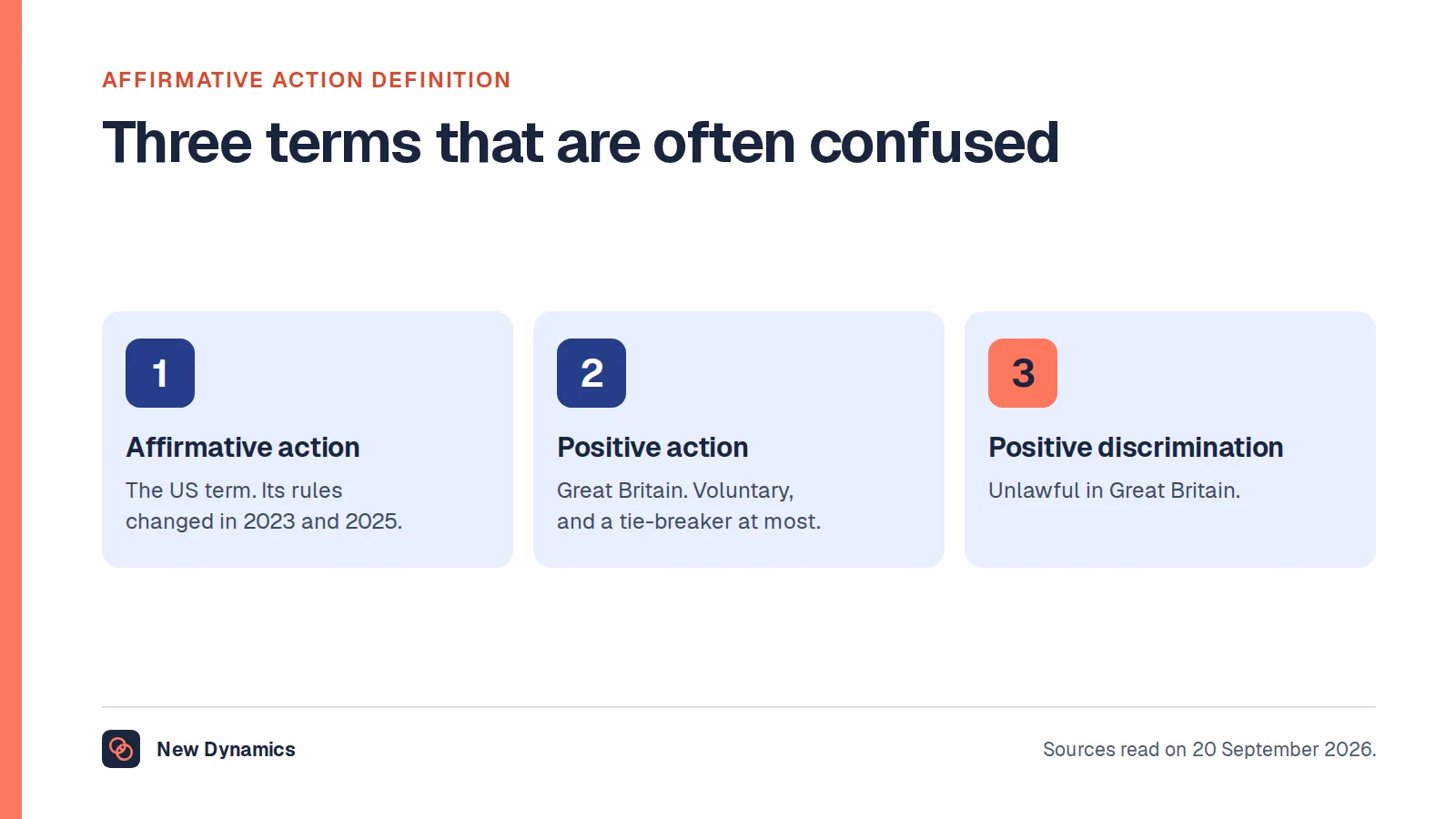
- Affirmative action goes further than not discriminating: it means deliberate steps to open opportunity to groups that have been excluded. Its legal position in the United States has changed a great deal. Our guide to the definition of affirmative action explains the history and the changes of 2023 and 2025.
The Cambridge Dictionary's business entry for equal opportunities captures the everyday sense of all three: “the idea that men and women, people of different races, religions, etc. should all be treated fairly and have the same opportunities, especially relating to employment”.

Where EEO is won or lost: five decisions
An EEO statement on the careers page costs nothing. Equal opportunity is decided in a handful of everyday processes.
- Job adverts. Requirements that are not needed for the job narrow the field for no reason. Our guide to writing a job ad shows how to advertise the work rather than a type of person.
- Interviews. The same questions, asked of everyone, scored against the same criteria, by more than one interviewer. Our manager interview questions show the pattern.
- Pay. Review pay by role and by group at least once a year, and be able to explain every difference with a reason that is about the work.
- Promotion. Publish the criteria. Consider everyone who meets them, not only those who ask. Record why each decision was made.
- Complaints. A route that people trust, and a record of what happened when they used it.
In each case the test is the same. Could you show a stranger the evidence behind the decision, and would that evidence be about the work?

Common mistakes
Treating the statement as the policy. The sentence at the foot of the advert is a claim. The policy is what happens in the interview room and the pay review.
Assuming EEO stops at hiring. Training, promotion, pay and dismissal are covered too, and that is where long-serving employees experience unfairness.
One person deciding alone. Unchecked individual judgement is where bias lives. Structured decisions and a second pair of eyes protect everyone, including the manager.
No records. If you cannot show why a decision was made, you cannot defend it.
Punishing the complainant. Retaliation is unlawful in its own right, whatever the outcome of the original complaint.
Confusing EEO with diversity targets. Equal opportunity is about how each decision is made. Our guide to diversity in the workplace covers the wider picture.
Frequently asked questions
What is the definition of EEO?
EEO, or equal employment opportunity, is the principle that decisions about hiring, pay, promotion, training, discipline and dismissal must be based on a person's ability to do the job and not on a characteristic that the law protects, such as race, sex, religion, age or disability.
What does EEOC stand for?
EEOC stands for the Equal Employment Opportunity Commission, the United States federal agency that enforces the laws against workplace discrimination. It investigates charges of discrimination, tries to settle them and can bring lawsuits.
Which characteristics does EEO protect?
Under US federal law, as summarised by the EEOC: race, colour, religion, sex (including pregnancy, childbirth or related conditions, transgender status and sexual orientation), national origin, age (40 or older), disability and genetic information. State and local laws often add more.
Which employers have to follow EEO laws?
According to the EEOC, most employers with at least 15 employees, or 20 in age discrimination cases, as well as most labour unions and employment agencies. Smaller employers are often covered by state or local law.
What does “EEO employer” mean on a job advert?
It is a statement that the employer will consider applicants without regard to protected characteristics. It is a claim about how decisions are made, not a guarantee, and it carries no meaning unless the interview, pay and promotion processes behind it are fair.
What is the UK equivalent of EEO?
In Great Britain the equivalent idea is equality under the Equality Act 2010, which Acas describes as equal job opportunities and fairness for employees and job applicants. The protected characteristics differ a little from the US list, and the law is enforced through employment tribunals rather than a commission.
Your next step: test one decision
Take the most recent promotion or pay decision in your team. Write down the evidence behind it in three lines. If the three lines are about the work, EEO is real in that team. If they are not, you have found where to start.
For a full framework, read and download our equal employment opportunity guide. The guide is free to read, and the PDF uses our short download form.
Want promotion and pay decisions to rest on recorded evidence? Book a New Dynamics demo and bring your current approach. You can also email contact@new-dynamics.com.