TL;DR
- Good manager interview questions ask for evidence of how someone gets results through other people: setting direction, coaching, giving feedback, handling poor performance and making decisions.
- Ask every candidate the same core questions, probe for specifics and score the answers against criteria agreed in advance. Acas advises asking each applicant the same questions where possible.
- Candidates should prepare six to eight real stories, told as situation, task, action and result, and be ready to say what they learned and what they would do differently.
Hiring a manager is one of the most consequential decisions an organisation makes. The person will shape the working lives of everyone in the team. Yet manager interviews often drift into a pleasant chat about experience, followed by a decision based on confidence and rapport.
This article gives you 50 manager interview questions grouped by theme, with notes on what strong answers include. It also covers a simple scorecard, questions for first-time managers and team leaders, questions to avoid, sample answers and the questions a candidate should ask in return. It is written for interviewers and candidates alike.
What you look for at interview should match what you expect afterwards. See how New Dynamics performance reviews keep goals, feedback and behaviours in one conversation once your new manager has started.
What to look for in a manager interview
A manager gets results through other people. So the interview should test how the candidate does that, as well as what they know.
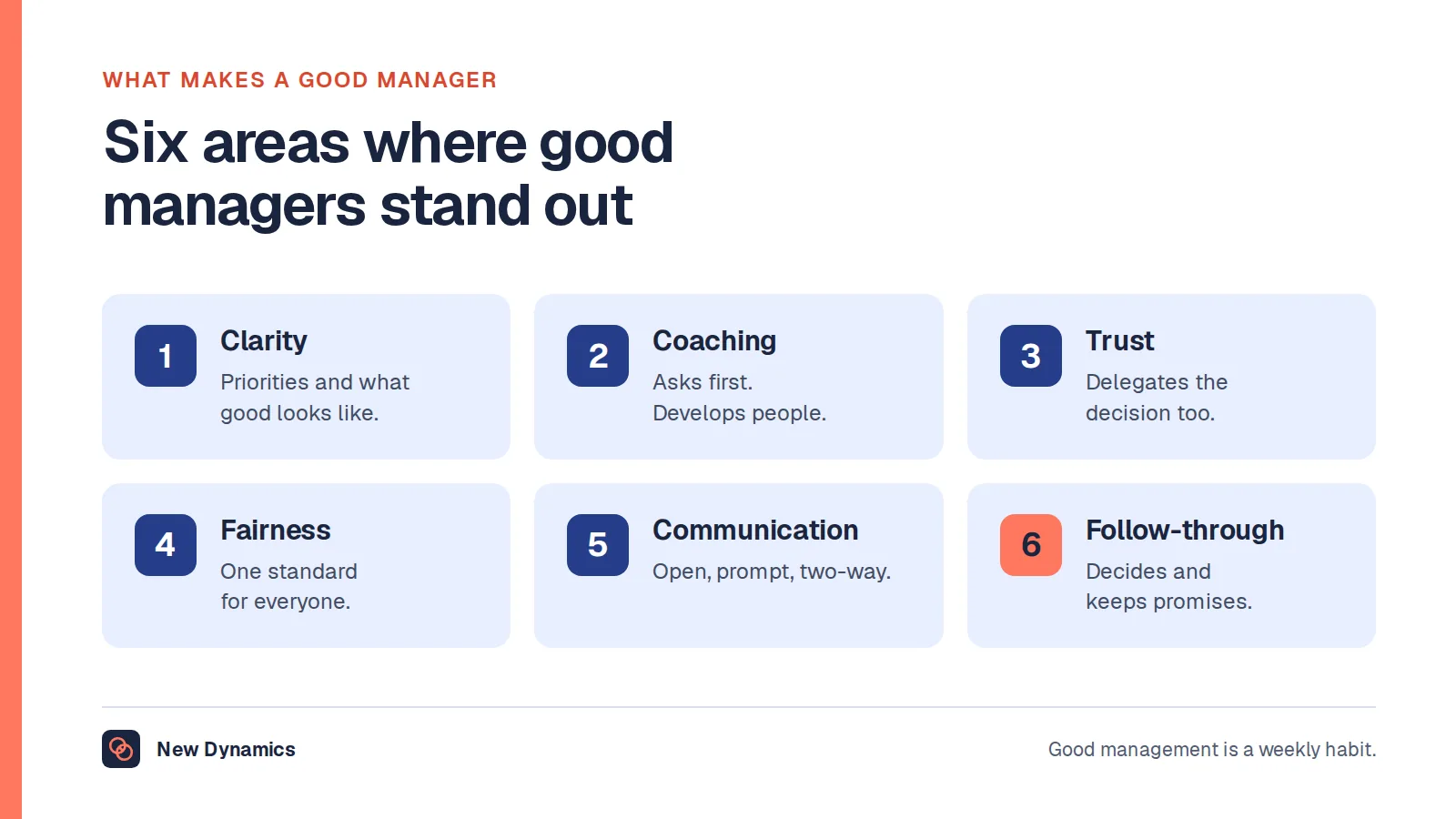
Google's guide to the research behind great managers lists ten behaviours of its most effective managers, beginning with “Be a good coach” and “Empower the team without micromanaging”. “Have key technical skills” is on the list, but it is one item of ten. We describe the full set in what makes a good manager.
That suggests six themes to cover.
- Leading and motivating people
- Coaching, feedback and development
- Handling performance problems and conflict
- Decisions, priorities and results
- Working across teams and with senior leaders
- Self-awareness and learning

How to ask: behavioural and situational questions
Two kinds of question work well.
- Behavioural questions ask what the person did: “Tell me about a time when…”
- Situational questions ask what they would do: “What would you do if…” These suit first-time managers, who have less history to draw on.
The UK Civil Service describes both in its Success Profiles guidance on behaviours. Candidates “may be asked to give examples of when you have demonstrated a particular behaviour”, or “how you would behave in a given situation”.
Whichever you choose, probe. The first answer is often rehearsed. Follow up with: What exactly did you do? What did you say? What happened next? What would you do differently? Listen for “I” as well as “we”, and for results as well as actions.
50 manager interview questions by theme
Choose eight to ten for a one-hour interview.
Leading and motivating people
- Tell me about the team you manage now. How would its members describe your style?
- Describe a time when you took over an existing team. What did you do in the first 90 days?
- Tell me about a time when you had to lead your team through an unpopular change.
- How do you make sure that each person knows what is expected of them?
- Give me an example of how you adapted your approach to suit a particular individual.
- Tell me about a time when morale was low. What did you do, and what happened?
- How do you recognise good work? Give me a recent example.
- Tell me about a time when you delegated something important. How did you decide what to hand over?
- How do you run your one-to-ones? What do you talk about?
Strong answers include: specific people and situations, evidence of listening before acting, clear expectations, delegation of decisions as well as tasks, and results for the team.
Coaching, feedback and development
- Tell me about someone you have developed. Where are they now?
- Describe the most difficult piece of feedback you have given. How did you prepare, and how did it go?
- How often do your team members receive feedback from you? How would I see that if I watched you for a week?
- Tell me about a time when you received tough feedback from your own team. What did you change?
- How do you approach a development conversation with someone who does not want promotion?
- Give an example of helping a high performer to stay challenged.
- Tell me about a time when you hired or promoted someone who did not work out. What did you learn?
- How do you help a new starter to become effective quickly?
Strong answers include: named examples of people who grew, feedback given promptly and specifically, openness to feedback on themselves, and interest in development beyond their own team's needs.
Performance problems and conflict
- Tell me about a time when someone in your team was underperforming. What did you do, step by step?
- Describe a time when you had to let someone go, or move them out of a role. How did you handle it?
- Tell me about a conflict between two members of your team. What was your role?
- Give an example of dealing with poor behaviour from a high performer.
- Tell me about a time when you disagreed with your own manager. What happened?
- How do you handle a complaint about one of your team from another department?
- Describe a time when you had to deliver bad news to your team.
- What would you do if you discovered that a team member had hidden a serious mistake?
Strong answers include: acting early, clear expectations and support before formal steps, fairness, working with HR and following procedure, and respect for the person throughout.
Decisions, priorities and results
- Tell me about the most significant result your team achieved last year. What was your contribution?
- How do you set goals for your team? Give me an example of one, and how you measured it.
- Describe a time when you had more work than capacity. How did you decide what would not get done?
- Tell me about a decision you made with incomplete information. How did it turn out?
- Give an example of a decision you got wrong. What did you do next?
- How do you keep track of your team's progress without micromanaging?
- Tell me about a time when you had to cut costs or do more with less.
- Describe a process that you improved. What was the measurable effect?
- How do you decide what to handle yourself and what to escalate?
Strong answers include: clear goals and measures, real trade-offs, ownership of mistakes, and a way of monitoring that does not rely on checking everything.
Working across teams and with senior leaders
- Tell me about a time when you needed something from another team that had different priorities.
- Describe how you keep your own manager informed. What do you escalate, and when?
- Give an example of influencing a decision without having the authority to make it.
- Tell me about a time when you represented your team's interests to senior leaders.
- How have you handled a situation where company priorities conflicted with what your team wanted?
- Describe a cross-functional project that you led. What made it hard?
Strong answers include: understanding of others' priorities, relationships built before they were needed, candour with senior people, and loyalty to the team and the organisation together.
Self-awareness and learning
- What kind of manager are you at your best? And under pressure?
- What would your current team say is the most frustrating thing about working for you?
- What have you changed about how you manage in the past two years? What prompted it?
- Tell me about a manager you learned from, and what you took from them.
- Which part of management do you find hardest?
- How do you look after your own wellbeing, and what do you do when you see a team member struggling?
- Why do you want to manage people? What would you miss if you stopped?
Strong answers include: specific weaknesses with evidence of work on them, examples of changing in response to feedback, and a real interest in people.
Closing questions
- What would you want to achieve in your first 90 days here?
- What do you need from your own manager to do your best work?
- What have we not asked that we should know?
Questions for first-time managers and team leaders
Candidates stepping up for the first time have little management history. Ask about informal leadership, and use situational questions.
- Tell me about a time when you led a piece of work without having authority over the people involved.
- Describe a time when you helped a colleague to improve at something.
- Have you ever given a peer difficult feedback? What happened?
- What would you do in your first month as team leader?
- How would you manage former peers, including friends?
- One of your team is regularly late with their work, and others are complaining. What would you do?
- What do you expect to find hardest about the move, and how will you prepare?
- Which parts of your current work would you need to let go of?
Our guide to boss vs leader covers the shift in mindset that these questions are testing.
How to score answers fairly
Acas, in its guidance on interviewing job applicants, says: “When interviewing it's a good idea to ask each applicant the same questions where possible. This is to ensure you're treating applicants in the same way.” It also suggests that, if possible, each interview should be carried out by more than one person, to reduce the risk of discriminating.
A simple scorecard turns that into practice.
| Score | What you heard |
|---|---|
| 1 | No relevant example, or an answer about what “one should” do |
| 2 | A relevant example, but vague about their own actions or the result |
| 3 | A clear example with specific actions and a result |
| 4 | A clear example, a strong result, and reflection on what they learned or would change |
Decide the questions and the criteria before you meet anyone. Each interviewer scores separately, straight after the interview, and the panel compares notes afterwards. When you decide, Acas advises checking that “decisions are based on how each applicant met each point in the job description and person specification”.
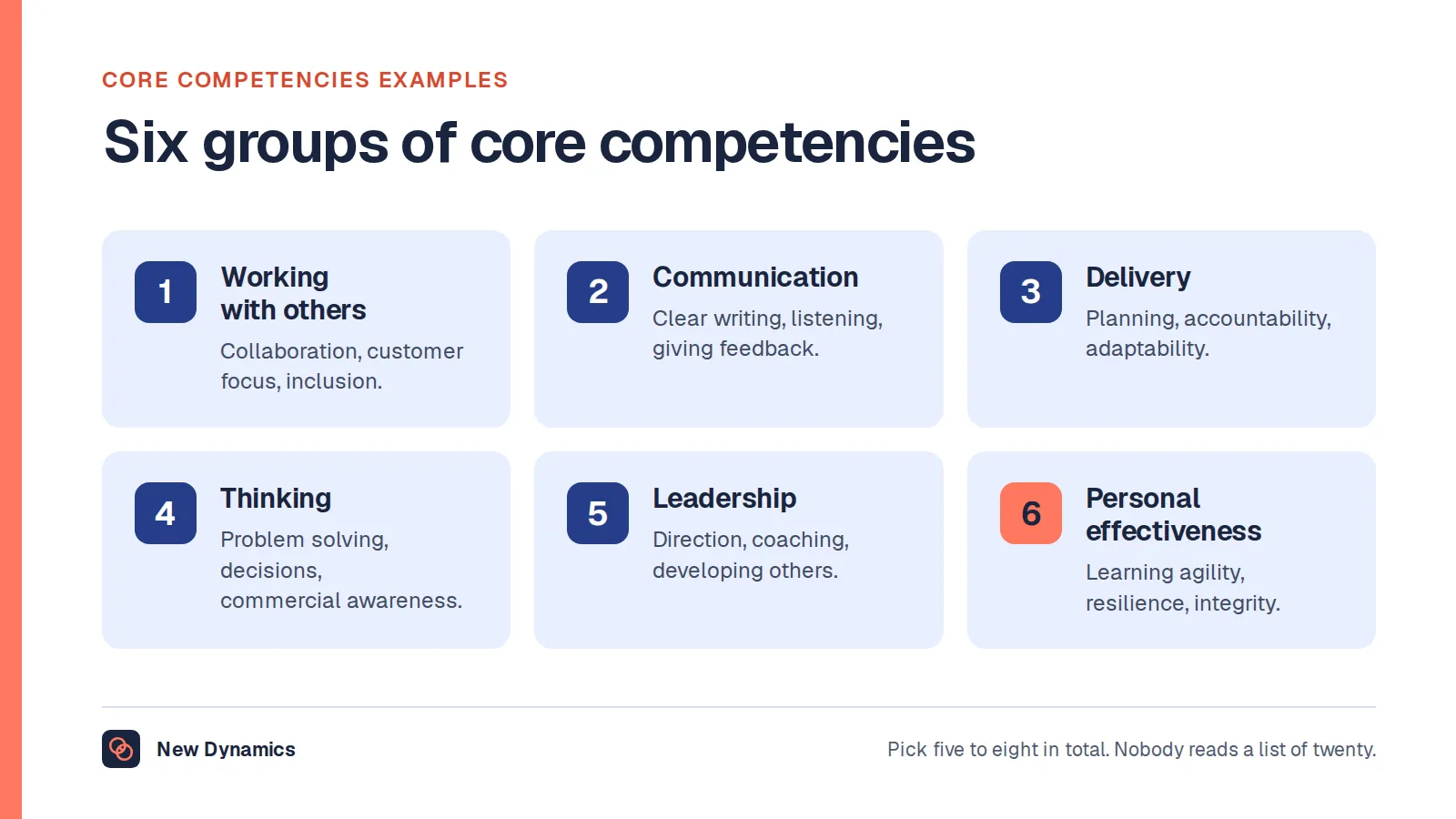
Link your criteria to your own expectations of managers. Our guide to core competencies shows how to describe them as behaviours.

Questions to avoid
Acas is plain on this point: “Questions must not discriminate.” Keep every question about the job and the person's ability to do it.
- Do not ask about age, marital status, children or plans for a family, religion, nationality, sexual orientation or health.
- Ask about ability to meet a real requirement in the same way of everyone. For example, “This role involves travel two days a week. Can you do that?”
- Ask every candidate whether they need adjustments for the interview. Acas says: “By law you must ask anyone coming to an interview to tell you if they need reasonable adjustments so they can attend.”
- Keep notes factual. Acas says that interview notes and recordings must be stored “securely and confidentially”, in line with data protection rules.
This is general information based on guidance for Great Britain. It is not legal advice. Our plain guide to the definition of discrimination at work explains the terms.
Also avoid brainteasers, questions about star signs or favourite animals, and “Where do you see yourself in five years?” unless you know what a good answer would be.
For candidates: how to answer manager interview questions
Prepare six to eight stories. Choose real situations that cover the themes above: developing someone, handling underperformance, a conflict, a hard decision, a mistake, a change and a result you are proud of. Each story can serve several questions.
Use situation, task, action, result. Spend most of the time on your actions. End with the result and what you learned.
Say “I” for your actions and “we” for the results. Interviewers need to know what you did. Your future team needs to know that you share credit.
Include a failure. A candidate with no mistakes has either not managed for long or not reflected much.
Show your routines. Describe how you run one-to-ones, set goals and give feedback. Good management is mostly habit.
A sample answer
Question: Tell me about a time when someone in your team was underperforming.
Situation. An experienced analyst in my team began missing deadlines last spring, and two reports went out with errors.
Task. I needed to understand why, and get the quality back, without losing a good person.
Action. I raised it privately within the week, with the two examples. I asked what was going on before giving my view. He had taken on a colleague's work during a vacancy and had not told me that he was struggling. We agreed to move one report to someone else for two months, set a simple checklist for his reviews and met weekly for fifteen minutes. I also changed how I allocate work during vacancies.
Result. His deadlines were back on track within a month, and there were no further errors that quarter. What I learned was that I had missed the signs for six weeks. I now ask about workload in every one-to-one.
It works because it is specific, shows the manager asking before judging, includes a result and admits a lesson.
Questions to ask in a manager interview, as the candidate
Your questions tell the panel how you think. These also help you to decide whether you want the job.
- What would success look like in this role after a year?
- What is the team like now, and what is the biggest challenge it faces?
- Why is the role vacant?
- How much freedom would I have over hiring, budget and priorities?
- How are managers here supported and developed?
- How does the organisation handle performance reviews and feedback?
- How would you describe your own management style?
- What would you want me to change first, and what should I leave alone?

Frequently asked questions
What questions are asked in a manager interview?
Expect questions about leading people, giving feedback, developing others, handling underperformance and conflict, setting goals, making decisions, working with other teams and your own self-awareness. Most begin “Tell me about a time when”, and ask for a real example.
How do I prepare for a manager interview?
Prepare six to eight real stories that cover developing someone, handling poor performance, a conflict, a hard decision, a mistake and a result. Structure each as situation, task, action and result. Be ready to describe your routines for one-to-ones, goals and feedback.
What are good interview questions to ask a manager candidate?
Ask: tell me about someone you have developed. Describe the hardest feedback you have given. Tell me about a time when someone was underperforming. How do you track progress without micromanaging? What would your team say is frustrating about working for you?
How do you answer “What is your management style?”
Describe what you actually do, with an example. For instance: “I agree clear goals, meet everyone weekly and give people room to decide how. Last year that meant handing our planning process to a team member, who improved it.” Avoid labels without evidence.
What should I ask at the end of a manager interview?
Ask what success looks like after a year, what the team's biggest challenge is, why the role is vacant, how much freedom you would have over hiring and priorities, and how managers are supported. These show that you are thinking about the job, not just the offer.
How should interviewers score manager candidates?
Agree the questions and criteria in advance, ask every candidate the same core questions and score each answer on a simple scale straight after the interview. Use more than one interviewer, score separately and then compare. Base the decision on the job requirements.
Your next step: build your question set
- Choose the six to eight behaviours that matter most for this manager role.
- Pick one or two questions from this list for each.
- Write down what a strong answer would include.
- Agree the scorecard with the other interviewers before you meet the first candidate.
For a full process, from the job description to the offer, read and download our recruitment and selection guide. The guide is free to read, and the PDF uses our short download form.
Want your new managers to start with clear goals, regular check-ins and feedback? Book a New Dynamics demo and bring your expectations of managers. You can also email contact@new-dynamics.com.