TL;DR
- Ageist means treating people unfairly because of their age. Ageism, in the World Health Organization's words, covers stereotypes (how we think), prejudice (how we feel) and discrimination (how we act) based on age.
- It affects the young as well as the old. Acas says that age discrimination can happen to people of any age, and describes four types: direct, indirect, harassment and victimisation.
- Much workplace ageism is unintended: an assumption about who wants training, who can manage, who is good with technology. Prevention starts with managers who challenge the joke and check the assumption.
“She is a bit young to lead that team.” “He will not want to learn the new system at his age.” Neither speaker would call themselves prejudiced. Each has made a decision about a person from a number. That is what ageist means, and it is a prejudice that people can voice in a meeting without noticing.
This article gives the definition of ageist and of ageism, shows what it looks like at work using the examples in official guidance, outlines the law in the UK and the United States, and sets out how to prevent it. It is general information, not legal advice.
Fair decisions about people rest on evidence. See how New Dynamics performance reviews bring goals, feedback and development into one fair discussion.
What does ageist mean?
The Cambridge Dictionary defines ageist as “treating people unfairly because of their age”. Its examples are “an ageist remark” and an ageist “job advertisement”. It defines ageism as “unfair treatment of people because of their age”.
The World Health Organization gives a fuller definition in its questions and answers on ageism: “Ageism refers to the stereotypes (how we think), prejudice (how we feel) and discrimination (how we act) towards others or oneself based on age.”
That sentence has three parts.
- Stereotypes: how we think. “Older workers cannot cope with change.” “Young people have no staying power.”
- Prejudice: how we feel. Discomfort at being managed by someone younger. Impatience with a colleague who is older.
- Discrimination: how we act. Who is hired, trained, promoted, listened to or made redundant.
Two words in the definition deserve notice. “Others or oneself” means that ageism can be turned inwards: the employee who does not apply because “they will want someone younger”. And “based on age” means any age.

Ageism affects every age
The WHO is direct: “Ageism affects everyone.” It gives, as an example of where ageism is seen, “practices that limit younger people's opportunities to contribute to decision-making in the workplace”. It reports that in Europe, the only region with data on all age groups, younger people report more age discrimination than other age groups.
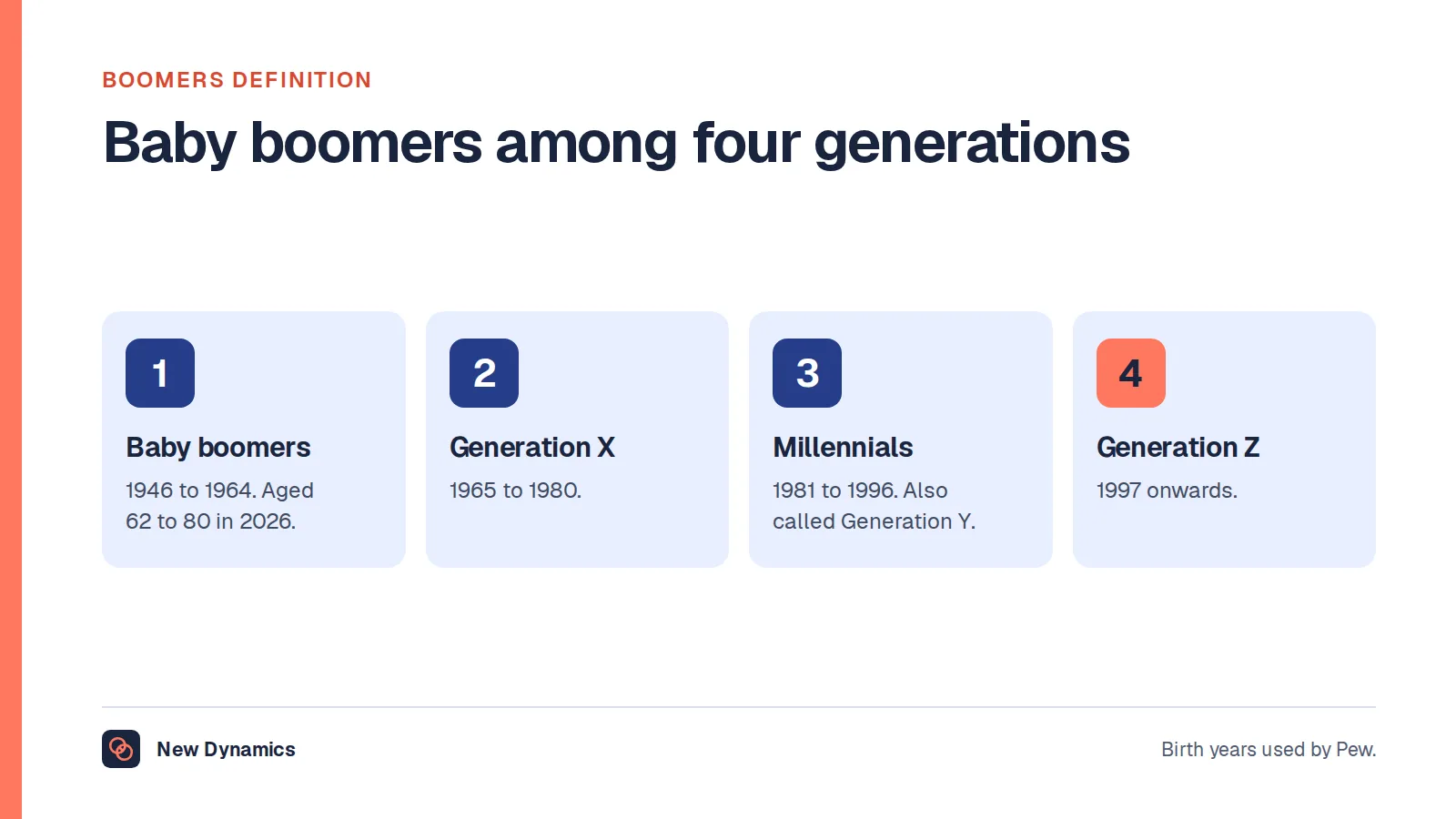
Acas takes the same view of the law in Great Britain. Its guidance on age discrimination says: “Age discrimination can happen to people of any age.” It adds a point that matters in an era of generational labels. The law protects a person of a particular age or belonging to an age group, and Acas notes: “Terms such as ‘Gen Z’ or ‘millennials’ can also indicate an age group.” Our guide to the definition of boomers explains why such labels are poor guides to people.
Four types of age discrimination, with Acas's examples
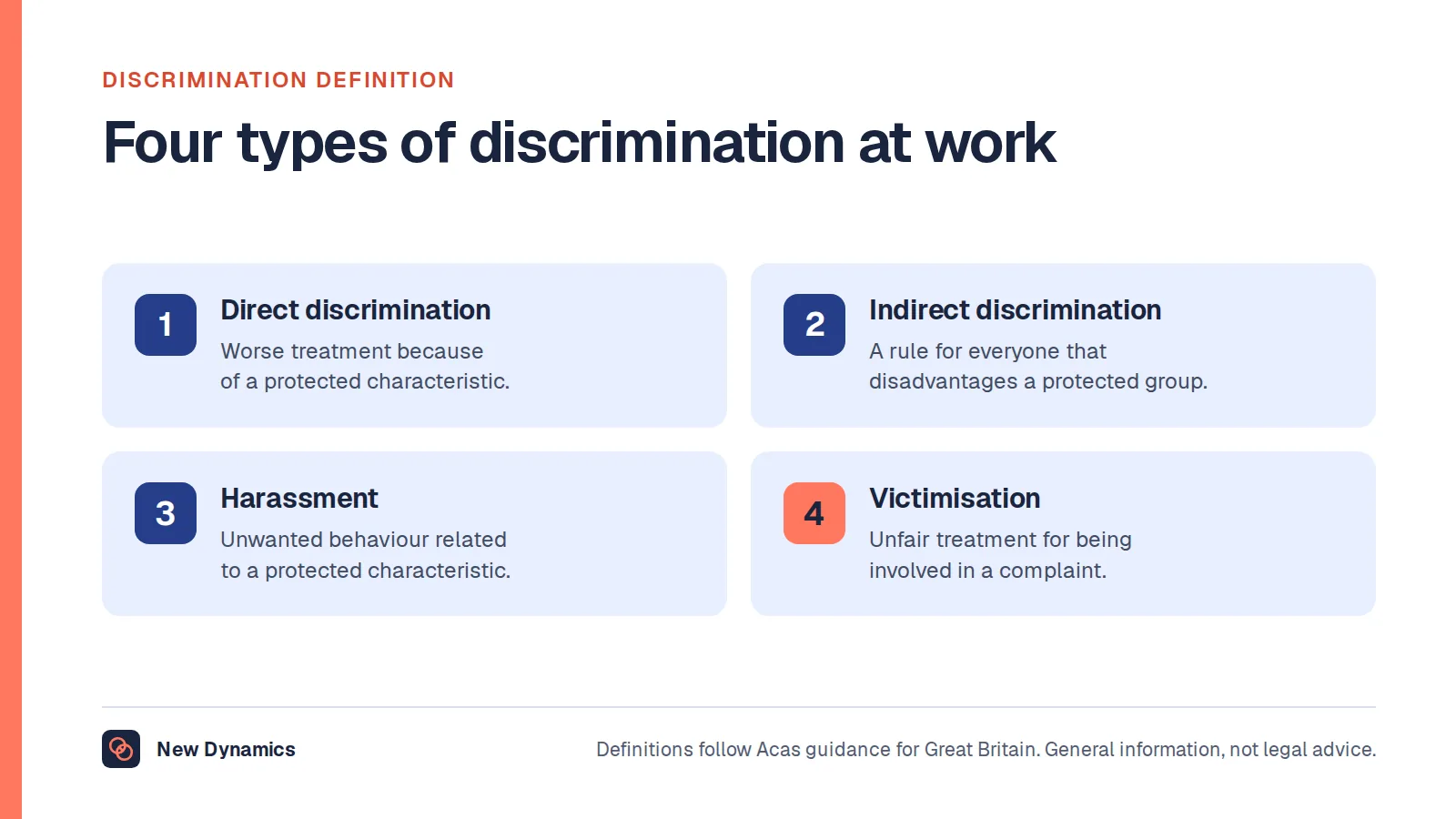
Acas says that age discrimination “is sometimes also known as ageism”, and describes four types.
- Direct discrimination. Someone is treated less favourably because of their age, their perceived age or the age of someone they are connected with. Acas's example: Pat is 55, and asks to do a management skills course. The manager refuses, believing that it is not worth investing in someone who might retire in a few years.
- Indirect discrimination. A practice, policy or rule applies to everyone, but puts people of a particular age at a disadvantage. Acas's example: an employer advertises for a “recent graduate”, which is likely to disadvantage older workers.
- Harassment. Unwanted behaviour related to age that violates someone's dignity or creates an intimidating, hostile, degrading, humiliating or offensive environment. Acas's example: Kim is the oldest person in the team, and the manager keeps offering Kim a seat in stand-up meetings, even after being asked to stop.
- Victimisation. Someone is treated less favourably because they were involved with a discrimination complaint. Acas's example: Charlie, an 18-year-old apprentice, complains about colleagues leaving children's toys on the desk as a joke, and the manager suggests ending the apprenticeship.
Two of those four examples involve a manager who meant well or thought it was funny. Acas notes that behaviour can be harassment even where that effect was not intended.
Acas also explains that, in some circumstances, an employer might be able to make or justify a decision that is based on age, for example where there is an occupational requirement. Take advice before relying on that.

The law in outline
Great Britain. Acas explains that age is one of nine protected characteristics under the Equality Act 2010. The law protects employees, workers, contractors hired to do the work personally, job applicants and former workers. GOV.UK's guide to working after State Pension age adds that the default retirement age no longer exists, and that an employer who sets a compulsory retirement age must give a good reason.
United States. The Equal Employment Opportunity Commission's page on age discrimination explains that the Age Discrimination in Employment Act “forbids age discrimination against people who are age 40 or older”. It adds: “It does not protect workers under the age of 40, although some states have laws that protect younger workers from age discrimination.” The law covers every aspect of employment, including hiring, firing, pay, job assignments, promotions, layoff, training and benefits.
So the two systems differ on one large point. British law protects every age. The US federal law protects people of 40 and over.
What ageism looks like at work
Drawing on Acas's guidance on preventing age discrimination, these are the places to look.
- Recruitment. Acas says that you must not assume that a younger worker lacks the credibility to be a manager, or that an older worker is not strong enough for a physically demanding job. It gives an interview question to avoid: “How would you feel about managing people older than yourself?”
- Job adverts. “Recent graduate”, “digital native”, “energetic young team”, “mature and experienced”. Our guide to the job ad lists the wording that Acas warns against.
- Training and promotion. Deciding that someone is too old to be worth developing, or too young to be taken seriously.
- Pay and benefits. Acas notes that pay or benefits linked to length of service could discriminate indirectly, because young workers are less likely to qualify, although they can sometimes be objectively justified.
- Everyday language. “OK, boomer.” “Snowflake.” “Past it.” “Wet behind the ears.”
- Stereotypes that sound like compliments. Acas's example of stereotyping is “being surprised when an older worker is good with technology”.
- Unconscious bias. Acas gives two examples: a manager who feels insecure about managing someone older, and a manager who ignores an idea from a younger worker and then accepts the same idea from someone older.
- Retirement. Asking pointed questions about when someone plans to go.
Five ways to prevent ageism
Acas lists five measures that help to prevent age discrimination.
- Stop inappropriate behaviour. Make it clear that ageist behaviour and language is not acceptable, including what some people call banter. Acas is blunt about managers who look away: “If your managers allow discrimination to happen, they are also discriminating.”
- Be aware of unconscious bias and stereotyping. Check the assumption before you act on it. Ask the person.
- Check the areas where it often happens. Acas names recruitment, pay and benefits, performance and development, menopause and retirement.
- Understand that needs change through working life. Flexibility, adjustments and development matter at 22, at 45 and at 67, for different reasons.
- Recognise the effect on mental health and wellbeing. Being written off, or never taken seriously, wears people down.
The WHO adds a wider view. It says that three strategies work in reducing ageism: policy and law, educational activities and intergenerational interventions, which bring together people of different generations. At work, that means mixed-age project teams, and mentoring that runs in both directions.

If you experience ageism
- Write down what happened: dates, words and who was present.
- Raise it informally, if you feel able to. Many ageist remarks are thoughtless, and stop when they are named.
- Use the formal route if that fails. Our guide to the meaning of grievance explains the procedure.
- Know that you are protected. Treating someone badly because they complained is victimisation, which is itself unlawful in Great Britain.
- Get advice. Acas runs a helpline in Great Britain. In the US, the EEOC handles charges of age discrimination.
Common mistakes
Thinking that ageism only affects older people. Young workers are stereotyped as lazy, entitled or unreliable, and it harms them in the same way.
Treating age jokes as harmless. They are often tolerated where other jokes would not be, which is the reason to stop them.
Managing by generation. A seminar on “what Gen Z wants” teaches managers to stereotype. Ask the individuals.
Coded adverts. “Digital native” and “recent graduate” say “young” without saying it.
Assuming retirement plans. Ask everyone about their future in the same way, and believe the answer.
Ignoring your own data. Look at who is hired, trained, promoted and made redundant, by age band.
Frequently asked questions
What is the definition of ageist?
Ageist means treating people unfairly because of their age. An ageist remark, advert or decision is one that rests on an assumption about what people of a certain age are like or can do.
What is ageism?
The World Health Organization defines ageism as the stereotypes (how we think), prejudice (how we feel) and discrimination (how we act) towards others or oneself based on age. It can be directed at any age group, and at oneself.
What is an example of ageism at work?
Acas gives the example of a 55-year-old who is refused a management course because the manager thinks that they might retire soon. Another is an advert for a “recent graduate”, which is likely to disadvantage older applicants.
Can young people experience ageism?
Yes. The WHO says that ageism affects everyone, and that in Europe younger people report more age discrimination than other age groups. In Great Britain, the law protects people of every age. US federal law protects people aged 40 and over.
Is ageism illegal?
In Great Britain, age is a protected characteristic under the Equality Act 2010, and direct and indirect discrimination, harassment and victimisation are unlawful, with some exceptions. In the US, the Age Discrimination in Employment Act forbids discrimination against people aged 40 or older. This is general information, not legal advice.
Is “OK, boomer” ageist?
It can be. Acas lists ageist language, inappropriate comments and jokes as examples of behaviour that can amount to harassment related to age. Whether a single remark crosses the line depends on the circumstances, but it has no place at work.
Your next step: check three things
- Read your last three job adverts for words that point to an age.
- Look at who received training and promotion in the past year, by age band.
- The next time you hear an age joke at work, say something.
For a practical approach to fairness at work, read and download our diversity and inclusion guide. The guide is free to read, and the PDF uses our short download form.
Want decisions about people to rest on evidence, not assumptions? Book a New Dynamics demo and bring your current review process. You can also email contact@new-dynamics.com.