TL;DR
- A job ad is a public announcement of a vacancy that people can apply for. It is a short piece of persuasion, and differs from the job description, which is the fuller internal record of the role.
- A good job ad has six parts: a plain title, the pay, place and hours, what the person will do, what they truly need, what you offer and how to apply.
- Wording matters. Acas and the US EEOC both warn that phrases such as ‘recent graduate’ can discriminate. Acas also suggests advertising in at least two different ways or places.
A job ad has only a few seconds to work. In that time a stranger decides whether the job is real, whether they could do it, whether it pays enough and whether they like the sound of you. Many adverts waste those seconds on a paragraph about the company's passion for excellence.
This article explains what a job ad is, how it differs from a job description, the six parts of a good one, the wording that the guidance warns against and where job ads are found. It includes a sample job posting that you can copy, and a checklist to run before you publish.
An advert is the first statement of what you expect from someone. See how New Dynamics performance reviews keep goals, feedback and behaviours in one conversation once your new starter has joined.
What is a job ad?
The Cambridge Dictionary defines a job advertisement as “an announcement in a newspaper, on the internet, etc. about a job that people can apply for”. Job ad, job advert, job posting and job listing all mean the same thing. “Posting” and “listing” are the usual words for an advert on a website.
A job ad is not a job description, although the two are often confused.
| Document | Reader | Purpose | Length |
|---|---|---|---|
| Job ad | A stranger who might apply | To attract suitable people and let others rule themselves out | Short |
| Job description | Applicants, the post holder, the manager | To record the duties and responsibilities of the role | Fuller |
| Person specification | Applicants and the selection panel | To list the skills and experience needed, essential and desirable | A list |
Acas's guidance on how to advertise a job says that when you advertise, or when someone asks to apply, you should give them the job description, an application form, the person specification, information about your organisation and an equality and diversity monitoring form. The ad is the front door. The other documents are the house.
Acas also makes a point that surprises some employers: “You're not legally required to advertise a job, but it's a good idea to.” Advertising means that you are less likely to discriminate, even unintentionally, and more likely to get a wider range of suitable applicants.
The six parts of a good job ad
- A plain job title. Use the words that candidates search for. “Customer Support Adviser” will be found. “Happiness Hero” will not.
- Pay, place and hours. The salary or range, the location, whether the work is on site, hybrid or remote, and the working pattern. Candidates need these to decide whether to read on. Our guide to the meaning of DOE explains why “depends on experience” is a poor substitute for a range.
- What you will do. Four to six lines on the real work, in the second person: “You will answer customer emails and calls.”
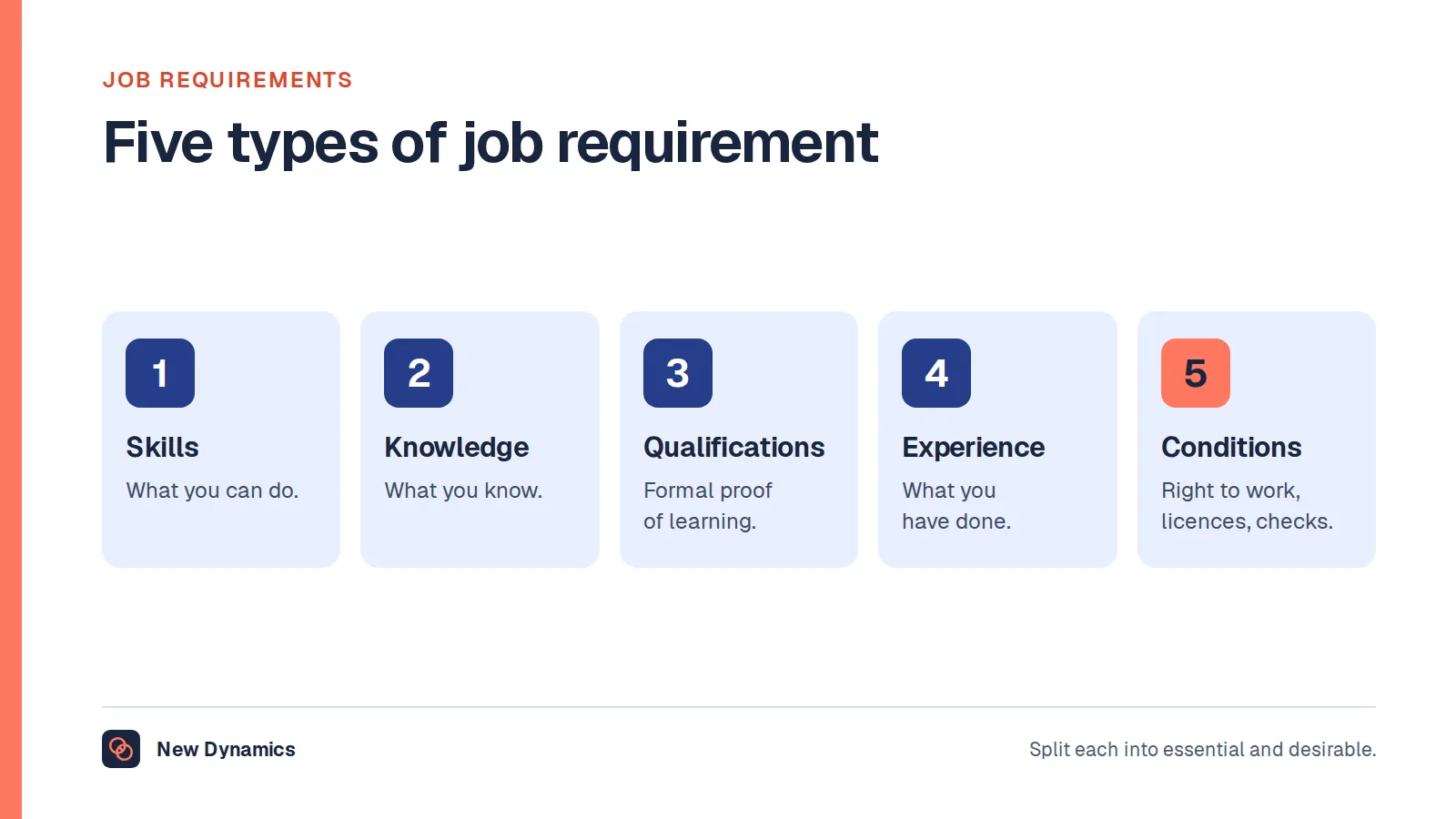
- What you need. Only the true essentials, and a few desirables that are clearly labelled. Our guide to job requirements shows how to cut the list.
- What we offer. Holiday, pension, flexibility, training and anything that is distinctive. Be specific.
- How to apply. What to send, to whom, by when, what happens next, and how to ask for an adjustment to the process.

A sample job posting
Adapt this to your role. Text in square brackets is for you to complete. The example is invented.
Customer Support Adviser
£27,000 a year · Leeds, hybrid (three days a week in the office) · Full time, 37.5 hours, Monday to Friday · Permanent
[Company name] makes booking software for independent garages. Eighteen of us work from an office near Leeds station. We are looking for a sixth member of our support team.
What you will do
- Answer customers' questions by email, chat and phone, and solve them the first time where you can.
- Spot problems that keep coming up, and tell our product team about them.
- Write and update help articles.
- Help new customers to set up their accounts.
What you need
- Clear, friendly written and spoken English.
- Patience with people who are having a bad day.
- Confidence with everyday software. We will teach you ours.
Experience in a support role is useful, and not essential. Full training is given.
What we offer
25 days' holiday plus bank holidays, a 5% employer pension contribution, a training budget of £750 a year, and a quarterly review of your goals and development.
How to apply
Send your CV and a few lines on why this job suits you to [email address] by [date]. We reply to every applicant. Interviews are on [dates], by video or in person. If you need any adjustments to the process, tell us and we will arrange them.
It is about 230 words long. A candidate can tell within a few seconds whether to read on.
Wording to avoid
Acas. Its guidance says: “When advertising a job, you must not ask for or exclude anyone with a certain protected characteristic.” It gives examples of words and phrases that could be discriminatory:
- “recent graduate” or “highly experienced”, which can discriminate on the ground of age, unless you can prove a good reason for the requirement;
- “barmaid” or “handyman”, because they imply that you want a woman or a man. Acas advises inclusive language “that defines the job not the applicant”;
- a nationality where you mean a language. “German sales rep” could discriminate against race, so “German-speaking sales rep” would be more appropriate.
The EEOC. In the United States, the Equal Employment Opportunity Commission's summary of prohibited employment policies and practices says that it is illegal to publish a job advertisement that shows a preference for, or discourages someone from applying because of, race, colour, religion, sex, national origin, age (40 or older), disability or genetic information. Its example: “a help-wanted ad that seeks ‘females’ or ‘recent college graduates’ may discourage men and people over 40 from applying and may violate the law”.
Beyond the law, some wording simply loses you good candidates.
- Jargon and clichés: rockstar, ninja, fast-paced, work hard and play hard.
- “Competitive salary”. It tells the reader nothing, and they may assume the worst.
- A wall of requirements. Each extra line persuades some capable people not to apply.
- Vague hours, such as “flexibility required”. Say what you mean.
This is general information, not legal advice.
Five checks before you publish
- Plain title. Would a candidate type these words into a search box?
- Pay shown. A figure or a range, with the place and the hours.
- Essentials only. Can you give a good reason for each requirement?
- Inclusive words. No terms that point to age, sex, nationality or another protected characteristic.
- Two places. Will the advert reach a wide range of people?

Four places where job ads can be found
Acas advises: “It's a good idea to advertise in at least 2 different ways or places.” Its example is a newspaper and a jobs website. It warns that if you only use social media, you could miss applicants who do not use it, and that an online advert might only be seen by specific groups of people.
- The employer's own careers page. Free, under your control, and the place where interested people look first.
- Job boards and public employment services. Commercial job websites, and government services. In Great Britain, GOV.UK offers employers the Find a job service to advertise and manage vacancies.
- Social and professional networks. Useful for reach and for referrals. Acas's warning about who sees an online advert applies here most of all.
- Print and local channels. Newspapers, trade and professional publications, community notice boards, colleges and universities.
Recruitment agencies and employee referrals are further routes. Referrals are quick, but if you rely on them alone you can end up hiring people who resemble the people you already have. We do not list or rank individual job sites, because their prices and terms change.

What else to tell applicants
Acas lists things that you should tell applicants you will need from them, such as proof that they have the right to work in the UK, whether they will need a reference, and whether they will need a health check before they start. It adds: “You must tell applicants how you'll use their personal information.” A link to a short privacy notice for candidates does the job.
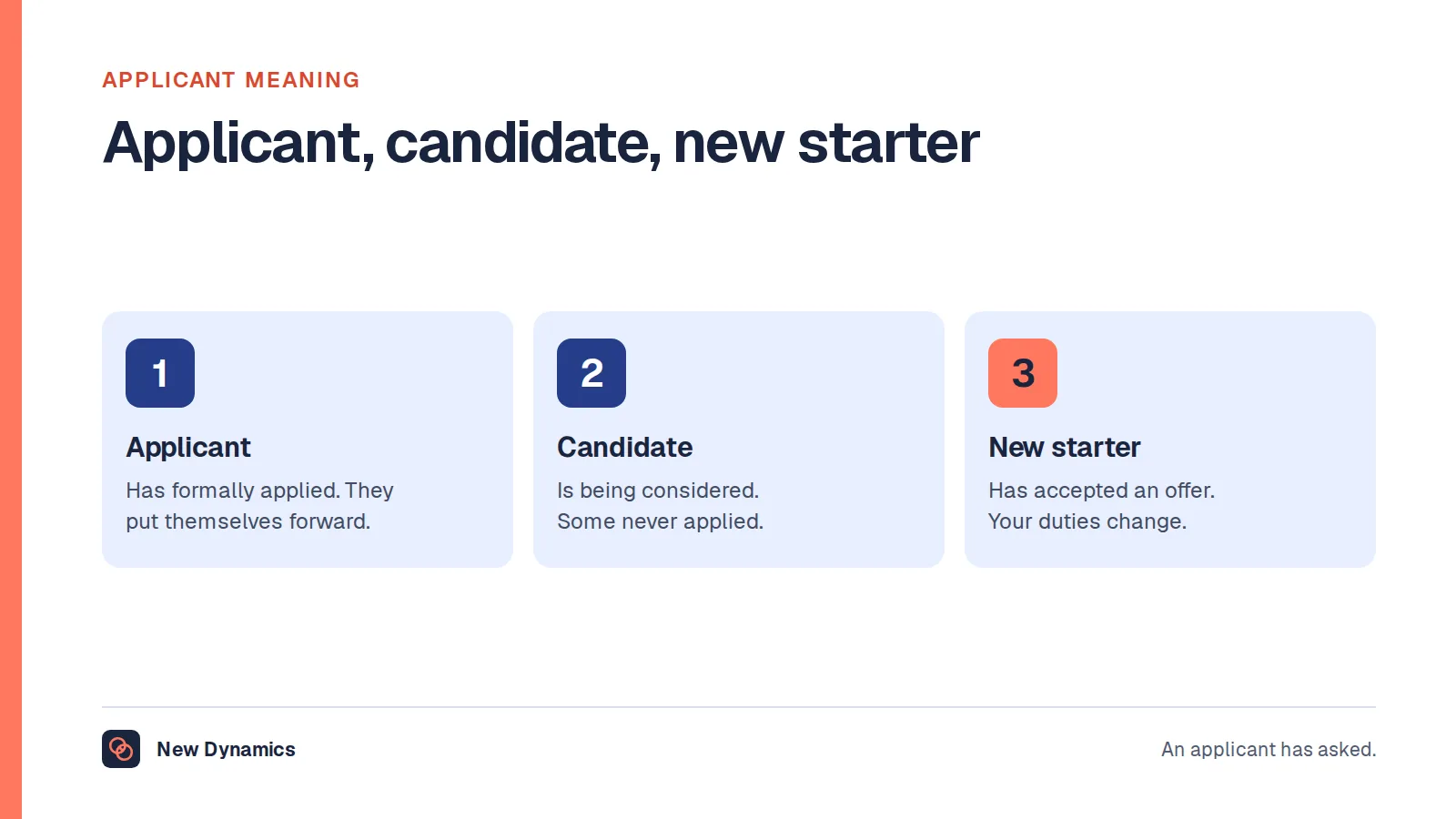
Then keep the promise that the advert makes. If you say that you reply to every applicant, reply to every applicant. Our guide to the meaning of applicant sets out what every applicant is owed.
Common mistakes
Pasting in the job description. Nobody reads two pages on a phone.
Leading with the company. Lead with the job. One or two sentences about the organisation are enough.
Hiding the pay. You will spend the time that you saved in interviews with people who cannot accept the salary.
Requirements copied from the last advert. Check each one against the job as it is now.
One channel only. See Acas's advice above.
No closing date, and no reply. Both damage your reputation with the people you may want to hire next year.
Frequently asked questions
What is a job ad?
A job ad, or job advertisement, is a public announcement of a vacancy that people can apply for. It appears on careers pages, job boards, social networks or in print, and is also called a job advert, job posting or job listing.
What is the difference between a job ad and a job description?
A job ad is a short announcement that aims to attract suitable applicants. A job description is a fuller record of the duties and responsibilities of the role. Acas suggests giving applicants the job description and the person specification alongside the advert.
What should a job posting include?
Include a plain job title, the pay, place and hours, four to six lines on what the person will do, the true essential requirements, what you offer, and how to apply, with a closing date and an offer of adjustments.
Where can job advertisements be found?
Four common places are employers' own careers pages, job boards and public employment services, social and professional networks, and print or local channels such as newspapers, trade publications and notice boards. Agencies and referrals are further routes.
What words should I avoid in a job ad?
Acas warns against phrases such as “recent graduate” or “highly experienced”, gendered titles such as “handyman”, and naming a nationality when you mean a language. Avoid jargon, and avoid “competitive salary” in place of a figure.
Do I have to advertise a job?
Acas says that you are not legally required to advertise a job in Great Britain, but that it is a good idea, because it lowers the risk of discrimination and brings a wider range of applicants. Follow any recruitment policy that your organisation has.
Your next step: rewrite one advert
- Take your most recent job ad, and time how long it takes to find the pay, the place and the hours.
- Rewrite it in the six parts above, in under 300 words.
- Run the five checks.
- Publish it in at least two places, and reply to everyone who applies.
For a fair process from the job description to the offer, read and download our recruitment and selection guide. The guide is free to read, and the PDF uses our short download form.
Want the expectations in your advert to carry through to goals and reviews? Book a New Dynamics demo and bring your current approach. You can also email contact@new-dynamics.com.