TL;DR
- Employers' liability insurance is compulsory in Great Britain. GOV.UK says to get it “as soon as you become an employer”, “to cover you for at least £5 million from an authorised insurer”.
- Who it must cover is decided by the working relationship, not the paperwork. HSE is explicit that it “does not matter whether you usually call someone an employee or self-employed or what their tax status is”.
- The penalties are daily. You can be fined £2,500 for every day you are not properly insured, and £1,000 for failing to display the certificate.
Most employment obligations give you a grace period. This one does not: the duty starts on the day you become an employer, and the fine is charged per day.
This article explains what employers' liability insurance covers, who has to have it, how much, who counts as an employee for the purpose, and what the rules on the certificate actually say.
Deciding who this covers means knowing who works for you and on what terms. See how New Dynamics org charts keep that picture current.
What it is, and what it is not

The Employers' Liability (Compulsory Insurance) Act states the duty plainly: "every employer carrying on any business in Great Britain shall insure, and maintain insurance, under one or more approved policies with an authorised insurer or insurers against liability for bodily injury or disease sustained by his employees, and arising out of and in the course of their employment in Great Britain in that business".
HSE's brief guide for employers draws the distinction that catches people out. Public liability insurance "covers you for claims made against you by members of the public or other businesses, but not for claims by employees", and while public liability "is generally voluntary, employers' liability insurance is compulsory". Holding one does not satisfy the requirement for the other.
The duty in four parts
GOV.UK's guidance on employers' liability insurance sets the headline obligations:
- Get it as soon as you become an employer. Not at the end of the first month, and not when the first person starts work.
- Cover of at least £5 million. HSE notes that "in practice, most insurers offer cover of at least £10 million", and that the £5 million minimum "includes costs", so the usable cover is lower than the headline.
- From an authorised insurer. The Act defines that by reference to permission under the Financial Services and Markets Act, and GOV.UK points employers at the Financial Conduct Authority register to check.
- Display the certificate where employees can access it, "for example at your workplace, on your website or work intranet", and show it to inspectors on request.
Who is exempt, and why the exemption is narrower than it looks
GOV.UK lists two exemptions: you do not need the insurance if you only employ "a family member" (the list runs from spouse and civil partner through to half-sibling) or "someone who is based outside of England, Scotland and Wales".
HSE adds the qualification that removes most of the comfort. The family exemption "does not apply to family businesses which are incorporated as limited companies". A husband-and-wife limited company with no other staff is not exempt on that ground, although a separate exemption covers "companies employing only their owner where that employee also owns 50% or more of the issued share capital".
The overseas point has a threshold too. If employees are normally based abroad but spend "more than 14 days continuously in Great Britain, or more than seven days on an offshore installation", cover is needed for them.
Northern Ireland, the Isle of Man and the Channel Islands have their own arrangements. This is general information rather than legal advice.
Who counts as an employee

This is the part most likely to leave a business uninsured without realising it. The requirement applies to people employed "under a contract of service or apprenticeship", and HSE is blunt that the paperwork does not decide it:
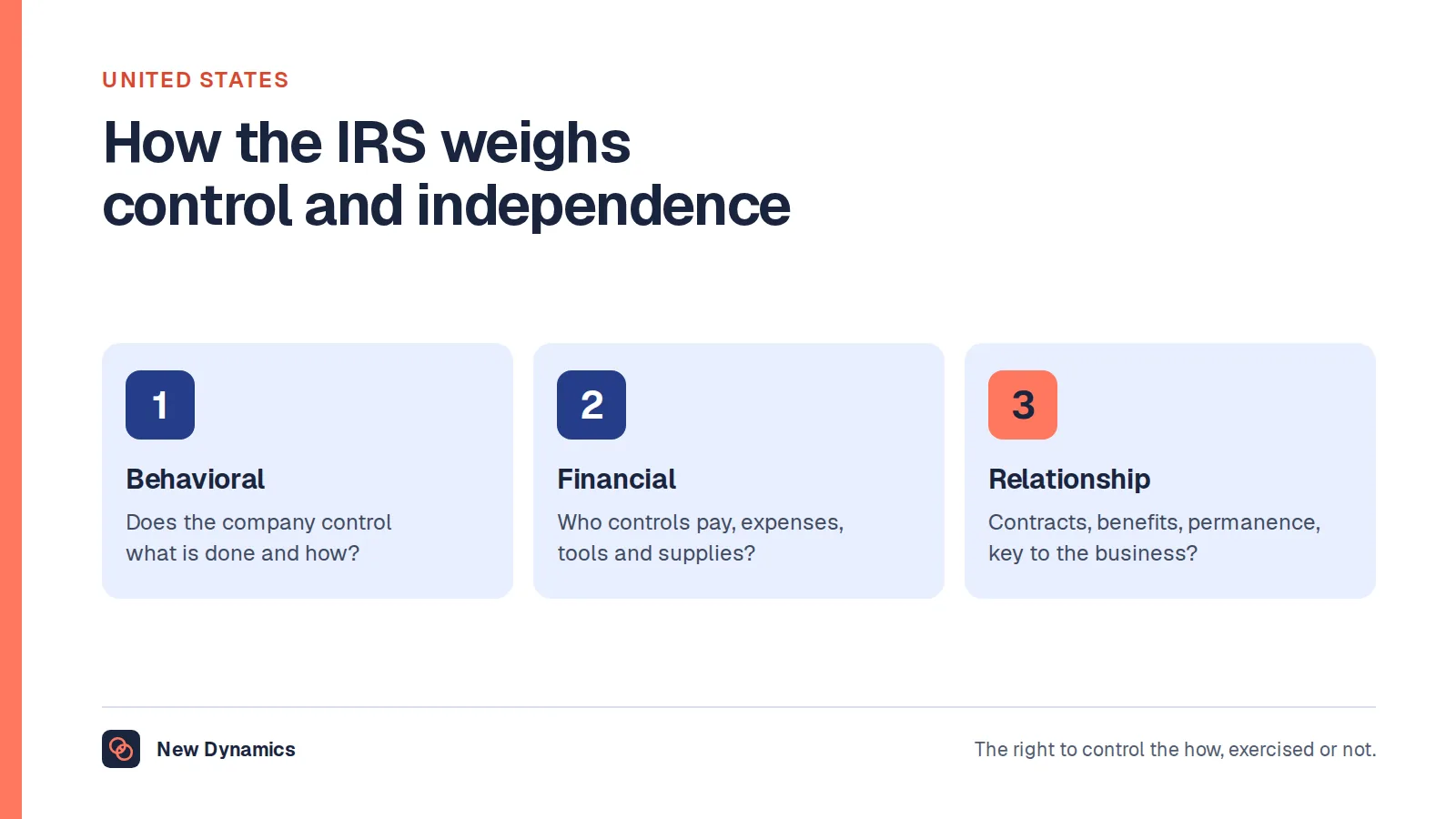
"It does not matter whether you usually call someone an employee or self-employed or what their tax status is... What matters is the real nature of your relationship with the people who work for you and the nature and degree of control that you have over the work they do."
Indicators that cover is probably needed: you deduct National Insurance and income tax from what you pay them; you control where, when and how they work; you supply their materials and equipment; you have a right to any profit they make; they cannot send a substitute; or they are treated the same as your other employees.
Indicators that it may not be: they do not work exclusively for you; they supply most of their own equipment and materials; they are clearly in business for their own benefit; they can send a substitute; or you do not deduct tax or National Insurance. HSE adds the caveat that even someone self-employed for tax purposes "may be classed as an employee for other reasons".
Our post on the independent contractor distinction covers the same question from the contracting side.
Volunteers, unpaid students, people on training programmes and work experience students are usually picked up by an existing policy without a separate arrangement, though HSE advises talking to the insurer for long placements or unusual work.
The certificate
Your insurer issues a certificate when you take out or renew the policy, and it must state the minimum level of cover and the companies covered. Display a copy where employees can easily read it. Electronic display is allowed, provided employees "know how and where to find the certificate and have reasonable access to it", which means it is not enough to file it somewhere only the office manager can reach.
For employees on offshore installations, a copy does not have to be on every installation, but a request must be met "within ten working days".
Keep the old ones anyway
There is no longer a legal requirement to keep expired certificates. HSE nonetheless advises keeping "as far as is possible, a complete record" of your employers' liability insurance, and gives the reason: "some diseases can appear decades after exposure to their cause", and a former employee may claim for the period when they were exposed. An employer who cannot identify the insurer for that period "risks having to meet the costs of such claims themselves".
Keeping a folder of certificates is a five-minute annual habit that protects against a claim nobody in the business will remember.
What your insurer cannot do
The Act restricts what a policy may contain. HSE lists conditions an insurer cannot impose: they cannot refuse to pay compensation purely because you have not provided reasonable protection against injury or disease, because you did not keep specified records or supply information from them, because you did something they told you not to do, because you failed to do something they told you to do, or because you have not met a legal requirement connected with protecting employees.
Two things follow. The insurer must pay the full amount agreed or awarded, and cannot make you or the employee pay part of a claim. But where the insurer believes your failure caused the claim, the policy "may enable the insurer to sue you to reclaim the cost of the compensation". The protection is for the injured employee, not for a negligent employer.
Penalties and enforcement
HSE enforces this, and inspectors can ask to see the certificate and other insurance details. The fines are per day: up to £2,500 for any day without suitable insurance, and up to £1,000 for not displaying the certificate or refusing to show it to an inspector.
If you are employing someone for the first time

- Arrange cover before the first day, not after it.
- Check the insurer is authorised on the FCA register before you buy.
- Display the certificate somewhere every employee can reach, including anyone who never visits the office.
- Start the folder. Keep every certificate from now on, with the policy number and the insurer.
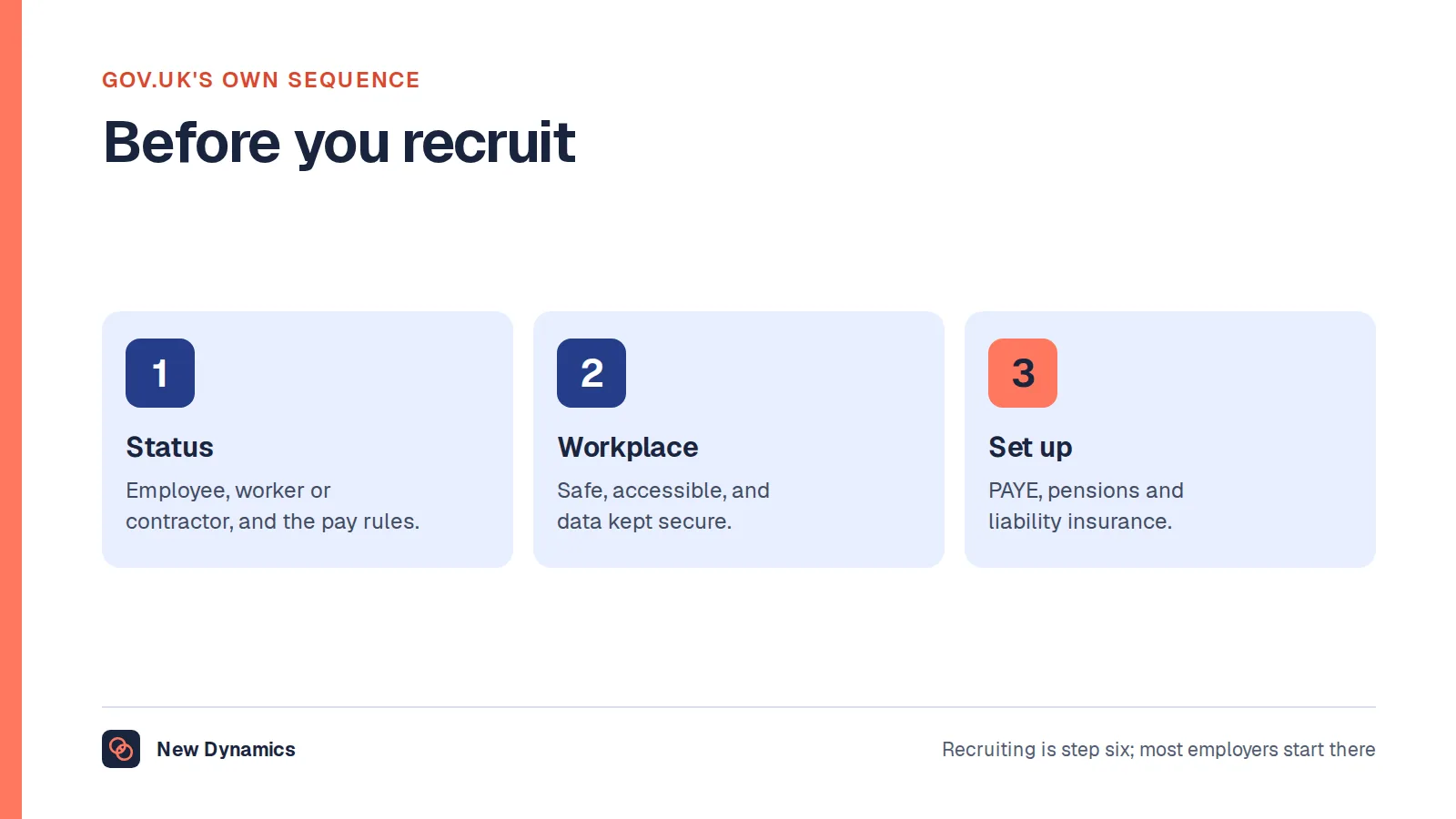
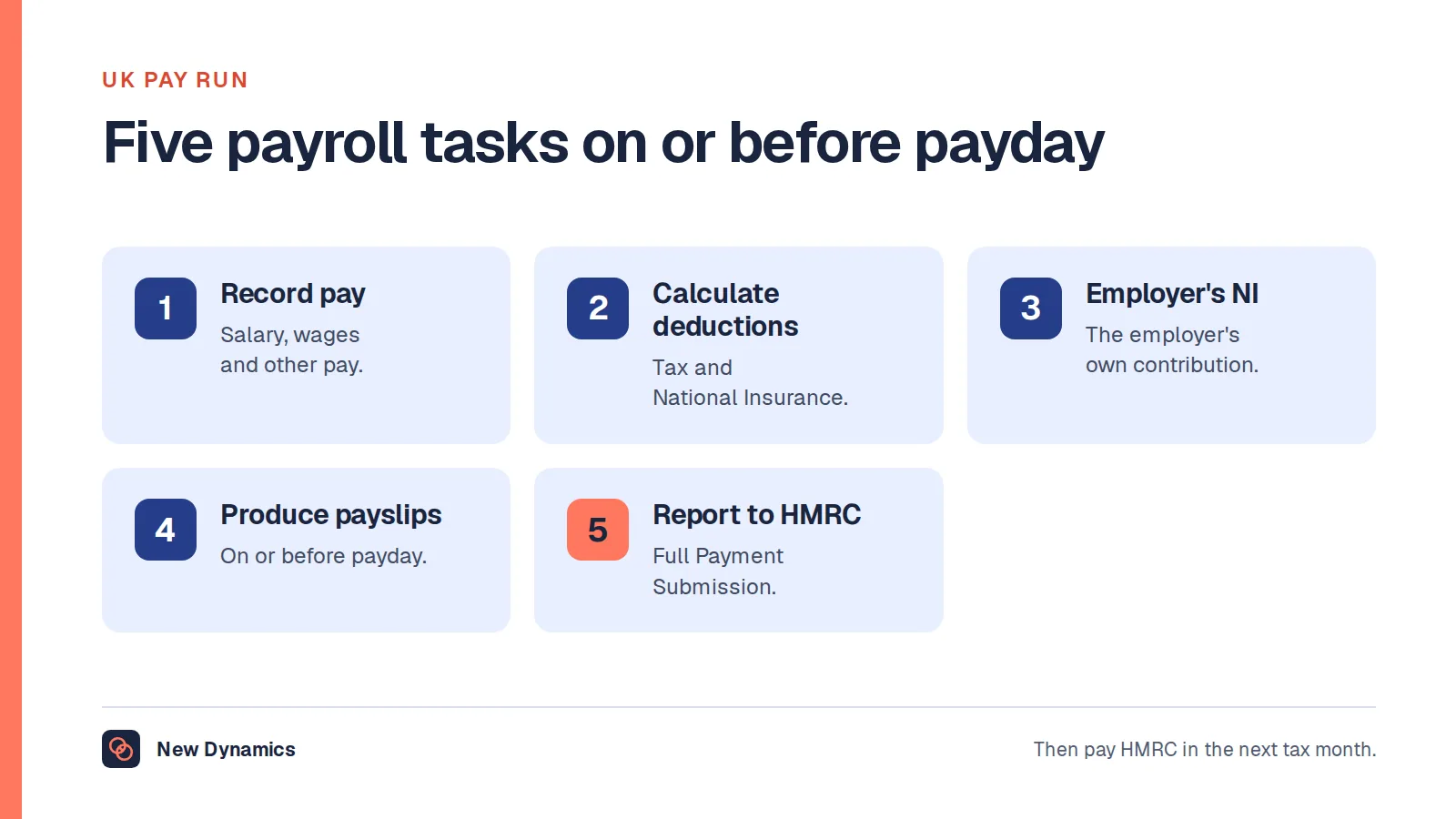
Our payroll definition post covers the other obligations that start on the same day.
Frequently asked questions
Do I need employers' liability insurance?
If you employ anyone under a contract of service in Great Britain, yes, from the day you become an employer. The exemptions are narrow: a business employing only close family members, which does not apply to limited companies, and a company employing only its owner where that person holds at least half the share capital.
How much employers' liability insurance do I need?
At least £5 million from an authorised insurer. HSE notes that most insurers offer at least £10 million in practice, and that the £5 million minimum includes costs, so it is worth considering more than the statutory floor.
Is employers' liability insurance the same as public liability insurance?
No. Public liability covers claims by members of the public or other businesses and is generally voluntary. Employers' liability covers claims by your own employees and is compulsory. Holding one does not satisfy the requirement for the other.
Do I need cover for contractors and freelancers?
It depends on the real working relationship rather than the label. HSE says the tax status and the name of the contract are not decisive; what matters is control over the work, who supplies equipment, whether a substitute can be sent and whether the person works exclusively for you.
Where do I have to display the certificate?
Somewhere employees can easily read it. Electronic display is allowed (a workplace noticeboard, an intranet or a website) provided employees know where to find it and have reasonable access. Failing to display it can attract a fine of up to £1,000.
Do I have to keep old insurance certificates?
Not by law, but HSE strongly advises keeping a complete record. Some work-related diseases appear decades after the exposure that caused them, and an employer who cannot identify the insurer for that period may have to meet the claim themselves.
What is the fine for not having employers' liability insurance?
Up to £2,500 for each day you are not properly insured. HSE inspectors enforce this and can ask to see your certificate and other insurance details at any time.
Your next step: check three things today
- Confirm the policy covers at least £5 million and that the insurer is on the FCA register.
- Check the certificate is displayed where every employee can reach it, including remote workers.
- List everyone who works for you and ask, for each, who controls the work.
For the wider set of duties that arrive with your first employee, read and download our human resources management guide. The guide is free to read, and the PDF uses our short download form.
Want an accurate picture of who works for you and on what terms? Book a New Dynamics demo and bring your current structure. You can also email contact@new-dynamics.com.