TL;DR
- There is no single employee engagement definition: the CIPD notes that the MacLeod Review found more than fifty. The academic literature agrees that engagement is a psychological state experienced by employees, distinct from job quality, behaviour or management action, and the CIPD recommends the Utrecht definition of work engagement: a state of mind in which, rather than being burnt out, employees show vigour, dedication and absorption. Engage for Success defines it from the organisation's side as the conditions in which all members give of their best each day, committed to the organisation's goals and values, motivated to contribute, with an enhanced sense of their own wellbeing.
- An engaged workforce is not the same as a satisfied, happy or busy one. Satisfaction is contentment with the deal; happiness is mood; busyness is hours. Engagement shows in energy and persistence, pride and enthusiasm, and concentration on the work, and in the behaviour that follows: discretionary effort, ideas offered, problems raised early, customers spoken well to. It varies from team to team and week to week, and it can be lost.
- The MacLeod Review's four enablers are a strategic narrative from leaders, engaging line managers who motivate, empower and support, employee voice in decisions, and organisational integrity, where stated values match the actual culture. The CIPD adds that people are naturally motivated to do a good job and become demotivated when overworked, unsupported or frustrated, and that HR systems can get in the way as much as drive engagement. Improving it is mostly the manager's weekly practice: clear goals, real conversations, listening that leads to action, and thanks.
A board asks for a plan to improve engagement. A survey vendor offers to measure it. A manager says their team is engaged because nobody has resigned. Each of them means something different, which is why the plan, the survey and the manager's confidence so often fail to connect. What is an engaged workforce? The honest answer starts with an admission: the term has no agreed definition, and the first job is to choose one.
This article gives the employee engagement definition from two sources, the CIPD's factsheet and the Engage for Success movement that grew out of the MacLeod Review, explains what engaged is not, describes what an engaged workforce looks like in a team you can walk into, sets out the four enablers, and gives a way to improve work engagement that does not depend on a programme.
Most of what builds engagement happens between a manager and a team in an ordinary week, and thanks is the part most often left out. See how New Dynamics recognition lets colleagues and managers thank people for specific work, in the flow of the week, where the whole team can see it.
Employee engagement definition: choose one
The CIPD factsheet opens with the problem: “There's no common understanding of employee engagement. For example, the 2009 MacLeod Review found over 50 definitions!” One of the earliest is Kahn's, which focuses on how people “express themselves physically, cognitively, and emotionally” as they interact with their jobs. The CIPD says one thing is clear in the academic literature: engagement is “a psychological state experienced by employees” and “should be seen as different from job quality, employee behaviour or management action”. Some definitions used by consultancies are closer to job satisfaction and bundle in job clarity, resources, recognition, development and voice, which the CIPD warns makes it hard to tell engagement from everything around it.
The definition the CIPD recommends is the Utrecht University group's definition of work engagement: “a state of mind in which, rather than being burnt out, employees show”:
- Vigour: energy, resilience and effort.
- Dedication: enthusiasm, inspiration and pride.
- Absorption: concentration and being engrossed in one's work.
Engage for Success defines it from the organisation's side: “a workplace approach resulting in the right conditions for all members of an organisation to give of their best each day, committed to their organisation's goals and values, motivated to contribute to organisational success, with an enhanced sense of their own well-being”. David MacLeod's gloss is shorter: “how we create the conditions in which employees offer more of their capability and potential”.
The two fit together. The Utrecht definition describes the state in the person; the MacLeod definition describes the conditions the organisation creates for it. An engaged workforce is one where most people, most of the time, are in the first state because the organisation has built the second.

What engaged is not
- Not satisfied. Satisfaction is contentment with the deal: pay, hours, security. A satisfied person may do exactly what is required and no more. The CIPD notes that definitions closer to job satisfaction cause confusion.
- Not happy. Happiness is mood. An engaged person can have a bad week; a happy person can be coasting.
- Not busy. Hours are not engagement. Absorption is concentration on work that matters, not presence.
- Not loyal by default. Nobody resigning tells you about the job market as much as the team.
- Not a survey score. The score is a measurement of the state, taken at one moment, and only as good as the questions.
What an engaged workforce looks like in a team
Engage for Success describes engagement from the employee's side as getting up in the morning thinking “Great, I'm going to work. I know what I'm going to do today. I've got some great ideas about how to do it really well”, and as understanding one's role and where it fits in the organisation's purpose, being given a voice, being “focussed on clear goals, trusted and empowered, receiving regular and constructive feedback, supported in developing new skills, thanked and recognised for achievement”. From the employer's side it describes pride and loyalty, advocacy to customers, going the extra mile to finish a piece of work, and employees' ideas improving products and services.
In a team you can walk into, that shows as:
- People who can say what the team is for and what they are doing this week towards it.
- Problems raised early, by the person who spotted them, without waiting to be asked.
- Ideas offered and, sometimes, acted on; and people told what happened to the ones that were not.
- Effort that continues when nobody is watching, and stops at a sensible hour.
- Customers and colleagues spoken to with pride in the work.
- A manager who knows each person's goals, obstacles and development, because they talk every week.
The state varies. Engage for Success says engagement “varies from poor to great”, can be nurtured and dramatically increased, and “can be lost and thrown away”. A team that was engaged in the spring can be worn down by the autumn.
The four enablers
The MacLeod Review summarised four enablers of engagement, which the CIPD lists as:
- A strategic narrative. Leadership that gives “a strong strategic narrative about the organisation”: where it is going and why, told in a way people can repeat.
- Engaging managers. Line managers who motivate, empower and support their employees.
- Employee voice. Voice throughout the organisation, involving employees in decision making.
- Organisational integrity. Stated values reflected in the actual culture: “what we say is what we do”.

The CIPD adds three findings worth keeping beside the enablers. Autonomy is one of the most established influences on motivation: being empowered to shape one's job makes it more meaningful. The quality of relationships and managerial support is consistently related to job satisfaction, enthusiasm, effort and intention to quit. And a warning: “people management and HR systems can get in the way of employee engagement as much as drive it”; employers should not assume that workers are inherently demotivated and need inspiring leadership, because “people are naturally motivated to do a good job and become demotivated when they feel overworked, unsupported or frustrated”.
How to improve work engagement
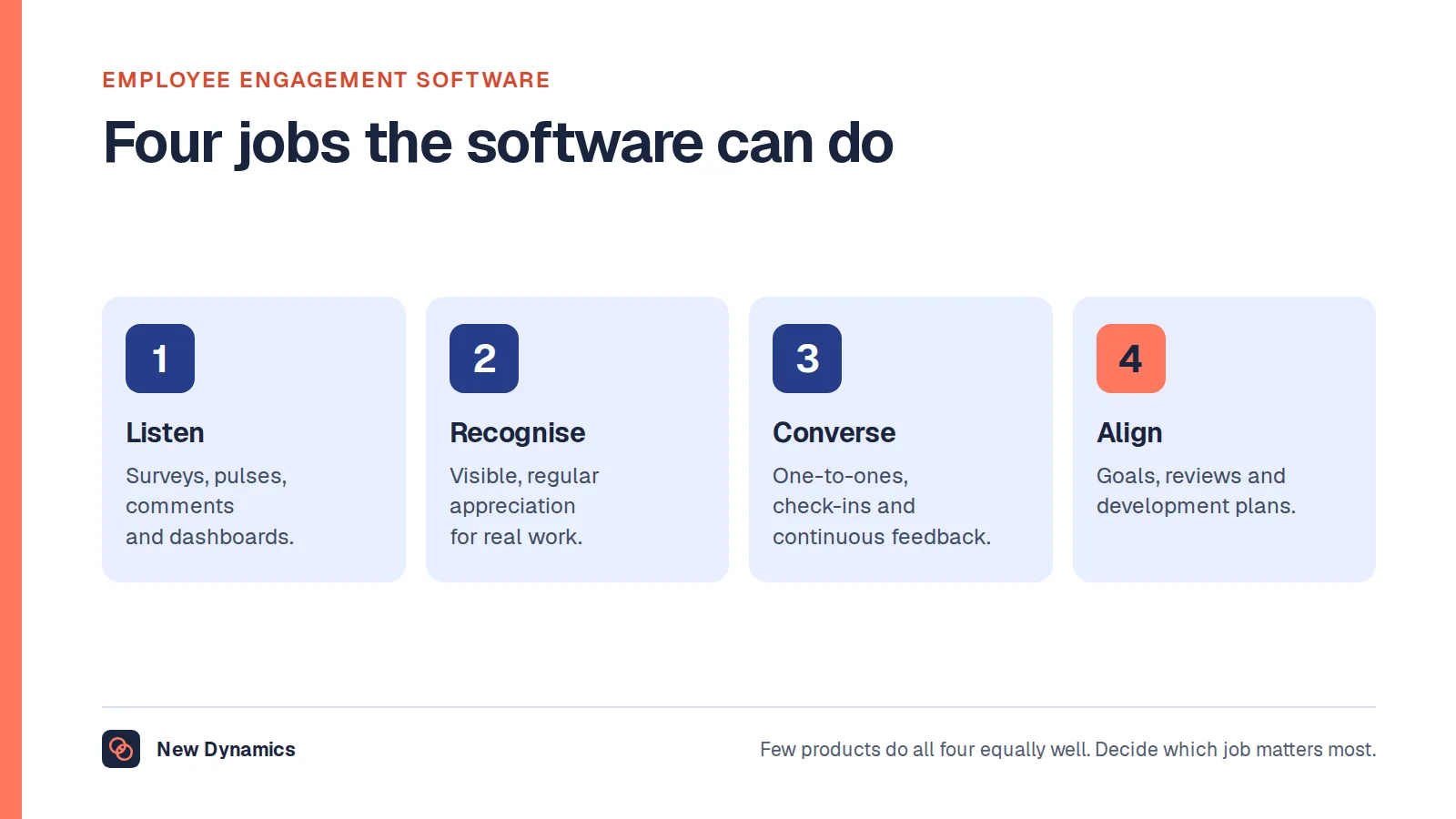
Because engagement is a state in the person, produced by conditions the organisation creates, improving it is less a programme than a practice. Four steps, one per enabler, most of them the manager's:
- Tell the story and connect the goals. Leaders say where the organisation is going in plain words; each team's goals and each person's objectives connect to it visibly. If people cannot say what their work is for, start here.
- Make the weekly conversation real. A one-to-one every week or two about the work, the obstacles and the person, not a status report. Managers who motivate, empower and support do it in these conversations, not in the annual review.
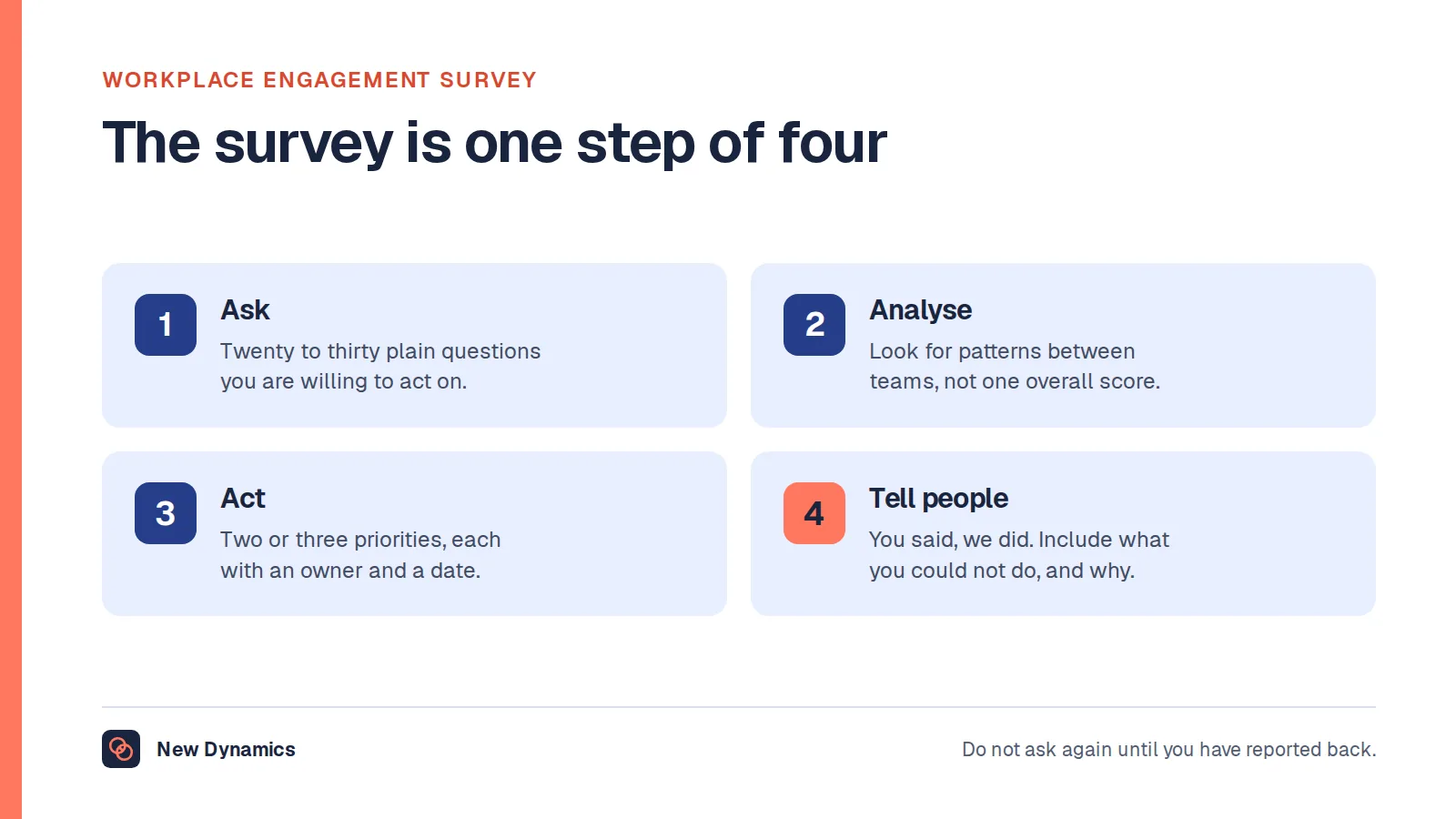
- Listen, act, close the loop. Ask, through surveys and in conversation; act on what you can; tell people what you did and what you could not do and why. Voice that leads nowhere lowers engagement faster than not asking.
- Remove what demotivates, and say thank you. Find what is overworking, under-supporting or frustrating people and fix the worst of it; then recognise specific work, promptly and publicly. Integrity is the values in action, including the value of noticing.
Measure it with a short, regular survey built on the state, not on everything around it: energy, pride and concentration, plus the enablers; our post on the workplace engagement survey gives the questions. Treat the score as a thermometer, not the patient.

Frequently asked questions
What is an engaged workforce?
One in which most people, most of the time, are in the state the CIPD-recommended Utrecht definition describes: showing vigour, dedication and absorption in their work rather than burnout. Engage for Success defines it from the organisation's side as the conditions in which all members give of their best each day, committed to the organisation's goals and values, motivated to contribute, with an enhanced sense of their own wellbeing.
What is the definition of employee engagement?
There is no single one; the CIPD notes that the MacLeod Review found more than fifty. The academic consensus is that engagement is a psychological state experienced by employees, distinct from job quality, behaviour or management action. The CIPD recommends the Utrecht definition: vigour, dedication and absorption.
What is the difference between employee engagement and job satisfaction?
Satisfaction is contentment with the job and its terms; a satisfied employee may do what is required and no more. Engagement is energy, pride and concentration in the work itself, and shows in effort, ideas and problems raised. The CIPD warns that definitions which blur the two make it hard to know what to act on.
What are the four enablers of employee engagement?
From the MacLeod Review: a strategic narrative from leaders, engaging line managers who motivate, empower and support, employee voice in decision making, and organisational integrity, where stated values match the actual culture.
How do you improve work engagement?
Connect people's goals to a clear story, make the manager's regular conversation real, listen and act and close the loop, remove what overworks, under-supports or frustrates people, and recognise specific work promptly. The CIPD notes that people are naturally motivated to do a good job and that HR systems can get in the way as much as help.
Your next step: choose the definition, then look at one team
- Adopt one definition in writing: the state (vigour, dedication, absorption) and the conditions (the four enablers).
- Walk into one team and look for the signs above; ask the manager what the weekly conversation covers.
- Find the one thing most overworking, under-supporting or frustrating that team, and fix it.
- Measure with a short survey, act, and tell people what changed.
For a listening cycle that leads to action rather than a report, read and download our employee engagement guide. The guide is free to read, and the PDF uses our short download form.
Want goals, one-to-ones, recognition and a short survey in one place, so the four enablers are habits rather than a programme? Book a New Dynamics demo and bring your last survey. You can also email contact@new-dynamics.com.