TL;DR
- An employer of record is the legal employer. The contract, the payroll, the employment rights and most of the liability follow from that single fact.
- It differs from a PEO, which shares employment with the client, and from an agency, where Acas notes “your contract is with the employment agency” and the hiring organisation directs the work.
- An EOR does not create a local entity for you and does not give you a sponsor licence. GOV.UK is clear you usually need one to employ someone from outside the UK.
Most explanations of this arrangement bury the defining fact three paragraphs down. It is a single sentence, and everything else is a consequence of it.
This article covers what an employer of record is, what follows from it, how it compares with a PEO and an agency, and the two things it does not solve.
Knowing who employs whom is the first thing a growing organisation loses track of. See how New Dynamics org charts keep that visible.
Our post on the PEO deliberately left this arrangement alone, because it is a different one.
The one fact

An employer of record is the legal employer of the person doing the work. The company that wanted the person hired (the client) is not.
Everything else follows:
- The contract of employment is with the EOR, not with you. The name on it is a company the person may never otherwise deal with.
- The EOR runs the payroll, operates local withholding and makes the statutory returns.
- Employment rights attach to the EOR, as the employer in law.
- Employment liability sits mainly with the EOR, which is usually the point of the arrangement, and the reason its contract with the client will contain indemnities.
GOV.UK's guidance on employment status explains why the identity of the employer matters so much: status "helps determine their rights" and "their employer's responsibilities", a person "may have a different employment status in tax law", and "courts and tribunals can make final decisions on employment status". You can label a relationship; a tribunal can relabel it.
This is general information rather than legal advice.
How it compares

EOR. Sole legal employer. Used mostly where a company wants somebody employed in a country in which it has no legal entity.
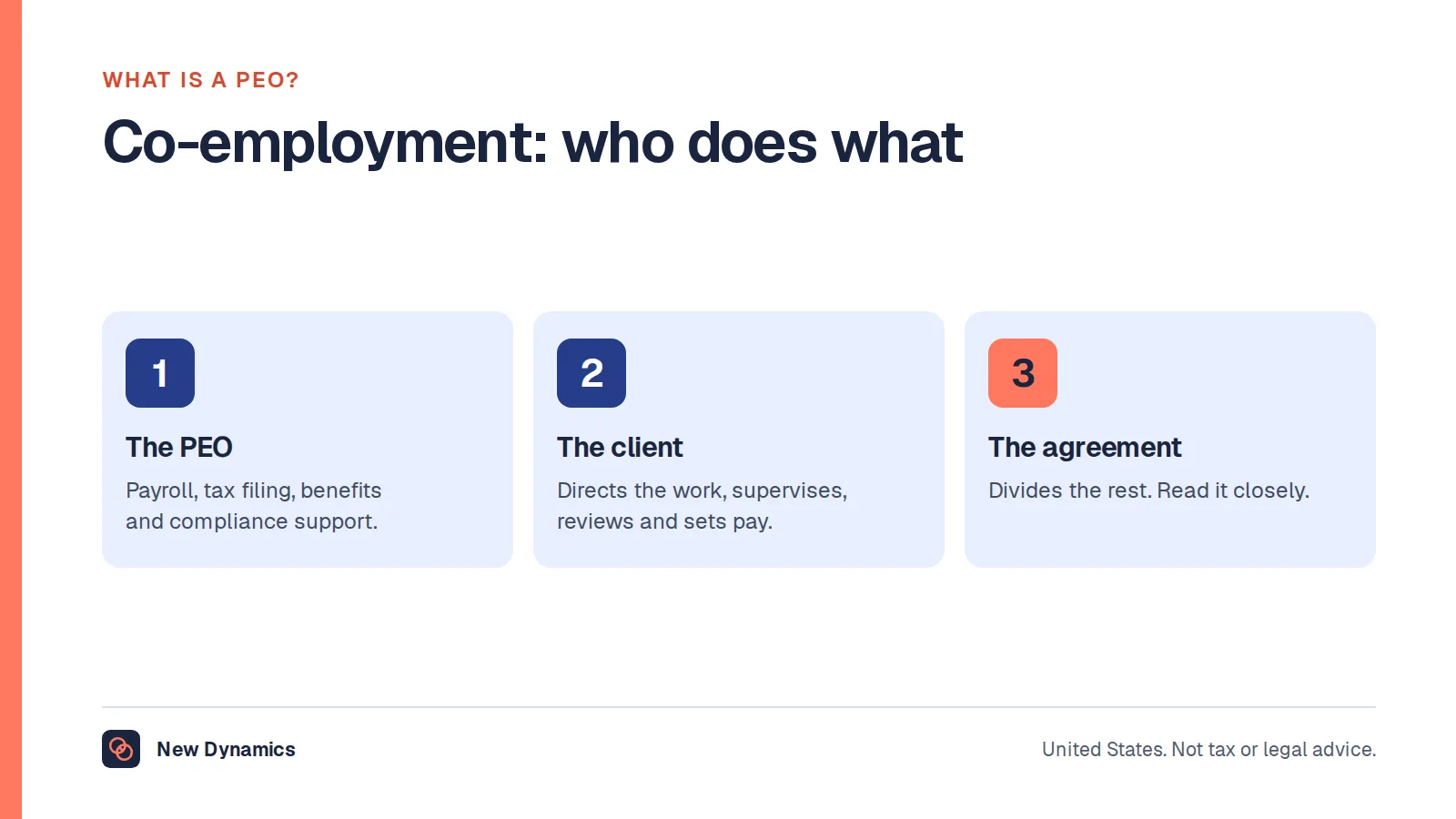
PEO. Co-employment: the client remains an employer and shares specific responsibilities with the provider. Our PEO post covers how that split works.
Agency. Acas's guidance on agency workers describes the third model: "if you're an agency worker, your contract is with the employment agency", which places the worker with "a 'hiring organisation' for an 'assignment'". Crucially, "when you're on an assignment, the hiring organisation is responsible for directing your work".
That last sentence is the one to carry into an EOR arrangement. The EOR holds the contract; your managers direct the work. Acas also notes that an employment agency "can also be called a recruitment agency, a temporary work agency, a staffing company, an employment business", the vocabulary in this area is loose, and the label tells you less than the contract does.
Who directs the work, and why it matters
In practice the client sets objectives, reviews performance and decides priorities, while the EOR holds the paperwork. That split is workable, and it is also where problems start.
Acas points out that for agency workers, "it's important to know if you have the legal status of 'employee' or 'worker'", because "it affects what you're entitled to and what your obligations are". The same question can arise around an EOR arrangement, and the answer depends on the facts of the working relationship rather than on the contract's heading.
The practical rule: keep the client's role to directing the work, and leave everything that is an employer's act (discipline, dismissal, pay changes, contractual terms) to the entity that is the employer. Mixing those is how an arrangement designed to reduce risk creates a new one.
The duties an intermediary carries
The UK's rules for employment agencies and businesses give a sense of what a compliant intermediary looks like. GOV.UK's guidance on employment agencies and businesses says such a business cannot "charge a fee to a work-seeker for work finding services", "stop someone from working elsewhere or terminating their contract with you", "withhold payments or wages due", or "make unlawful deductions from pay".
It must also make sure workers are "paid for all the work they do", "paid holiday", "not forced to work longer than 48 hours a week", "paid at least the National Minimum Wage", "protected under health and safety laws", given "a key information document and written terms of engagement... before you start looking for work for them", and given "a written statement when they start work - this includes all workers, including those registered as limited companies".
Those rules apply to agencies rather than to every EOR arrangement, but they are a reasonable standard to hold any intermediary to.
What an EOR does not do
It does not create a local entity for you. If your reason for wanting one is trading presence, tax registration or a local bank account, an EOR does not deliver those.
It does not give you a sponsor licence. GOV.UK's guidance on visa sponsorship for employers is explicit: "you'll usually need a sponsor licence to employ someone to work for you from outside the UK", including EU and EEA citizens "who arrived in the UK after 31 December 2020". No licence is needed for "Irish citizens", people "with settled or pre-settled status under the EU Settlement Scheme" or those "with indefinite leave to remain in the UK". And "sponsoring someone does not guarantee that they'll get a visa to work for you in the UK".
It does not transfer culture or management. The person's experience of work is created by your managers, whoever signs the contract. Our employee experience post covers the conditions that actually produce it.
Before signing

- Read the employment contract the person will receive, not just your agreement with the provider.
- Check who can do what. Which acts are reserved to the EOR, and what happens when you want someone dismissed.
- Check notice, termination and what happens if you leave the provider, including whether the person's employment continues.
- Agree the data arrangement, since the provider will hold personal data about people who work with your teams every day.
Our HR compliance post covers the duties that sit with whoever turns out to be the employer.
For the person employed this way
Your rights attach to the company named on your contract. Read it, check your status, and know who to raise a grievance with, because the people you work with every day may not be the people who can resolve it. GOV.UK points anyone unsure about status to Acas for advice.
Frequently asked questions
What is an employer of record?
A company that acts as the legal employer of someone doing work for a different company. It holds the employment contract, runs payroll, makes statutory returns and carries most employment obligations, while the client directs the day-to-day work.
What is the difference between an EOR and a PEO?
An EOR is the sole legal employer. A PEO operates co-employment, where the client remains an employer and shares defined responsibilities with the provider. The practical difference is whether you are still an employer of the person or not.
Why do companies use an employer of record?
Usually to employ someone in a country where they have no legal entity, without setting one up. It can also be used to move quickly, or to place employment obligations with a provider that specialises in them.
Does an employer of record sponsor visas?
Not by virtue of being an EOR. GOV.UK says an employer usually needs a sponsor licence to employ someone from outside the UK, and that sponsoring someone does not guarantee a visa. Whether a provider holds a licence is a question to ask specifically.
Who directs the work under an EOR arrangement?
The client, in practice. Acas describes the same split for agency work: the contract is with the agency, while the hiring organisation is responsible for directing the work during an assignment.
Is an employer of record the same as an employment agency?
No, though they are related. An agency places a worker with a hiring organisation for an assignment. An EOR is set up to be the continuing legal employer, usually where the client has no entity in the country concerned.
What should you check before using an EOR?
The employment contract the person will actually receive, which acts are reserved to the provider, what happens on termination or if you change provider, and how personal data will be handled. Read the employee's contract, not only your own.
Your next step: read the employee's contract
- Ask for the template employment contract the person will be given.
- List the employer acts reserved to the provider, and check your managers know them.
- Confirm the immigration position separately, including any sponsor licence.
- Write down who the person raises a grievance with, and tell them.
For the wider set of employer duties this arrangement moves around, read and download our human resources management guide. The guide is free to read, and the PDF uses our short download form.
Want to see who employs whom across a growing organisation? Book a New Dynamics demo and bring your current structure. You can also email contact@new-dynamics.com.