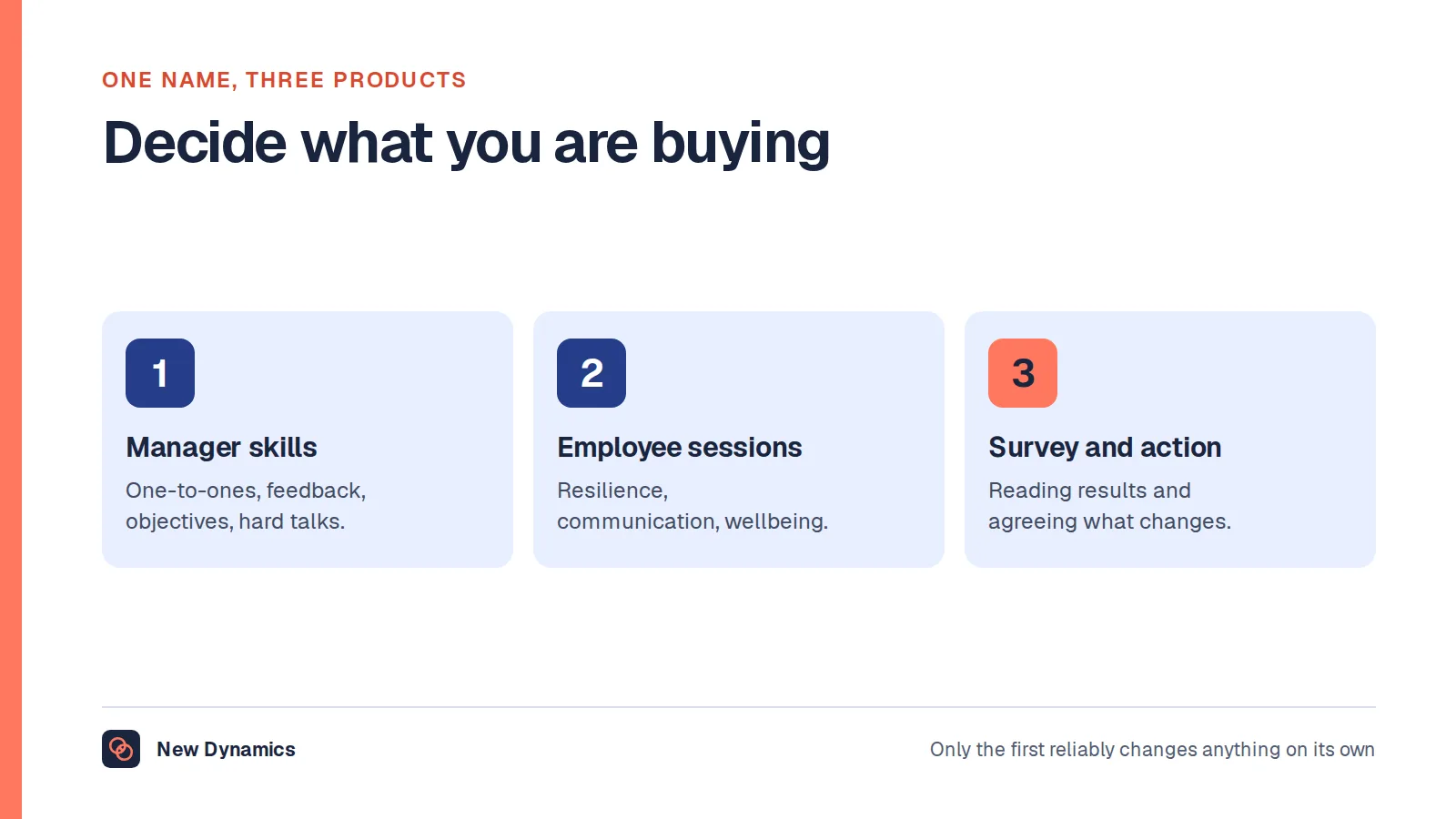
TL;DR
- Employee experience is the sum of the conditions an organisation actually controls, workload, autonomy, support, behaviour, role clarity and how change is handled.
- HSE already publishes those six as its Management Standards, in checkable language. They are the most useful employee experience framework in the UK and they cost nothing.
- The common failure is measuring the response more often instead of changing the conditions. A quarterly survey on an unchanged workplace produces a trend line, not an improvement.
Somebody is given employee experience to own, usually alongside their existing job. They buy a survey, run a workshop, and produce a journey map. A year later the workload is the same, the rota is the same, and the score has moved by a point.
This article explains what employee experience means, how it differs from engagement, the six conditions an employer in the UK is already expected to manage, and how to audit yours without buying anything.
Experience is made of ordinary conversations, not annual events. See how New Dynamics feedback keeps that record continuous.
What it means
Employee experience is everything a person encounters at work that the organisation controls: how much work there is, how much say they have over it, whether support exists, how people treat each other, whether the role is clear, and how change is handled.
That definition deliberately excludes things outside the employer's control and includes things employers often treat as fixed. A rota is experience. A policy nobody can find is experience. The quality of the coffee is not the point.
It is not engagement
Engagement is how people respond to their work, their energy, commitment and willingness to stay. Experience is the set of conditions producing that response.
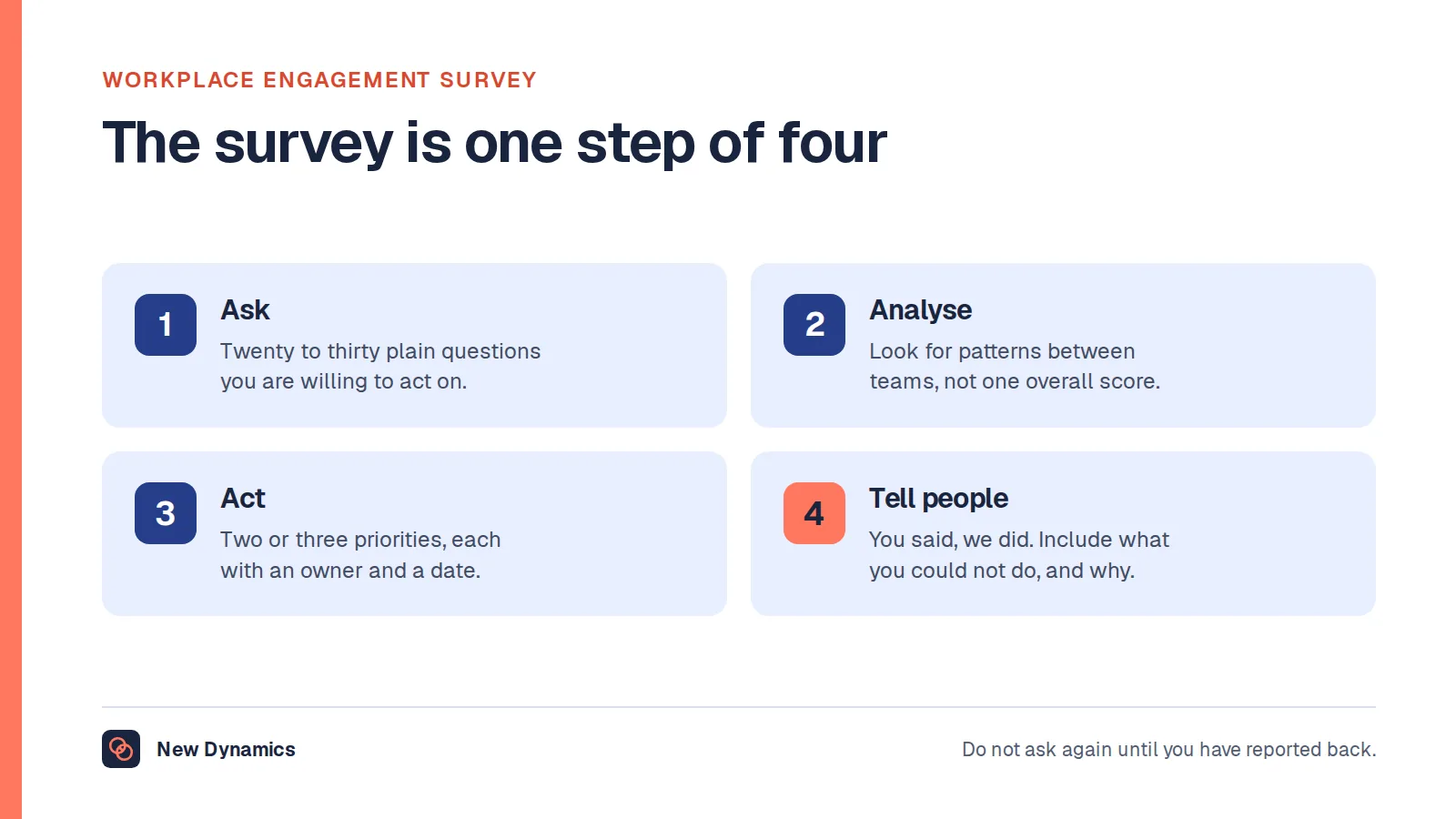
The distinction matters because it decides what you do next. If the score is low, measuring it again does not change anything; changing the conditions does. Our workplace engagement survey post covers measuring the response properly, which is still worth doing, as an instrument, not a remedy.
The six conditions

The UK already has a published description of the conditions an employer is expected to manage. HSE's Management Standards set out six, in language specific enough to check.
Demands covers "issues such as workload, work patterns, and the work environment". The standard is that employees "are able to cope with the demands of their jobs", with the organisation providing "adequate and achievable demands in relation to the agreed hours of work" and designing jobs "to be within the capabilities of employees".
Control is how much say a person has over their work: control over "pace of work", encouragement "to use their skills and initiative", a say over "when breaks can be taken", and consultation "over their work patterns".
Support covers "the encouragement, sponsorship and resources provided by the organisation, line management and colleagues". The standard expects the organisation to have "policies and procedures to adequately support employees", that "employees know what support is available and how and when to access it", that they "know how to access the required resources to do their job", and that they "receive regular and constructive feedback".
Relationships covers promoting positive working "to avoid conflict and dealing with unacceptable behaviour", including systems "to enable and encourage employees to report unacceptable behaviour".
Role asks "whether people understand their role within the organisation and whether the organisation ensures that the person does not have conflicting roles", and expects the requirements placed on people to be "compatible".
Change is the one most experience programmes ignore. The standard expects employees to indicate "that the organisation engages them frequently when undergoing an organisational change", with "timely information to enable them to understand the reasons for proposed changes", "adequate employee consultation" including "opportunities for employees to influence proposals", awareness of "the probable impact of any changes to their jobs", training where needed, awareness of "timetables for changes", and "access to relevant support during changes".
Six conditions, each with observable states. That is a better employee experience framework than most things sold as one, and it is free. This is general information rather than legal advice.
The moments nobody calls experience

Alongside the conditions sit the mandated moments. GOV.UK's guide for employers lists what has to be in place before anyone starts: a safe and accessible workplace, keeping "employee information and data safe", PAYE, pensions and liability insurance.
Nobody calls those experience, and everybody notices when they go wrong. A payslip that is late, a workplace somebody cannot physically use, a pension that was never set up, these overwhelm any amount of journey mapping. Our HR compliance post covers that list in order.
The common failure
Measuring the response more often, instead of changing the conditions.
It is an understandable trap. A survey is purchasable, schedulable and produces a chart. Reducing someone's workload requires either more people or less work, both of which are decisions somebody senior has to make. So the survey becomes the programme, and the conditions stay as they were.
The test is simple: name one thing about demands, control, support, relationships, role or change that is different from a year ago. If nothing is, no amount of listening has become experience.
Auditing yours without buying anything

- Take the six conditions and, for each, write what the observable state currently is. Not the aspiration.
- Pick the two worst, because attempting six is how nothing changes.
- Find the decision behind each, and who can take it. Most experience problems are resource or policy decisions wearing a culture costume.
- Change one thing and tell people why, which does more than a programme launch.
Repeat next quarter. That is the whole method, and its only difficulty is that step three usually leads somewhere uncomfortable.
Frequently asked questions
What is employee experience?
Everything a person encounters at work that the organisation controls: workload and hours, how much say they have, what support exists, how people treat each other, whether the role is clear, and how change is handled. It is the set of conditions, not the feelings they produce.
What is the difference between employee experience and engagement?
Engagement is how people respond to their work. Experience is the conditions producing that response. Measuring engagement more often does not change experience, which is why survey programmes with no operational changes tend to produce flat trend lines.
What is an employee experience framework?
HSE's Management Standards are the most useful public one in the UK: demands, control, support, relationships, role and change, each written as observable states rather than aspirations. They were designed for work-related stress and describe exactly the conditions an employer manages.
Who owns employee experience?
In practice, whoever controls workload, rotas, resourcing and how change is announced, which is line management and the leadership team, not the person given the title. HR can describe the conditions and hold people to account for them.
How do you measure employee experience?
Describe the current observable state of each of the six conditions and review it periodically. Surveys tell you how people are responding, which is useful context, but the measure that matters is whether any condition has actually changed.
What is workplace experience?
The same idea, sometimes used more narrowly to mean the physical and digital environment, buildings, equipment, systems and access. Both sit inside the wider set of conditions, and neither compensates for unmanageable demands.
Do you need employee experience software?
Not to start. The six conditions can be described on a page, and the decisions that change them sit with managers and leaders. Buy something when you know which condition you are trying to move and why a tool would help.
Your next step: describe the current state
- Write one honest sentence for each of the six conditions.
- Choose the two worst and name the decision behind each.
- Identify who can take that decision, by name.
- Change one thing this quarter and tell people it happened.
For running the listening side properly, read and download our employee engagement guide. The guide is free to read, and the PDF uses our short download form.
Want the conditions visible between surveys rather than once a year? Book a New Dynamics demo and bring last year's survey results. You can also email contact@new-dynamics.com.