TL;DR
- Facilities managers oversee services, systems and processes to ensure an organisation's buildings are safe, efficient and productive environments for those working within them, as Prospects puts it. Skills England's level 4 standard says the occupation is about making sure that buildings and their services meet the needs of the people that work in them.
- The responsibilities fall into seven groups: hard services (maintenance, building fabric, mechanical and electrical systems), soft services (cleaning, catering, security, reception, waste), health, safety and compliance, contractors and procurement, budgets and value for money, space and projects, and people and emergencies. In larger organisations the role is strategic and contract-led; in smaller ones it is hands-on.
- Write the position description around the estate, the split between hard and soft services, the contracts managed, the budget and the compliance duties, and say whether the manager is on call for emergencies.
When the heating fails, the cleaners do not turn up, the lift is out and the fire alarm test is due, one person's phone rings. A facilities manager job description has to cover all of that and the longer game: leases, refurbishments, energy, security and the contracts that keep a building running without anyone noticing.
This article gives a facility manager job description sample: what the role is, seven responsibilities as Prospects, the National Careers Service and Skills England describe them, the split between hard and soft services, the skills, the routes in and a position description template to adapt. The routes are for England; the duties are the same wherever there is a building.
Facilities managers run on service levels and budgets that need to be visible. See how New Dynamics Goals & OKRs keep targets and progress in one place.
What does a facilities manager do?
Prospects says facilities managers “oversee services, systems and processes to ensure an organisation's buildings are safe, efficient and productive environments for those working within them”, coordinating the day-to-day running of buildings and estates while contributing to longer-term planning, so that workplaces are “safe, compliant and cost-effective”. It lists the areas: catering, cleaning, contractor management, health and safety, maintenance, security and space planning.
The National Careers Service puts it in one line: facilities managers “oversee the operation, maintenance and security of buildings and workplaces”, with estates manager, support services manager and contracts manager as alternative titles. Skills England's facilities manager apprenticeship, a level 4 standard of 24 months, describes the occupation as “Making sure that buildings and their services meet the needs of the people that work in them.”
Prospects makes the point that shapes every description: responsibilities vary with the size and structure of the organisation. “In larger organisations, you may focus on strategic planning and contract management, while in smaller settings you may take a more hands-on operational role.”
Hard services and soft services
Prospects lists the specialisms: contract and supplier management; estates and property management; hard services, which it defines as building fabric, mechanical and electrical systems, maintenance and compliance; health, safety and environmental compliance; soft services, which it defines as cleaning, catering, security, reception and waste management; and space planning and workplace strategy.
| Service type | Covers | Typically delivered by |
|---|---|---|
| Hard services | Building fabric, heating, ventilation, electrical, lifts, fire systems, maintenance and statutory compliance | In-house technicians and specialist contractors |
| Soft services | Cleaning, catering, security, reception, post, waste and recycling | Contractors, often under service-level agreements |
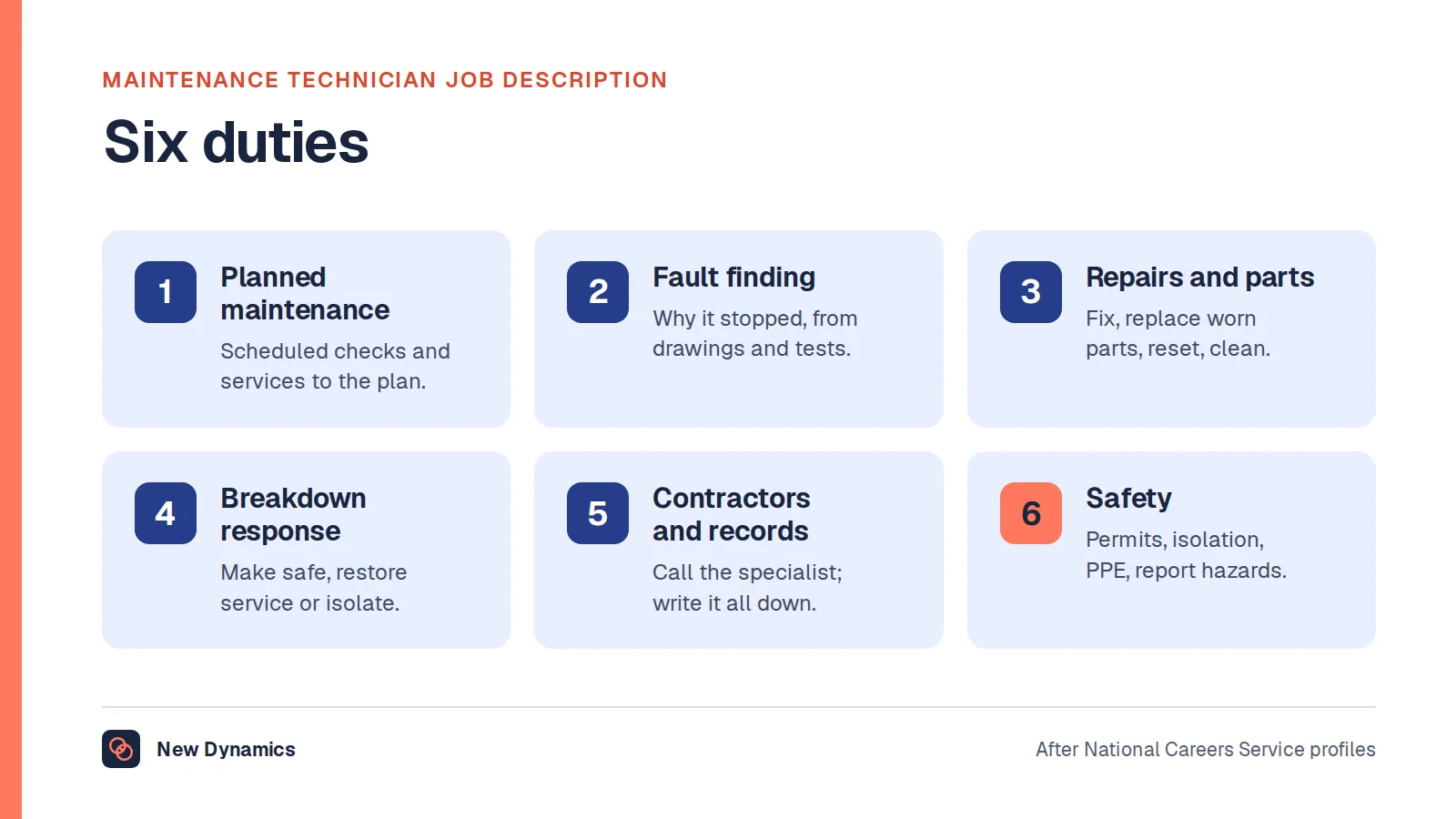
Most facilities manager posts cover both; some split into hard and soft services managers under a head of facilities. Our maintenance technician job description describes the hands-on side of hard services.
Facilities manager responsibilities: seven areas
Prospects lists what a facilities manager needs to do, from preparing tender documents and managing procurement to responding to emergencies. The National Careers Service adds working with a property team so that building services run smoothly, coordinating refurbishments, renovations and office moves, planning for sustainability and energy efficiency, negotiating with contractors for cleaning, IT support and security, managing spending and budgets, and keeping tenant partners informed. Grouped for a position description, the work has seven areas.
- Hard services. Keep the building fabric and its mechanical and electrical systems maintained, tested and compliant, through planned maintenance and reactive repair.
- Soft services. Coordinate security, reception, cleaning, catering, waste disposal and recycling to agreed standards.
- Health, safety and compliance. Ensure buildings meet health and safety requirements and comply with legislation and industry standards; keep staff safe and the site secure; hold the statutory records.
- Contractors and procurement. Prepare tender documents, run procurement, and oversee, coordinate and monitor contractors' work for quality and compliance.
- Budgets and value for money. Manage spending, compare costs for goods and services, and plan energy efficiency and sustainability measures.
- Space and projects. Plan and optimise the use of space; assess new premises; run relocations, refurbishments and office moves with minimum disruption.
- People and emergencies. Lead the facilities team, monitor service levels with performance management techniques, keep occupants and tenants informed, and respond to emergencies and urgent issues.

Skills to ask for
The National Careers Service lists business management, leadership, customer service, administration, thoroughness and attention to detail, working well with others, maths, initiative and confident use of computers and the main software packages.
Four deserve emphasis in a facilities manager description.
- Contract management. Most services are bought, not made; the manager's leverage is the specification, the service levels and the review meeting.
- Compliance discipline. Fire, water, gas, electrical, lifts, asbestos: each has a test, a record and a date, and missing one is a legal problem.
- Calm in an emergency. Floods, power failures and security incidents happen at night and at weekends.
- Customer service. The building's occupants are the customers; a facilities manager who is hard to reach is a facilities manager who is being worked around.
Routes in and qualifications
The National Careers Service says you can become a facilities manager through a university course, an apprenticeship, working towards the role or direct application. It names foundation degrees and degrees in facilities management, building services management, business and management and building surveying; apprenticeships including facilities management supervisor at level 3, facilities manager at level 4 and senior and head of facilities management at level 6, taking two to four years; and the route of starting as a management assistant or apprentice in facilities services and working up, with professional qualifications from the Institute of Workplace and Facilities Management. For direct application it says relevant experience, including technical skills related to buildings and management, and qualifications in building services engineering, surveying or health and safety may help.

Working pattern
The National Careers Service gives typical hours of 38 to 42 a week, between 8am and 6pm flexibly; Prospects says 38 to 40 hours, with longer hours to meet project deadlines or respond to emergencies, and notes that some roles involve shift work. Say in the description whether the manager is on call, how emergencies are covered, how many sites are involved and how much travel between them.
Facilities manager position description template
Job title: Facilities Manager (or Estates Manager, Head of Facilities)
Reports to: Head of Operations, Finance Director or Head of Estates
Direct reports: Facilities coordinator, maintenance technicians, reception and security staff; contract managers for outsourced services
Purpose: Ensure the organisation's buildings are safe, compliant, well maintained and cost-effective, so that the people who work in them can do so without interruption.
Responsibilities:
- Plan and oversee maintenance of the building fabric and mechanical and electrical systems; hold statutory testing and inspection records.
- Coordinate soft services: cleaning, catering, security, reception, post, waste and recycling.
- Ensure compliance with health and safety legislation and industry standards; lead fire, water and other statutory regimes; keep staff and the site safe and secure.
- Prepare tenders, run procurement and manage contractors and service-level agreements; monitor quality and compliance.
- Manage the facilities budget; compare costs; plan energy efficiency and sustainability measures.
- Plan and optimise space; assess premises; run refurbishments, relocations and office moves with minimum disruption.
- Lead the facilities team; monitor service levels; communicate with occupants and tenants.
- Respond to emergencies and urgent issues; hold the on-call rota where applicable.
Skills and experience:
- Experience managing buildings, contractors and budgets across hard and soft services.
- Working knowledge of health and safety and statutory compliance for buildings.
- Contract and supplier management; procurement.
- Leadership, customer service and calm under pressure.
- IWFM or equivalent qualification, or a relevant degree or apprenticeship: desirable.
Working pattern: Hours, on-call and emergency cover, number of sites, travel.
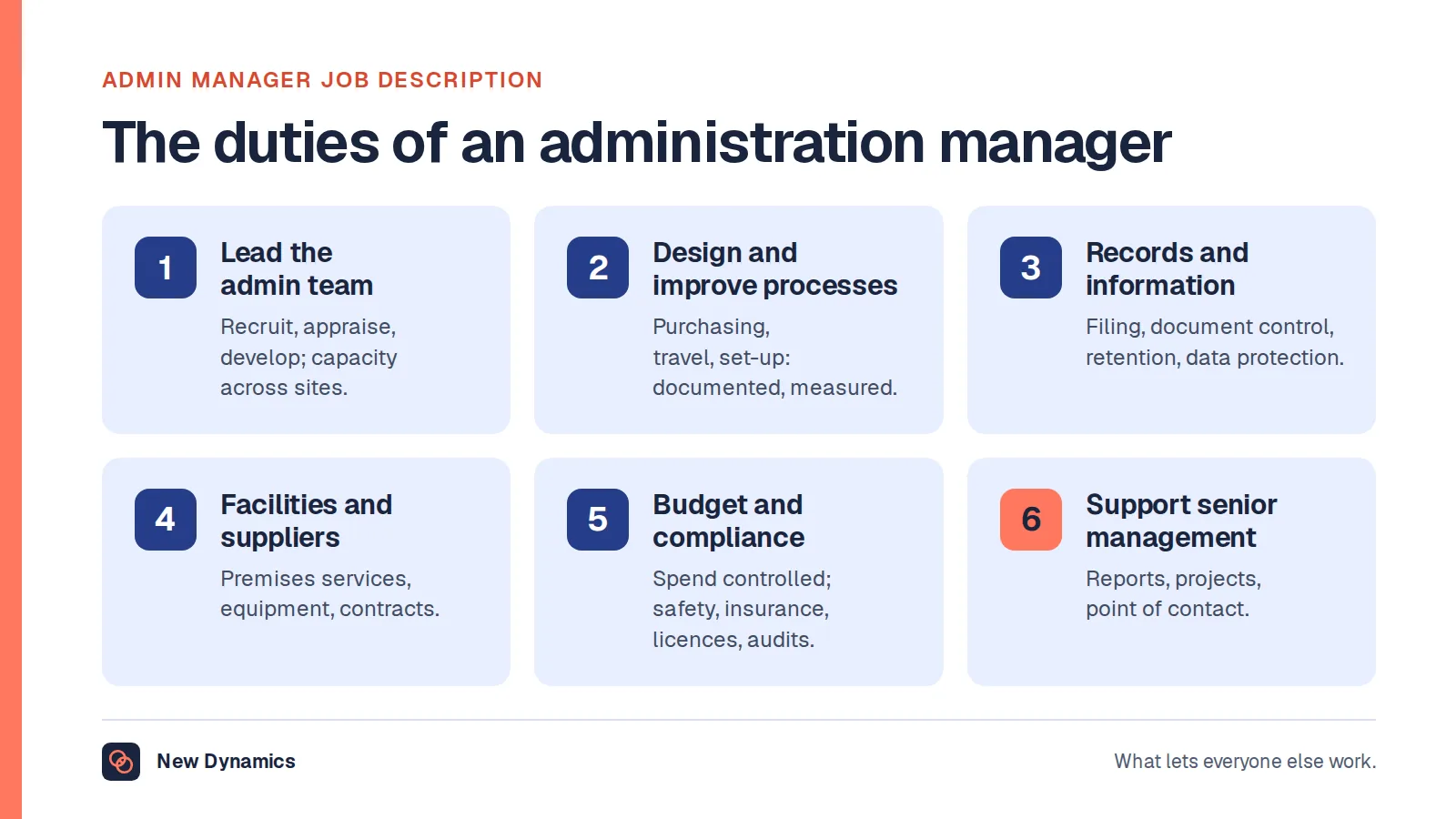
Our job description template explains each section; for the office-side counterpart, see our administration manager job description.

Frequently asked questions
What does a facilities manager do?
A facilities manager oversees the services, systems and processes that keep an organisation's buildings safe, efficient and productive, as Prospects puts it: maintenance and compliance, cleaning, catering, security and reception, contractors and procurement, budgets, space planning, projects and emergencies.
What are the responsibilities of a facilities manager?
Seven areas: hard services, soft services, health, safety and compliance, contractors and procurement, budgets and value for money, space and projects, and people and emergencies. Prospects' list runs from preparing tender documents to responding to emergencies; the National Careers Service adds refurbishments, office moves, sustainability and budgets.
What is the difference between hard and soft facilities services?
Prospects defines hard services as building fabric, mechanical and electrical systems, maintenance and compliance, and soft services as cleaning, catering, security, reception and waste management. Hard services keep the building working; soft services keep it usable.
What qualifications does a facilities manager need?
None is mandatory. Routes include degrees in facilities management, building services or surveying, the facilities manager apprenticeship at level 4 or the senior and head of facilities management degree apprenticeship at level 6, professional qualifications from the Institute of Workplace and Facilities Management, and promotion from facilities assistant roles. Health and safety qualifications help.
What skills does a facilities manager need?
The National Careers Service lists business management, leadership, customer service, administration, attention to detail, teamwork, maths, initiative and confident software use. Contract management, compliance discipline and calm in emergencies matter most in practice.
What is a facility manager position description?
Another name for the job description, common in the United States and in larger organisations: a document stating the purpose, responsibilities, reporting line, requirements and working pattern of the facilities manager post. The template above is one.
Your next step: describe the estate
- List the buildings, sites and the split between hard and soft services.
- Name the contracts managed and the budget held.
- Set out the statutory compliance regimes the manager owns.
- State the on-call and emergency arrangements, and plan the first weeks with a site tour and a contract review.
For setting and tracking service-level and budget objectives, read and download our OKR guide. The guide is free to read, and the PDF uses our short download form.
Want facilities targets, contractor reviews and compliance dates in one place? Book a New Dynamics demo and bring your current job descriptions. You can also email contact@new-dynamics.com.