TL;DR
- Asset manager is not one job. At least four roles share the title: the investment asset manager who runs money, the property asset manager who runs a building portfolio's value, the physical or estates asset manager who keeps plant and buildings working through their life, and the IT asset manager who owns the hardware, software and licences.
- Each has its own occupational description. O*NET covers the investment version as Investment Fund Managers, who “plan, direct, or coordinate investment strategy or operations for a large pool of liquid assets”; the property version sits under Property, Real Estate, and Community Association Managers, who “plan, direct, or coordinate the selling, buying, leasing, or governance activities” of real estate; the estates version under Facilities Managers, who “plan, direct, or coordinate operations and functionalities of facilities and buildings”; and the IT version under Computer and Information Systems Managers.
- The practical consequence is that an asset manager advert which does not name the asset has told the reader almost nothing, and the shortlist will contain four kinds of candidate. Name the asset, the decisions the person owns, the measure of success and the people they work through, and the role levels itself.
Someone says they are an asset manager. You still do not know whether they spend the day reading company results, negotiating a lease, scheduling a pump overhaul or reconciling software licences.
"Asset manager" is a title attached to at least four distinct jobs, in four industries, with different skills, different measures and different pay. This article sets out each of them, explains how to tell which one an advert means, and shows how to write and level the role once you have decided. It is general information about the occupation, not investment or legal advice.
Four jobs with one title is also four ways for a review to go wrong, because what counts as good work differs completely between them. See how New Dynamics performance reviews let you run the review cycle on your own form, with completion visible instead of chased.
The four jobs

1. The investment asset manager
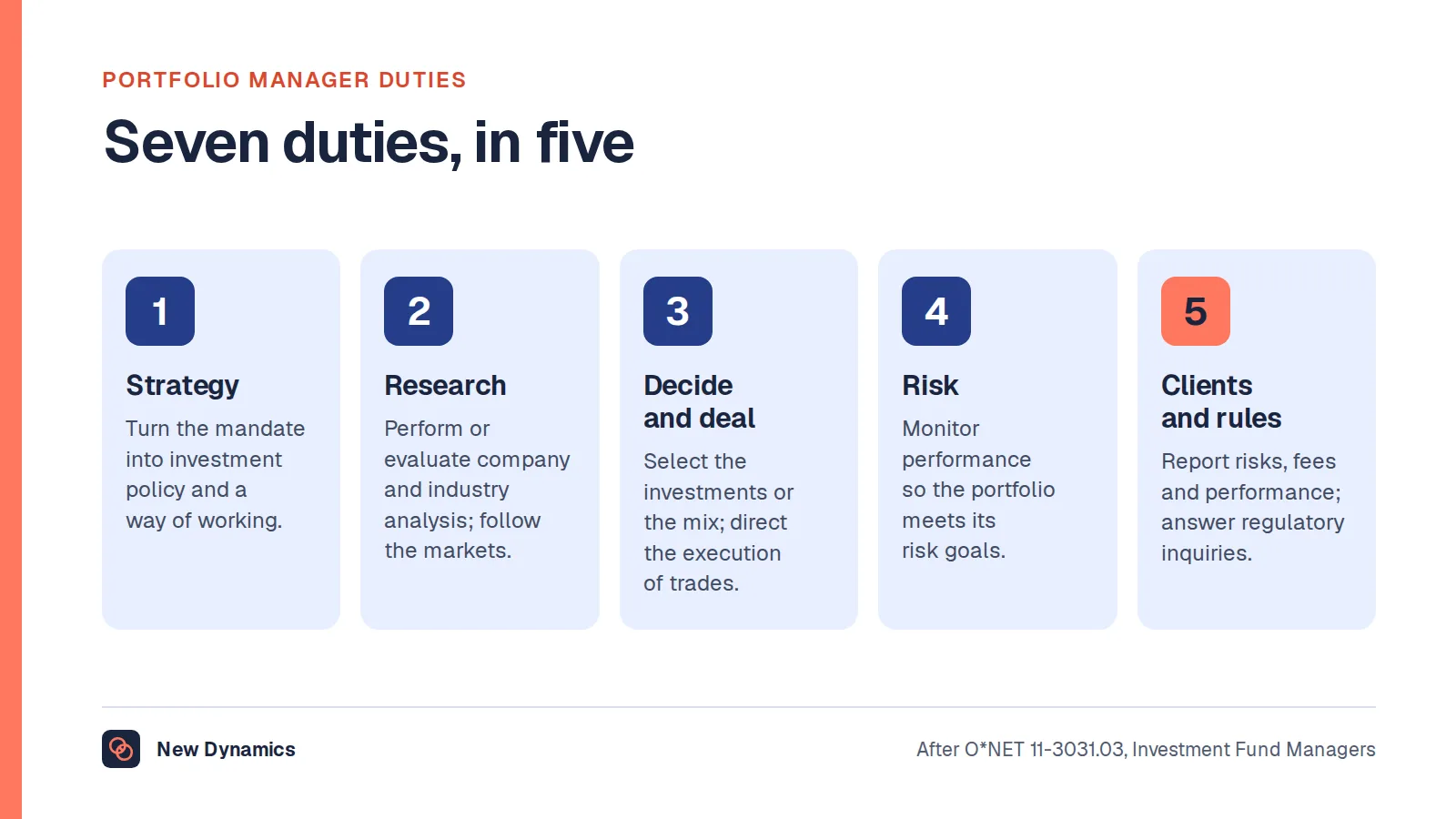
Runs money on behalf of other people. O*NET's occupation is Investment Fund Managers, described as those who "plan, direct, or coordinate investment strategy or operations for a large pool of liquid assets supplied by institutional investors or individual investors", with Portfolio Manager among the reported job titles.
- Owns: a mandate, what the money is for, what may be held and what risk is acceptable.
- Day: research, allocation decisions, risk monitoring, client reporting and regulatory work.
- Measured on: return against a benchmark or objective over a long horizon, plus process and compliance.
- Read next: our portfolio manager post covers this version in full, including the UK regulatory layer.
2. The property or real estate asset manager
Maximises the value and income of a property portfolio: what to buy, hold, refurbish, re-let or sell. O*NET's nearest occupation is Property, Real Estate, and Community Association Managers, covering those who "plan, direct, or coordinate the selling, buying, leasing, or governance activities of commercial, industrial, or residential real estate properties".
Its tasks include managing "operations, maintenance, administration, and improvement of commercial, industrial, or residential properties", preparing "detailed budgets and financial reports for properties", acting "as liaisons between on-site managers or tenants and owners", soliciting and analysing "bids from contractors for repairs, renovations, and maintenance", reviewing rents "to ensure that they are in line with rental markets", and marketing vacant space to prospective tenants.
- Owns: the business plan for each property and for the portfolio.
- Measured on: income, occupancy, yield, capital value and the delivery of the asset plan.
- Not the same as: the property manager or managing agent, who runs the building day to day. The asset manager decides what happens to it.
3. The physical, estates or infrastructure asset manager
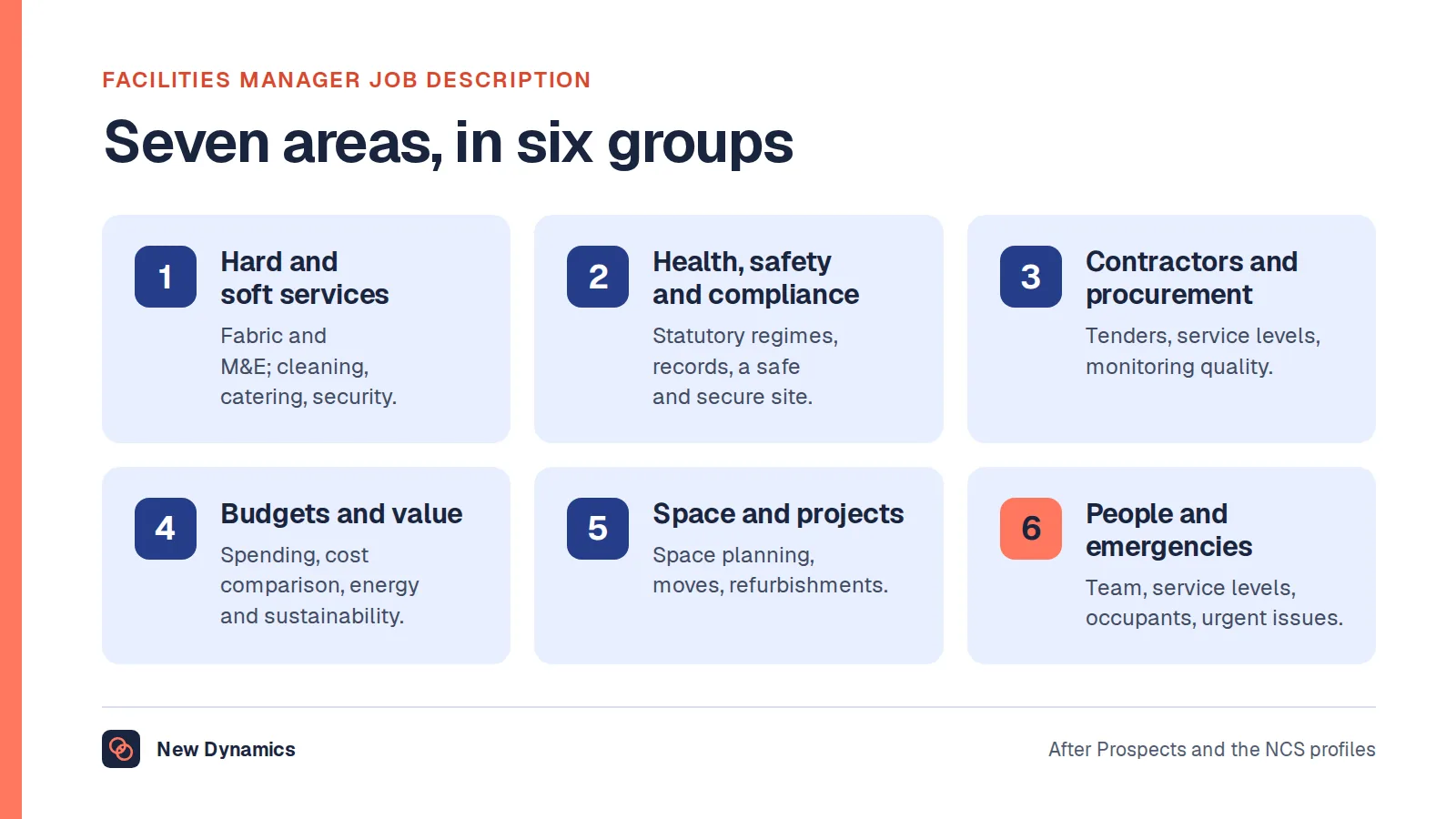
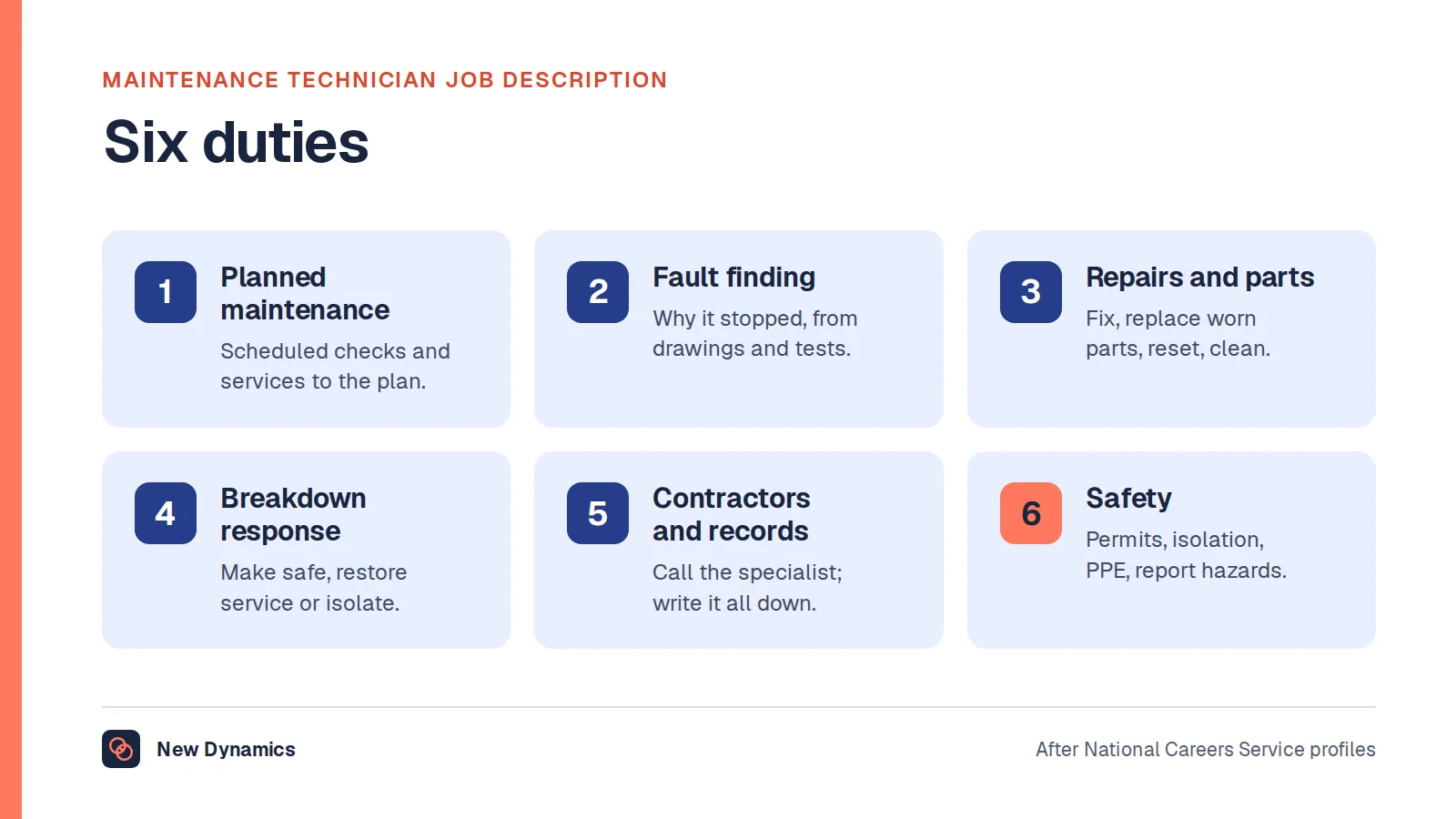
Keeps plant, buildings, networks or vehicles working economically across their whole life: maintenance strategy, condition, renewal and disposal. In smaller organisations this is the facilities manager's job. O*NET's Facilities Managers "plan, direct, or coordinate operations and functionalities of facilities and buildings", with tasks including monitoring "the facility to ensure that it remains safe, secure, and well-maintained", overseeing "the maintenance and repair of machinery, equipment, and electrical and mechanical systems", overseeing construction and renovation projects "to ensure that facilities meet environmental, health, and security standards, and comply with government regulations", planning, administering and controlling budgets, and disposing of surplus property.
The National Careers Service's facilities manager profile gives the UK version of the day: working with a property team so building services run smoothly, coordinating refurbishments, renovations and office moves, making sure repairs and maintenance meet health and safety standards, planning for sustainability and energy efficiency, negotiating with contractors for services such as cleaning, IT support and security, managing spending and budgets, and keeping tenant partners up to date. It describes progression to senior facilities manager, head of estates, or regional management with responsibility for several properties.
- Owns: the asset register, the maintenance and renewal plan, and the capital case for replacement.
- Measured on: availability and reliability, safety and compliance, whole-life cost, and the backlog.
4. The IT asset manager
Owns what the organisation has bought, what it is running, what it is licensed for and what it should retire. O*NET files the management of this under Computer and Information Systems Managers, whose tasks include evaluating "the organization's technology use and needs and recommend improvements, such as hardware and software upgrades", controlling "operational budget and expenditures", purchasing necessary equipment, developing computer information resources "providing for data security and control, strategic computing, and disaster recovery", and managing "backup, security and user help systems".
- Owns: the asset and licence register, the refresh cycle, the renewal calendar and the disposal process.
- Measured on: accuracy of the register, licence compliance, cost per seat and avoided spend at renewal.
Comparing the four
| Investment | Property | Estates and physical | IT | |
|---|---|---|---|---|
| The asset | Money and securities | Buildings and land | Plant, buildings, networks, fleet | Hardware, software, licences |
| Core decision | What to hold | Buy, hold, improve, sell | Maintain, renew, replace | Buy, refresh, retire |
| Main measure | Return against objective | Income, yield, value | Availability and whole-life cost | Accuracy, compliance, cost |
| Works through | Analysts and dealers | Agents and contractors | Engineers and contractors | Vendors and service desk |
| Regulated? | Heavily, in the UK | Partly, by tenure and tenancy law | By safety and sector regulation | By licensing and data protection |
How to tell which one an advert means

Four reliable tells:
- The industry. An investment firm, a property company, a utility or a bank's IT function narrows it immediately.
- The verbs. "Allocate" and "benchmark" mean investment. "Let", "rent review" and "dilapidations" mean property. "Condition", "criticality" and "renewals" mean physical assets. "Licence", "refresh" and "end of life" mean IT.
- The team named. Analysts, agents, engineers or a service desk.
- The qualification asked for. Investment exams, a surveying qualification, an engineering background, or an IT service management certification.
If the advert gives none of these, ask before the interview. Two of the four jobs have nothing in common except the word.
How to write the advert
- Name the asset in the first line. "Asset manager (commercial property portfolio)" costs nothing and saves everyone a wasted conversation.
- State what the person decides alone. Approving a refurbishment, changing an allocation, retiring a system, and what needs a committee.
- State the measure. Return, yield, availability, compliance; over what period.
- State who they work through. Almost every version of this job delivers through other people: contractors, agents, engineers, analysts or vendors.

Levelling and paying the role
Because the four jobs carry the same title, internal pay comparisons made on title alone are meaningless. Level the role on what it actually requires: the value and criticality of what is managed, the decisions the person takes without approval, the technical depth needed, the number of people and suppliers they direct, and the consequence of getting it wrong.
That is exactly what a structured job evaluation is for. Our job evaluation guide sets out how to compare roles on factors rather than titles, which is the only way to place four different jobs called "asset manager" on the same pay structure without an argument.
What transfers between the four, and what does not
Transfers: thinking in whole-life cost rather than purchase price; building and defending a business case; managing through contractors and suppliers; keeping a register that other people trust; balancing today's cost against tomorrow's failure.
Does not transfer: the technical content, the regulation and the professional qualifications. An excellent IT asset manager does not become a property asset manager by learning some vocabulary, and hiring as if they could is the most expensive version of this confusion.
Frequently asked questions
What does an asset manager do?
It depends entirely on the asset. An investment asset manager runs money within a mandate; a property asset manager decides what to buy, hold, improve or sell in a property portfolio; an estates or physical asset manager keeps plant and buildings working economically across their life; an IT asset manager owns the hardware, software and licence estate. All four plan and control the value of something over time, and that is where the resemblance ends.
What is the difference between an asset manager and a property manager?
The property manager, or managing agent, runs the building day to day: tenants, service charge, repairs, compliance. The asset manager decides what should happen to the property (refurbish, re-let, hold or sell) and owns the business plan and the financial result.
Is an asset manager the same as a fund manager or portfolio manager?
In the investment sense, broadly yes. The two are treated as a single occupation by O*NET, Investment Fund Managers, with Portfolio Manager among the reported job titles. "Asset management" is often the name of the firm or the industry, while "portfolio manager" is the person running a particular portfolio.
What does an IT asset manager do?
Keeps an accurate register of what the organisation owns and runs, tracks licences and entitlements, plans the refresh cycle, prepares for renewals and audits, and manages secure disposal. It sits inside the wider technology management function that O*NET describes as evaluating the organisation's technology use and needs, controlling the operational budget, purchasing equipment and managing security and support systems.
What qualifications does an asset manager need?
There is no common answer across the four jobs, which is itself the point. The investment role runs on finance exams and regulatory approval; the property role on a surveying or real estate qualification; the estates role on an engineering or facilities background; the IT role on service management and licensing knowledge. Ask which asset first, then ask about qualifications.
How do you level an asset manager role?
On factors rather than the title: the value and criticality of what is managed, the autonomy of the decisions, the technical knowledge required, the number of people and contracts directed, and the consequences of error. A structured job evaluation lets four roles with the same name sit correctly on one pay structure.
Your next step: name the asset
- Put the asset class in the job title, not only in the body of the advert.
- Write down the three decisions the person makes without approval.
- State the measure of success and the period it is judged over.
- Level the role by factors before comparing it with anyone else called asset manager.
For comparing roles on what they actually require rather than what they are called, read and download our job evaluation guide. The guide is free to read, and the PDF uses our short download form.
Want reviews, objectives and check-ins on your own form, so four jobs with one title can still be judged fairly? Book a New Dynamics demo and bring your current job descriptions. You can also email contact@new-dynamics.com.