TL;DR
- Maintenance jobs keep buildings, plant and equipment safe and working. They split into two families: property or building maintenance, which Skills England sums up as ensuring that buildings are in a safe working condition, and engineering maintenance, which it describes as conducting maintenance of engineering plant, equipment and systems.
- The duties are the same shape in both: planned maintenance checks, finding and fixing faults, replacing worn parts, responding to breakdowns, and knowing when to call a specialist contractor. What differs is the kit, the qualifications and the safety rules.
- Write the description around the assets the technician will look after, the split between planned and reactive work, the call-out pattern and the certificates the site requires.
Every building and every production line has someone whose phone rings when something stops working. The maintenance technician is that person: the one who runs the planned checks so that the phone rings less often, and who fixes the fault when it rings anyway.
This article gives a maintenance technician job description for the two common kinds of maintenance job, building and engineering. It explains what maintenance jobs mean, lists the duties as the National Careers Service and Skills England describe them, sets out the skills and routes in, and ends with a template to adapt. The routes and standards are for England; the duties travel.
A technician's work is mostly invisible when it goes well, so record it. See how New Dynamics Goals & OKRs keep targets and progress in one place.
What are maintenance jobs?
Maintenance jobs keep assets safe and working: buildings, their heating, lighting and alarm systems, and the plant and machinery inside them. Skills England's apprenticeship standards give the two families a one-line definition each.
- Property maintenance. The property maintenance operative standard, a level 2 apprenticeship of 24 months, describes the occupation as “Ensuring that buildings are in a safe working condition.”
- Engineering maintenance. The engineering maintenance technician standard, a level 3 apprenticeship of 42 months with electrical, mechanical, and control and instrumentation options, describes it as “Conducting maintenance of engineering plant, equipment and systems.”
The word technician usually signals the engineering end and a level 3 qualification; operative, handyperson and caretaker signal the building end. In practice many employers use maintenance technician for both, so the job description has to say which it means.
Maintenance technician duties
The National Careers Service profile for a maintenance fitter, whose alternative titles include maintenance engineer, says the role installs, services and repairs industrial machinery and equipment, and lists the day-to-day tasks. In our words, a maintenance fitter could install pipework, valves, pumps and motors; carry out planned maintenance checks; find and fix faults; replace worn parts, reset instrument controls and clean machinery; and respond to emergency breakdowns, for example on a factory production line.
The caretaker profile covers the building end. Its tasks include carrying out day-to-day maintenance checks and minor repairs, booking outside contractors for major repair work, and making sure heating, lighting and alarm systems are working properly, alongside opening and locking up, keeping communal areas clean and ordering supplies.
Put together, a maintenance technician job description has six duties.
- Planned maintenance. Run the scheduled checks and services on the site's assets, to the maintenance plan and the manufacturers' instructions.
- Fault finding. Diagnose why something has stopped or is running badly, using the drawings, the controls and test equipment.
- Repairs and parts. Fix what can be fixed, replace worn parts, reset controls and clean machinery.
- Breakdown response. Attend emergency breakdowns quickly, make the area safe and get the asset back into service or isolate it.
- Contractors and records. Know when a job needs a specialist, book and supervise contractors, and record every check, fault and repair.
- Safety. Work to the site's permits, isolation procedures and protective equipment rules, and report hazards.

Building maintenance and engineering maintenance compared
| Aspect | Building maintenance | Engineering maintenance |
|---|---|---|
| Assets | Fabric, heating, lighting, alarms, plumbing, grounds | Production plant, pumps, motors, control systems, pipework |
| Typical titles | Property maintenance operative, caretaker, handyperson | Maintenance fitter, maintenance engineer, engineering maintenance technician |
| Standard | Property maintenance operative, level 2 | Engineering maintenance technician, level 3 |
| Rhythm | Daily checks, minor repairs, contractors for the rest | Planned maintenance, fault finding, emergency breakdowns |
| Setting | Schools, offices, housing, leisure centres | Factories, utilities, energy, food and drink |
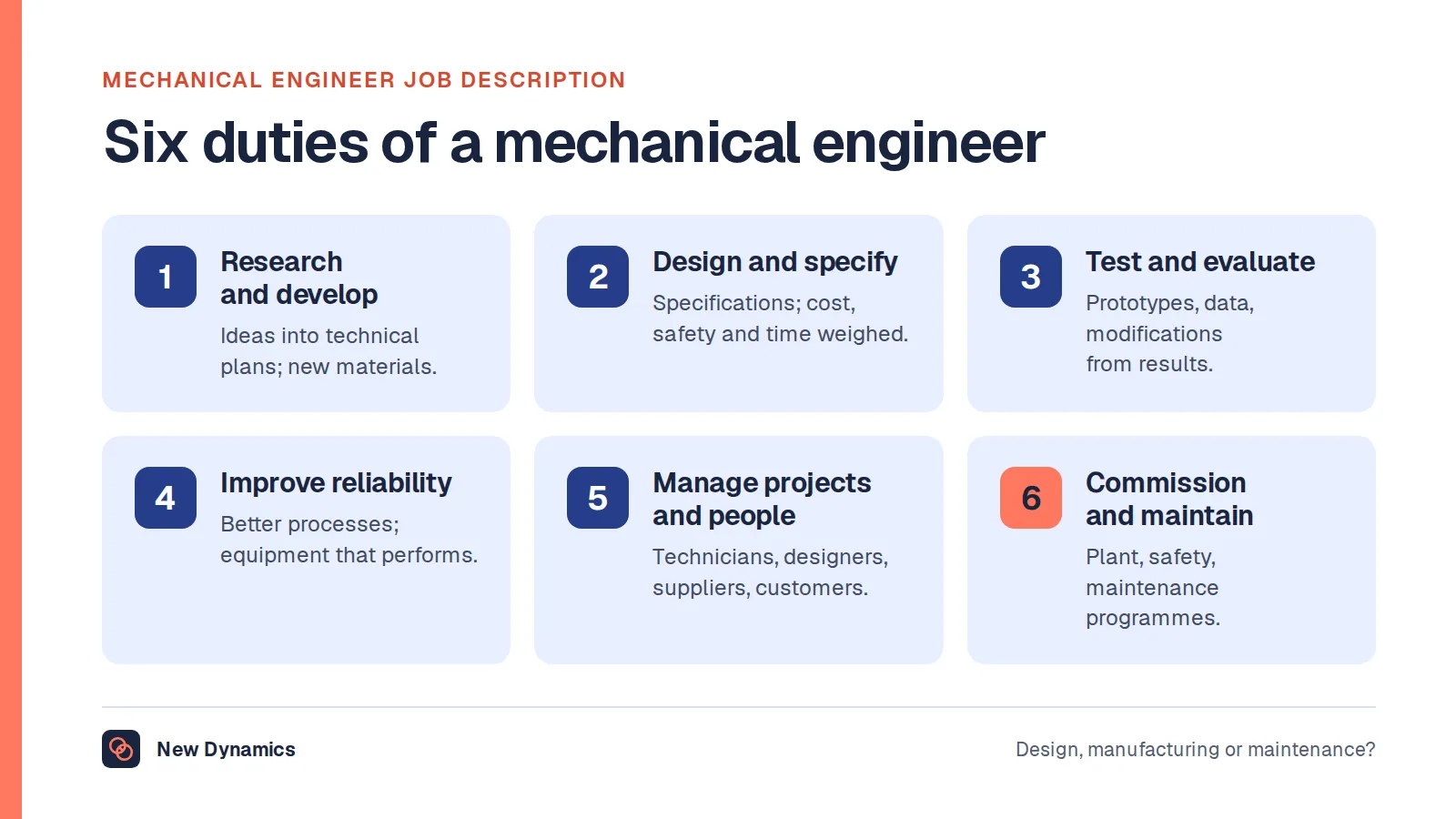
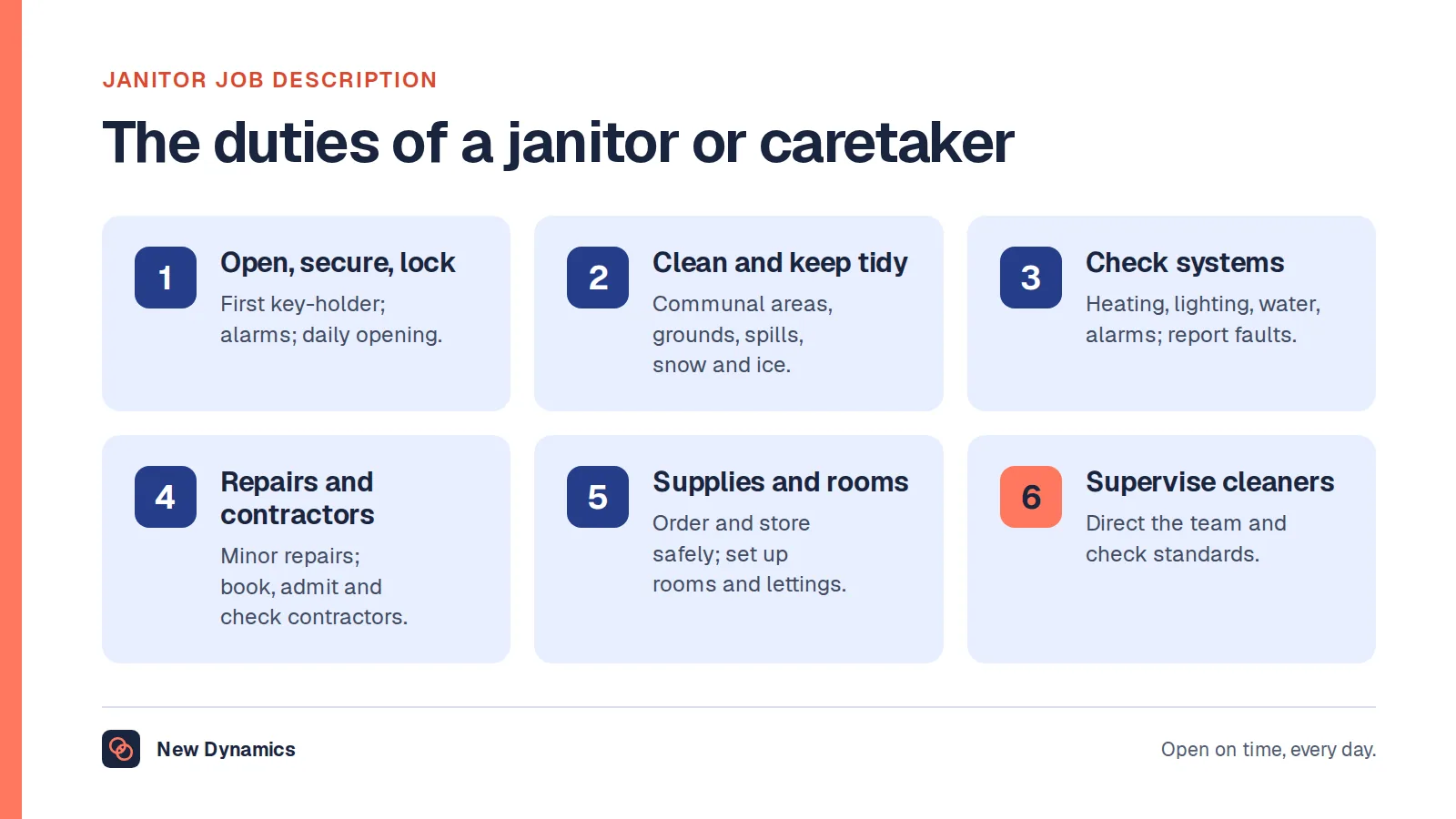
The National Careers Service notes that a maintenance fitter could work in a factory or at a client's business and may need to wear protective clothing, and that a caretaker's environment may be physically active. Our janitor job description covers the caretaking role in full, and our mechanical engineer job description the engineering role above the technician.
Skills to ask for
For a maintenance fitter, the National Careers Service lists practical skills for repairing and maintaining equipment, the ability to work well with your hands, problem-solving skills, the ability to work on your own, the ability to make decisions about tools and equipment, thoroughness and attention to detail, the ability to work well with others, concentration, and competent use of a computer and the main software packages.
For a caretaker it adds the ability to use your initiative, customer service skills and knowledge of public safety and security.
Two skills deserve their own line in the description.
- Knowing when to stop. A good technician knows the limit of their competence and calls the electrician, the gas engineer or the lift contractor rather than having a go.
- Recording. Maintenance history is what makes the next fault quicker to find and the next audit easier to pass. Ask for someone who writes things down.
Both can be tested at interview; our interview questions for a technician show how.

Routes in and qualifications
The National Careers Service says you can become a maintenance fitter through a college course, an apprenticeship or by applying directly with qualifications and experience in maintenance work such as mechanical engineering, pipefitting, welding or electrical engineering. Relevant apprenticeships include engineering fitter at level 2 and engineering maintenance technician or maintenance and operations engineering technician at level 3. For many jobs, it says, you will need an industry safety certificate.
For a caretaker, the routes are a property maintenance operative or facilities services operative apprenticeship at level 2, or direct application, with good practical skills; some employers ask for GCSEs in English and maths. The profile says you will need to pass enhanced background checks, and may need a driving licence for some jobs.
State in the description which certificates the site needs on day one and which you will train: the electrical, gas, working-at-height, confined-space and legionella tickets vary by site, and a description that lists them all as essential shrinks the field to nobody.
Working pattern and call-outs
Maintenance jobs are shaped by when things break. Say clearly whether the role is days only, on a shift rota or on a call-out rota, how call-outs are paid, and whether the technician works alone. The National Careers Service gives typical hours of 42 to 44 a week for a maintenance fitter and 38 to 42 for a caretaker, with evenings and weekends possible in both. Our guide to time off in lieu covers one common way to handle the extra hours.
A maintenance technician job description template
Job title: Maintenance Technician (state building or engineering)
Reports to: Facilities Manager or Maintenance Manager
Purpose: Keep the site's buildings, plant and equipment safe, compliant and working through planned maintenance, fault finding and repair.
Responsibilities:
- Carry out planned preventive maintenance on the assets listed in the maintenance schedule.
- Diagnose faults and carry out repairs within your competence, replacing parts and resetting controls as needed.
- Respond to breakdowns and emergencies, make the area safe and restore service or isolate the asset.
- Book, supervise and sign off specialist contractors for work beyond your scope.
- Keep accurate records of checks, faults, repairs and parts used.
- Follow permit-to-work, isolation and PPE procedures and report hazards.
- Keep stock of common parts and consumables.
Skills and experience:
- Practical skill in repairing and maintaining (building fabric and services / mechanical and electrical plant).
- Problem-solving and the ability to work alone and make decisions about tools and equipment.
- Thoroughness, attention to detail and clear written records.
- A relevant level 2 or level 3 qualification, apprenticeship or equivalent experience.
- Certificates required on day one: (list). Certificates we will train: (list).
Working pattern: Hours, shifts, call-out rota and pay, lone working, driving licence if needed.
Our job description template explains each heading. For the first weeks, when a new technician learns the site's assets and its quirks, our employee onboarding guide has a plan.

Frequently asked questions
What does a maintenance technician do?
A maintenance technician keeps buildings, plant and equipment safe and working. The duties are planned maintenance checks, finding and fixing faults, replacing worn parts, responding to breakdowns, booking specialist contractors for work beyond their scope, keeping records and following safety procedures.
What is the definition of maintenance jobs?
Maintenance jobs are roles that keep assets in a safe working condition. Skills England's standards describe the two main families: property maintenance, ensuring that buildings are in a safe working condition, and engineering maintenance, conducting maintenance of engineering plant, equipment and systems.
What are the responsibilities of a maintenance job?
Planned maintenance to a schedule, fault diagnosis, repairs and parts replacement, breakdown response, supervising contractors, keeping maintenance records, managing spare parts and working to the site's safety rules. The exact list depends on whether the role covers a building or engineering plant.
What skills does a maintenance technician need?
According to the National Careers Service, a maintenance fitter needs practical repair skills, the ability to work with their hands, problem-solving, the ability to work alone and make decisions about tools and equipment, thoroughness, teamwork, concentration and competent computer use. Knowing the limits of your competence and keeping good records matter as much.
What qualifications does a maintenance technician need?
In England, common routes are a college course, a level 2 or level 3 apprenticeship such as property maintenance operative or engineering maintenance technician, or direct application with experience in trades such as mechanical engineering, pipefitting, welding or electrical engineering. Many sites require an industry safety certificate.
What is the difference between a maintenance technician and a caretaker?
A caretaker looks after a building, keeping it secure, clean and maintained, and books contractors for major repairs. A maintenance technician, particularly in engineering, services and repairs plant and machinery and diagnoses faults. Some employers use maintenance technician for both, so the job description should say which it means.
Your next step: write the description around the assets
- List the assets the technician will look after and the maintenance schedule for them.
- Say what share of the work is planned and what is reactive.
- State the hours, the call-out rota and how it is paid.
- Separate the certificates needed on day one from those you will train.
For the first weeks on site, read and download our employee onboarding guide. The guide is free to read, and the PDF uses our short download form.
Want maintenance goals, check-ins and records in one place for every technician? Book a New Dynamics demo and bring your current job descriptions. You can also email contact@new-dynamics.com.