TL;DR
- A field engineer installs, commissions, services and repairs equipment at customer sites rather than in a workshop. The closest occupational description is O*NET's repairers of commercial and industrial equipment, who “repair, test, adjust, or install electronic equipment”, test faulty equipment “to diagnose malfunctions, using test equipment or software”, perform “scheduled preventive maintenance tasks”, calibrate equipment “to prescribed specifications” and consult “with customers, supervisors, or engineers… to resolve problems in system operation or maintenance”.
- Three conditions shape everything: the person travels, works without direct supervision, and is a guest on someone else's premises. HSE names the occupation among lone workers, “those who work by themselves without close or direct supervision, for example: as delivery drivers, health workers or engineers”, and notes that “many of them are exposed to work-related road risks”.
- Those conditions create obligations a site-based advert never mentions. HSE is explicit that “as an employer, you must manage any health and safety risks before people can work alone”, and that this “applies to anyone contracted to work for you, including self-employed people”. The van, the rota, the escalation route and the lone working arrangements belong in the job description.
A field engineer does the same technical work as a workshop engineer, minus the workshop, the colleague at the next bench and the parts store. Everything that makes the job different comes from those three absences.
This article sets out what field engineers do: nine duties, the three conditions that shape the work, the lone working and driving obligations that come with it, what to measure and a template. It is general information about the role, not legal or safety advice.
A field engineer's work is spread across sites, days and customers, which makes it easy to do well and hard to see. See how New Dynamics Goals & OKRs keep targets and progress in one place.
The three conditions

- Travel. The working day includes driving, and the territory decides how much of it. Time on the road is time not fixing things, and it is where a lot of the job's frustration lives.
- Working alone. No colleague to check the diagnosis with, no second pair of hands for the heavy part, and nobody to notice if something goes wrong.
- Somebody else's site. The engineer works under the customer's rules (induction, permits, escorts, access hours) while representing their own employer. Technical competence is half the job; being someone a customer is glad to see is the other half.
Nine duties

O*NET's nearest occupation, Electrical and Electronics Repairers, Commercial and Industrial Equipment, covers those who "repair, test, adjust, or install electronic equipment, such as industrial controls, transmitters, and antennas". Its tasks map onto the field role.
- Diagnose. "Test faulty equipment to diagnose malfunctions, using test equipment or software, and applying knowledge of the functional operation of electronic units and systems", and "study blueprints, schematics" and manuals.
- Inspect. "Inspect components of industrial equipment for accurate assembly and installation or for defects, such as loose connections or frayed wires."
- Repair. "Repair or adjust equipment, machines, or defective components, replacing worn parts."
- Install and commission. "Install repaired equipment in various settings", and "set up and test industrial equipment to ensure that it functions properly".
- Preventive maintenance. "Perform scheduled preventive maintenance tasks, such as checking, cleaning, or repairing equipment, to detect and prevent problems." The planned work that stops the unplanned work.
- Calibrate. "Calibrate testing instruments and installed or repaired equipment to prescribed specifications."
- Demonstrate and train. "Operate equipment to demonstrate proper use or to analyze malfunctions", often the difference between a fault that recurs and one that does not.
- Advise the customer. "Consult with customers, supervisors, or engineers to plan layout of equipment or to resolve problems in system operation or maintenance."
- Record and stock. "Maintain equipment logs that record performance problems, repairs, calibrations, or tests", and "maintain inventory of spare parts".
Duty nine is the one that separates a good field engineer from a fast one. The log is what the next engineer reads, and the van stock decides whether the next visit is needed at all.
The van, the parts and the first-time fix
The single biggest lever in field service is whether the engineer can finish the job on the first visit. It depends on things mostly outside their control:
- What is on the van, and who decides the stock list.
- How good the information was when the job was booked. A call logged as "machine not working" costs a return visit that "error 27 on the older model" would not.
- Whether the right documentation is accessible on site, including where there is no signal.
- Whether the engineer can order and get a part without three approvals.
An employer who wants a better first-time-fix rate usually has to change one of those four rather than the engineer.
Lone working and driving
These are real duties, they sit with the employer, and they belong in the job description rather than in a folder nobody opens.
HSE's guidance on protecting lone workers is direct: "as an employer, you must manage any health and safety risks before people can work alone", and this "applies to anyone contracted to work for you, including self-employed people". It defines lone workers as "those who work by themselves without close or direct supervision", giving as examples people working "as delivery drivers, health workers or engineers", and notes that "there will always be greater risks for lone workers without direct supervision or anyone to help them if things go wrong. Many of them are exposed to work-related road risks."
Practically, a field engineering role needs:
- A check-in arrangement that someone actually monitors, and an agreed response if a check-in is missed.
- A rule for jobs that should not be done alone, and the authority to stop and call rather than improvise.
- Violence and aggression covered, not only physical hazards, since engineers meet frustrated customers on bad days.
- Driving managed as work, using HSE's guidance on driving and riding safely for work, which covers employers, workers who drive or ride, and vehicle safety technologies and telematics. Schedules that only work if somebody speeds are a management decision, not a driver's choice.
This is general information rather than advice on your circumstances, and the duty is the employer's.
What the advert must say

- The territory, and realistic drive times. "National" and "South East" mean very different weeks.
- Overnights. How many, typically, and how they are booked and paid.
- The on-call arrangement, including frequency and payment.
- The vehicle and equipment: van or car, personal use, tools, stock, phone and laptop.
Adding "some travel may be required" to a role that is four nights away a month is the fastest way to lose a hire in the first quarter.
How the job is measured
- First-time fix, understood as a system measure rather than a personal one.
- Response and repair time against whatever service commitments exist.
- Repeat visits for the same fault, which is the honest quality measure.
- Preventive maintenance completed on schedule, because it is always the first thing sacrificed.
- Customer feedback, sampled, and read alongside the job type rather than on its own.
- Records completed on the day, which everything else depends on.
Avoid measuring jobs closed per day in isolation: it rewards short visits and punishes the engineer who stays to fix the underlying cause.
Routes in and progression
Most field engineers come from an apprenticeship, a technician role in a workshop or plant, the armed forces, or a related trade. The transition needs support: the technical part is usually familiar, and the alone, on-site, customer-facing part is not.
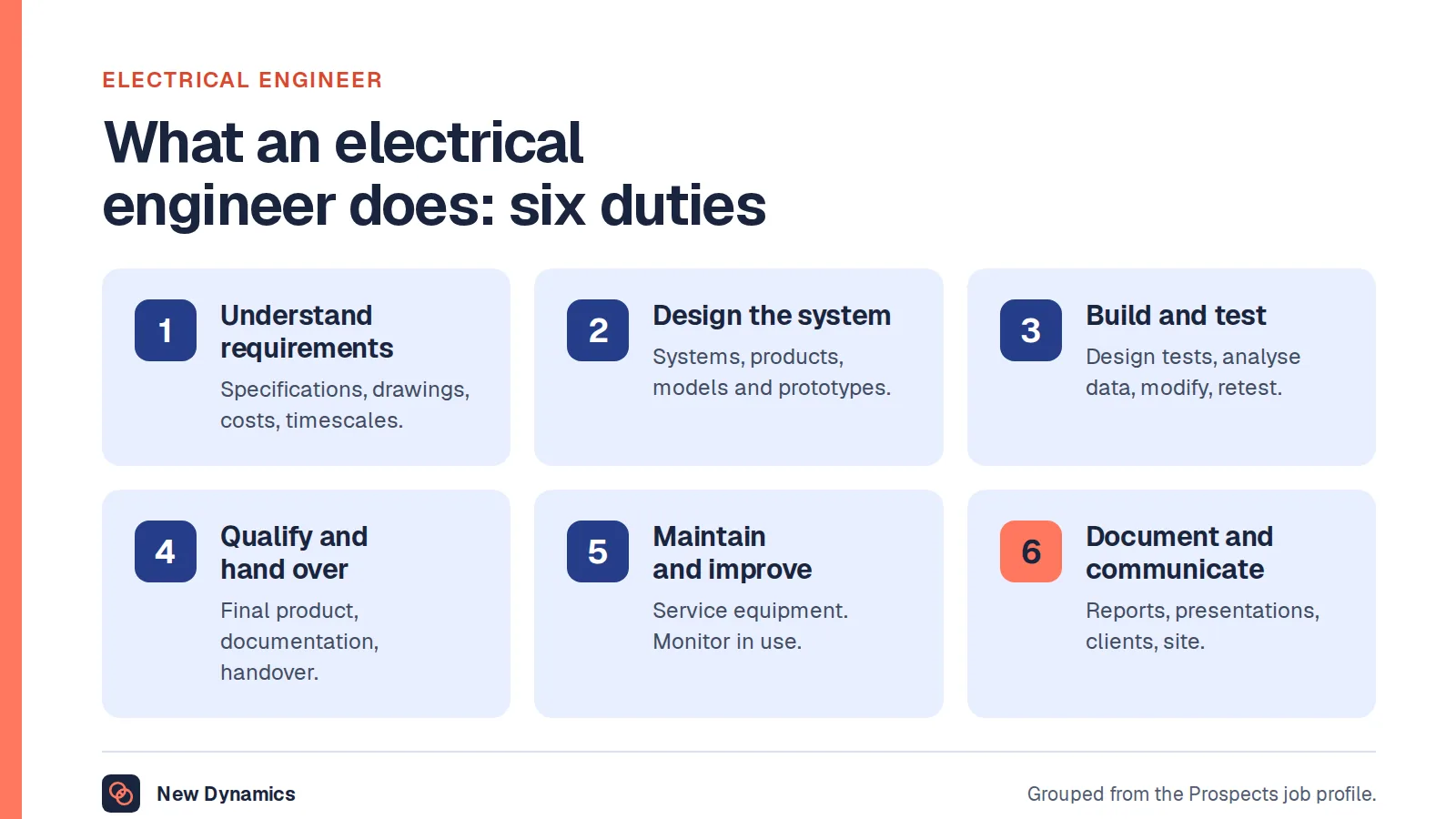
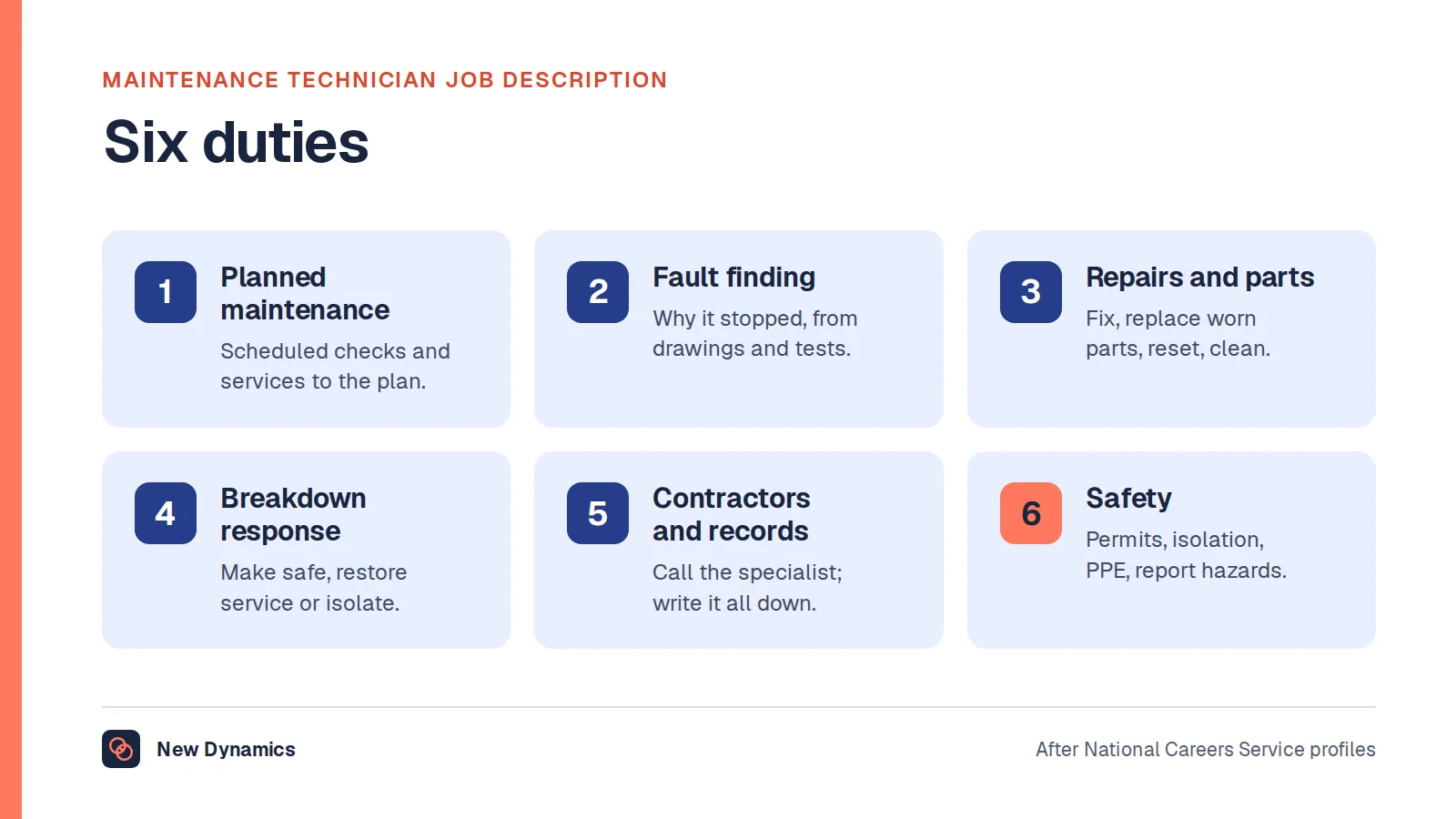
Progression runs to senior or specialist engineer, technical support and training, field service management, applications or commissioning work, and sales engineering. Our maintenance technician job description covers the site-based equivalent, and our electrical engineer job description the design-side neighbour.
Field teams also lose people to the travel rather than to the work, which is why the honesty of the advert matters commercially. Our employee retention guide covers the wider pattern.
A field engineer job description template
Job title: Field service engineer
Reports to: Field service manager
Territory: [area], [typical daily drive time], [overnights per month]
Equipment supported: [products or systems, and their rough installed base]
Purpose: Keep customers' equipment working, and leave each site with the fault fixed, the customer informed and the record complete.
Responsibilities
- Diagnose faults using test equipment, software, schematics and manuals.
- Repair, replace and adjust components, and install and commission equipment.
- Carry out scheduled preventive maintenance and calibration to specification.
- Demonstrate correct operation and advise customers on use and upkeep.
- Complete equipment logs, service reports and records on the day of the visit.
- Manage van stock, order parts, and return faulty or unused items.
- Work within customer site rules, and within our lone working and driving policies.
- Escalate anything unsafe or outside your competence rather than improvising.
Lone working: check-in arrangements, the jobs that require two people, and the escalation contact.
Vehicle: [type], [personal use], [tools and equipment provided].
On-call: [frequency, hours, payment].
Frequently asked questions
What do field engineers do?
Install, commission, service, repair and calibrate equipment at customer sites. The work includes diagnosing faults with test equipment and schematics, inspecting components, replacing parts, carrying out scheduled preventive maintenance, demonstrating correct use, advising customers, keeping equipment logs and service records, and managing van stock and parts.
What is the difference between a field engineer and a maintenance technician?
Mostly where the work happens and who is around. A maintenance technician usually looks after equipment on one site, with colleagues, a workshop and a parts store nearby. A field engineer travels between customer sites, works without direct supervision, and carries their parts and tools with them.
Is a field engineer a lone worker?
Usually yes. HSE defines lone workers as those who work by themselves without close or direct supervision and gives engineers as an example, noting that there are always greater risks for people without supervision or anyone to help if things go wrong, and that many are also exposed to work-related road risks. The employer must manage those risks, including for contracted and self-employed people. This is general information, not legal advice.
What makes a good field engineer?
Diagnosis, obviously, but also the ability to explain a fault to a customer who is annoyed, the discipline to write the record on the day, the judgement to stop when a job is unsafe or outside their competence, and the organisation to keep a van stocked and a diary realistic.
How should a field engineer be measured?
On first-time fix treated as a system measure, response and repair times against service commitments, repeat visits for the same fault, preventive maintenance completed on schedule, sampled customer feedback read alongside job type, and records completed on the day. Counting jobs closed per day rewards short visits and punishes thorough ones.
What should a field engineer advert include?
The territory with realistic drive times, the typical number of overnights and how they are paid, the on-call arrangement and its frequency and payment, and the vehicle and equipment provided including whether personal use is allowed. "Some travel may be required" is not a description of a field role.
Your next step: put the travel in the advert
- State the territory, typical drive times and monthly overnights.
- Describe the on-call rota and what it pays.
- Write the lone working arrangements into the job description, including who monitors check-ins.
- Measure first-time fix as a system problem and fix the stock, information or approvals behind it.
For why field teams lose people to the travel rather than the work, read and download our employee retention guide. The guide is free to read, and the PDF uses our short download form.
Want objectives, check-ins and reviews that reach people who are rarely at a desk? Book a New Dynamics demo and bring your current service measures. You can also email contact@new-dynamics.com.