TL;DR
- An electrical engineer designs, develops, tests and maintains electrical systems and equipment, from small electronic devices to power grids, working to a specification from concept through to handover.
- The six main duties are understanding requirements, designing systems, building and testing, qualifying and handing over, maintaining and improving, and documenting and communicating. An electrician installs and maintains the systems that engineers design.
- Employers ask for technical knowledge, an analytical approach, communication, commercial awareness and teamwork. In the UK, engineers usually work towards Incorporated or Chartered Engineer status, assessed against the five areas of UK-SPEC.
Every building, vehicle, factory and network runs on electrical systems that someone designed, tested and signed off. That someone is an electrical engineer. The title covers a wide range of work, from a circuit in a hearing aid to the protection systems of a national grid, and job descriptions for it are often either vague or copied from a different discipline.
This electrical engineer job description explains what the job involves, sets out six main duties, separates the engineer from the electrician, lists the skills that employers ask for, summarises the UK route to professional registration and gives a template that you can adapt.
Engineers work to specifications, and their own objectives should be as clear. See how New Dynamics Goals & OKRs keep targets and progress in one place, so that a design engineer's year has the same definition as a design.
What does an electrical engineer do?
Prospects, the UK graduate careers service, opens its electrical engineer job profile with a one-line definition: “Electrical engineers design, develop and maintain electrical systems and equipment - from small electronic devices to large power grids”. It adds that the systems and components “will be to required specifications” and that you “could be involved in projects from the concept and detail of the design, through to implementation, testing and handover”.
Prospects also notes that electrical engineers work in many sectors, from multinational corporations to small specialist enterprises, and that the variety of employers gives multiple entry routes into the profession.
Two distinctions matter when you write or read a job advert.
- Electrical or electronic. Electrical engineering tends to mean power: generation, distribution, machines and building services. Electronic engineering tends to mean signals, circuits and devices. Many roles span both, and many degrees are titled electrical and electronic engineering.
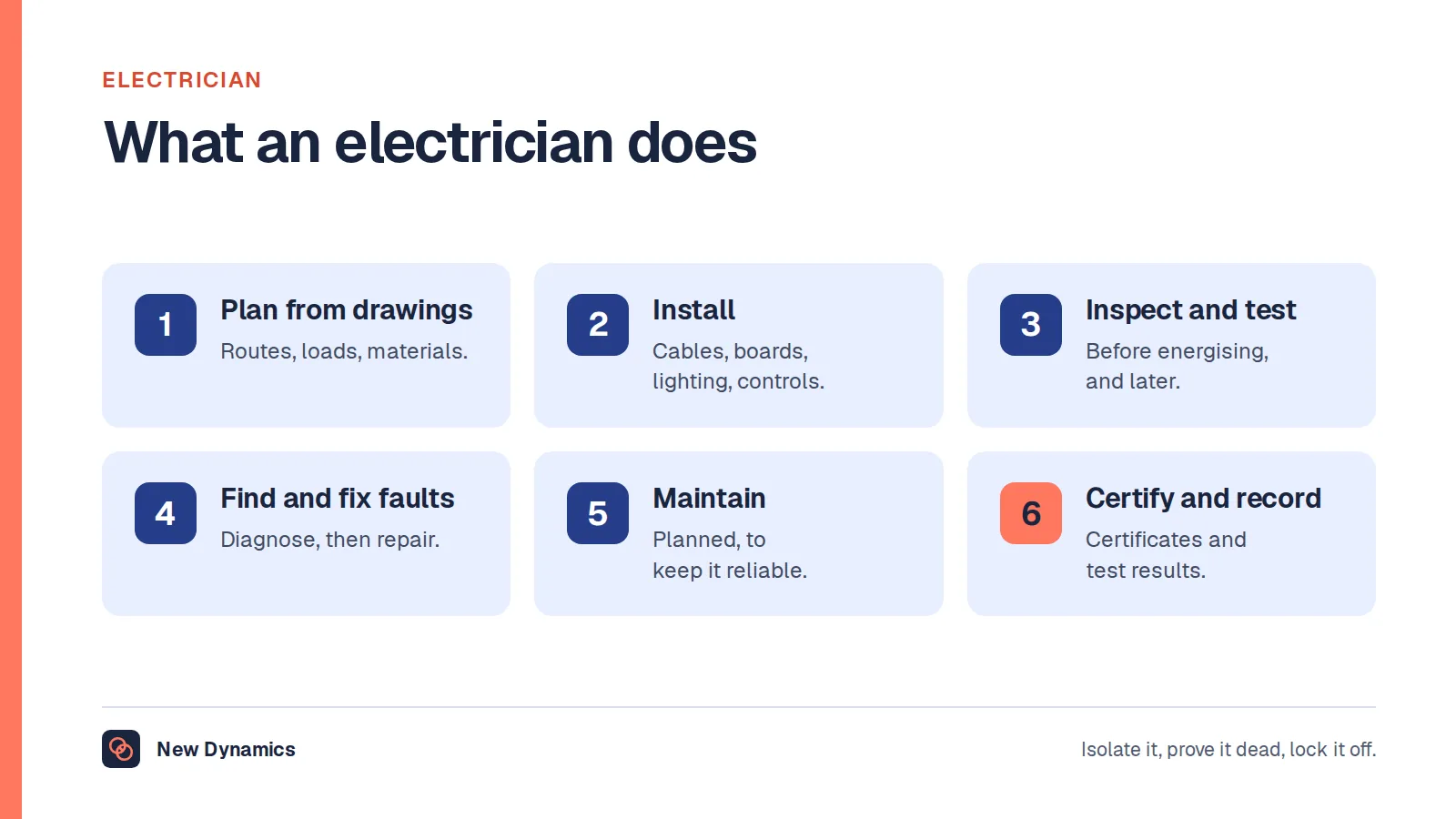
- Engineer or electrician. The engineer designs, specifies and tests. The electrician installs, maintains and repairs to the design. See our guide to the electrician job description for the trade.
Electrical engineer duties: six responsibilities
Prospects lists the tasks that an electrical engineer will typically need to do, from identifying customer requirements to monitoring a product in use. Grouped, they come to six duties.
- Understand the requirements. Identify what the customer needs, read design specifications and technical drawings, research suitable solutions and estimate costs and timescales.
- Design the system. Design systems and products, make models and prototypes using three-dimensional design software, and liaise with the rest of the design team.
- Build and test. Design and conduct tests, record, analyse and interpret the data, propose modifications and retest.
- Qualify and hand over. Qualify the final product or system, prepare the product documentation and hand over to the customer or the operations team.
- Maintain and improve. Service and maintain equipment, and monitor the product in use to improve the next design.
- Document and communicate. Write reports, give presentations, communicate with clients and contractors and attend meetings on site.
The balance between these duties depends on the role. A design engineer in a consultancy lives in the first two and the last. A site or maintenance engineer lives in the middle four.

Electrical engineer and electrician: the difference
| Question | Electrical engineer | Electrician |
|---|---|---|
| What they produce | Designs, specifications, test results and reports | Installed, tested and maintained systems |
| Where they work | Offices, laboratories, test facilities and sites | Sites, buildings, plants and vehicles |
| Typical UK route | Accredited degree or degree apprenticeship, then professional registration | Apprenticeship and trade qualifications |
| Who they answer to | The specification, the client and the professional standard | The design, the wiring regulations and the inspection regime |
Both are skilled, both are regulated in different ways, and neither is the junior of the other. A good project needs the engineer and the electrician to talk early, because a design that cannot be installed is not a design.

Ten skills employers ask for
Prospects lists the skills that an electrical engineer will need to show. They fall into ten.
- Relevant technical knowledge and up-to-date sector knowledge.
- An analytical and problem-solving approach to work.
- Project management skills and the ability to multitask.
- Commercial awareness.
- Communication skills, described by Prospects as “oral and written communication skills to make technical information easy to understand for non-technical audiences”.
- Flexibility to adapt to evolving technologies.
- Planning and organisational skills, such as time and resource allocation.
- Teamwork in a multidisciplinary team.
- Leadership and management skills for career progression.
- A commitment to continuing professional development throughout a career.
Only the first is purely technical. The rest are the skills of working with people, money and time, which is why a job advert that lists software packages and nothing else attracts the wrong applicants.
Qualifications and the route to chartered status
Degree. In the UK, most electrical engineers hold a degree in electrical or electronic engineering or a related subject. Prospects lists accepted related subjects including building services, communications, computing and software, electromechanical, mechanical and production, physics and power and energy engineering, and advises checking whether a course is accredited by the Engineering Council, because accreditation helps with professional registration later.
Degree apprenticeship. Skills England lists an Electrical and electronic engineer (degree) apprenticeship at level 6, typically 42 months, alongside level 3 and level 4 standards for electrical product service and installation, power networks and power protection and commissioning.
Professional registration. Prospects says: “Most electrical engineers work towards professional registration as an Incorporated Engineer (IEng) or Chartered Engineer (CEng), with EngTech status increasingly recognised for those entering through apprenticeships.” Registration is assessed against UK-SPEC, the UK Standard for Professional Engineering Competence and Commitment. The Engineering Council says that each registration title “requires demonstration of five broad areas”: knowledge and understanding; design, development and solving engineering problems; responsibility, management and leadership; communication and interpersonal skills; and professional commitment. Our guide to the chemical engineer job description explains how those five areas double as a competency framework for reviews.
Security clearance. Prospects notes that some work, for example in defence and nuclear power, has security implications, and that applicants may be debarred on grounds such as a criminal record or nationality.
Requirements differ in other countries. Check the rules where you work.

Electrical engineer job description template
Adapt the template to your organisation. Keep every line true.
Job title: Electrical engineer
Reports to: Lead electrical engineer or engineering manager
Location and travel: [Office, site or hybrid], with visits to [sites, suppliers or test facilities]
Purpose of the role: To design, test and deliver electrical systems for [products, buildings or networks] to specification, on time and safely.
Main duties:
- Establish customer and project requirements and turn them into specifications
- Design electrical systems and components, including calculations, drawings and models
- Plan and carry out tests, analyse results and propose modifications
- Qualify systems, prepare documentation and support handover
- Support maintenance and monitor systems in service to improve future designs
- Report to clients, contractors and colleagues in writing and in person
- Work to [named standards and regulations] and the company's safety procedures
Skills and experience:
- Degree in electrical or electronic engineering or a related subject, or equivalent experience
- Working towards, or holding, IEng or CEng registration
- Experience of [the sector, systems or design software that matter to you]
- Clear communication with technical and non-technical audiences
- Commercial awareness and sound planning
We provide: A structured route to professional registration with a mentor, funded CPD, and clear objectives reviewed each quarter.
Name the sector and the systems. "Electrical engineer" alone tells a candidate almost nothing about whether the job is a substation, a printed circuit board or a hospital's building services. Our job description template explains the structure.
Common mistakes in electrical engineering job adverts
Listing software instead of work. Tools change. Describe the systems, the standards and the responsibility.
Asking for chartered status for a graduate role. Registration takes years of responsible experience. Ask for it only where the role needs it.
Mixing up engineer and electrician. An advert that asks for a degree and wiring installation experience in the same line will attract neither.
No mention of registration support. Prospects says employers are impressed by enthusiasm to gain professional status. Candidates are impressed by employers that fund it.
Vague on site work. Say how often, where and whether it involves nights, heights or confined spaces.
Frequently asked questions
What does an electrical engineer do?
An electrical engineer designs, develops, tests and maintains electrical systems and equipment, from small electronic devices to power grids. Typical work includes establishing requirements, designing to specification, testing and analysing results, qualifying and documenting the final system, and monitoring it in use to improve future designs.
What is the difference between an electrical engineer and an electrician?
The engineer designs, specifies and tests electrical systems, usually after a degree or degree apprenticeship and with professional registration as the goal. The electrician installs, maintains and repairs systems to the design, usually after an apprenticeship and trade qualifications. Both are skilled, regulated roles.
What qualifications does an electrical engineer need in the UK?
Usually a degree in electrical or electronic engineering or a related subject, ideally accredited by the Engineering Council, or a level 6 degree apprenticeship. Most engineers then work towards Incorporated Engineer or Chartered Engineer registration, assessed against UK-SPEC.
What skills does an electrical engineer need?
Technical and sector knowledge, an analytical approach, project management, commercial awareness, clear communication with non-technical audiences, adaptability to new technology, planning, teamwork, leadership and a commitment to continuing professional development.
Where do electrical engineers work?
In many sectors, from multinational corporations to small specialist firms. Prospects mentions manufacturing, defence and nuclear power, and notes demand in renewable energy, infrastructure and high-tech sectors. Engineers work in consultancies, contractors, manufacturers, utilities and in-house teams.
What should an electrical engineer job description include?
The title, the sector and systems, who the engineer reports to, the location and travel, the purpose of the role, six or seven main duties, the qualifications and registration expected, the skills needed, the standards worked to, and the support offered for professional registration and CPD.
Your next step
If you are hiring, rewrite your advert so that the first paragraph names the systems the engineer will design and the standards they will work to. If you are applying, map your experience against the five areas of UK-SPEC and write one example for each.
For a method that turns a specification into objectives, read and download our SMART goals guide. The guide is free to read, and the PDF uses our short download form.
Want engineers' objectives, feedback and development in one place? Book a New Dynamics demo and bring your current approach. You can also email contact@new-dynamics.com.